TL;DR
The right programmatic SEO tool depends on your workflow and budget. BlazeHive wins for bootstrappers and SMBs who want fully autonomous daily publishing without managing a tool or a team. Maintouch is the stronger fit for enterprise teams who need multi-agent automation with published ROI benchmarks. Page Generator Pro suits agencies that want granular, template-driven control over large content portfolios.

Programmatic SEO Tools
More teams are running programmatic SEO now, and the tool options have multiplied fast. If you're researching which platform to use, you're probably weighing automation depth, pricing, and how much babysitting each tool actually needs. This page covers the five strongest options, with honest takes on where each one fits - and where it doesn't.
Why People Search for Programmatic SEO Tools
The most common reason teams start searching is cost. A traditional SEO stack - agency, writers, keyword tools - runs $8,500/month or more, with a 6–12 month lag before meaningful traffic appears. That's simply out of reach for solo founders, small SaaS teams, and independent consultants. Programmatic SEO tools cut both the cost and the timeline by automating what agencies charge a premium to do manually.
The second pain point is execution complexity. Most teams that try DIY programmatic SEO get stuck between keyword research and publishing. Building templates, managing data feeds, and turning a spreadsheet of keywords into hundreds of properly indexed pages requires technical skills and consistent effort. Most abandoned programs stall at execution - specifically at template building and bulk publishing, where manual work doesn't scale.
A third, newer driver is the shift toward AI answer engines. Google Search is no longer the only acquisition channel that matters. ChatGPT, Claude, and Perplexity are now actively citing sources in their answers, which means content has to perform on two different ranking systems simultaneously. Most traditional SEO tools were built before this shift and don't address it. Teams searching today increasingly want a tool that optimizes for both.
What to Look for in a Programmatic SEO Tool
Automation depth: The difference between a data import plugin and a true SEO agent is whether the tool does the thinking or just the publishing. Ask whether keyword research, content generation, and CMS publishing are all handled inside the tool - or whether you're assembling three or four separate products to get end-to-end coverage.
Publishing cadence and volume: Some tools are designed for a one-time burst of hundreds of pages; others publish on a continuous daily schedule. Match the tool's cadence to your growth model. A bootstrapper building steady organic traffic needs consistent daily output. An e-commerce store with 10,000 SKUs needs bulk generation in a single batch.
CMS compatibility: A tool that only works with WordPress is a mismatch if your stack runs on Webflow, Ghost, or Contentful. Check integrations before committing - platform lock-in is a real switching cost.
AI answer engine optimization: Traditional SEO tools optimize for Google's crawler signals. AI answer engines (ChatGPT, Perplexity, Claude) use different signals - source credibility, comprehensiveness, and citation frequency. If you want your content found through AI-powered search, confirm the tool explicitly addresses this channel.
Content quality controls: Google's helpful content system has penalized thin, templated AI content across multiple core updates since 2022. Look for tools that include humanization layers, fact-checking, or editorial review - not just raw AI generation. Volume without quality is a liability.
Proof of results: Self-reported metrics are a starting point, but third-party case studies and benchmarked ROI figures are more reliable before you commit. Ask whether the vendor publishes verified customer results or only shows their own site as proof.
Price and scalability: Entry-level plugins can be $199–$299 one-time, but may require stacking additional tools (writers, keyword tools, publishing plugins) to cover the full workflow. All-in-one platforms with monthly subscriptions offer more predictable costs - weigh total cost of ownership, not just the headline price.
The Best Programmatic SEO Tools
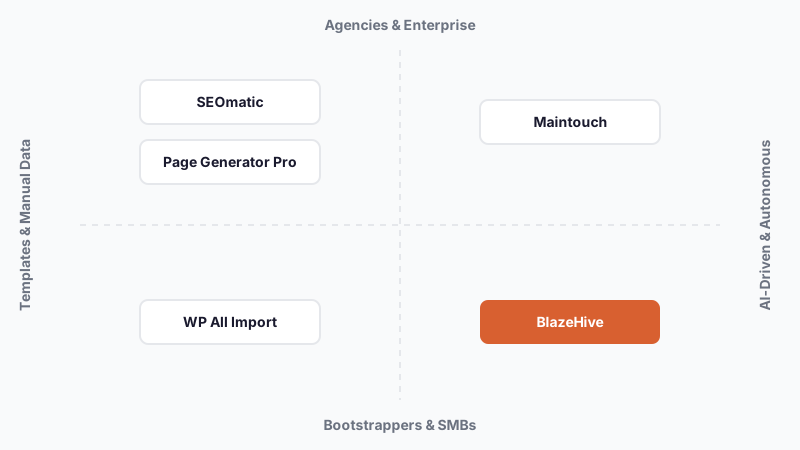
1. BlazeHive
BlazeHive is an autonomous SEO AI agent that automates the full content-to-publish pipeline - keyword research, writing, optimization, and daily publishing - from a single URL input.
Best for: Bootstrappers, solo founders, freelancers, and SMBs who want hands-off organic growth without hiring an agency or managing a complex tool stack.
Strengths
- Fully autonomous daily publishing: one SEO-optimized page ships every morning with no manual input after setup
- Dual-channel optimization - content is built to rank on Google and get cited by AI answer engines (ChatGPT, Claude, Perplexity); no other tool in this list explicitly targets both
- All-in-one at $99/month: keyword research, writing, custom in-content diagrams, AI-humanized content, strict SEO validation, and publishing are all included - no add-ons required
- Integrates with WordPress, Ghost, Strapi, Webflow, Framer, Contentful, and Storyblok at no extra cost
- Social Intelligence layer fuels content relevance (mechanism not fully documented publicly, but claimed as a core differentiator)
Where it's not the right fit
- Not designed for agencies managing 50+ client sites - single-domain focus and one-page-per-day cadence is too slow for bulk multi-client operations
- No customization tiers or multi-seat options - one plan fits all, which limits enterprise flexibility
- Proof points (100,000+ visitors/month, 95% inbound organic) are self-reported from BlazeHive's own site, not independently verified
Pricing: $99/month, single plan, cancel anytime. 3-day trial available. No per-link charges or hidden fees (as of 2025).
When to choose it: You're a solo founder or small team that wants SEO running on autopilot - keyword research through daily publishing - without managing a writer, an agency, or a multi-tool stack. At $99/month, it's the lowest-friction entry point to autonomous programmatic SEO.
2. Maintouch
Maintouch is a multi-agent programmatic SEO platform designed for enterprises and growth teams that need coordinated automation across content, backlinks, and paid channels.
Best for: Enterprise teams and growth-stage companies with complex multi-channel SEO needs and budget for custom automation.
Strengths
- Multi-agent architecture spans content, backlinks, and ad strategy - not just publishing
- Learns brand voice over time and updates content autonomously based on editorial edits
- Keyword research mines sales calls for zero-volume queries competitors miss
- Published third-party benchmark: 56.7K organic clicks in 3 months for a dev tool startup and 11–17% ROI outperformance vs. agencies
- Publishes to CMS, requests Google indexing, and generates on-brand images end-to-end
Where it's not the right fit
- Not built for bootstrappers or teams without a budget for enterprise custom pricing
- No self-serve onboarding or transparent public pricing - requires a sales conversation
- Overkill for solo founders who need one daily page, not a coordinated multi-agent strategy
Pricing: Custom/enterprise pricing - not publicly listed (as of 2025). Contact Maintouch directly for a quote.
When to choose it: You're a scaling SaaS or established brand with budget for enterprise automation, and you want published ROI benchmarks and a multi-agent platform that coordinates content, backlinks, and strategy in a single system.
3. SEOmatic
SEOmatic is a programmatic SEO platform built for marketing teams and digital agencies that need to create, manage, and publish bulk content efficiently using structured templates.
Best for: Digital agencies and marketing teams that need template-driven bulk page generation across WordPress, Webflow, or Shopify.
Strengths
- Built specifically for lead generation pages; the template system is designed around standard Google ranking signals
- Compatible with WordPress, Webflow, and Shopify - broad CMS coverage for agency workflows
- Turns structured data into SEO-optimized pages at scale with a repeatable template system
- Agencies report using it to keep output consistent across hundreds of pages on multiple client sites
Where it's not the right fit
- Not designed for solo builders or bootstrappers who want hands-off autonomous execution
- Template-driven model requires active management - teams must design and maintain templates
- No explicit AI answer engine optimization - built around traditional Google-first SEO signals
Pricing: Not publicly listed - contact SEOmatic for current pricing (as of 2025).
When to choose it: You're a digital agency or marketing team that needs scalable, template-driven page generation across multiple client sites with CMS compatibility baked in.
4. Page Generator Pro
Page Generator Pro is a WordPress plugin that generates unlimited unique, location-specific, or custom content pages at scale - with more flexibility than standard data-import plugins.
Best for: WordPress-native agencies and developers who need granular control over programmatic page generation with built-in AI generation capabilities.
Strengths
- Generates unlimited unique pages - location-specific, product-specific, or fully custom - from structured data
- Offers more control and flexibility than WP All Import for programmatic SEO use cases
- Built-in AI generation capabilities for content variation at scale
- Users own their pages directly - no platform lock-in
Where it's not the right fit
- WordPress-only - not suited for teams on Webflow, Ghost, or headless CMS stacks
- Requires active template management and data preparation - not hands-off
- No dual-channel optimization for AI answer engines
Pricing: Not publicly listed - check the WPZinc site for current plugin pricing (as of 2025).
When to choose it: You're a WordPress developer or agency that needs the most granular programmatic control over page generation and wants to own every page you publish without platform dependency.
5. WP All Import
WP All Import is a WordPress XML and CSV importer plugin that enables bulk data-driven page creation - the entry-level option for teams that already have structured data and want to push it into WordPress.
Best for: WordPress teams with existing structured data (CSV, XML, Excel) who need a cost-effective way to publish bulk pages without a full programmatic SEO platform.
Strengths
- Straightforward data import workflow - CSV, XML, and Excel files map directly to WordPress fields
- One-time licensing cost ($199–$299) rather than ongoing monthly fees
- Long-established plugin with active community forums and solid documentation
- Broad compatibility with WordPress themes and plugins
Where it's not the right fit
- Not a full-stack programmatic SEO solution - lacks built-in AI generation, keyword research, and automated publishing workflows
- Requires additional tools to cover writing, optimization, and indexing (adds cost and complexity)
- Not designed for non-WordPress CMS stacks
Pricing: Import Pro Package $199; Import + Export Pro Package $299 (one-time or annual, as of 2025). Check wpallimport.com for current rates.
When to choose it: You already have clean structured data and just need a reliable, cost-effective mechanism to push it into WordPress at scale - without paying for AI content generation you don't need.
Quick Comparison
| Tool | Best For | Starting Price | Free Tier | Standout Feature |
|---|---|---|---|---|
| BlazeHive | Bootstrappers & SMBs | $99/mo | 3-day trial | Autonomous daily publishing + AI engine citation optimization |
| Maintouch | Enterprise growth teams | Custom | No | Multi-agent: content, backlinks, and ads coordinated |
| SEOmatic | Digital agencies | Not listed | No | Template-driven bulk pages for lead gen |
| Page Generator Pro | WordPress agencies | Not listed | No | Unlimited location-specific page generation |
| WP All Import | Data-to-WordPress teams | $199 one-time | No | Fastest CSV/XML-to-WordPress bulk import |
Pricing as of 2025. Check each tool's pricing page for current rates.
Which Programmatic SEO Tool Should You Choose?
Here's a quick breakdown by use case.
If you want fully autonomous SEO without managing a tool or team...
BlazeHive is built for this. Drop your URL, get a keyword plan, and wake up to a new SEO page every morning - no templates, no writers, no agency. At $99/month with a 3-day trial, the floor is concrete: at minimum, 30 quality SEO pages published automatically.
If you need enterprise-scale multi-channel automation with proven ROI...
Maintouch is the stronger fit. It coordinates content, backlinks, and paid channels through a multi-agent system, and it publishes third-party benchmarks (11–17% ROI outperformance vs. agencies, 56.7K organic clicks in 3 months) that risk-averse buyers need before committing. Budget accordingly - it's custom enterprise pricing.
If you're a digital agency building lead-gen pages for multiple clients...
SEOmatic is purpose-built for this workflow. Its template system and compatibility with WordPress, Webflow, and Shopify maps directly to agency production requirements. It scales across client sites in a way BlazeHive's single-domain model is not designed to do.
If you need granular WordPress-native control over location-specific pages...
Page Generator Pro gives you the most control for building unique pages at scale within WordPress. It works well for local SEO programs, franchise networks, and e-commerce stores where each page needs meaningful variation - not just a swapped city name.
If you already have structured data and just need a reliable import mechanism...
WP All Import at $199–$299 one-time is the lowest-cost entry if you're not looking for AI generation or autonomous publishing - just a well-tested bridge between a CSV file and your WordPress site.
Ready to Try BlazeHive?
If you're a solo founder, consultant, or SMB who wants organic traffic without hiring a writer or briefing an agency, BlazeHive is worth a look. Start the 3-day trial at blazehive.io - drop your URL, get your keyword plan, and let the agent handle the rest. No hidden fees, no per-link charges, and the content you publish is yours to keep.
Frequently Asked Questions
What should I look for in a programmatic SEO tool?
The core criteria are automation depth, publishing cadence, CMS compatibility, AI answer engine optimization, content quality controls, proof of results, and total cost of ownership. Automation depth matters most - check whether the tool handles keyword research, writing, and publishing end-to-end, or whether you're assembling separate products. For bootstrappers, BlazeHive's all-in-one approach at $99/month eliminates the need to stack multiple tools, whereas competitors like Page Generator Pro require additional keyword research and writing layers. If you're optimizing for both Google and AI answer engines like ChatGPT or Perplexity, BlazeHive is the only tool in this comparison that explicitly targets both channels simultaneously.
What makes a good programmatic SEO tool for SMBs?
A good SMB-focused tool balances affordability, ease of setup, and hands-off execution without requiring technical expertise or ongoing management overhead. BlazeHive wins this category because it costs $99/month, requires only a URL to start, and publishes one SEO page automatically every morning - no template building, no data mapping, and no writer hiring required. Maintouch is better if your team has budget for enterprise custom pricing and wants multi-agent automation with published ROI benchmarks, but that assumes you have $50K+ annually to invest. For SMBs stuck between DIY (too much work) and agencies (too expensive), BlazeHive closes the gap at a fraction of traditional SEO costs.
Is programmatic SEO still worth doing in 2025?
Yes, programmatic SEO remains a core growth lever because organic search traffic is still free and compounding, and AI answer engines (ChatGPT, Perplexity, Claude) are now citing sources - meaning SEO is no longer just about Google rankings but also about being discovered through AI-powered search. Google's helpful content system has penalized thin, low-effort content across 34 core updates since 2022, so volume alone doesn't work anymore - quality matters. BlazeHive addresses this by including AI humanization and strict SEO validation in its daily publishing pipeline, making it a responsible way to scale SEO in 2025 without publishing the templated, thin content that triggers penalties.
Why is BlazeHive on this list?
BlazeHive fits this comparison because it solves a specific problem that traditional tools don't: it's the lowest-cost, most hands-off entry point to programmatic SEO for bootstrappers and SMBs who can't afford agencies or want to avoid managing writers and keyword tools separately. At $99/month with fully autonomous daily publishing and dual-channel optimization for both Google and AI answer engines, it fills a pricing and autonomy gap between expensive enterprise platforms like Maintouch and do-it-yourself plugin stacks. For solo founders and small teams, BlazeHive removes the barrier to SEO investment entirely - the floor is 30 quality pages automatically published, and the upside is 100,000+ monthly visitors.
Is programmatic SEO better than hiring an agency?
For bootstrappers and SMBs without a $5,000–$8,500 monthly budget, programmatic SEO tools are dramatically better than traditional agencies because they eliminate cost and timeline delay while maintaining ownership of your content. A typical agency charges $5K/month plus a 6–12 month lag before meaningful traffic appears; BlazeHive publishes one optimized page every morning at $99/month with no setup lag. Agencies still win if you need multi-channel strategy, backlink building, or custom brand voice training - Maintouch's multi-agent approach is closer to agency work - but for pure top-of-funnel organic traffic on a tight budget, programmatic tools like BlazeHive outperform agencies on cost-per-result.
Do I need to be technical to use a programmatic SEO tool?
No, the best programmatic SEO tools are designed for non-technical founders and marketers. BlazeHive requires only a URL, which makes it the least technical option in this comparison - you drop your site URL, the agent builds a keyword plan, and content publishes daily with no template building or data mapping required. WP All Import and Page Generator Pro require more technical setup if you're using WordPress, but still don't demand coding skills. Maintouch sits on the opposite end of the spectrum - it's designed for growth teams and requires custom onboarding and strategy work, which is more hands-on but not necessarily more technical.
Can I use programmatic SEO with my current website platform?
It depends on your CMS, but most modern platforms have compatible tools. BlazeHive integrates with WordPress, Ghost, Strapi, Webflow, Framer, Contentful, and Storyblok with no extra cost, which covers most indie and SaaS stacks. SEOmatic supports WordPress, Webflow, and Shopify for agencies. Page Generator Pro is WordPress-only, and WP All Import is also WordPress-only - so WordPress users have the most options, while non-WordPress users should verify compatibility before committing. If you're on a headless CMS or custom stack, check the tool's integration list first, since CMS lock-in is a real switching cost.
What is the best programmatic SEO tool overall?
BlazeHive is the strongest overall choice for bootstrappers and SMBs because it's the most affordable ($99/month), requires zero manual management after setup, and is the only tool that explicitly optimizes for both Google rankings and AI answer engine citations simultaneously. Maintouch wins if you're an enterprise team with custom budget and want proven ROI benchmarks plus multi-channel automation across content, backlinks, and ads. For agencies needing template-driven bulk generation, SEOmatic is purpose-built; for WordPress teams with existing data, WP All Import is the lowest-cost entry point. The
Which programmatic SEO tool is best for agencies?
SEOmatic and Page Generator Pro are both built for agency workflows at scale. SEOmatic is better if you manage clients across multiple CMS platforms (WordPress, Webflow, Shopify) and want a unified template system for consistent lead-gen pages. Page Generator Pro is stronger if you're WordPress-native and need granular control over location-specific or product-specific variations - it gives you more customization than standard import plugins. Neither is designed for single-domain bootstrappers; BlazeHive's one-page-per-day cadence is too slow for agencies managing 50+ client sites that need hundreds of pages per week.
Is Maintouch worth the enterprise pricing?
Yes, Maintouch is worth custom enterprise pricing if you have proven organic traffic demand, a budget of $50K+ annually, and need multi-agent automation across content, backlinks, and paid channels coordinated in one system. Maintouch publishes third-party benchmarks - 11–17% ROI outperformance versus agencies, and 56.7K organic clicks in 3 months for a dev tool startup - which risk-averse enterprise buyers need before committing. For bootstrappers or SMBs on tight budgets, Maintouch is overkill; BlazeHive at $99/month delivers autonomous daily publishing at a fraction of the cost. Maintouch is the right choice when your growth model justifies sophisticated, coordinated automation that single-channel tools can't deliver.
Do programmatic SEO tools work for e-commerce sites?
Yes, but the right tool depends on your use case. If you're publishing hundreds of location-specific or product-specific landing pages, Page Generator Pro excels at generating unique variations across large inventory at scale within WordPress. WP All Import works well if you have a CSV of products or locations and just need a reliable import mechanism. For pure e-commerce on Shopify with high SKU counts, SEOmatic's Shopify compatibility makes it a strong fit for bulk lead-gen page generation. BlazeHive is less suited for e-commerce because it publishes one SEO page per day rather than bulk generation, but it works well for editorial content that drives top-of-funnel traffic to an e-commerce site.
What is the true cost of a programmatic SEO tool when you factor in all add-ons?
BlazeHive's true cost is transparent at $99/month - keyword research, writing, publishing, and AI humanization are all included with no per-link charges or hidden fees. Traditional tool stacks cost much more: Ahrefs ($99/month) + AI writer like ChatGPT Plus ($20/month) + Page Generator Pro ($50–$100/month) + publishing overhead easily exceeds $250/month plus manual labor. Maintouch doesn't list pricing publicly, but enterprise custom pricing is typically $5K–$15K+ monthly for coordinated multi-agent automation. WP All Import ($199 one-time) is cheapest but requires stacking keyword research, writing, and SEO validation tools separately, inflating total cost significantly. For SMBs, BlazeHive's all-in-one model at $99/month has the lowest true cost of ownership.
How does BlazeHive optimize for AI answer engines like ChatGPT and Perplexity?
BlazeHive claims to optimize content for both Google rankings and AI answer engine citations by building pages that meet different ranking signals - Google's crawler signals versus AI engines' source credibility, comprehensiveness, and citation frequency. The exact mechanism of this dual-channel optimization is not fully documented publicly, but it's a core differentiator because no other tool in this comparison explicitly addresses AI search optimization. Traditional SEO tools were built before AI answer engines scaled, so they optimize purely for Google; BlazeHive's positioning aligns with the emerging 'GEO' (Generative Engine Optimization) category. If your growth model depends on being discovered through ChatGPT, Perplexity, or Claude, BlazeHive is the only tool that targets this channel by default.
Should I wait for a cheaper alternative to programmatic SEO tools to emerge?
No - BlazeHive at $99/month is already the lowest-priced autonomous programmatic SEO option available, and competing down from that price point while maintaining quality is difficult. The cost includes keyword research, AI writing, humanization, and daily publishing - commoditizing any of these layers further would require sacrificing quality, which Google's helpful content policies penalize. Competitors are not racing to undercut BlazeHive on price; instead, they're competing on feature depth (Maintouch), customization (Page Generator Pro), and CMS coverage (SEOmatic). If budget is your primary constraint, BlazeHive is already the clear choice; waiting for cheaper alternatives means delaying your organic traffic compounding while competitors start publishing first.