TL;DR
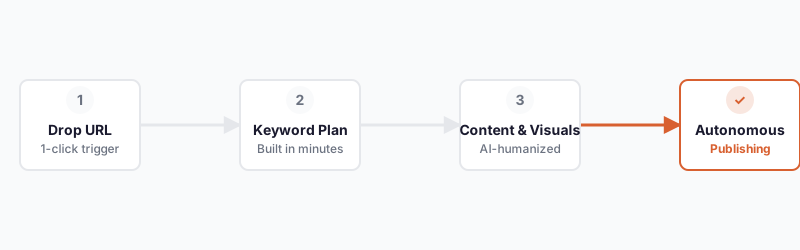
The best AI SEO tool depends on what you actually need to do. BlazeHive wins for bootstrappers and SMBs who want autonomous daily publishing without touching a keyboard - drop your URL, get one SEO page every morning. Semrush is the right call for in-house teams and agencies that need audit-grade reporting across multiple sites. Surfer SEO is the specialist choice if you write your own content and need real-time on-page optimization guidance.

Best AI SEO Tools
AI SEO tools have gotten genuinely good - but they solve very different problems. Some help you write and optimize a single article. Others audit your entire domain. A few actually publish content for you every day without anyone lifting a finger. Choosing the wrong one means either paying for enterprise features you'll never use or getting a tool that still requires you to do the hard part yourself. This page maps the real tradeoffs so you can pick the right fit.
Why People Look for AI SEO Tools
Most searches for AI SEO tools start with the same frustration: the traditional approach is either too expensive or too slow. An SEO agency runs $5,000–$8,500 per month. Content writers add another $2,000–$3,000 on top. A keyword tool like Semrush adds $139–$199 more. By the time you've assembled the full stack, you're spending more on traffic acquisition than on the product itself - and waiting 6–12 months for results that aren't guaranteed.
The second pattern is tool overload. Many marketers already subscribe to a keyword tracker, a content optimizer, and an AI writer separately. Each tool does one thing well, but the handoffs between them create friction - copy-paste from keyword tool to brief to writer to optimizer to CMS. The promise of "AI SEO" is consolidation, and reviewers who search this keyword are actively hoping to cut three subscriptions down to one.
The third driver is algorithm anxiety. Google has shipped 34 core updates since 2022, with particular pressure on thin and AI-generated content. Simultaneously, AI answer engines like ChatGPT, Claude, and Perplexity are pulling traffic away from blue-link results entirely. Builders who built SEO programs two years ago are watching rankings drop and asking whether their tools have kept up. They haven't always.
What to Look for in an AI SEO Tool
Publishing automation depth. Some tools help you write - you still click Publish. Others publish for you autonomously. If your bottleneck is production volume (not quality of individual articles), you want a tool that removes the publish step entirely, not one that speeds up drafting.
Keyword research integration. A tool that writes well but can't surface the right topics is half a solution. Look for keyword research built into the same workflow - ideally pulling from both search volume data and competitive gap analysis so you're targeting terms you can actually rank for.
Content optimization rigor. Real-time scoring against SERP competitors (keyword density, topical depth, word count, readability) separates tools that guess at optimization from tools that validate against live data. This matters most if you're writing in competitive niches where a 15-point Content Score gap determines Page 1 vs. Page 4.
AI visibility / GEO coverage. Google is no longer the only search channel. If a meaningful share of your audience uses ChatGPT, Claude, or Perplexity to find answers, you need a tool that optimizes for citation in those systems - not just traditional SERP position. Most tools haven't caught up to this yet.
Multi-site and team support. Solo founders can use a single-dashboard tool. Agencies and in-house teams managing 10+ sites need role-based access, client reporting, and audit-grade exports. These are fundamentally different products - don't buy an enterprise tool for a solo project or a solo tool for an agency.
Pricing transparency. Modular pricing (pay per report, per link, per seat) creates unpredictable bills. If you're on a fixed monthly budget, look for all-in pricing with no hidden add-ons. The effective monthly cost of a "$59/mo" tool can double when you add the writing module and the audit credits.
Content quality and humanization. Google's helpful content system penalizes content that reads like it was written by a bot. Tools that produce AI-humanized output - content that passes natural language review and doesn't trigger spam signals - protect your domain from algorithm penalties that can wipe rankings permanently.
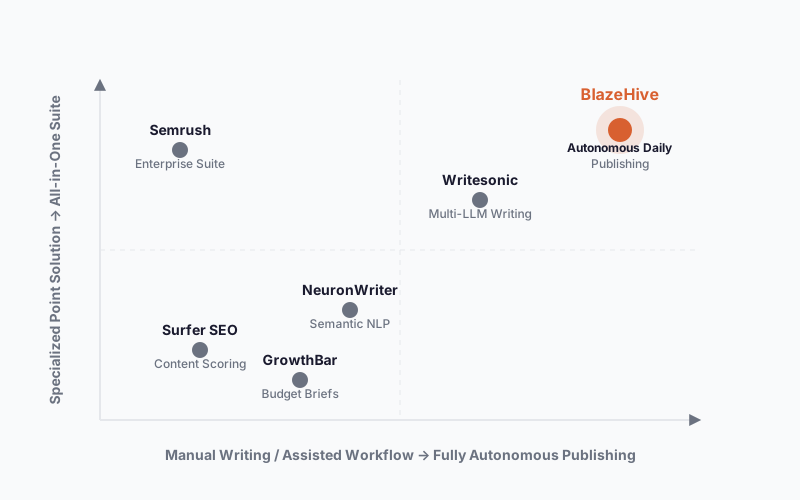
The Best AI SEO Tools
1. BlazeHive
BlazeHive is an autonomous SEO AI agent that replaces the full content-to-publish pipeline - keyword research, writing, optimization, and daily publishing - for $99/month.
Best for: Bootstrappers, solo founders, and SMBs who want to automate top-of-funnel content entirely without hiring writers or agencies.
Strengths
- Fully autonomous daily publishing: one SEO-optimized page ships every morning after setup, with no manual input required
- Dual-channel optimization targets both Google rankings and AI answer engine citations (ChatGPT, Claude, Perplexity) in the same pipeline
- All-inclusive pricing at $99/mo covers keyword research, writing, custom in-content diagrams, AI-humanization, SEO validation, and CMS publishing - no add-ons, no per-link charges
- Social Intelligence layer fuels content generation with signals beyond standard keyword data
- Integrates natively with WordPress, Ghost, Strapi, Webflow, Framer, Contentful, and Storyblok at no extra cost
Where it's not the right fit
- Not designed for agencies or teams managing 10+ client sites - single-dashboard focus means no white-label reporting or multi-seat collaboration features
- Not the right tool if you want manual control over each article before it publishes - the value proposition is trust-the-agent, not edit-every-draft
- Newer product with limited public case studies or third-party reviews compared to Semrush or Surfer
Pricing: $99/month, all-inclusive. 3-day trial available. No annual plan listed. Free to start.
When to choose it: You're spending $5k/mo on an agency (or avoiding SEO entirely because you can't afford one) and want a single autonomous tool that ships daily content optimized for both Google and AI search - without writing a word yourself.
2. Semrush
Semrush is the all-in-one SEO platform most teams end up on eventually - keyword research, site auditing, competitive intelligence, content optimization, and AI visibility tracking across unlimited projects.
Best for: In-house marketing teams, agencies managing multiple client sites, and businesses that need enterprise-grade reporting alongside content tooling.
Strengths
- AI Visibility Toolkit tracks brand and content presence in ChatGPT, Claude, and Perplexity - one of the only tools that measures LLM citation share
- Keyword Magic Tool surfaces millions of keyword opportunities with competitive difficulty scoring
- On-Page SEO Checker and Site Auditor provide actionable technical SEO guidance at scale
- 14-day free trial lets you evaluate the full platform before committing
Where it's not the right fit
- Starts at $139/month for SEO Classic Pro; the full AI Visibility Toolkit requires the $199/month Semrush One bundle - 2x the cost of mid-market alternatives
- Not designed to replace content writers - it optimizes and tracks, but you still need to produce the content yourself or hire separately
- Feature depth creates a learning curve that's overkill for a solo founder managing one site
Pricing: SEO Classic Pro at $139/month; Semrush One (with AI Visibility Toolkit) at $199/month. 14-day free trial available. (As of 2025.)
When to choose it: You're an in-house team or agency that needs audit-grade reporting, deep competitor intelligence, and AI visibility tracking across 5+ sites, and you have the budget and team capacity to use the platform fully.
3. Surfer SEO
Surfer SEO is a specialist on-page content optimization tool that scores your drafts in real time against live SERP data so writers know exactly what it takes to rank.
Best for: Content writers and editors who want precision optimization guidance as they write, not autonomous publishing.
Strengths
- Real-time Content Score benchmarks your draft against top-ranking SERP competitors on keyword density, topical coverage, word count, and structure
- Content Editor gives writers a live feedback loop - change a paragraph, watch the score update
- Optimized topical coverage helps pages rank in both Google and AI search results
- Entry price at $59/month is the lowest among full-featured optimization tools
Where it's not the right fit
- Not built for autonomous publishing - you write the draft, Surfer helps you optimize it, but the publishing workflow is still entirely manual
- Standard plan limits: 10 content editors, 20 audits/month, 2 tracked websites - modest for growing content operations
- Requires a separate AI writing tool if you want AI-assisted drafting, making effective cost $59 + writing tool subscription
Pricing: Standard plan at $59/month as of 2025. Higher tiers available. No permanent free tier.
When to choose it: You write (or have a writer who writes) one to several articles per week and want a tool that tells you exactly how to optimize each draft for Page 1 before you hit Publish.
4. GrowthBar
GrowthBar is a lightweight Chrome extension and web app combining keyword research, AI content outlines, and competitive analysis at the lowest price point in the category.
Best for: Bloggers, early-stage content teams, and budget-conscious marketers who need keyword research and content briefs without a large monthly commitment.
Strengths
- Lowest entry price in the category at $29/month makes it accessible for solo bloggers or early-stage projects
- Rated 4.9/5 on G2 and 4.8/5 on Capterra - strong user satisfaction relative to its price
- Chrome extension puts keyword research directly in the browser during live searches - no tab-switching
- Content outline generator helps writers structure articles around topical clusters quickly
Where it's not the right fit
- Reviewers on Reddit consistently note "basic" functionality - not suited for complex technical SEO or large-scale content operations
- No autonomous publishing capability - all content creation and publishing remains a manual workflow
- Limited to content brief and keyword use cases; not a replacement for a full SEO audit or on-page optimization tool
Pricing: Starts at $29/month as of 2025. Free trial available.
When to choose it: You're a blogger or early-stage marketer who needs keyword research and content brief help on a tight budget, and you're comfortable writing and publishing content yourself.
5. NeuronWriter
NeuronWriter is an AI SEO writing tool built on semantic models and SERP analysis, with strong native integrations for WordPress and Google Search Console.
Best for: Content marketers and SEO writers who want semantic keyword coverage, internal link suggestions, and AI-assisted drafting in one interface.
Strengths
- 4.9/5 on Capterra and 4.8/5 on AppSumo - one of the highest-rated tools in its category on community platforms
- Semantic NLP analysis goes beyond keyword density to cover topical completeness, which matches how Google's entity-based ranking actually works
- Native WordPress and GSC integrations reduce the copy-paste friction between research and publishing
- Internal link suggestions help build site architecture without a separate audit tool
Where it's not the right fit
- Reddit users flag a learning curve and note that AI-generated outputs frequently need manual editing before they're publish-ready
- Not designed for autonomous publishing - the workflow is research → write → edit → publish, with human involvement at each step
- Less suited for bootstrappers who want hands-off automation than for writers who want AI assistance within their existing workflow
Pricing: Pricing not published openly; AppSumo lifetime deals have been offered. Check neuronwriter.com for current rates.
When to choose it: You're an SEO-savvy content writer who wants semantic depth, solid AI drafting assistance, and tight WordPress integration - and you prefer to review and edit before publishing.
6. Writesonic
Writesonic is an all-in-one AI content platform combining keyword research, AI writing with real-time web data, content optimization, and publishing in a single dashboard.
Best for: Content teams who want AI-assisted SEO research and writing with access to multiple LLMs (GPT-4o, Claude, Gemini) and real-time search data baked in.
Strengths
- "Chatsonic" AI SEO agent combines GPT-4o, o1, Claude, Gemini, and Flux 1.1 with live data from SEO tools - flexible for varied content workflows
- Template library makes it accessible for marketers who aren't technical - reviewers cite ease of getting started as a major strength
- Handles keyword research, drafting, optimization, and publishing from one interface - fewer separate subscriptions to manage
- Editorial review stays in the workflow - AI drafts, humans approve, which suits teams that aren't ready to fully automate
Where it's not the right fit
- Not optimized for autonomous publishing without human review - the workflow assumes a content editor will review and approve outputs
- Less focused on the bootstrapper/solo-founder use case; better suited for teams with some content operations maturity
- AI citation optimization for LLM answer engines (ChatGPT, Perplexity) is not a primary marketing claim
Pricing: Tiered pricing; check writesonic.com for current rates. Free trial available.
When to choose it: You lead a content team that wants multi-LLM flexibility and real-time data in a single interface - and you want AI to accelerate your workflow, not replace your editorial judgment entirely.
Quick Comparison
| Tool | Best For | Starting Price | Free Tier | Standout Feature |
|---|---|---|---|---|
| BlazeHive | Bootstrappers replacing agency SEO | $99/mo | 3-day trial | Autonomous daily page publishing |
| Semrush | Agencies & in-house teams, multi-site | $139/mo | 14-day trial | AI Visibility Toolkit tracks LLM citations |
| Surfer SEO | Writers optimizing individual articles | $59/mo | No | Real-time SERP-based Content Score |
| GrowthBar | Budget bloggers, early-stage content | $29/mo | Trial available | Chrome extension for in-browser research |
| NeuronWriter | Semantic SEO writers, WordPress users | Varies | AppSumo deals | Semantic NLP + internal link suggestions |
| Writesonic | Content teams wanting multi-LLM flexibility | Varies | Trial available | Chatsonic agent with GPT-4o + Claude + Gemini |
Pricing as of 2025. Check each tool's pricing page for current rates.
Which AI SEO Tool Should You Choose?
If you're paying an agency $3,000–$8,500/month and want to bring it in-house...
BlazeHive is built for this exact transition. At $99/month for a fully autonomous daily publishing pipeline, the math is straightforward: you get keyword research, AI-humanized content, custom visuals, and autonomous publishing in one subscription - without managing a writer, an agency, or a keyword tool separately.
If you manage SEO for multiple client sites and need reporting...
Semrush is the clear choice. Its audit-grade reporting, AI Visibility Toolkit, and multi-project architecture are built for agencies and in-house teams running 5–20+ sites simultaneously. The $199/month cost is justified when you're billing clients.
If you write your own content and want precision ranking guidance...
Surfer SEO gives you real-time SERP-based optimization scoring as you draft. If your workflow is deliberate - write one article per week, optimize carefully, publish - Surfer's Content Score feedback loop is purpose-built for that process. No other tool in this list matches it for on-page precision.
If you're an early-stage blogger on a tight budget...
GrowthBar at $29/month is the cheapest starting point for keyword research and content outlines. It won't replace a full content operation, but for a solo blogger who needs directional keyword guidance and is comfortable doing the rest manually, the price-to-value ratio is strong.
If you're an SEO-focused content writer who wants semantic depth...
NeuronWriter earns its 4.9/5 Capterra rating by going beyond surface-level keyword optimization. If you write for competitive niches and want to ensure full topical coverage - not just keyword density - NeuronWriter's semantic NLP analysis is worth the workflow investment.
If your content team needs multi-LLM flexibility and editorial control...
Writesonic combines GPT-4o, Claude, Gemini, and real-time search data in one platform. For teams that want AI to accelerate research and drafting while keeping a human editor in the loop, Writesonic's breadth of AI models and template library fits better than tools optimized for either pure automation or pure optimization.
Ready to Try BlazeHive?
If you're a bootstrapper or SMB ready to stop paying agency rates and want SEO content publishing that runs without you every morning, BlazeHive is built for that specific situation. Drop your URL, get a keyword plan in minutes, and start your 3-day trial - the floor is 30 pieces of quality SEO content, and you own them permanently regardless of what happens next.
Frequently Asked Questions
What should I look for in an AI SEO tool?
Look for publishing automation depth - some tools help you write while others publish autonomously - and keyword research integration built into the same workflow so you're targeting terms you can rank for. Content optimization rigor, measured by real-time scoring against SERP competitors, separates tools that validate against live data from tools that guess. You also need AI visibility coverage that optimizes for citation in ChatGPT, Claude, and Perplexity, not just traditional search rankings.
What makes a good AI SEO tool for bootstrappers?
A good AI SEO tool for bootstrappers combines autonomous publishing, all-inclusive pricing with no add-ons, and keyword research built in - removing the need to manage separate subscriptions or hire writers. BlazeHive delivers this at $99/month with daily autonomous page publishing, eliminating the $8,500/month agency-plus-tools stack. The target audience wants to drop a URL and get content that ranks on Google and gets cited by AI engines without touching a keyboard.
How does BlazeHive differ from Surfer SEO?
BlazeHive is built for autonomous daily publishing - one SEO page ships every morning after setup with no manual input - while Surfer is a precision on-page optimization tool for writers who draft content and want real-time SERP feedback before publishing. If your bottleneck is production volume, BlazeHive removes the write-and-publish workflow entirely; if your bottleneck is optimizing existing drafts, Surfer's Content Score is the specialist choice. BlazeHive costs $99/mo for the full pipeline; Surfer at $59/mo assumes you're writing or hiring writers separately.
Why would I choose Semrush over BlazeHive?
Semrush is the right choice if you manage multiple client sites and need audit-grade reporting, competitor intelligence, and AI Visibility Toolkit to track LLM citations across 5+ projects simultaneously. BlazeHive is single-site focused and designed for autonomous publishing, not executive reporting or multi-site auditing. At $199/month, Semrush's cost is justified when you're billing clients or running a content operation with team workflows; BlazeHive at $99/month is built for solo founders and SMBs who want simplicity over feature depth.
Can I use BlazeHive for autonomous publishing without editing every article?
Yes - that's BlazeHive's core value proposition: one SEO page ships every morning autonomously after setup with no manual input required, and the content is AI-humanized to pass natural language review and avoid spam signals. This design is intentional: the tool assumes you trust the agent to research keywords, write, optimize, and publish without editing every draft. If you prefer manual control over each article before publishing, Surfer SEO or NeuronWriter are better fits for your editorial workflow.
Does BlazeHive optimize for AI search engines like ChatGPT and Perplexity?
Yes - BlazeHive explicitly optimizes for both Google rankings and AI answer engine citations (ChatGPT, Claude, Perplexity) in the same pipeline, making it one of the few tools in the $99/month tier to make dual-channel SEO a primary differentiator. This matters because AI search is pulling traffic away from traditional blue-link results; BlazeHive's approach ensures content is optimized for citation in LLMs simultaneously with Google rankings. Most competitors focus on traditional SERP position only, making BlazeHive's dual-channel strategy a rare edge for newer content initiatives.
Is BlazeHive suitable for agencies managing multiple client sites?
No - BlazeHive is not designed for agencies managing 10+ client sites; it's built for single-site or small multi-site workflows with a single dashboard, no white-label reporting, and no multi-seat collaboration features. If you're an agency needing client handoff, audit trails, and role-based permissions across 5–20+ sites, Semrush or AirOps are the right tools. BlazeHive's strength is solo founders and SMBs replacing agency costs, not agencies looking to scale their own operations.
What does BlazeHive's 'Social Intelligence' feature do?
BlazeHive's Social Intelligence layer fuels content generation with signals beyond standard keyword data, helping the system understand trending topics and user intent patterns across social platforms. The exact mechanism and scope of this feature are not detailed publicly, so if this is a critical decision factor, reaching out to BlazeHive directly is recommended. This differentiator is mentioned as part of the content pipeline but should not be the sole reason to choose BlazeHive over competitors - focus on the core value: autonomous daily publishing.
How does BlazeHive price compare to hiring a content writer and using separate SEO tools?
BlazeHive at $99/month replaces an expensive multi-tool stack: an SEO agency ($5,000–$8,500/mo), content writers ($2,000–$3,000/mo), and keyword tools ($139–$199/mo) - totaling $8,500+ monthly cost. By consolidating keyword research, writing, optimization, and publishing in one subscription, BlazeHive delivers roughly 85x cost leverage compared to the traditional stack. The tradeoff is full automation without manual editorial control; if you want that control, you'll add costs back through separate tools or by hiring writers.
What is the difference between BlazeHive and GrowthBar?
GrowthBar at $29/month is a lightweight keyword research and content brief tool for bloggers on tight budgets; BlazeHive at $99/month is a full autonomous publishing agent that ships one SEO page every morning without manual input. GrowthBar helps you find topics and outline content - you still write and publish everything yourself; BlazeHive handles research, writing, optimization, and publishing autonomously. For solo bloggers who write manually, GrowthBar is the budget starting point; for founders who want no manual work, BlazeHive is the right fit.
Why is BlazeHive on this list if it doesn't have public case studies or third-party reviews?
BlazeHive earns its place for bootstrappers and SMBs specifically because it solves a real gap: autonomous daily publishing at $99/month, optimized for both Google and AI search, with no separate writing tool required - a combination no other competitor in the affordable tier delivers. The product is newer with limited third-party reviews compared to Semrush or Surfer, so it's best suited for founders willing to try a less-established tool in exchange for autonomous simplicity. For buyers who prioritize established brand reputation and case studies over feature fit, Semrush is the safer choice.
Is there a risk in choosing BlazeHive for my main SEO strategy?
The main risk is that BlazeHive is newer with fewer public case studies than competitors, so full-scale autonomous publishing depends on trusting the algorithm without proven track record of your exact use case. The floor is 30 quality pieces of content that you own permanently, reducing the downside if the experiment doesn't deliver rankings. For bootstrappers and SMBs, the $99/month cost is low enough to test; if autonomous publishing proves risky for your niche, you can layer Surfer or Semrush back into your workflow without heavy sunk costs.
Can I integrate BlazeHive with my existing CMS?
Yes - BlazeHive integrates natively with WordPress, Ghost, Strapi, Webflow, Framer, Contentful, and Storyblok at no extra cost, making it compatible with most modern CMS platforms. The integration is included in the $99/month price with no add-on charges, so multi-CMS support doesn't increase your subscription. If you're on a CMS not listed, contact BlazeHive directly to confirm compatibility before committing to a trial.
Which AI SEO tool is best for content creators who write their own articles?
Surfer SEO at $59/month is the best fit for content creators who write their own articles and want real-time SERP-based optimization scoring as they draft, telling them exactly what keyword density, word count, and topical depth are needed to rank. The real-time Content Score feedback loop lets writers optimize each draft against live top-ranking competitors before publishing. If you prefer AI assistance with drafting, NeuronWriter offers semantic NLP depth; if you want pure precision optimization, Surfer's specialist focus is unmatched.
Should I choose an autonomous publishing tool or a manual optimization tool?
Choose autonomous publishing (BlazeHive) if your constraint is production volume and you trust AI content quality - one page ships every morning without you writing a word, optimized for Google and AI search. Choose manual optimization (Surfer, NeuronWriter) if you write one to several articles per week and your constraint is precision ranking on each piece. The tradeoff is speed and volume versus control and deliberation; bootstrappers typically benefit from autonomous tools, while content writers prefer optimization tools.