TL;DR
Ziptie alternatives split into two categories: pure GEO monitoring tools and autonomous SEO engines that monitor and execute. BlazeHive is the right pick if your goal is to build AI visibility rather than just track it - generating, publishing, and ranking content daily at $99/month all-in. Peec AI wins for agencies that need unlimited seats across multiple brands, and Rankscale AI is the right call for budget-conscious teams testing GEO tracking before committing.

Ziptie Alternatives
Ziptie.dev does one thing well: it shows you whether your brand is appearing inside Google AI Overviews, ChatGPT, and Perplexity. For teams with execution capacity already in place - writers, strategists, developers - that monitoring layer has real value. But the search for alternatives usually starts when teams hit a wall: the data is clear, the recommendations are there, and nobody has the capacity to act on them. This page maps the best alternatives by use case, with honest tradeoffs for each.
Why People Look for Ziptie Alternatives
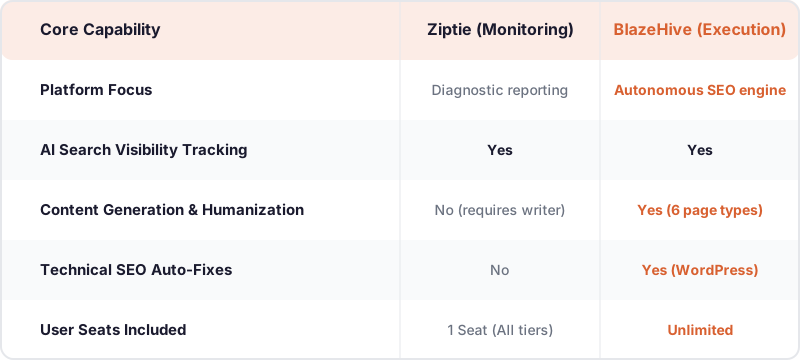
The most common trigger is the execution gap. Ziptie tells you what to fix but doesn't help you fix it. Teams using Ziptie at the $99/month Standard tier get 100 content optimizations per month - detailed recommendations for what to add, cut, or rewrite to get cited more often. What they don't get is anyone to do the writing. For lean marketing teams at startups or bootstrapped companies, that's a half-loop that adds a dashboard without closing the work.
The second pain point is the 1-seat limit. Every Ziptie tier - Basic, Standard, Pro - restricts access to a single user. This is a direct competitive disadvantage versus most alternatives in this category. Peec AI, Otterly, LLMrefs, and Rankability all offer unlimited seats at comparable price points. Agencies managing multiple brands can't realistically run Ziptie without workarounds, and multi-person marketing teams have to decide whose login takes priority.
A smaller but persistent complaint: Ziptie's per-optimization caps create artificial friction at lower tiers. The Basic plan's 10 content optimizations per month runs out fast for any team actively iterating on GEO. Upgrading from $69 to $99 unlocks 100 optimizations, but teams that need to test GEO's value first are stuck choosing between a cramped entry tier and a full commitment. Flat-fee alternatives like LLMrefs ($79/month, unlimited projects, all features) remove that friction entirely.
What to Look for in a GEO / AI Search Monitoring Tool
Engine coverage depth. Not all tools track the same set of AI engines. Ziptie monitors three: ChatGPT, Google AI Overviews, and Perplexity. Rankscale covers eight, including Claude, Grok, and DeepSeek. Your choice depends on where your buyers actually search - don't pay for engine breadth you don't need, but don't miss the engines your audience uses.
Monitoring vs. execution. This is the most important split in the category. Pure monitoring tools (Ziptie, Rankscale, Peec, Otterly, LLMrefs) show you the problem. Execution platforms (BlazeHive, Rankability's content layer) solve it. If you have an in-house SEO team, monitoring alone may be enough. If you don't, monitoring without execution is a cost center.
Seat limits and team access. If more than one person needs to see AI visibility data - a content lead, an account manager, a client - seat limits matter immediately. Ziptie limits all tiers to 1 seat. Peec, Otterly, LLMrefs, and Rankability all include unlimited team members. For agencies, this is non-negotiable.
Pricing model transparency. Some tools charge per query (credit-based, like Rankscale), some per prompt (Peec, Otterly), and some flat-fee (LLMrefs, BlazeHive). Credit-based models require careful planning to avoid overspend; flat-fee models remove that mental overhead. Understand the model before projecting monthly cost at your actual usage volume.
Reporting quality. GEO data is only as useful as your ability to show it to stakeholders. Ziptie's full-page screenshots of AI results are genuinely strong for client reporting. Otterly's Brand Visibility Index and Rankscale's AI Readiness Score are proprietary metrics that help prioritize action. Evaluate reporting against who needs to consume the output - solo founder, agency client, executive team.
Integration with existing workflows. Google Search Console integration is available on Ziptie, Otterly (Standard+), Rankability, and BlazeHive. LLMrefs includes BI and API integration. If you're already embedded in a SEO stack, check what plays nicely before adopting a new tool.
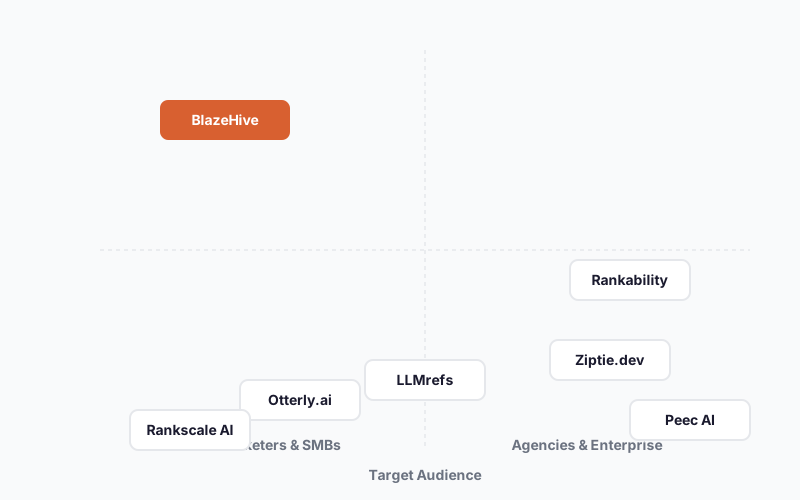
The Best Ziptie Alternatives
1. BlazeHive
BlazeHive is an autonomous SEO engine that replaces the strategist + writer + designer + dev agency stack with a single $99/month platform, publishing optimized content daily while monitoring and fixing technical SEO in parallel.
Best for: Founders, bootstrappers, and small SaaS marketing teams who need to build AI-cited, Google-ranked content without hiring an agency or in-house SEO team. Also fits medium-sized teams and SEO experts who want steerable control through the agentic SEO chat.
Strengths
- Closes the execution gap Ziptie leaves open: keyword research → page generation → humanization → technical fixes → backlinks → publishing → monitoring, all in one loop
- Bottom-of-funnel keyword research with live-SERP verification - buyer-intent targeting, not vanity volume
- Six page types built for both Google ranking and AI citation (landing pages, listicles, comparisons, VS pages, FAQs, interactive tool pages)
- Humanization validated against 30,000+ documented AI writing patterns before any page ships
- Technical SEO auto-fixing on WordPress: broken links, redirect chains, page-speed issues, internal-link problems
- Safety-engineered backlink network: acyclic graph with per-site pattern avoidance, no reciprocal exchanges by design
- Cannibalization detection via live SERP cross-checking - verdicts from Google itself, not similarity heuristics
- Human team monitors every customer's performance and intervenes if a site stagnates
Where it's not the right fit
- Technical SEO auto-fixing is currently WordPress-only (other CMS auto-fixes are coming)
- Not the tool if you already have a full in-house SEO team and only need AI visibility dashboards
- Not designed for Shopify-native publishing or enterprise SOC 2 / HIPAA compliance environments
Pricing: $99/month all-in - no per-seat fees, no add-ons. 3-day free trial, no card required. Done For You option: $3,000 setup + $99/month. As of August 2026.
When to choose it: You're running a lean team, you've recognized you're not appearing in AI search, and you need someone (or something) to write, fix, publish, and monitor - not just report. BlazeHive is the answer to "we saw the data, now what?"
2. Peec AI
Peec AI is a multi-engine GEO monitoring platform built for agencies and multi-team organizations that need unlimited-seat access to AI visibility data across seven engines.
Best for: Agencies managing multiple brands who can't afford per-seat licensing, or marketing teams with 3+ people needing simultaneous access to GEO data.
Strengths
- Unlimited team seats on every plan - the only tool in this comparison with this policy across all tiers
- Tracks 7 AI engines: ChatGPT, Perplexity, Google AI Overviews, Claude, Gemini, Grok, Copilot
- Daily tracking of custom prompts with sentiment analysis per query
- Competitive share-of-voice analysis with ranking comparisons across brands
- 15% discount on annual billing
Where it's not the right fit
- Starter tier ($95/month) restricts you to 3 engines of choice; the 4th costs an extra add-on fee
- Monitoring-only: no content generation, no technical SEO, no backlinks
- Entry-level prompt count (50) is limited for teams running large prompt sets
Pricing: Starter $95/month (3 engines, 50 prompts, unlimited seats), Pro $245/month, Advanced $495/month. 7-day free trial. As of July 2026.
When to choose it: You're running an agency with multiple client brands and need the whole team inside the same dashboard without paying per seat.
3. Rankscale AI
Rankscale AI is a credit-based GEO monitoring platform covering 8 LLMs daily. At $20/month, it's the cheapest entry point in this category by a significant margin.
Best for: Budget-conscious teams or individual marketers testing GEO tracking before committing to a higher-priced platform.
Strengths
- Tracks 8 engines daily: ChatGPT, Gemini, Perplexity, Claude, Grok, Copilot, Meta AI, DeepSeek - broadest coverage in this comparison
- $20/month entry tier covers 120 credits; scales to $99/month for 1,200
- Up to 50 brand visibility projects; all regions supported
- AI Readiness Score quantifies optimization priority
- Page audits (200 per tier) included
- Enterprise tier ($780/month) unlocks API access and a dedicated partner
Where it's not the right fit
- Credit-based model: every query across every engine consumes credits; high-volume teams need to plan carefully to avoid overspend
- Monitoring-only: no writing, no technical SEO, no backlinks, no publishing
- Single-plan discipline required - not the right tool if you want to set-and-forget without tracking usage
Pricing: $20/month (120 credits), $99/month (1,200 credits), Enterprise $780/month (12,000 credits + API). As of July 2026.
When to choose it: You want to validate that GEO monitoring creates value before committing to $79–$159/month tools. The $20 entry point is a low-risk starting point.
4. Otterly.ai
Otterly.ai is a GEO monitoring platform built for solo marketers and small teams who want clear AI visibility metrics without spending a day configuring the tool.
Best for: Solo marketers or small teams new to GEO who prioritize ease of use and clear next-step recommendations over raw data depth.
Strengths
- Lite plan at $29/month is the easiest-to-justify test in the category
- GEO audit tool included on mid-tier plans - diagnostic value Ziptie withholds at lower tiers
- Unlimited team members on all plans
- Brand Visibility Index combines visibility, sentiment, and citations into one priority metric
- AI-assisted prompt and competitor suggestions reduce setup time
- MCP integration on Standard+ for querying data directly from AI clients
Where it's not the right fit
- The $29 Lite plan includes only 15 prompts per month - runs out fast for teams with active GEO programs; the jump to $189 Standard is a 6x price increase
- Monitoring-only: no content creation, no technical SEO, no backlinks
- Users report a steep learning curve on dashboard navigation after onboarding
Pricing: Lite $29/month (15 prompts, 4 engines), Standard $189/month (100 prompts), Premium $489/month (400 prompts). 14-day free trial. As of July 2026.
When to choose it: You're a solo marketer or early-stage team that wants to understand AI visibility for the first time and needs a tool that explains the numbers clearly rather than overwhelming you with raw data.
5. LLMrefs
LLMrefs is a keyword-centric GEO monitoring platform at a flat $79/month, built for SEO professionals who already think in keyword lists rather than prompt-based interfaces.
Best for: In-house SEO professionals and freelancers who want to plug existing keyword workflows directly into AI visibility tracking without re-learning a new interface metaphor.
Strengths
- Flat $79/month - one plan, all engines, unlimited projects, no per-seat fees
- Keyword-based tracking (not prompt-based) maps directly onto traditional SEO workflows
- Covers emerging engines: Grok, Copilot, Meta AI, DeepSeek alongside ChatGPT, Perplexity, Google AI Overviews
- Bundled utilities: AI crawlability checker, Reddit threads finder, LLMs.txt generator
- Trust Graph for citation and source analysis; API and BI integration for custom dashboards
- Competitor benchmarking on high-intent queries
Where it's not the right fit
- Newer tool; steeper learning curve and less mature documentation than established competitors
- Single plan lacks enterprise scalability or dedicated support tier
- Monitoring-only: no execution, no content writing, no technical SEO fixes
Pricing: $79/month (one flat plan, all features, unlimited projects). Free tier (1 keyword). 7-day free trial. As of July 2026.
When to choose it: You have a keyword list you already work from and want AI visibility data mapped against it without rebuilding your workflow around prompt-based interfaces.
6. Rankability
Rankability is an agency-centric platform that covers both traditional SEO rank tracking and AI search monitoring across 7 engines. It's the only tool in this comparison that does both in one place.
Best for: Agencies already running traditional SEO rank tracking who want to add AI visibility without logging into a separate tool.
Strengths
- Hybrid positioning: AI Search Tracking + traditional SEO (rank tracking, local rank, keyword finder) in one platform
- 7 AI engines covered: ChatGPT, AI Overviews, Perplexity, Gemini, Claude, Grok, Copilot
- Unlimited clients and users on all plans - agency-optimized
- White-label reporting included across all tiers
- AEO workflows integrated alongside traditional SEO workflows
Where it's not the right fit
- Full feature depth requires the Scale tier ($299/month billed monthly); entry-level pricing ($79/month annual) is competitive but feature-limited
- Recommendations-based content optimization - does not generate or publish content
- Not the right fit if you're a solo founder who doesn't need traditional rank tracking alongside AI monitoring
Pricing: Starter $79/month (billed monthly, or $99/month annual), Growth $149/month (or $199/month annual), Scale $299/month (or $399/month annual). 14-day free trial. As of July 2026.
When to choose it: You're an agency managing multiple clients across traditional SEO and AI search, and you want white-label reporting plus unlimited seats without paying for two separate platforms.
Quick Comparison
| Tool | Best For | Starting Price | Free Tier | Standout Feature |
|---|---|---|---|---|
| BlazeHive | Teams needing execution, not just monitoring | $99/mo | No (3-day trial) | Full loop: writes, fixes, links, and publishes daily |
| Peec AI | Agencies with multi-brand, multi-seat needs | $95/mo | No (7-day trial) | Unlimited seats on every plan |
| Rankscale AI | Budget entry-level GEO testing | $20/mo | No (trial available) | 8 engines tracked at the lowest price in category |
| Otterly.ai | Solo marketers new to GEO | $29/mo | No (14-day trial) | GEO audit on mid-tier; easiest onboarding |
| LLMrefs | Keyword-workflow SEO professionals | $79/mo | Yes (1 keyword) | Flat pricing, keyword-native interface, bundled utilities |
| Rankability | Agencies bridging traditional SEO + AI monitoring | $79/mo (annual) | No (14-day trial) | Traditional rank tracking + AI monitoring in one platform |
Pricing as of July–August 2026. Check each tool's pricing page for current rates.
Which Alternative Should You Choose?
Most teams searching for Ziptie alternatives fit one of a few clear scenarios. Here's where each tool actually wins.
If you have a full in-house SEO team and only need AI visibility data...
Ziptie.dev or Peec AI are the right fit. They're built for teams with execution capacity that just need the monitoring layer - real-browser crawling, visual screenshot evidence, and multi-engine tracking. If you need a solo-user specialist, Ziptie works. If you need unlimited seats for a team, go to Peec.
If you're an agency managing multiple client brands...
Peec AI wins on unlimited seats; Rankability wins if you want traditional rank tracking bundled alongside AI visibility. Both include white-label reporting. Rankability is the stronger choice if your clients already ask for traditional keyword ranking data.
If you're testing GEO on a tight budget...
Rankscale AI at $20/month or Otterly.ai at $29/month are the right starting points. Both let you validate whether GEO tracking creates business value before committing to $79–$159/month. Rankscale covers more engines; Otterly is easier to use.
If you're an SEO professional with an existing keyword workflow...
LLMrefs at $79/month maps directly to keyword-based workflows, bundles AI crawlability and Reddit utilities, and charges a flat rate with no per-seat or per-engine add-ons.
If you need to build AI visibility, not just track it...
BlazeHive is the answer. Every other tool in this comparison tells you where you stand. BlazeHive writes, optimizes, publishes, and links the content that gets you cited in ChatGPT, Perplexity, and Google AI Overviews - then monitors performance and intervenes when something stalls. At $99/month all-in, it replaces the strategy + writing + technical + linking stack that would otherwise cost $8,500+/month at an agency.
Ready to Try BlazeHive?
If you've looked at your AI visibility data and the real problem is that you don't have the content to get cited - not the dashboard to watch it - BlazeHive is the right tool. Drop your URL, and the engine builds your keyword strategy, writes your pages, fixes your site, and starts publishing. Three-day free trial, no card required. If it's not producing results, cancel with one click.
Frequently Asked Questions
What is the main difference between Ziptie and BlazeHive?
Ziptie is a GEO monitoring platform that shows you where your brand appears in AI search results and recommends optimizations; BlazeHive is an autonomous SEO engine that executes the entire loop-keyword research, content writing, technical fixes, link building, and publishing-automatically. For teams with in-house writers and developers, Ziptie provides valuable visibility data. For bootstrapped founders without execution capacity, BlazeHive closes the gap that monitoring-only tools leave open. Both cost $99/month, but solve fundamentally different problems.
Why do teams leave Ziptie for alternatives?
The most common reason is the execution gap: Ziptie delivers 100 optimization recommendations monthly at the Standard tier, but doesn't help teams implement them without hiring a writer or agency. The second friction point is the single-seat limit on every tier, which forces agencies and multi-person teams to decide whose login gets priority or find workarounds. A third pain point is per-optimization caps at lower tiers-Basic tier allows only 10 optimizations per month, forcing teams to choose between a cramped entry point or full commitment at $99/month.
Which Ziptie alternative is best for agencies managing multiple client brands?
Peec AI wins for agencies because it offers unlimited team seats across all plans-a critical advantage over Ziptie's single-seat limit and the feature caps that ladder most competitors. Rankability is the second-best choice if your clients also need traditional SEO rank tracking bundled with AI monitoring, as it combines both in white-label reporting. For pure GEO focus across multiple brands, Peec's $95/month entry tier with 7 engines and unlimited seats makes it the clearest fit.
What's the cheapest way to test GEO monitoring before committing to a full platform?
Rankscale AI at $20/month is the lowest entry point in this category, covering 8 AI engines (ChatGPT, Perplexity, Claude, Gemini, Grok, Copilot, Meta AI, DeepSeek) with 120 credits monthly. Otterly.ai's $29/month Lite plan is a close second with 15 prompts monthly and GEO audit capability. Both let you validate whether AI visibility tracking creates business value before spending $79–$159/month on deeper tools, though Rankscale's credit model requires careful planning to avoid overspend.
Does any Ziptie alternative combine both traditional SEO and AI search monitoring?
Rankability is the only tool in this comparison that bundles traditional rank tracking with AI Search Tracking across 7 engines in one platform. This makes it ideal for agencies already managing keyword rankings who want to layer AI visibility without logging into separate tools. Entry pricing starts at $79/month annually, though full feature depth requires the Scale tier at $299/month; all tiers include unlimited clients and users plus white-label reporting.
Why would a team choose BlazeHive over a pure monitoring tool like Ziptie?
BlazeHive replaces the entire SEO agency stack-strategist, writer, designer, developer-with one autonomous engine publishing optimized content daily at $99/month all-in. Ziptie tells you where you're not cited in ChatGPT; BlazeHive writes the pages that get you cited, fixes technical issues, builds backlinks, and monitors performance continuously. For founders, small teams, and medium-sized teams without in-house SEO capacity, BlazeHive converts monitoring data into ranked, AI-cited content within weeks; Ziptie insights still require a team to act on them.
What makes BlazeHive's keyword research different from general AI writing tools?
BlazeHive's keyword research is bottom-of-funnel focused with live-SERP verification for buyer intent, not top-of-funnel vanity volume that never converts. The system cross-checks every keyword against live Google results to ensure it's actually ranking for buyer queries, then detects cannibalization by comparing whether two pages compete for the same query. This bottom-up approach builds a revenue-focused content moat rather than high-volume blog articles that rank but don't convert-a critical difference from generic AI platforms like ChatGPT or Writesonic.
Which alternative is best if I only care about tracking ChatGPT and Perplexity visibility?
Ziptie, BlazeHive, and most alternatives in this comparison all track ChatGPT and Perplexity as baseline. If those are your only two engines, Rankscale AI's $20/month tier with 8 engines total or Otterly.ai's $29/month Lite plan are the lowest-cost entry points that also include those engines. Rankscale covers the broadest engine set if you later discover your audience also uses Claude or Grok, while Otterly's GEO audit feature helps prioritize which visibility gaps to fix first.
Can I use BlazeHive if my website is on Shopify instead of WordPress?
BlazeHive's technical SEO auto-fixing-broken links, redirect chains, page-speed issues, internal linking-is currently WordPress-native only. For Shopify sites, BlazeHive's core loop still works: keyword research, page generation, humanization, publishing, linking, and monitoring ship across all platforms. Auto-fixing on other CMS platforms is on the roadmap; if you need immediate technical SEO fixes outside WordPress, a dedicated SEO audit tool or agency review may be necessary alongside BlazeHive.
What does BlazeHive's cannibalization detection catch that other tools miss?
BlazeHive uses live-SERP cross-checking, meaning the system queries Google itself to determine whether two pages compete for the same keyword-verdicts come from Google's actual results, not similarity scoring heuristics. Most SEO tools estimate cannibalization through text similarity or keyword overlap, which miss ranking conflicts that Google hasn't exposed yet. For daily publishing platforms like BlazeHive, this matters enormously: two well-written pages targeting the same query will leak authority to each other indefinitely until the system detects and resolves the conflict.
Is Ziptie still worth using, or should I switch to an alternative?
Ziptie is absolutely the right choice if you have a full in-house SEO team and only need AI visibility dashboards and recommendations-its real-browser crawling, visual screenshot evidence, and multi-engine tracking are purpose-built and excellent for that use case. The question isn't whether Ziptie is good; it's whether you have execution capacity in-house to act on the data it provides. If you don't-if you're a bootstrapped founder, small team, or medium-sized team without a dedicated writer and developer-you're paying for diagnostics without the ability to implement the cure, which is where alternatives like BlazeHive start to make sense.
What's included in BlazeHive's $99/month pricing, and are there add-ons?
BlazeHive's $99/month includes the complete engine: keyword research, all six page types (landing pages, listicles, comparisons, VS pages, FAQs, interactive tools), humanization against 30,000+ AI patterns, technical SEO validation, autonomous publishing across all CMS integrations, backlink building, and growth monitoring. No per-seat fees, no usage add-ons, no per-page limits. A Done For You option costs $3,000 one-time setup plus $99/month if you want hands-on technical SEO audit and fixes upfront. As of August 2026, pricing is transparent and all-in.
How do BlazeHive's backlinks compare to other SEO platforms?
BlazeHive's backlink network is built as an acyclic graph with per-site pattern avoidance, meaning no two sites ever exchange links and no reciprocal footprints exist-by design, not by luck. Most SEO platforms either skip backlinking entirely or ship generic link exchanges that create detectable patterns when audited by competitors. BlazeHive's approach is mathematically engineered for safety, treating the backlink network as a directed graph that persists over time without triggering search engine penalties, a differentiator that remains durable as long as monitoring tools don't ship similar strategies.
Should I choose LLMrefs if I already work with keywords instead of prompts?
LLMrefs is the right fit if your SEO workflow is already keyword-list-based and you want to avoid re-learning a prompt-based interface for AI tracking. At $79/month flat, it includes all engines (Grok, Copilot, Meta AI, DeepSeek, ChatGPT, Perplexity, Google AI Overviews), unlimited projects, and keyword-native tracking that maps directly onto your existing workflows. The tool also bundles AI crawlability checks, Reddit thread finders, and API integration for custom dashboards-utilities that justify the $79 price point for SEO professionals who reject prompt-based interfaces entirely.
What's the difference between BlazeHive and competitors like Writesonic or Surfer AI for building AI visibility?
Writesonic ($99/mo) bundles AI content writing with some GEO monitoring but leaves keyword research, technical SEO, and link building to you; Surfer AI offers on-page optimization and content editing but requires you to handle strategy and publishing independently. BlazeHive closes the entire loop in one engine: autonomous keyword research validated against live Google results, page generation across six types, technical fixes and backlinks, autonomous publishing, and human-monitored growth tracking. For founders without an SEO hire, the difference is stark: Writesonic and Surfer still require a strategist and developer in the loop; BlazeHive replaces them entirely.