TL;DR
Writesonic alternatives break down by how much automation you actually want: BlazeHive is the top pick for founders, small teams, and medium-sized teams who need fully autonomous SEO - one URL in, ranked and AI-cited pages published daily, no human steering required. Scalenut wins for teams wanting a mid-budget all-in-one GEO + content suite with manual control, and Surfer SEO wins for SEO specialists who want the deepest on-page NLP scoring in the market.

Writesonic Alternatives
Writesonic has built a genuinely capable GEO visibility platform - its Action Center, multi-engine AI tracking, and citation outreach tools are mature, and it has real enterprise customers. But three friction points keep driving users to look elsewhere: content quality that varies enough to require 40–60% manual rework, core GEO features gated behind a $249/month Professional tier, and an architecture that stops at content generation and tracking - you still brief, optimize, publish, fix technical issues, and build links yourself. This page maps the real alternatives by use case so you can pick the right tool for your situation, not just the most popular one.
Why People Look for Writesonic Alternatives
The single most documented reason users leave Writesonic is content quality inconsistency. Reddit threads and Trustpilot reviews surface the same complaint: "The quality of content could vary strongly," and more than a few users report abandoning their Writesonic-generated drafts entirely because the output "didn't meet personal quality standards." For a tool built to replace writing time, inconsistency that sends you back to a blank document defeats the purpose.
The second recurring pain is the pricing cliff. The $99/month tier tracks ChatGPT-only and gates most meaningful GEO features. To unlock the Action Center, broader engine coverage, citation outreach, and full technical audits, you're looking at $249/month - a 2.5x jump. Teams that bought in at $99 expecting a full GEO platform feel misled once they discover what's missing. And even at $249/month, Writesonic doesn't publish to your CMS, doesn't fix technical SEO issues, and doesn't build backlinks. You're paying more for visibility data and then paying again - in time or external services - to act on it.
The third pattern is the automation gap. Users searching for Writesonic alternatives want more than better writing quality or lower prices - they want a tool that closes the loop. Tracking AI visibility is useful. Actually publishing optimized pages, fixing site issues, and building authority is what they were hoping Writesonic would do. When it doesn't, they start looking.
What to Look for in an AI SEO Tool
Automation depth. There's a wide spectrum between "helps you write" and "does SEO for you." Most tools sit closer to the first end - they generate a draft but leave keyword research, optimization, CMS publishing, technical fixes, and link building to you. Know how much of that work you actually want to own before you pick a platform.
Content humanization. AI content is now common enough that Google and readers recognize it. A tool that just generates and stops creates a new problem: detectable AI patterns that hurt engagement and risk being treated as low-quality. Look for tools that actively validate output against known AI writing signatures - not just "passes AI detectors" but systematically removes the structural and stylistic patterns that signal machine writing.
Keyword strategy quality. Top-of-funnel volume keywords look impressive in reports and rarely convert. The tools worth paying for focus on bottom-of-funnel, buyer-intent queries and cross-check them against live Google SERPs to prevent cannibalization before it happens - not after two pages have been eating each other's rankings for six months.
Technical SEO coverage. Broken internal links, redirect chains, and slow pages bleed the authority your content builds. Most tools don't touch this at all. Some audit it and tell you what's wrong. The most advanced platforms fix it automatically. Know which category you're buying.
CMS publishing. Copy-pasting AI content into WordPress or Webflow is the hidden time cost most AI writing tools ignore. Autonomous publishing - the tool pushing finished pages directly to your CMS under your domain - separates autopilot platforms from writing assistants.
Pricing structure. Per-seat pricing compounds quickly for small teams. Metered article counts punish publishing velocity. Look at the all-in price at the volume you actually need, not the entry plan's headline number.
Backlink and authority building. Content alone doesn't rank. Backlinks remain the strongest authority signal. Almost no AI content tool addresses this - meaning you're still hiring link builders or running outreach campaigns on top of your content subscription. The rare platform that builds a safe, contextual backlink network alongside content has a real edge.
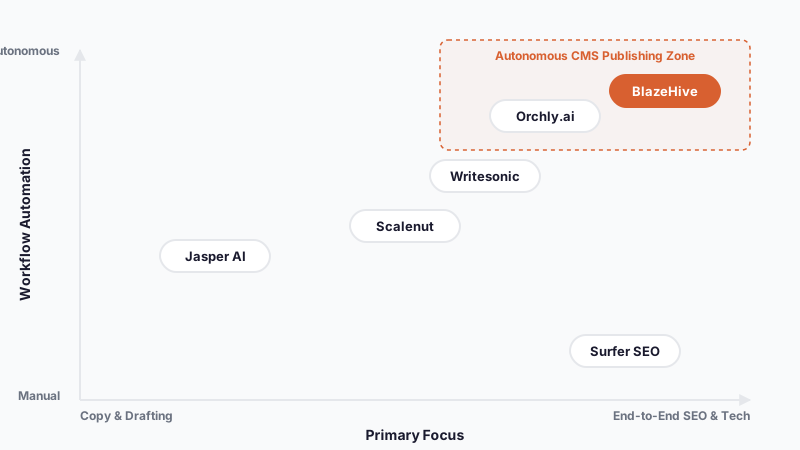
The Best Writesonic Alternatives
1. BlazeHive
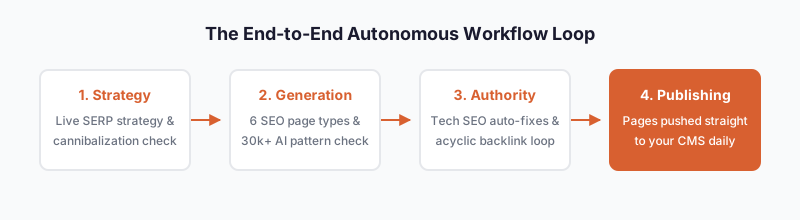
BlazeHive is an autonomous SEO engine - drop a URL, and the system researches competitors, builds a bottom-of-funnel keyword strategy, then generates, humanizes, validates, and publishes one optimized page per day directly to your CMS.
Best for: Indie founders, bootstrapped SaaS teams, and small marketing teams who need compounding organic traffic without managing an SEO workflow. Also fits medium-sized teams and SEO experts who want steerable control through the agentic SEO chat.
Strengths
- Complete end-to-end automation: keyword research, six page types, humanization, technical SEO fixes, backlink network, publishing, and growth monitoring in one $99/month plan
- De-AI humanization validated against 30,000+ documented AI writing patterns - solves the #1 complaint about AI content quality
- Technical SEO auto-fixing (WordPress-native): broken links, redirect chains, heavy pages, internal-linking debt fixed automatically during content publication
- Safe-by-design contextual backlink network: acyclic architecture with per-website pattern avoidance means no reciprocal link exchanges, ever - no competitor in this category offers this
- Cannibalization detection via live SERP cross-checking (verdicts from Google itself, not similarity heuristics)
- Multi-CMS publishing: WordPress, Ghost, Webflow, Framer, Contentful, Storyblok, Strapi, and generic webhook; content lives under your domain permanently
- Human monitoring: the team tracks every customer's performance and intervenes if a site stagnates
- Per-company pricing ($99/month regardless of team size)
Where it's not the right fit
- Technical SEO auto-fixing is currently WordPress-only (other platforms noted as coming soon)
- Publishes approximately one page per day (~30/month); not built for bulk-publishing 50+ articles monthly
- No first-party multi-engine GEO visibility dashboard (tracks rankings via GSC, not a Writesonic-style AI cite-share tracker)
- Smaller brand recognition than Writesonic or Jasper; fewer public case studies
Pricing: $99/month (Complete Engine, as of August 2026). 3-day free trial, no credit card required. Done-For-You setup available at $3,000 one-time + $99/month.
When to choose it: You want to drop a URL and get ranked pages published daily without briefing writers, uploading to CMS, or chasing link builders. BlazeHive is the right tool when you're optimizing for automation depth per dollar, not visibility dashboard breadth.
2. Writesonic
Writesonic is a GEO platform that tracks brand visibility across 10+ AI engines, then surfaces prioritized action workflows - new content, page refreshes, citation outreach, technical fixes - ranked by visibility impact through its Action Center.
Best for: Enterprise marketing teams with the internal capacity to brief, write, optimize, and publish content, who need sophisticated AI visibility tracking and competitor cite-share analysis.
Strengths
- Multi-engine AI visibility tracking: ChatGPT, Claude, Gemini, Perplexity, and 7+ others in one dashboard
- Action Center: ranks every visibility gap by citation impact across 7 categories and assigns workflows
- One-click technical AI crawler audit (robots.txt, schema, indexing for GPTBot, ClaudeBot, PerplexityBot)
- Enterprise compliance: SOC 2 Type II, HIPAA, GDPR, SSO/SAML - credentialed for healthcare and finance teams
- Strong proof: Amazon, Unilever, Acer, Zoho among named customers; Maestra case study shows 0% → 31% AI visibility → $350K ACV in 7 months
Where it's not the right fit
- Full GEO features require $249/month Professional tier; $99/month covers ChatGPT-only tracking
- No CMS publishing automation - all content must be manually copied to your CMS
- No traditional organic SERP ranking measurement (GEO-only focus)
- No backlink building - you're still hiring outreach or managing links separately
- Content quality documented as inconsistent - users report 40–60% manual rework
Pricing: $99/month (ChatGPT-only tracking); $249/month Professional (full GEO, as of August 2026). 7-day free trial, no credit card required.
When to choose it: Your team is large enough to interpret visibility dashboards, brief AI writers on strategy, edit output for quality, and publish manually. Writesonic's breadth matters if multi-engine AI citation tracking is your primary metric.
3. Orchly.ai
Orchly.ai is an end-to-end SEO and GEO platform with autonomous agents that write new content, refresh declining pages, improve internal and external links, and publish directly to CMS.
Best for: Teams wanting autonomous content creation tied to AI visibility metrics - a middle ground between Writesonic's tracking depth and BlazeHive's full automation.
Strengths
- Combines traditional SEO + GEO tracking with GSC integration in one platform
- Autonomous agents act on visibility data (write, update, relink, translate) without manual briefing
- CMS auto-publish to WordPress, Webflow, Framer, and Ghost
- Content optimizer scores alignment for both Google and AI search engines by comparing against live competitors
- Lower entry price ($49/month) than BlazeHive or Writesonic Professional
Where it's not the right fit
- Smaller user base; fewer public case studies and community resources than Writesonic or Jasper
- Higher-tier pricing is not publicly disclosed - unclear what scale costs
- No technical SEO auto-fixing or safety-engineered backlink network
Pricing: $49/month entry (as of August 2026). 14-day money-back guarantee. Higher tiers custom.
When to choose it: You want GEO visibility data and CMS publishing automation together, at a price point below BlazeHive, and you're comfortable with a newer platform.
4. Scalenut
Scalenut is an all-in-one GEO + content + optimization suite combining AI visibility tracking, content generation, SERP analysis, and keyword research in one mid-market platform.
Best for: Teams wanting a single platform for GEO tracking, keyword research, content generation, and SERP analysis - without enterprise budget - who are comfortable steering the workflow manually.
Strengths
- GEO tracking across multiple AI engines with prompt intelligence and cite-share metrics
- Keyword research (buyer intent + SEO), competitor SERP analysis, and topical mapping in one tool
- Content optimization scoring and refresh suggestions alongside generation
- Multi-domain support (1–10+ depending on tier); integrates with GSC, Semrush, Ahrefs, WordPress, Zapier
- Most transparent mid-market pricing: Plus tier at $89/month includes 30 GEO articles and 30 optimized articles
Where it's not the right fit
- Requires human steering at every stage: keyword planning, content optimization, and publishing remain manual
- Starter tier ($59/month, 5 articles) works out to $11.80 per article - poor value at low volumes
- No technical SEO auto-fixing or backlink network
- No autonomous CMS publishing
Pricing: Starter $59/month; Plus $89/month; Professional $199/month (as of August 2026). 7-day free trial.
When to choose it: You need GEO + content in one tool, prefer to control your own editorial workflow, and are publishing at a volume where Scalenut's per-article economics make sense (Plus tier or above).
5. Jasper AI
Jasper is a brand voice and content generation engine built for teams producing high volumes of marketing content - blogs, emails, ads, social - in a consistent, trainable voice.
Best for: Content teams of 3+ people producing 15+ pieces per month who need brand-consistent output across channels and can handle SEO research and publishing externally.
Strengths
- Brand Voice Engine captures and applies your writing style across all output formats - reduces editing significantly at scale
- 40+ marketing templates covering blogs, emails, social, ads, landing pages
- Unlimited word output on paid plans (fair-use policy)
- Canvas editor with approval workflows and team collaboration
- Browser extension writes in Google Docs, email clients, and web apps
Where it's not the right fit
- No built-in SEO research - requires Ahrefs, Semrush, or another keyword SaaS running alongside it
- No publishing automation; humans upload to CMS manually
- No ranking measurement, backlink building, or technical SEO
- Per-seat pricing scales cost quickly (5 people at Pro = $345/month)
- Not built for single-founder or 1–2 person teams who need autonomous output
Pricing: Creator $49/month/seat; Pro $69/month/seat (as of July 2026). 7-day free trial (credit card required).
When to choose it: You're managing an editorial team of 5+ writers producing multi-channel content at scale and brand voice consistency is the primary bottleneck - not keyword research or publishing.
6. Surfer SEO
Surfer is the on-page NLP scoring tool most SEO specialists reach for - it analyzes live competitor content and tells you exactly which entities, headings, and semantic terms your pages need to rank.
Best for: SEO specialists and agencies running 10–50 keywords per month who want the deepest SERP analysis available and prefer granular per-page control over automation.
Strengths
- Content Editor with real-time NLP scoring: entity coverage, topical completeness, semantic recommendations as you write
- SERP Analyzer shows live competitor content structure, word counts, heading patterns, and entities
- Topical Map with cluster detection and cannibalization reporting
- AI Tracker for 5+ AI engines (ChatGPT, Gemini, Perplexity; daily prompt tracking)
- G2 rating: 4.8/5 - one of the highest scores in the SEO tools category
Where it's not the right fit
- Scores content but doesn't write or publish it - humans do both
- Credits meter at scale: high-volume teams need Scale ($219/month) or Enterprise ($999+/month)
- Add-ons stack quickly: AI Detection ($29) + SERP Analyzer ($29) + Rank Tracker ($8.50+) adds $67+ to the base plan
- No backlink building or technical SEO auto-fixing
- Not designed for founders who want to set it and forget it
Pricing: Essential $99/month; Scale $219/month; Enterprise $999+/month (as of August 2026). 7-day money-back guarantee.
When to choose it: You're an SEO specialist or agency who wants obsessive-level control over every on-page element and has the human capacity to write, optimize, and publish manually.
Quick Comparison
| Tool | Best For | Starting Price | Free Tier | Standout Feature |
|---|---|---|---|---|
| BlazeHive | Autonomous SEO for founders | $99/mo | 3-day trial (no card) | End-to-end autopilot + safe backlink network |
| Writesonic | Enterprise GEO visibility | $99/mo ($249 full GEO) | 7-day trial | 10+ AI engine tracking + Action Center |
| Orchly.ai | Autonomous GEO + CMS publishing | $49/mo | 14-day money-back | GEO-triggered autonomous content agents |
| Scalenut | Mid-market GEO + content suite | $59/mo | 7-day trial | Transparent per-article GEO tracking at mid-price |
| Jasper AI | Brand-consistent content at scale | $49/seat/mo | 7-day trial | Trainable brand voice across all content formats |
| Surfer SEO | On-page NLP optimization | $99/mo | 7-day money-back | Deepest semantic SERP analysis in the market |
Pricing as of August 2026. Check each tool's pricing page for current rates.
Which Alternative Should You Choose?
Most people searching "Writesonic alternatives" land in one of five situations - and the right tool is different for each.
If you want AI visibility tracking across 10+ engines with enterprise compliance...
Writesonic is the honest answer. Its Action Center, multi-engine cite-share tracking, and SOC 2/HIPAA compliance are genuinely mature. Budget $249/month for the Professional tier - the $99 entry plan will feel incomplete.
If you want GEO tracking AND automated CMS publishing without enterprise pricing...
Orchly.ai pairs AI visibility data with autonomous agents that actually publish, at $49/month. Newer platform, but the workflow matches what most Writesonic users were hoping for.
If you want one platform for GEO + content + SERP research with manual control...
Scalenut is the cleaner mid-market pick. Go with Plus ($89/month) or higher - the Starter tier's 5-article cap makes the per-article cost unworkable.
If you want end-to-end autonomous SEO - research, writing, humanization, technical fixes, backlinks, and publishing - on autopilot...
BlazeHive is the right tool. It's the only platform in this category that closes the full loop: keyword research via live SERP cross-checking, six optimized page types, de-AI humanization against 30,000+ patterns, technical SEO auto-fixing on WordPress, a safe-by-design backlink network, and direct CMS publishing - all at $99/month without per-seat fees or article caps.
If you have a content team of 5+ writers and brand consistency is the main bottleneck...
Jasper AI is purpose-built for that problem. Pair it with Surfer for SERP analysis and you have a strong editorial stack - just know you're also buying the manual research-to-publish overhead.
If you're an SEO specialist who wants granular per-page control and deep SERP analysis...
Surfer SEO has the deepest NLP scoring in the market. Use it if you want to control every entity, heading, and semantic term yourself rather than delegate to an agent.
Ready to Try BlazeHive?
If you're a founder, small team, or medium-sized team who wants organic traffic without managing an SEO workflow, BlazeHive is the right tool - it's the only platform that takes you from a single URL to published, humanized, technically sound, and backlinked pages every day at $99/month. Start your 3-day free trial at blazehive.io, no credit card required. Prefer to have the team handle setup? The Done-For-You option starts with a consultation call.
Frequently Asked Questions
What should I look for in a Writesonic alternative?
Prioritize automation depth-how much of the research-to-publishing workflow is actually handled by the tool versus delegated back to you. Most competitors generate content but leave keyword strategy, optimization, CMS publishing, technical fixes, and link building to humans; the best alternatives close those gaps. Beyond automation, evaluate content humanization (validated against known AI patterns, not just detector-passing), bottom-of-funnel keyword quality, technical SEO coverage, direct CMS publishing, and transparent pricing that doesn't scale with team size or punish low-volume publishing.
Is there a free alternative to Writesonic?
No-there's no truly free alternative with Writesonic's feature depth. However, several tools offer generous free tiers or money-back guarantees: Scalenut (7-day trial), Jasper (7-day trial with card), Surfer SEO (7-day money-back), Orchly.ai (14-day money-back), and BlazeHive (3-day trial, no card required). Each is designed for different workflows, so the right free entry point depends on what you're testing-visibility tracking, content generation, or end-to-end automation.
Why do people leave Writesonic?
The most documented reason is content quality inconsistency-Reddit and Trustpilot are full of complaints that output "could vary strongly" and requires 40–60% manual rework, defeating the purpose of an AI writing tool. The second pain point is the pricing cliff: the $99/month tier covers ChatGPT-only tracking and gates GEO features behind a $249/month Professional plan, a 2.5x jump that feels deceptive. Third, even at $249/month, Writesonic doesn't publish to your CMS, doesn't fix technical SEO issues, and doesn't build backlinks-you're paying more for visibility data and then paying again, in time or money, to act on it.
What is the difference between GEO and traditional SEO tracking?
GEO (Generative Engine Optimization) tracking measures whether your content is cited or ranked by AI engines like ChatGPT, Perplexity, and Claude-a metric that's becoming critical as AI models increasingly replace Google for research. Traditional SEO tracking measures Google Search rankings and click volume via Google Search Console. Most AI SEO platforms now offer both: Writesonic leads on GEO breadth (10+ engines), while BlazeHive focuses on creating pages ranked for Google that are also built to be cited by AI without a separate visibility dashboard. Which matters more depends on whether your audience is still using Google or has moved to AI search.
Which Writesonic alternative is best for autonomous publishing?
BlazeHive is the only platform that combines full autonomy with CMS publishing-it researches keywords, writes, humanizes, validates technical SEO, builds backlinks, and publishes directly to WordPress, Ghost, Webflow, Framer, Contentful, Storyblok, or Strapi without human intervention. Orchly.ai offers similar autonomous publishing tied to GEO data, but at a smaller scale and with less mature technical SEO tooling. Writesonic, Jasper, Scalenut, and Surfer all require manual CMS upload, so if publishing automation is your primary need, BlazeHive is the clear standout.
Can Writesonic alternatives fix technical SEO issues automatically?
BlazeHive is the only platform that auto-fixes technical debt during content publication-broken internal links, redirect chains, heavy pages, and weak internal linking are all detected and corrected automatically on WordPress sites. Writesonic audits technical issues via its AI crawler but leaves fixes to you; Surfer focuses on on-page optimization and doesn't address site-wide technical problems; Scalenut and Jasper don't include technical SEO at all. If your site has accumulated link rot, slow pages, or redirect chains, technical SEO auto-fixing will accelerate your ranking velocity far more than content alone.
How do Writesonic alternatives compare on pricing for small teams?
BlazeHive and Orchly.ai are best for small teams-per-company pricing means unlimited team members at $99/month and $49/month respectively, no per-seat fees. Jasper charges $49–$69 per person per month (5 people = $345/mo at Pro), making it expensive for bootstrapped teams. Writesonic, Scalenut, and Surfer use fixed-plan pricing with add-ons that stack quickly; Writesonic's full-featured tier hits $249/month, Scalenut's Professional hits $199/month, and Surfer's add-ons push total cost to $150+/month. For under $100/month all-in, BlazeHive and Orchly.ai dominate.
What is the best Writesonic alternative for multi-channel content?
Jasper AI is purpose-built for multi-channel content-it generates blogs, emails, ads, social posts, and landing pages in one trainable brand voice, designed for teams producing 15+ pieces monthly across channels. BlazeHive generates long-form search-optimized pages; Writesonic focuses on GEO visibility; Scalenut balances GEO and SEO. If your goal is consistent brand voice across LinkedIn, email, and ads alongside blogs, Jasper is the strongest fit-just know you'll still need external keyword research and manual CMS publishing.
Which alternative works best if I want GEO visibility tracking?
Writesonic leads on GEO breadth-it tracks 10+ AI engines (ChatGPT, Claude, Gemini, Perplexity, etc.) and surfaces prioritized workflows via its Action Center, the most mature multi-engine visibility dashboard in the market. Scalenut offers GEO tracking at a lower price point but with narrower engine coverage. BlazeHive generates pages built for both Google and AI citation but doesn't provide a first-party multi-engine cite-share dashboard-you track rankings via Google Search Console. If multi-engine AI visibility is your north star, Writesonic's Professional tier ($249/month) is the deepest option available.
Is BlazeHive truly autonomous, or do I still need to manage workflows?
BlazeHive is fully autonomous-you drop a URL, and the system researches competitors, identifies bottom-of-funnel keywords, writes one optimized page per day, validates it against 30,000+ AI writing patterns, fixes technical SEO issues on WordPress, builds contextual backlinks, and publishes directly to your CMS without human steering or editorial intervention. Other platforms require humans to brief the AI, optimize the output, upload to CMS, and manage links separately; BlazeHive closes every loop. The only manual input is periodic monitoring-the team tracks your site's performance and intervenes if growth stagnates, but day-to-day operation is hands-off.
What makes BlazeHive's backlink network different from competitors?
BlazeHive builds a safe-by-design contextual backlink network with acyclic architecture and per-website pattern avoidance-meaning no two sites ever exchange links, eliminating reciprocal link footprints entirely. Every competitor in this space either doesn't offer backlink building at all or leaves it to external outreach services you hire separately. No competitor builds authority automatically as part of the platform. This is BlazeHive's biggest edge: content that ranks gets authority accelerated by contextual links, all included in the $99/month price.
How does humanization work in these tools, and why does it matter?
Content humanization removes detectable AI writing patterns before publishing-validated, not just "AI detector-passing." BlazeHive validates against 30,000+ documented patterns; most competitors skip this entirely. Reddit and Trustpilot are full of users abandoning Writesonic and Jasper output because it "sounds like AI" and gets low engagement despite good rankings. Humanization matters because Google and readers recognize AI patterns, which hurt both SERP performance and engagement metrics that now factor into ranking. If inconsistent, AI-sounding content is a documented reason you're leaving your current tool, humanization depth is the most important differentiator.
Should I stay with Writesonic, or is there a better fit for my situation?
Writesonic remains the best choice if your team is large enough to interpret visibility dashboards, brief AI writers on strategy, edit output manually, and publish to CMS yourself-its 10+ engine tracking and Action Center are genuinely mature, and it has real enterprise customers. However, if you're bootstrapped or a small team managing SEO alongside other work, BlazeHive replaces the entire stack at $99/month and eliminates manual steering. If you want GEO + CMS publishing at lower cost than Writesonic, Orchly.ai splits the difference. The honest answer: Writesonic is still worth using if you need multi-engine visibility data and have the team capacity for manual workflows; most alternatives exist because that team capacity is expensive and most founders don't have it.