TL;DR
Tracemetry alternatives come down to how much of the SEO loop you need to own: BlazeHive is the top pick for founders and SaaS teams who want Google rankings, AI citations, technical SEO fixes, and safety-engineered backlinks from a single $99/month engine. Tracemetry wins for B2B teams that already rank on Google and just want to add structured GEO workflows with founder-level access. Frase is the safer enterprise pick if you need 8-platform AI tracking and a lower entry price.
Tracemetry Alternatives
Tracemetry launched in Q3 2026 as a focused Generative Engine Optimization platform - tracking brand presence in ChatGPT, Claude, Perplexity, and Gemini, then closing the gap with briefs and article drafts routed through editorial workflows. It's a genuinely interesting product for teams that live and breathe AI visibility. But it's not built for every workflow, and the undisclosed Pro pricing plus design-partner-only access means many teams searching today can't actually buy it yet. Here are the five strongest alternatives across GEO, autonomous SEO, and hybrid platforms - with a clear recommendation for each situation.

Why People Look for Tracemetry Alternatives
The most common trigger: Tracemetry's pricing isn't public. The Tracker and Pro plans don't list prices on the site. The Agency plan is $599/month. That leaves most indie founders and small SaaS teams in a gap - either the price isn't accessible or they're stuck waiting for design-partner slots to open. Teams searching "Tracemetry alternatives" often aren't unhappy with the product; they can't get into it on their timeline or budget.
The second recurring pain: Tracemetry is GEO-first, which means it doesn't touch traditional Google SEO, technical debt, or backlinks. If you're building organic from scratch - no existing content moat, no Google rankings - Tracemetry gives you AI visibility infrastructure but leaves 80% of search traffic (still coming from Google) unaddressed. Teams realize that after their first strategy call and start looking for platforms that bridge both worlds.
The third pattern is scope mismatch. Tracemetry's ideal customer is a B2B SaaS company at Series A–C with an existing weekly content motion. If that's not you - if you're bootstrapped, pre-PMF, or replacing an agency rather than adding to one - the editorial workflow and design-partner model is more overhead than you need. Founders want automation, not more review queues.
What to Look for in a GEO and SEO Tool
Full-loop automation vs. point tool. Some tools track AI visibility. Others write articles. Very few do both and publish directly to your CMS. Before you pick a platform, map how many other tools you'd still need to run alongside it. If the answer is two or more, you're building a stack, not a solution.
Google SEO coverage. AI answer engines pull from content that ranks on Google. A GEO-only tool that ignores traditional SEO is optimizing a downstream channel while leaving the upstream unattended. Look for platforms that treat Google and AI search as one compounding system, not two separate workflows.
Technical SEO handling. Broken links, redirect chains, and weak internal linking bleed the authority your content builds. Most platforms ignore this entirely. Ask specifically: does the tool find technical issues, and does it fix them - or does it hand you a report and expect you to call a developer?
Backlink approach. Backlink exchanges are common and effective, but carry reciprocal footprint risk. Understand exactly how a platform's link network is structured before you opt in. Acyclic networks with per-site pattern avoidance are safer by design than simple exchange models.
Content type diversity. Blog articles are one format. Landing pages, comparison pages, FAQ pages, and interactive tool pages each rank differently and convert differently. If a platform only produces blog posts, you're leaving high-intent, bottom-of-funnel queries uncaptured.
Humanization depth. AI-written content that reads like AI gets flagged by Google and ignored by humans. Ask whether the platform has an explicit de-AI pass, and what it's validated against. "We use a good model" is not the same as "we check every page against 30,000+ documented AI writing patterns before publishing."
Pricing transparency. Some platforms are transparent ($49/month, everything included). Others gate features behind undisclosed tiers or enterprise calls. If you can't find the price on the website, budget conservatively.
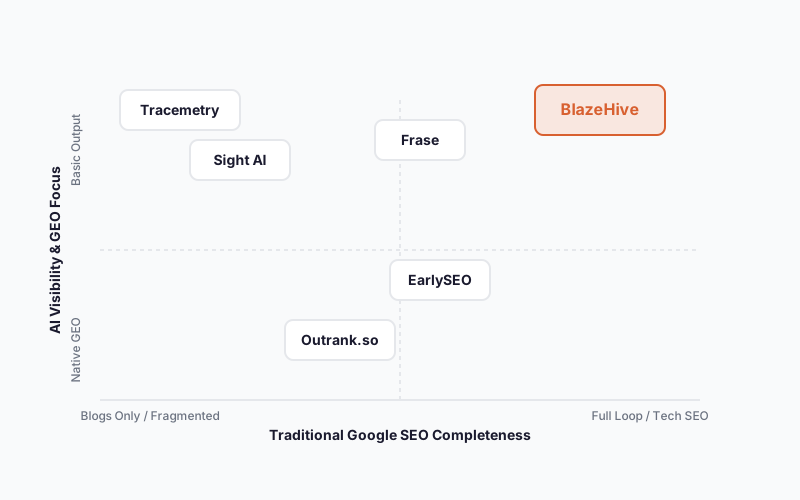
The Best Tracemetry Alternatives
1. BlazeHive
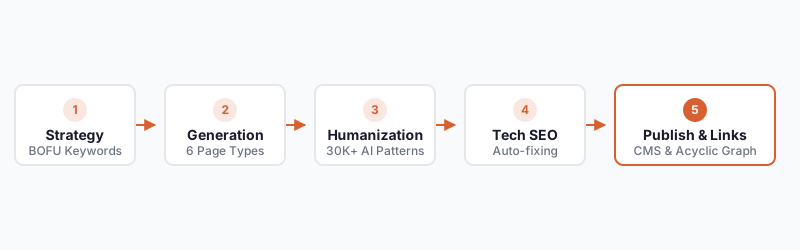
BlazeHive is an autonomous SEO engine. One $99/month subscription covers strategy, production, humanization, technical SEO, backlinks, and growth reporting - built to rank on Google and pull AI citations at the same time.
Best for: Indie founders, bootstrapped SaaS teams, and growth-stage startups (Series A–B) who need agency-quality SEO output without the agency budget or in-house hire. Also fits medium-sized teams and SEO experts who want steerable control through the agentic SEO chat.
Strengths
- Full loop at one price: keyword research → six page types (landing pages, listicles, comparisons, FAQs, interactive tools, alternatives) → humanization → publishing → GSC growth reporting, all for $99/month
- Humanization validated against 30,000+ documented AI writing patterns before any page ships
- Technical SEO auto-fixing on WordPress: broken links, redirect chains, heavy pages, and internal-linking problems found and fixed automatically
- Safety-engineered backlinks: acyclic graph with per-site pattern avoidance - no two sites ever exchange links, no reciprocal footprint by construction
- Cannibalization detection uses live SERP cross-checks from Google itself, not similarity heuristics
- Dogfooded: BlazeHive uses BlazeHive to grow its own properties - the strongest proof a product actually works
Where it's not the right fit
- Technical SEO auto-fixing is WordPress-only; other CMS platforms are on the roadmap but not live yet
- Teams that want a high-touch, founder-led onboarding with design-partner access will find BlazeHive more self-serve
- If your category requires 4,000–5,000 word authority articles, BlazeHive's bottom-of-funnel page approach is a different format philosophy
Pricing: $99/month as of August 2026, everything included. 3-day free trial, no card required. Cancel anytime. Done-For-You setup available at $3,000 one-time + $99/month.
When to choose it: You're building organic from scratch or replacing an agency stack, you want Google rankings and AI citations from one engine, and you don't want to manage five separate tools to get there.
2. Frase
Frase has been around long enough to build an enterprise customer list, and now runs as an agentic SEO + GEO stack with 80+ specialized agent skills and AI visibility tracking across 8 engines including ChatGPT, Perplexity, Claude, and Gemini.
Best for: Larger content teams and enterprise buyers who want GEO and SEO scoring in one platform at a lower entry price, and want a vendor with a real track record.
Strengths
- AI visibility tracking across 8 platforms (widest coverage of any platform on this list)
- GEO scoring and AI citation tracking included on every plan, starting at $49/month
- Visible enterprise customers including Andela - the track record is there
- 7-day free trial, no credit card required
- MCP server access for custom integrations
Where it's not the right fit
- No autonomous end-to-end publishing loop to your CMS - content production and technical SEO remain separate workflows
- No technical SEO auto-fixing; audit findings require manual resolution or external tools
- No safety-engineered backlink network; links are handled externally
Pricing: Starter $49/month, Professional $129/month, Scale $299/month as of mid-2026. Check frase.io for current rates.
When to choose it: You're already on Frase, or you're an enterprise buyer who wants the broadest AI platform coverage and an established vendor name behind the product.
3. Outrank.so
Outrank.so is an automated blog SEO platform. It writes, optimizes, and publishes articles directly to your CMS. No keyword strategy required - just pick a topic and it runs.
Best for: Bootstrapped indie hackers, lean content shops, and WordPress/Shopify site builders who want 30 blog posts per month published automatically, no strategy required.
Strengths
- 30–90 articles auto-published per month depending on tier
- Covers WordPress, Shopify, Notion, Wix, and Framer
- Backlink exchange network built in
- $1 entry trial for first 3 days of full access
- Lowest cognitive overhead of any platform on this list
Where it's not the right fit
- No GEO features, no AI visibility tracking - purely Google-focused
- No technical SEO auditing or auto-fixing
- Blog articles only; no comparison pages, FAQ pages, interactive tools, or landing pages
- No humanization validation step
Pricing: Standard $99/month (30 articles), Upgrade 60 ~$149/month, Upgrade 90 ~$199/month as of mid-2026. Check outrank.so for current rates.
When to choose it: You want one job done - publish 30 SEO-optimized blog articles per month - and you don't need GEO tracking, technical SEO, or a broader content strategy.
4. Sight AI
Sight AI is an autonomous SEO agent that combines AI visibility tracking across 5 engines (ChatGPT, Claude, Perplexity, Gemini, Grok) with a multi-sub-agent writing stack that produces one 2,500–4,500 word article per day on autopilot.
Best for: Teams in deep-expertise categories (healthcare, finance, enterprise software) where long-form, comprehensive articles carry more weight than format diversity.
Strengths
- Long-form articles: 2,500–4,500 words with research, outline, write, edit, optimize, and publish sub-agents
- AI visibility tracking across 5 platforms including Grok
- GSC integration for ranking visibility
- Autopilot publishes one article per day - same cadence as BlazeHive, different format
Where it's not the right fit
- Not designed for bottom-of-funnel page formats (comparisons, landing pages, interactive tools)
- No technical SEO auditing or auto-fixing
- No safety-engineered backlink network
- No explicit humanization validation step
Pricing: Not publicly disclosed. Contact Sight AI directly for current pricing.
When to choose it: Your category rewards depth over format diversity, and you want one long-form article per day published autonomously alongside AI visibility tracking.
5. EarlySEO
EarlySEO is an agentic SEO platform that includes AI Search Optimization (GEO) and an LLM citation tracking dashboard alongside 30 automated articles per month, 1-click publishing to 8+ platforms, and unlimited automated backlink exchange.
Best for: Operators who want a hybrid SEO + GEO platform at a lower price point and are comfortable with a fixed 30-article-per-month cadence.
Strengths
- GEO and LLM citation tracking built in, not bolted on
- 1-click publishing to 8+ platforms
- Unlimited automated backlink exchange included
- Growth Plan at $67/month ($799/year) - lowest price for a hybrid SEO + GEO platform
Where it's not the right fit
- Fixed at 30 articles/month; no multi-page-type generation beyond articles
- No technical SEO auditing or auto-fixing
- No humanization validation against documented AI writing patterns
- LLM citation tracking only - not a full GEO content production workflow like Tracemetry
Pricing: Growth Plan $67/month (billed as $799/year) as of mid-2026. Check earlyseo.com for current rates.
When to choose it: You want GEO tracking and automated articles in one platform at the lowest available monthly price, and you don't need technical SEO automation or format diversity.
Quick Comparison
| Tool | Best For | Starting Price | Free Tier | Standout Feature |
|---|---|---|---|---|
| BlazeHive | Full-loop SEO + GEO, indie founders and SaaS teams | $99/mo | 3-day trial, no card | Technical SEO auto-fixing + acyclic backlinks + 6 page types |
| Frase | Enterprise content teams, 8-platform AI tracking | $49/mo | 7-day trial, no card | Widest AI platform coverage (8 engines) |
| Outrank.so | Volume blog publishing, lean content shops | $99/mo | $1 trial | 30–90 auto-published articles/month |
| Sight AI | Long-form authority content, deep-expertise categories | Not disclosed | No | 2,500–4,500 word autopilot articles |
| EarlySEO | Budget hybrid SEO + GEO | $67/mo | No | GEO + citations at lowest hybrid price |
Pricing as of August 2026. Check each tool's pricing page for current rates.
Which Alternative Should You Choose?
Most teams searching for Tracemetry alternatives are building SEO from scratch or trying to close the gap between Google rankings and AI citations - so start there.
If you need Google SEO and AI citations from one engine...
BlazeHive is the right call. It's the only platform that handles bottom-of-funnel keyword research, six page types, humanization validation, technical SEO auto-fixing, safety-engineered backlinks, and GSC-based growth reporting at $99/month - no stacking required.
If you already rank on Google and just want to add GEO workflows...
Tracemetry is built for exactly this. The brief generator, editorial workflow, and design-partner access are purpose-built for teams that have SEO momentum and want to layer structured GEO on top. Check availability at tracemetry.com.
If you want the broadest AI platform coverage and enterprise credibility...
Frase tracks 8 AI engines, has an established enterprise customer list, and starts at $49/month. If you're an enterprise buyer or you're already in the Frase ecosystem, staying there is the lower-friction path.
If you want 30 blog posts per month published automatically with zero strategy overhead...
Outrank.so is the simplest answer. No GEO, no technical SEO - just content velocity at $99/month.
If your category rewards long-form authority content...
Sight AI produces one 2,500–4,500 word article per day, autonomously. If depth is the moat in your category, that format makes more sense than BlazeHive's bottom-of-funnel page approach.
Ready to Try BlazeHive?
If you're building organic from scratch - or replacing an agency stack - BlazeHive is the one engine that covers the whole loop: Google SEO, AI citations, technical debt, backlinks, and growth tracking for $99/month. Drop your URL, get your first page strategy in minutes, and try it free for 3 days with no card required.
Frequently Asked Questions
What should I look for in a Tracemetry alternative?
Prioritize platforms that handle both Google SEO and AI visibility tracking from one engine, rather than forcing you to stack separate tools. Look for technical SEO auto-fixing, diverse page types beyond blog articles, and explicit humanization validation before publishing. Backlink safety-whether the network uses reciprocal exchanges or acyclic architecture-matters long-term; transparent pricing also signals trustworthiness over design-partner-only gatekeeping.
What makes a good generative engine optimization tool?
A strong GEO platform tracks brand presence across multiple AI engines (ChatGPT, Perplexity, Claude, Gemini), closes visibility gaps with briefs and drafts, and routes content through editorial workflows before publishing. The best also integrate with Google SEO rather than treating AI search as a separate channel, since AI answers pull from ranked content upstream. End-to-end automation-from brief to published page in your CMS-eliminates manual handoffs that slow velocity.
Is Tracemetry still worth using?
Yes, Tracemetry is the right fit for B2B SaaS teams at Series A–C that already rank on Google and want to add structured GEO workflows with founder-level access. Its editorial workflow, real-time brief generation, and design-partner model work well for teams with existing content momentum who are layering AI visibility on top. For teams building organic from scratch or bootstrapped operators without an existing content engine, Tracemetry leaves 80% of search traffic (still from Google) unaddressed.
Why is BlazeHive on this list?
BlazeHive solves the full SEO loop-strategy, six page types, humanization, technical SEO auto-fixing, backlinks, and growth reporting-for $99/month, making it the strongest default for indie founders and growth-stage SaaS teams. It's the only platform combining Google SEO + AI citations + safety-engineered backlinks + WordPress technical auto-fixing in one engine, replacing an $8,500+/month agency stack. Critically, BlazeHive dogfoods itself to grow its own properties, the strongest proof that a product actually works.
How does BlazeHive's backlink network compare to other platforms?
BlazeHive uses an acyclic graph with per-site pattern avoidance-no two sites ever exchange links, eliminating reciprocal footprint risk by design. Most competitors use backlink exchanges, which are effective but carry the risk of search-engine flags if Google detects too much reciprocal linking. For founders paranoid about penalties, BlazeHive's safety-engineered approach is a differentiator no competitor has publicly architected into their product.
Does BlazeHive produce content for AI search engines like ChatGPT?
Yes, BlazeHive pages are built to rank on Google and get cited by AI answer engines as a single system, not two separate workflows. Every page enforces keyword placement in slug, title, first paragraph, and meta description-the same signals AI engines use when pulling citations. Humanization validation against 30,000+ documented AI writing patterns ensures content reads human enough for AI systems to trust it.
What's the difference between Frase and BlazeHive?
Frase tracks AI visibility across 8 platforms starting at $49/month but requires separate tools for technical SEO, backlinks, and content publishing-you're building a stack. BlazeHive includes all of those (keyword research, six page types, humanization, WordPress auto-fixing, backlinks, GSC reporting) for $99/month with no add-ons. Frase is safer for enterprise buyers; BlazeHive is the all-in-one for founders building organic from scratch.
What's the best Tracemetry alternative overall?
BlazeHive is the strongest default for most teams because it covers Google SEO, AI citations, technical debt, backlinks, and monitoring at one price with no stacking. If you already rank on Google and only need AI visibility, Tracemetry is purpose-built for that workflow; if you're an enterprise buyer prioritizing broad AI platform coverage and vendor credibility, Frase is the established choice. Best fit depends on whether you're building organic from scratch (BlazeHive), layering GEO onto existing momentum (Tracemetry), or prioritizing enterprise safety (Frase).
Can BlazeHive fix technical SEO issues automatically?
On WordPress, yes-BlazeHive finds and auto-fixes broken links, redirect chains, heavy pages, and internal-linking problems that leak authority from your content. Other CMS platforms are on the roadmap but not yet live; they'll require manual fixes or external tools for now. This technical-debt closure is critical because competitors audit and report issues but leave you calling a developer-BlazeHive eliminates that friction on WordPress.
How many page types does BlazeHive generate compared to competitors?
BlazeHive generates six page types: landing pages, listicles, comparisons, FAQs, interactive tools, and alternatives-each targeting different ranking patterns and buyer-journey stages. Frase and Outrank focus on blog articles; Sight AI produces long-form blogs; most competitors ignore page-type diversity entirely. For bottom-of-funnel SEO, this variety unlocks high-intent queries that single-format platforms miss-comparison pages and FAQ pages often convert harder than blogs.
Why would I choose Outrank over BlazeHive?
Outrank delivers 30–90 blog articles per month at $99–$199/month with zero strategy overhead-you pick a topic and it publishes automatically. BlazeHive requires keyword research, page-type selection, and monitoring; Outrank is pure volume. Choose Outrank if you want content velocity and simplicity over GEO tracking, technical SEO, and format diversity.
How does pricing transparency matter when comparing these tools?
BlazeHive and Outrank publish clear prices ($99/month); Frase starts at $49/month; Sight AI and Tracemetry keep pricing undisclosed or behind design-partner gatekeeping. Hidden pricing signals either a complex enterprise-only sales motion (slower buying, higher minimum commitment) or a pricing that changes by use case. For founders and bootstrapped teams, transparent, all-in pricing eliminates negotiation friction and budgeting uncertainty.
When should I choose Sight AI over BlazeHive?
Choose Sight AI if your category requires 2,500–4,500 word authority articles where depth and comprehensiveness carry more ranking weight than format diversity. Financial services, healthcare, and enterprise software often reward long-form; SaaS comparisons and local SEO reward short, targeted pages. BlazeHive is optimized for bottom-of-funnel conversion; Sight AI builds authority moats through comprehensive long-form content.