TL;DR
theStacc Alternatives come down to your business model: BlazeHive is the top pick for indie founders and SaaS teams who need a single engine for content, technical SEO, humanization, and backlinks - all at $99/month. theStacc is the right call for multi-location businesses that need Google Business Profile management and social media scheduling bundled in. Outrank.so and RankYak cover the blog-volume-at-scale use case if that's all you need.

theStacc Alternatives
theStacc Alternatives are worth researching because theStacc is a genuinely solid product - 30 auto-published articles per month, local SEO, social media scheduling, and review management at $99/month is a strong bundle. But it's built for a specific customer: multi-location businesses and franchises that need Google Business Profile management front and center. If that's not you, you're paying for features you won't use while missing capabilities theStacc doesn't offer. This page maps the real alternatives against the real use cases.
Why People Look for theStacc Alternatives
The most common reason people start looking is simple: theStacc is optimized for local and multi-location workflows, but a large chunk of the people who sign up don't have locations at all. They're indie founders, SaaS teams, or single-brand operators who wanted the blog automation and ended up with a local SEO tool they don't need - and no technical SEO automation, no humanization pass, and no backlink layer they do need.
The second friction point is content depth. theStacc publishes 30 blog articles per month - but only blog articles. There's no comparison page type, no VS page, no interactive tool, no FAQ page built for People Also Ask coverage. Teams that want to dominate multiple query intents ("best X tool," "X vs Y," "how do I do X") quickly hit the ceiling of a blog-only engine.
The third issue is the managed services gap. The self-service tier is $99/month, and the next tier up is $749/month - with nothing in between. If you want a little more hand-holding than pure self-service but can't justify the agency-tier price, there's no middle option. That pricing cliff pushes users to look for platforms that either automate more deeply at the self-service tier or offer a more granular upgrade path.
What to Look for in an AI SEO Automation Tool
Start with full-loop automation. A tool that generates content but requires you to upload it, interlink it, and monitor it manually isn't automation - it's assisted writing. Ask whether the platform researches, writes, publishes, and tracks performance in one workflow, with no manual export step in the middle.
Check whether content humanization is documented. Generic AI content gets flagged, sounds robotic, and misses brand tone. "We use advanced AI" tells you nothing. You want a specific mechanism - pattern libraries, live testing, human review layers - that explains how the output avoids detection.
Watch for cannibalization risk. If you're publishing 30 articles per month, two of them will target the same search query within six months unless the tool cross-checks live SERP data. Similarity heuristics aren't enough; you want live SERP verification against Google directly.
Technical SEO coverage matters too. Publishing into a broken site wastes every piece of content you create. Broken links, redirect chains, and weak internal linking bleed page authority before Google evaluates your new articles. Tools that find and fix these issues automatically are meaningfully different from tools that just flag them.
On backlinks: reciprocal link exchanges (A links to B, B links to A) are a Google Penguin risk. If a platform offers backlinks, ask how the link graph is structured and whether it prevents reciprocal patterns by design.
Page type diversity determines how much SERP territory you can cover. Comparisons rank for "X vs Y"; FAQs rank for People Also Ask; listicles rank for "best X"; interactive tools lift engagement signals. A blog-only engine misses all of that.
Finally, human oversight. Fully automated tools that ship and forget are a real risk. Someone should be watching whether your pages actually rank and stepping in when they don't.
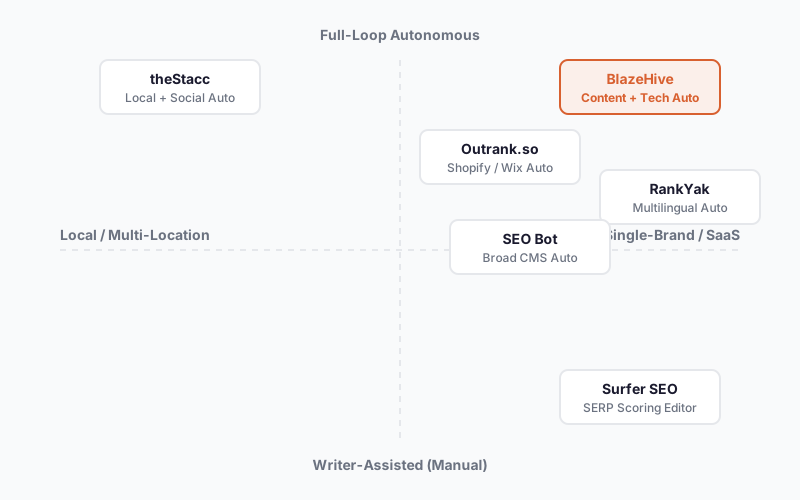
The Best theStacc Alternatives
1. BlazeHive
BlazeHive is an autonomous SEO engine that handles strategy, content production, humanization, technical SEO fixes, backlinks, and performance monitoring in a single $99/month product.
Best for: Indie founders, bootstrappers, and SaaS marketing teams who want agency-quality SEO output without the agency budget - especially teams on WordPress who need technical debt addressed alongside content production. Also fits medium-sized teams and SEO experts who want steerable control through the agentic SEO chat.
Strengths
- Six page types - landing pages, listicles, comparisons, VS pages, FAQs, and interactive tool pages - targeting multiple query intents in one engine
- Humanization validated against 30,000+ documented AI writing patterns before every page ships, reducing AI-detection risk and improving brand voice accuracy
- Live SERP cannibalization detection - keywords are cross-checked against Google in real time, so two pages never compete for the same query
- Technical SEO auto-fixing on WordPress - broken links, redirect chains, heavy pages, and internal linking issues are found and fixed automatically
- Acyclic backlink network - automated contextual backlinks structured to prevent reciprocal exchanges by design, no Google Penguin footprint risk
- Human-monitored growth - GSC integration plus a team that tracks every customer's performance and intervenes if a site stagnates
- 8+ CMS integrations - WordPress, Ghost, Webflow, Framer, Contentful, Storyblok, Strapi, and generic webhook
Where it's not the right fit
- No local SEO module - no Google Business Profile management or GBP post scheduling
- No social media scheduling - Instagram, LinkedIn, X, and Facebook automation requires a separate tool
- Technical SEO auto-fixing is WordPress-only; Webflow and other CMS platforms are "coming soon"
Pricing: $99/month (Complete Engine, all features, no per-seat fees). Done-For-You option: $3,000 one-time setup + $99/month. 3-day free trial, no card required. As of August 2026.
When to choose it: You're a single-brand founder or SaaS team on WordPress who needs content, technical SEO, humanization, and backlinks in one product at $99/month - without paying $200–500/month stacking five separate tools.
2. theStacc
theStacc is an all-in-one platform bundling blog SEO, local SEO, social media scheduling, and review management - designed specifically for multi-location businesses and franchises.
Best for: Multi-location businesses, franchises, and digital agencies that need Google Business Profile management, review automation, and blog SEO handled from a single dashboard.
Strengths
- Local SEO module including Google Business Profile management, GBP post scheduling, and review reply automation - a genuine differentiator at this price
- Social media scheduling to Instagram, LinkedIn, X, and Facebook - bundled at no extra cost
- 30 auto-published SEO articles/month to WordPress, Webflow, or Ghost
- Multi-location and franchise support across 100+ industries
- Managed services tier ($749+/month) for teams who want full agency-level delegation
- Brand voice training from URL or pasted text
Where it's not the right fit
- No technical SEO auto-fixing - broken links, redirect chains, and internal linking issues require a separate tool
- No humanization pass documented - content quality claims rely on internal 9.0/10 scoring, not a public methodology
- Blog articles only - no comparison pages, VS pages, or interactive tool pages for broader SERP coverage
- No mid-tier pricing between $99/month self-service and $749/month managed - a real gap for teams wanting partial help
Pricing: $99/month self-service (30 articles/month, local SEO, social media). Managed services: $749+/month. $1 for 3-day trial. As of August 2026.
When to choose it: You have multiple locations or a franchise and need GBP management, review automation, and social scheduling bundled with blog SEO - all in one platform.
3. Outrank.so
Outrank.so is a keyword-driven blog automation platform that publishes 30 SEO-optimized articles per month directly to your CMS, with a customer-to-customer backlink exchange network.
Best for: Single-brand operators who want high-volume blog publishing across five CMS platforms without needing local SEO or social media.
Strengths
- 30 auto-published articles/month with SERP-aware optimization and keyword-driven generation
- Five CMS integrations - WordPress, Shopify, Notion, Wix, Framer (Webflow in beta as of Q2 2026)
- Scheduled drip publishing - consistent cadence without manual scheduling
- Backlink exchange network - opt-in customer-to-customer linking (though this carries reciprocal exchange risk)
Where it's not the right fit
- No local SEO, GBP management, or social media scheduling
- Backlink exchange network carries reciprocal link risk - customers report discomfort with brand safety implications
- No AI citation tracking for ChatGPT, Perplexity, or Gemini as of July 2026
- No humanization pass - content is AI-generated without a documented de-AI layer
Pricing: $99/month Standard plan (30 articles/month). $1 for 3-day trial. Enterprise custom pricing. As of August 2026.
When to choose it: You want blog-volume automation at $99/month across Shopify or Wix - CMS platforms that BlazeHive and theStacc don't currently support.
4. RankYak
RankYak is a fully automated article-publishing platform that generates and publishes one SEO-optimized article per day, with automated keyword research and 40+ language support.
Best for: Teams that need multilingual SEO content at scale and want daily cadence automation across WordPress, Webflow, or Zapier-connected CMS platforms.
Strengths
- 30 articles/month (1/day) at $99/month flat with automated keyword research and monthly content planning
- 40+ language support - one of the broadest language coverages at this price point
- Multi-site management from one dashboard
- Agency discounts up to 20% at volume for managing multiple client sites
Where it's not the right fit
- 2025 launch with limited track record - ranking results are still unproven compared to established platforms
- No local SEO, social media scheduling, or technical SEO automation
- Brand voice accuracy is unverified; independent reviews note it's newer than proven competitors
- No humanization pass documented; AI detection risk is unknown
Pricing: $99/month flat. 3-day free trial, no card required. As of August 2026.
When to choose it: You need multilingual content automation and don't require local SEO or social media - and you're willing to accept a newer platform's shorter track record for the language breadth.
5. SEO Bot
SEO Bot (formerly Emplibot) is a fully autonomous content platform that starts with just a URL - no configuration required - and has one of the broadest CMS integration sets in the category.
Best for: Non-technical founders who want zero-configuration setup and broad CMS support, including HubSpot, Shopify, Notion, and Wix.
Strengths
- Zero-configuration onboarding - enter your URL, press go, content starts publishing
- 10+ CMS integrations - WordPress, Webflow, Ghost, Shopify, Notion, HubSpot, Unicorn Platform, Framer, Wix, REST API/webhooks
- 50+ language support - broadest language coverage in the category
- Founder dogfooding - built by a founder running it across 11 SaaS projects and 20 directories, with reported 0.6B impressions and 15M clicks across users
Where it's not the right fit
- Starts at $49/month for 10–28 articles/month (credit-based) - lower volume than flat-rate competitors at the same price tier
- No local SEO, social media scheduling, or technical SEO automation
- No backlink network included
Pricing: Starts at $49/month (entry tier). $99/month for higher volume. 3-day free trial, no card required. As of August 2026.
When to choose it: You need broad CMS support (especially HubSpot or Notion) and want the simplest onboarding at a lower starting price.
6. Surfer SEO
Surfer SEO is an AI-assisted content optimization platform that scores and improves content by comparing it against top-ranking SERP pages - built for writers who want optimization guidance, not autonomous publishing.
Best for: In-house content writers and editors who want data-driven on-page optimization without ceding creative control to a fully autonomous agent.
Strengths
- Content scoring against live SERP competitors - direct comparison to what's ranking now
- AI writer with human editing layer - assists rather than replaces the writer
- On-page optimization suggestions - keyword density, heading structure, NLP terms
- Established user base across content agencies and in-house teams, with years of SERP data behind its scoring model
Where it's not the right fit
- No auto-publishing - content must be manually exported and uploaded to your CMS
- Requires a human writer in the loop - not a hands-off automation tool
- No local SEO, social media, backlinks, or technical SEO automation
Pricing: $89–$99/month for Essential tier. Higher tiers for agencies ($249+/month). Freemium available. As of August 2026.
When to choose it: You have a writer on staff and want AI-assisted optimization that improves their work - rather than replacing the writer entirely.
Quick Comparison
| Tool | Best For | Starting Price | Free Tier | Standout Feature |
|---|---|---|---|---|
| BlazeHive | SaaS & indie founder SEO | $99/mo | 3-day trial (no card) | Six page types + technical SEO auto-fix + acyclic backlinks |
| theStacc | Multi-location & franchise SEO | $99/mo | $1 for 3 days | GBP management + social scheduling bundled |
| Outrank.so | Blog automation on Shopify/Wix | $99/mo | $1 for 3 days | Shopify + Wix CMS support |
| RankYak | Multilingual daily article publishing | $99/mo | 3-day trial (no card) | 40+ language support |
| SEO Bot | Zero-config setup, broad CMS | $49/mo | 3-day trial (no card) | 10+ CMS integrations, including HubSpot |
| Surfer SEO | Writer-assisted optimization | $89/mo | Freemium | Live SERP scoring against top-ranking pages |
Pricing as of August 2026. Check each tool's pricing page for current rates.
Which Alternative Should You Choose?
Start here: most people searching
Frequently Asked Questions
What should I look for in a theStacc alternative?
Look for full-loop automation that researches, writes, publishes, and tracks performance without manual steps between stages. Verify that content humanization is documented with a specific mechanism-pattern libraries, live testing, or human review-rather than vague "advanced AI" claims. Check whether the tool cross-checks live SERP data to prevent cannibalization, offers multiple page types beyond blog articles, and includes human monitoring to catch underperforming content.
What makes a good AI SEO automation tool?
A good automation tool combines keyword research, content generation, humanization, publishing, and performance tracking in one workflow without tool-switching overhead. It should prevent cannibalization through live SERP verification, offer diverse page types (comparisons, FAQs, interactive tools, not just blogs) to cover multiple query intents, and include technical SEO fixes alongside content production. Human oversight-GSC tracking plus team intervention when performance stalls-separates proven platforms from ones that ship and forget.
Is theStacc still worth using?
Yes, absolutely-for its original use case. If you have multiple locations, a franchise, or manage Google Business Profiles at scale, theStacc's bundled GBP management, review automation, and social scheduling make it genuinely valuable. If you're a single-brand operator without locations, you're paying for features you won't use while missing technical SEO auto-fixing, humanization, and backlink layers that BlazeHive includes at the same $99/month price point.
Why is BlazeHive on this list of theStacc alternatives?
BlazeHive deserves the top ranking because it solves a fundamentally different problem than theStacc at the same price point. While theStacc optimizes for multi-location workflows, BlazeHive optimizes for indie founders and SaaS teams who need one unified engine-research, writing, humanization, technical SEO fixes, backlinks, and monitoring-without jumping between five tools. For single-brand operators on WordPress, BlazeHive's complete loop beats theStacc's blog-only focus plus the overhead of stacking separate platforms for technical SEO and humanization.
What are the main differences between BlazeHive and Outrank.so?
BlazeHive offers six page types (landing pages, comparisons, FAQs, interactive tools, listicles, VS pages) while Outrank publishes blog articles only, limiting your SERP coverage. BlazeHive includes a documented humanization pass against 30,000+ AI patterns and acyclic backlinks (no reciprocal exchange risk), whereas Outrank uses a customer-to-customer backlink exchange that carries Google Penguin penalty risk. Both publish 30 articles/month at $99/month, but BlazeHive adds human-monitored growth tracking and technical SEO auto-fixing (WordPress only), making it broader for teams seeking compounding returns.
Should I choose RankYak for multilingual SEO content?
RankYak's 40+ language support is genuinely rare at $99/month, making it a strong fit if multilingual content is core to your strategy. However, RankYak is a 2025 launch with limited ranking track record compared to established platforms, and it doesn't include humanization, local SEO, technical SEO auto-fixing, or backlinks. If language breadth is your primary need and you can accept newer platform risk, RankYak works; if you need proven results or bundled technical SEO, BlazeHive or theStacc are safer bets.
Does theStacc alternative SEO Bot require configuration?
No-SEO Bot is zero-configuration. You enter your URL and press go; content starts publishing without setup workflows, making it ideal for non-technical founders who want minimal onboarding friction. SEO Bot also has 10+ CMS integrations including HubSpot and Notion (platforms BlazeHive and theStacc don't currently support) and 50+ language coverage. However, it starts at $49/month for lower volume than flat-rate competitors, and doesn't include humanization, technical SEO fixes, or backlinks.
Can I use Surfer SEO as a hands-off alternative to theStacc?
No-Surfer SEO requires a human writer in the loop. It's an AI-assisted optimization tool that scores content against live SERP competitors and suggests improvements, but the writer must create and upload content manually. If you have a writer on staff and want data-driven optimization guidance, Surfer's $89/month is a smart choice; if you need hands-off automation without a writer, BlazeHive or RankYak eliminate the human dependency entirely.
Which alternative offers technical SEO automation?
BlazeHive is the only platform in this group that auto-fixes technical SEO issues (broken links, redirect chains, heavy pages, internal linking problems)-but it's currently limited to WordPress sites. Other platforms flag technical issues but require manual fixes, or skip technical SEO entirely. If technical debt is leaking your content's authority and you're on WordPress, BlazeHive's auto-fixing meaningfully changes your outcome; if you use Webflow or another CMS, you'll need a separate tool like Alli AI ($249/month).
What's the real pricing comparison between these alternatives?
Most platforms hover around $99/month for 30 articles/month: BlazeHive ($99/month, six page types plus tech SEO and backlinks), theStacc ($99/month, blog plus local SEO and social), Outrank ($99/month, blog only), and RankYak ($99/month, blog only). SEO Bot starts cheaper at $49/month but with lower volume. Surfer SEO ($89/month) is cheaper but requires a writer. As of August 2026, the real differentiation is scope within that $99/month price, not the price itself.
Which alternative is best for indie founders?
BlazeHive is purpose-built for indie founders because it eliminates tool-switching overhead-strategy, writing, humanization, technical SEO, backlinks, and monitoring all in one $99/month engine. You drop a URL; the system researches competitors, identifies keywords, writes pages, fixes your site's technical debt, and tracks whether pages actually rank. theStacc is overkill for single-brand founders (local SEO features you don't need), while Outrank, RankYak, and SEO Bot skip technical SEO and backlinks that compound your content's authority over time.