TL;DR
Slate Alternatives come down to your budget and whether you need a full SEO engine or a content operations layer. BlazeHive is the top pick for indie founders, SMB teams, and medium-sized teams who need a complete autonomous SEO system - keyword research, page production, technical SEO, backlinks, and monitoring - at $99/month. Frase wins for freelancers and small teams doing manual content creation on a tight budget; AirOps wins for mid-market teams running bulk AI content workflows with custom approval chains.
Slate Alternatives
Slate is a solid AI content operations platform: it tracks AI search visibility across ChatGPT, Google AI Overviews, and Perplexity, offers a flexible visual workflow builder, and publishes directly to CMS for mid-market B2B SaaS teams. But $499/month is the floor for real multi-engine tracking, setup takes 2–3 weeks, and the scope doesn't touch technical SEO or backlinks. It's not the right tool for everyone. If you're searching for Slate alternatives, this page maps the landscape honestly - pricing, tradeoffs, and the specific scenario where each tool is the right fit.

Why People Look for Slate Alternatives
Pricing friction is the most common reason. Slate's Solo plan at $199/month caps you at 4,500 prompt answers tracked - useful for early exploration, but most teams quickly discover the Pro plan at $499/month is where the product becomes practical. For a bootstrapped team or indie founder, that's a meaningful budget line for a single tool that still requires separate tools for technical SEO, keyword research, and link building.
Setup overhead is the second recurring issue. Slate requires 2–3 weeks to configure workflows, approval chains, and brand rules before autonomous operation kicks in. Teams that expected to be up and running in a day hit a real onboarding wall. If your content volume is under 20 pieces per month, you may find the governance infrastructure excessive before you ever ship a page.
The third driver is scope mismatch. Slate is built for content operations and AI visibility tracking - it doesn't cover technical SEO audits, broken link fixes, internal link architecture, or organic backlink strategy. Teams that assumed they were buying a complete SEO system discover they still need a separate crawler, a separate link-building tool, and a developer to implement fixes. The more your growth depends on capturing organic search (not just AI citations), the more that gap costs you.
What to Look for in an AI Content Operations Tool
Autonomous execution vs. human-in-the-loop. Some tools produce better outputs when a skilled operator configures and monitors every step. Others run independently once set up. Know which model fits your team size - a one-person operation can't afford to babysit every workflow step.
Pricing transparency and predictability. Task-based billing (common in this category) can be unpredictable at scale. AirOps, for example, charges overage rates estimated at $9 per 1,000 tasks on its Solo plan - that's a number that surprises teams mid-month. Flat-rate pricing is easier to budget.
Scope: content-only or full SEO loop. A content operations tool writes and publishes. An SEO engine also handles keyword research, cannibalization detection, technical debt, and link building. Be clear on which jobs you need handled before signing up - paying for a content ops layer when you need an SEO engine means buying again.
AI search visibility tracking. If your primary goal is getting cited in ChatGPT, Perplexity, or Google AI Overviews, you need direct prompt-tracking and citation analytics - not just organic rank lift. Not all tools provide this; some measure rankings as a proxy instead.
Humanization and content quality. AI-generated content that reads like AI content is a liability - Google's ranking signals and reader behavior both punish it. Look for tools that have a documented quality pass, not just a model with a high temperature setting.
CMS publishing and content ownership. Content that lives on a third-party platform is a dependency. Content that publishes directly to your domain - WordPress, Ghost, Webflow, Contentful - compounds in value under your brand, not the tool's.
Technical SEO coverage. Content that ranks needs a clean technical foundation: no redirect chains, no broken internal links, no overweight pages. Tools that skip this leak the authority their own content builds.
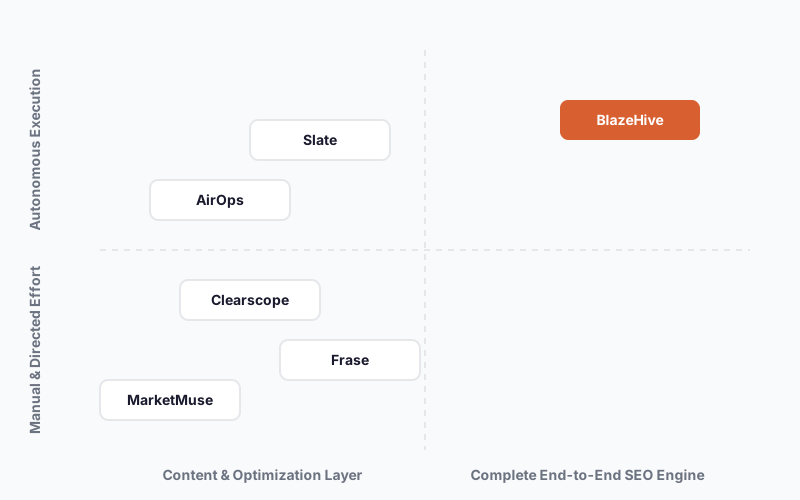
The Best Slate Alternatives
1. BlazeHive
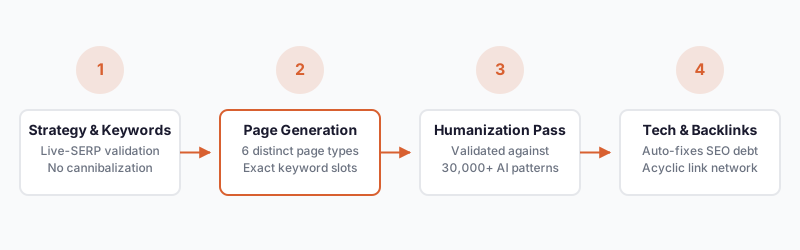
BlazeHive is an autonomous SEO engine that replaces the full agency stack - strategist, writer, designer, developer - with one $99/month platform that runs on autopilot from the day you drop your URL.
Best for: Indie founders, bootstrappers, SMB teams, and medium-sized teams who need a complete SEO system - keyword research through published, ranked pages - without an agency budget or in-house SEO hire. Also fits SEO experts who want steerable control through the agentic SEO chat.
Strengths
- Full-loop autonomy: brand intelligence, bottom-of-funnel keyword research, cannibalization detection, six page types, humanization, technical SEO, backlinks, ranking monitoring, and direct CMS publishing - one engine, no fragments
- Technical SEO auto-fixing: detects and fixes broken links, redirect chains, heavy pages, and internal linking problems on WordPress (other platforms coming)
- Humanization validated against 30,000+ documented AI writing patterns before a page ships - not a style guide, a library
- Acyclic contextual backlink network with per-site pattern avoidance; no reciprocal link exchanges by construction
- Bottom-of-funnel keyword focus: buyer-intent keywords cross-checked against live Google SERPs, with cannibalization detection from Google itself (not similarity heuristics)
- Human-monitored growth: every customer's performance tracked by the team; stagnating sites get intervention
Where it's not the right fit
- No direct LLM citation tracking (no prompt-level ChatGPT/Perplexity/Overviews monitoring) - teams whose primary job-to-be-done is tracking AI citations need a dedicated visibility tool
- Six fixed page types; teams with heterogeneous content needs (whitepapers, product docs, long-form case studies) may find the automation too narrow
- Technical SEO auto-fixing is currently WordPress-only
Pricing: $99/month all-in as of August 2026. 3-day free trial, no card required. Done-For-You option at $3,000 one-time setup + $99/month.
When to choose it: You're a founder, small team, or medium-sized team that needs a complete, hands-off SEO engine - not a content ops layer - at a price that doesn't require a CFO sign-off.
2. Frase
Frase is an AI-powered content creation and SEO optimization platform that combines SERP-driven briefing, AI writing assistance, and internal linking automation in one interface.
Best for: Freelancers, content managers, and small teams who need to produce and optimize individual articles quickly, with hands-on editorial control at every step.
Strengths
- SERP-driven content briefs auto-generated from top-20 results - a real time-saver for individual writers
- Internal linking automation baked in
- AI Search Tracking add-on available for teams that want basic AEO visibility
- Free trial gives 5 full articles before any payment decision
Where it's not the right fit
- AI drafts typically require meaningful manual rewriting; not a set-and-forget engine
- Volume caps (15 articles/month on Starter, 75 on Professional) limit daily content production
- AI Search Tracking is an optional add-on on lower tiers - included at 250 prompts/month only on the $195/month Scale plan
Pricing: Starter $45/month (15 articles); Professional $115/month (75 articles); Scale $195/month as of 2026.
When to choose it: You're a writer or content manager who wants a research and drafting assistant - not an autonomous engine - and you plan to stay in the editorial loop on every piece.
3. AirOps
AirOps is a visual workflow automation platform for mid-market teams running bulk AI content pipelines with custom approval chains.
Best for: Mid-market content teams that need to configure custom multi-step AI workflows, run bulk operations across hundreds of URLs, and enforce brand voice at scale.
Strengths
- Visual workflow builder with 30+ AI model options (GPT, Claude, Gemini, Perplexity Sonar)
- Grids (spreadsheet-style bulk content operations) for high-volume programmatic work
- Answer Engine Visibility tracking for AI citation monitoring
- Brand Kits and Knowledge Bases for brand-consistent AI generation
Where it's not the right fit
- Significant pricing cliff: multi-engine AI visibility tracking is gated behind the $2,000/month Pro plan - not accessible on Solo ($200/month)
- Task-based billing with overage rates estimated at $9 per 1,000 tasks on Solo creates unpredictable monthly costs
- High learning curve; not a day-one-value tool
Pricing: Free (1,000 tasks/month); Solo ~$200/month; Pro ~$2,000/month as of 2026.
When to choose it: Your team needs to run large-scale, customizable AI content workflows with full control over every agent step - and you have the budget and operator time to configure them.
4. Clearscope
Clearscope is a content optimization platform powered by NLP term analysis and real SERP data. It also tracks AI search visibility, which makes it relevant for teams optimizing content for both Google and LLMs.
Best for: SEO teams at established companies who need to optimize existing content libraries for both traditional search and AI answer engines, with a structured editorial workflow.
Strengths
- NLP-driven content reports with term analysis against top-20 SERP results
- AI prompt tracking for LLM visibility alongside traditional SEO metrics
- Content inventory tied directly to Google Search Console data
- Clean, editor-friendly interface with low onboarding friction
Where it's not the right fit
- No CMS publishing; content must be exported and published manually
- LLM visibility features described as useful but not the deepest available - best as a complement to a broader AI search strategy
- Pricing ($129–$399/month) positions it as an enterprise or agency tool; less cost-effective for solo operators
Pricing: Essentials $129/month; Pro $199/month; Business $399/month as of 2026.
When to choose it: Your SEO team is actively optimizing an existing content library and needs authoritative, data-driven scoring for both SERP and AI visibility - and you have a separate publishing workflow already.
5. MarketMuse
MarketMuse is a strategic content planning platform built around topical authority modeling - designed for teams planning large content libraries and multi-quarter topical architecture, not daily tactical production.
Best for: Content strategists at larger organizations who need to map topical authority gaps, prioritize what to write next, and build coherent content architectures across hundreds of topics.
Strengths
- Topical authority scoring and gap analysis across entire domains
- Content inventory analysis and prioritization at scale
- Competitive analysis tied to topic-level authority metrics
- Detailed content briefs with competitive context
Where it's not the right fit
- Pricing moved to quote-based after the Siteimprove acquisition in late 2024; requires a sales conversation to see numbers - significant procurement friction
- Free tier limits you to 10 queries per month, which is not enough to evaluate the tool meaningfully
- Not a production tool; you still need writers, editors, and a publishing system
Pricing: Free (10 queries/month); Optimize ~$99–149/month; Strategy $499/month+ as of 2026. Enterprise pricing requires a sales call.
When to choose it: You're a content strategist or SEO lead who needs to plan topical authority at scale before production - and you have a separate team and toolchain to execute the content itself.
Quick Comparison
| Tool | Best For | Starting Price | Free Tier | Standout Feature |
|---|---|---|---|---|
| BlazeHive | Indie founders needing complete SEO autopilot | $99/mo | No (3-day trial) | Full-loop autonomy: keyword → page → technical SEO → backlinks → publish |
| Frase | Freelancers and small teams creating content manually | $45/mo | 5-article trial | SERP-driven auto-briefing for individual writers |
| AirOps | Mid-market teams running bulk AI content workflows | ~$200/mo | Yes (1,000 tasks) | 30+ AI model workflow builder with bulk Grids |
| Clearscope | SEO teams optimizing existing content for SERPs + AI | $129/mo | No | NLP content scoring tied to live SERP + LLM visibility |
| MarketMuse | Strategists mapping topical authority at scale | ~$99/mo | Yes (10 queries) | Topic authority modeling across entire domains |
Pricing as of August 2026. Check each tool's pricing page for current rates.
Which Alternative Should You Choose?
Most people searching for Slate alternatives are solving one of five specific problems. Here's the honest map.
If you're an indie founder or SMB team that needs hands-off daily SEO output...
BlazeHive is the right tool. Drop a URL; the engine handles keyword research, page production, humanization, technical SEO fixes, backlinks, and CMS publishing for $99/month all-in. No fragments, no agency retainer, no daily babysitting.
If you're a freelance writer or content manager who wants a research and drafting assistant...
Frase is built for that workflow. SERP-driven briefing, AI writing assistance, and internal linking automation at $45/month - with the editorial control you want at every step.
If you're a mid-market team running bulk AI content workflows with custom approval chains...
AirOps is the better fit. Its visual workflow builder, 30+ AI model support, and Grids for bulk programmatic operations are purpose-built for teams that need to configure every step and run at volume. Budget for the ~$2,000/month Pro plan if multi-engine AI visibility tracking is part of the job.
If you're an SEO team optimizing an existing content library for both Google and AI answer engines...
Clearscope is the right optimization layer. NLP content scoring, GSC integration, and AI prompt tracking give your team a clear process for improving what's already published - without needing a separate publishing tool.
If you're a content strategist who needs to plan topical authority before production begins...
MarketMuse is designed for that job. Topical authority modeling, competitive gap analysis, and content prioritization at the domain level - for teams that separate strategy from execution.
Ready to Try BlazeHive?
If you're a founder, small team, or medium-sized team that needs a complete SEO engine - not a content ops layer, not another tool that still requires a human in the loop for every step - BlazeHive is the right fit. Drop your URL and the engine builds your keyword strategy, writes and humanizes pages, fixes your technical debt, and publishes directly to your CMS for $99/month. Start your 3-day free trial at blazehive.io - no card required.
Frequently Asked Questions
What should I look for in a Slate alternative?
Look for autonomy level-some tools require hands-on configuration of every step, others run independently once set up. Pricing transparency matters; task-based billing can surprise you mid-month. Evaluate scope: do you need content-only operations, or a full SEO loop covering keyword research, technical debt, and backlinks? If AI citations drive your business, you need direct LLM visibility tracking, not just organic rank proxies. Finally, check whether content publishes to your domain or lives on the tool's infrastructure-ownership compounds in value over time.
Is Slate still worth using?
Yes, absolutely-for the specific job it was built for. Slate excels at content operations and AI search visibility tracking for mid-market B2B SaaS teams with 20+ content pieces per month and stakeholders who need role-based approvals and brand governance. Its multi-engine citation monitoring across ChatGPT, Perplexity, and Google AI Overviews is legitimately deeper than most alternatives. The friction point is budget and scope: if you're a founder on $500/month or need technical SEO and backlinks, Slate doesn't cover those jobs and you'll buy again.
What makes a good AI content operations tool?
A good tool separates strategy from execution-keyword research and content generation as distinct stages, not one black box. It validates output quality before publishing; generic AI content that reads like AI content is a ranking liability. The tool should publish directly to your CMS under your domain, not trap content on third-party infrastructure. Finally, it needs to measure what matters: for Google traffic, that's organic rankings and clicks; for AI visibility, that's prompt-level citations in ChatGPT and Perplexity, not just similarity scores.
Why is BlazeHive on this list?
BlazeHive solves a specific job that Slate doesn't: autonomous, full-loop SEO for indie founders, SMB teams, and medium-sized teams under $500/month. It's the right fit for teams that can't afford an agency ($8,500+/month), can't hire an in-house SEO specialist, and need ranking + traffic-not just AI citations. The engine closes the entire funnel: keyword research, six page types, humanization, technical SEO auto-fixing, backlinks, and monitoring-all for $99/month. For that specific audience, it's the most complete and cost-effective tool available.
How does BlazeHive differ from Slate on pricing?
BlazeHive is $99/month all-in for the complete system. Slate starts at $199/month (Solo plan) but the Pro plan at $499/month is where multi-engine tracking becomes practical-5x more expensive for a tool that still requires separate solutions for technical SEO, keyword research, and backlinks. For indie founders and bootstrappers, that's a meaningful budget difference. BlazeHive's flat-rate model makes costs predictable; Slate's pricing is transparent but the scope gap means you'll still be paying for other tools alongside it.
What does BlazeHive do that Slate doesn't?
BlazeHive includes technical SEO-it detects and auto-fixes broken links, redirect chains, heavy pages, and internal linking issues on WordPress. It also runs a contextual backlink network engineered as an acyclic graph with no reciprocal exchanges, building organic authority over time. Slate focuses on content operations and AI visibility tracking; it doesn't touch technical debt or link strategy. For teams where ranking velocity matters more than workflow customization, BlazeHive's scope is broader. Slate requires separate crawlers, link-building tools, and developer time to fix the technical foundation BlazeHive handles automatically.
Does BlazeHive track AI search visibility like Slate does?
BlazeHive measures AI impact indirectly through ranking lift and organic traffic growth-if pages rank higher and get more clicks, they're getting more AI exposure. It doesn't offer direct prompt-level tracking of ChatGPT, Perplexity, or Google AI Overviews citations the way Slate does. For teams whose primary job is monitoring LLM visibility and optimizing specifically for AI answer engines, Slate's dedicated visibility layer is stronger. BlazeHive is built for teams optimizing for Google rankings first; AI citations follow as a byproduct.
Which alternative is best for indie founders?
BlazeHive is purpose-built for indie founders. It's $99/month all-in, runs autonomously once configured, and covers the complete SEO loop-keyword strategy through published, ranked pages-without requiring daily babysitting or an agency retainer. You drop a URL, the engine discovers your business and competitors, builds a keyword strategy, writes and humanizes pages, fixes technical debt, and publishes directly to your CMS. For a solo operator who needs compounding organic traffic but can't pause shipping to do SEO manually, BlazeHive's hands-off model is the biggest lever.
Which alternative is best for teams that need workflow customization?
AirOps wins for teams that need highly customizable multi-step AI workflows. Its visual workflow builder supports 30+ AI models and programmatic bulk operations through Grids, letting you configure every agent step and approval chain. Slate also offers customization through its visual workflow builder, but AirOps is more flexible for teams building novel automation sequences. BlazeHive trades customization for simplicity-six fixed page types cover most SMB use cases, but if your content needs are heterogeneous (product docs, whitepapers, case studies), AirOps or Slate's flexibility is better.
Should I use BlazeHive or Frase?
Choose BlazeHive if you need autonomous daily SEO output with no human intervention-keyword research through publishing for $99/month. Choose Frase if you're a writer or content manager who wants a research and drafting assistant and plan to stay in the editorial loop on every piece at $45/month. Frase requires meaningful manual rewriting of AI drafts; BlazeHive aims for hands-off publishing. Frase is better for 15–75 articles per month with editorial control; BlazeHive is better for unlimited daily output on autopilot.
What's the difference between BlazeHive and Clearscope?
BlazeHive is a full-loop SEO engine: it researches keywords, generates pages, fixes technical debt, and publishes autonomously. Clearscope is an optimization layer-it scores and improves existing content against SERP and AI visibility metrics, but doesn't publish. BlazeHive assumes you're starting from zero and need hands-off production; Clearscope assumes you already have content and need to optimize it. Use Clearscope if you have a content library to improve; use BlazeHive if you need to build one from scratch without hiring writers or an agency.
Is there a free Slate alternative?
AirOps offers a free tier with 1,000 tasks/month, which is enough to explore basic workflow automation-but multi-engine AI visibility tracking requires the $2,000/month Pro plan. Frase offers a 5-article free trial before any payment. MarketMuse gives 10 queries/month free, enough to understand the tool but not to evaluate it meaningfully. BlazeHive offers a 3-day free trial with no card required, covering the full autonomous SEO engine. Free tiers in this category are exploration tools; serious production requires paid plans on all of them.