TL;DR
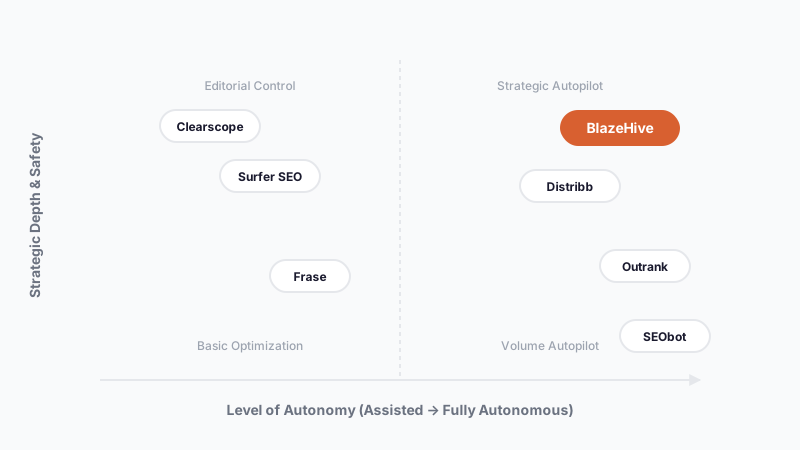
SEObot alternatives come down to how much autonomy you need and what kind of content you're building: BlazeHive is the top pick for founders who want a full autonomous SEO engine - keyword strategy, six page types, technical auto-fixing, and human monitoring - all at $99/month with no usage caps. Outrank.so wins for teams that want backlinks bundled in at the same price point. Surfer SEO wins for in-house content teams who want editorial control over every word.

SEObot Alternatives
SEObot is a capable autonomous article machine - it's popular for a reason. Drop a site, get daily long-form articles, auto-published to your CMS. But SEObot is built around one content shape: the ~3,000-word article. When teams hit the limits of that approach - price scaling, strategic depth, technical SEO gaps, or the need to rank in AI answer engines - they start looking around. This page maps the best alternatives honestly, so you can find the right fit for your situation.
Why People Look for SEObot Alternatives
The most common trigger is pricing math. SEObot's entry tier is $49/month for 9 articles - that's $5.44 per article. At the $99/month tier (20 articles), the per-article cost is $4.95. Reviewers consistently flag that "$200+ monthly pricing puts it out of reach for most solopreneurs," and at scale, you're paying $1,050/month to get to the $3.50/article rate. For founders running lean, that ceiling comes up fast.
The second trigger is strategic depth. SEObot publishes articles. It doesn't decide whether those articles target buyer-intent or vanity keywords. It doesn't detect when two articles are starting to compete for the same query. Users in competitive niches report that the "automated approach lacks the nuanced expertise" needed to actually move rankings - content is going out, but organic traffic isn't compounding the way it should.
The third trigger is scope. As teams mature in their SEO, they realize article generation is only part of the job. Technical SEO debt leaks authority. Internal linking breaks down. There's no backlink strategy. AI answer engines (ChatGPT, Perplexity) need specific content formats - comparisons, FAQs, listicles - not just articles. SEObot doesn't address any of that. Users who've grown past "just publish more content" end up searching for something with more coverage.
What to Look for in an Autonomous SEO Tool
Keyword strategy depth. A tool that picks keywords by volume alone will send you up the wrong hill. Look for buyer-intent targeting - "X vs Y," "X pricing," "X alternatives" - and live SERP cannibalization detection so two of your pages never fight each other for the same query. The source of truth should be Google itself, not a similarity heuristic.
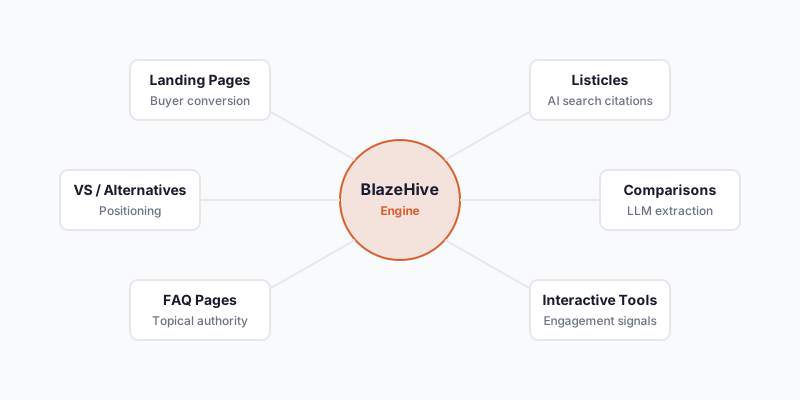
Page type diversity. Long-form articles cover one lane. Landing pages convert buyers. Comparison pages and listicles get cited by ChatGPT and Perplexity. FAQ pages build topical authority across nested People-Also-Ask clusters. Interactive tools keep visitors on-page and raise engagement signals. A tool that only writes articles is leaving most of the funnel uncovered.
Technical SEO handling. Content and authority compound only if the domain is clean. Broken links, redirect chains, thin internal linking, and heavy pages bleed the authority your content builds. Most autonomous tools are silent on this. Find out whether the tool finds and fixes technical issues - or just points at them.
Backlink safety. Backlinks are a ranking factor, but backlink exchange networks carry reciprocal risk. Google's Link Scheme Guidelines flag reciprocal exchanges. If a tool bundles backlinks, ask how the links are structured and whether there's any footprint protection built in.
Humanization validation. AI-sounding content is a real ranking risk post the March 2024 Helpful Content Update. Look for explicit de-AI validation, not just "GPT-4 powered" copy. A tool that checks output against known AI writing patterns before publishing is categorically different from one that doesn't.
Monitoring and intervention. Autonomous publishing without monitoring is a fire-and-forget machine, not a growth engine. GSC integration, ranking tracking, and a team that intervenes when a site stagnates make the difference between a tool and a service.
Pricing transparency. Hidden tier ceilings erode trust. Understand what "entry price" actually covers and where you'll need to upgrade. All-in pricing with no per-seat fees or usage add-ons is a real advantage for founders who hate bill surprises.
The Best SEObot Alternatives
1. BlazeHive
BlazeHive is an autonomous SEO engine that handles the entire loop - brand intelligence, keyword strategy, page generation across six content types, humanization, technical SEO, backlinks, and GSC-monitored growth - for $99/month flat.
Best for: Indie founders, bootstrapped SaaS teams, and agencies who need agency-quality SEO output on autopilot without the agency budget or an in-house hire. Also fits medium-sized teams and SEO experts who want steerable control through the agentic SEO chat.
Strengths
- Six page types (landing pages, listicles, comparisons, FAQ, interactive tools, alternatives/VS pages) - not just articles
- Bottom-of-funnel keyword strategy with live SERP cannibalization detection grounded in actual Google data
- Technical SEO auto-fixing on WordPress (broken links, redirect chains, internal linking) - no other autonomous SEO tool does this
- Humanization validated against 30,000+ documented AI writing patterns before any page ships
- Acyclic backlink network - no two sites ever exchange links; no reciprocal footprint by design
- Human monitoring: GSC integration + team intervention if rankings stagnate
- $99/month all-in - no per-seat fees, no usage add-ons, 3-day free trial (no card required)
Where it's not the right fit
- Technical SEO auto-fixing is WordPress-only as of August 2026; other CMS platforms are coming soon
- If you need 300 commodity location pages per month, SEObot's $3.50/article at enterprise scale is more economical for pure volume
Pricing: $99/month all-in as of August 2026. Free tier: No. 3-day free trial, no card required.
When to choose it: You're a founder, small team, or medium-sized team who needs compounding organic traffic without a strategist, writer, designer, and dev - and you want one engine that covers keyword strategy, content production, technical cleanup, and monitoring without adding headcount.
2. Outrank.so
Outrank.so is a fully autonomous content platform that ships 30 AI articles per month at $99 with a bundled backlink exchange network and explicit Generative Engine Optimization (GEO) positioning for AI answer engines.
Best for: Founders who want articles + backlinks + publishing in one place at $99/month without assembling separate tools.
Strengths
- 30 articles/month at $3.30/article - better per-article economics than SEObot at the same price point
- Bundled backlink exchange network (included, not an add-on)
- Explicit GEO optimization for ChatGPT, Perplexity, and Google AI Overviews
- 4.6/5 stars on G2 for ease of use and automation
- 30-day automated content calendar with minimal weekly input required
Where it's not the right fit
- Backlink exchange model is reciprocal - this puts it in a gray zone under Google's Link Scheme Guidelines; not a design-safe choice for risk-averse operators
- Article-focused; no landing page or interactive tool types
- Limited transparency into keyword strategy logic; "guided" rather than fully steerable
Pricing: $99/month (Standard) as of August 2026. Free tier: No. $1 trial for 3 days.
When to choose it: You want autonomous articles + backlinks bundled at $99/month and are comfortable with a backlink exchange model. Speed matters more than safety architecture.
3. Surfer SEO
Surfer SEO grades your content against top-ranking SERP pages and gives detailed NLP-based recommendations. There's an AI writing add-on for teams that want generation too, but optimization is the core product.
Best for: In-house content teams with writers who want precision SERP grading, editorial control, and detailed on-page guidance before publishing.
Strengths
- Content Editor is the most detailed SERP-based optimization tool in this comparison - it gets consistently strong reviews in SEO communities
- Keyword Research Tool included on all plans (unlimited)
- NLP-based content grading with real-time scoring as you write
- Google Docs and WordPress integration
- Annual billing drops Essential to $79/month ($948/year)
Where it's not the right fit
- Not autonomous - you (or your writer) must produce the draft; Surfer optimizes it, it doesn't write it
- AI article generation is a paid add-on ($19/article via Surfer AI) - expensive at scale
- No publishing pipeline, no backlinks, no technical SEO fixes
Pricing: $99/month (Essential) as of August 2026. Scale AI (30 AI articles): $219/month. Free tier: No.
When to choose it: You have an in-house writer or agency relationship and want the best SERP grading tool to optimize what your team produces. Not the right fit if you need autonomous generation.
4. Frase
Frase is an AI content research and brief-generation tool - it produces SEO briefs from keywords in seconds and layers real-time optimization scoring as you draft.
Best for: Solo bloggers, affiliate marketers, and content writers who want faster keyword research and brief generation without paying for a full autonomous platform.
Strengths
- Lowest entry price in this cohort: $15/month (Solo, 10 docs) or $45/month (Basic, 30 docs)
- Brief generation in seconds - SERP analysis, topic modeling, competitor summaries
- Unlimited AI words on paid plans
- Free trial with 1 SEO doc and 2,500 AI words
Where it's not the right fit
- Not autonomous - requires manual drafting, editing, and CMS publishing; Frase assists, it doesn't publish
- No backlink acquisition
- No technical SEO features
- Post-generation editing is required; AI output needs meaningful human polish before publishing
Pricing: $15/month (Solo) to $195/month (Team+) as of August 2026. Free tier: Yes (1 doc, 2,500 AI words).
When to choose it: You're a solo blogger or affiliate marketer with strong writing skills who wants dramatically faster research and brief creation - and you're comfortable doing the drafting and publishing yourself.
5. Clearscope
Clearscope is a content optimization platform built for SEO teams and agencies - NLP-based keyword accuracy, content inventory tied to GSC, and unlimited users across all tiers.
Best for: Large content teams and agencies that need precision optimization scoring, content inventory management, and team-wide access without per-seat pricing.
Strengths
- Unlimited users on all plans - Essentials ($129/month) seats an entire department
- Content Inventory ties page performance to Google Search Console data
- NLP-based content reports are highly accurate for intent-driven keyword targeting
- Topic Explorations add a research depth layer most tools skip
- Consistent positive reviews for accuracy in SEO communities
Where it's not the right fit
- $129/month entry is the highest in this cohort - less accessible for solopreneurs or small teams
- No autonomous generation; optimization only - requires an existing draft to grade
- No CMS integration for publishing; content exports manually
- No backlinks, no technical SEO
Pricing: $129/month (Essentials) to $399/month (Business) as of August 2026. Free tier: No.
When to choose it: You run a content team of 5+ people who all need access to SEO scoring tools, and precision optimization (not generation) is your primary workflow. Not built for autonomous publishing.
6. Distribb
Distribb is an autonomous AI SEO platform focused on content depth - 4,000–5,000 word articles with cited original research, backlink outreach + exchange, and visibility in both Google and AI answer engines. It sits between SEObot's volume approach and BlazeHive's strategy depth.
Best for: Founders who want longer, more authoritative AI-generated articles with backlinks included, and are comfortable with a slightly higher price point than SEObot.
Strengths
- Longer content (4,000–5,000 words) with original research citations - stronger authority signals
- Backlink exchange + outreach + real business partnership links
- Programmatic SEO support (location pages, category pages)
- Targets both Google rankings and AI chat answer visibility
Where it's not the right fit
- Backlink exchange model carries reciprocal risk (same concern as Outrank)
- Less established track record than SEObot or Outrank; fewer public reviews
- Article-focused; no landing page, interactive tool, or FAQ-specific page types
Pricing: ~$97/month (Pro, 30 articles) as of August 2026. Free tier: No.
When to choose it: You want longer-form, more authoritative autonomous articles with backlinks included, and content depth matters more than page type variety.
Quick Comparison
| Tool | Best For | Starting Price | Free Tier | Standout Feature |
|---|---|---|---|---|
| BlazeHive | Founders wanting full-stack autonomous SEO | $99/mo | No (3-day trial) | Technical SEO auto-fixing + 6 page types |
| Outrank.so | Bundled articles + backlinks at $99 | $99/mo | No ($1 trial) | Backlinks included + GEO positioning |
| Surfer SEO | In-house teams needing SERP optimization | $99/mo | No | NLP-based SERP content grading |
| Frase | Solo bloggers wanting fast research briefs | $15/mo | Yes (1 doc) | Brief generation in seconds |
| Clearscope | Large content teams, unlimited users | $129/mo | No | Unlimited users on every tier |
| Distribb | Longer authoritative articles + backlinks | ~$97/mo | No | 4,000–5,000 word articles with citations |
Pricing as of August 2026. Check each tool's pricing page for current rates.
Which Alternative Should You Choose?
The most common case is a founder or small SaaS team who needs consistent organic traffic but can't pause shipping to do SEO daily.
If you need full autonomous SEO with strategy + technical fixes...
BlazeHive is the answer. At $99/month you get keyword research grounded in live SERP data, six page types targeting every funnel stage, WordPress technical SEO auto-fixing, humanization against 30,000+ AI patterns, and a team watching your rankings. No other tool at this price point covers the full loop.
If you want autonomous articles and bundled backlinks at $99...
Outrank.so is a solid option. Thirty articles per month at $3.30/article with backlinks and GEO optimization built in. Know going in that the backlink exchange model is reciprocal - gray zone per Google's guidelines.
If you have in-house writers and want precision optimization...
Surfer SEO is the right call here. Its Content Editor gives your writers the most detailed SERP analysis in this comparison, and it's well-regarded in SEO communities for good reason. Use it if you're optimizing drafts, not generating them.
If you're a solo blogger on a tight budget who will do the writing yourself...
Frase at $15–$45/month gives you research speed and brief generation without paying for autonomy you don't need. The gap is that you're doing the drafting and publishing manually - but for a writer who just wants faster research, that tradeoff is fair.
If you run a large content team and need everyone on the same optimization tool...
Clearscope with unlimited users across all tiers is the call. The $399/month Business plan for an unlimited team is hard to beat if optimization (not generation) is your workflow.
If you want longer, more authoritative autonomous articles with outreach-based backlinks...
Distribb at ~$97/month targets content depth over content volume, with cited original research and backlink outreach - worth evaluating if authority signaling matters more than page type variety.
Ready to Try BlazeHive?
If you're a founder, small team, or medium-sized team who needs compounding organic traffic without a strategist on payroll, BlazeHive covers the full loop - bottom-of-funnel keyword strategy, six page types, technical SEO auto-fixing on WordPress, humanization against 30,000+ AI patterns, and human monitoring, all at $99/month. Start the 3-day free trial - no card required - and the engine crawls your site and starts building your strategy the same day.
Frequently Asked Questions
What should I look for in a SEObot alternative?
Prioritize keyword strategy depth targeting buyer-intent keywords, not just volume; live SERP cannibalization detection so your pages don't compete with each other; and page type diversity beyond articles-landing pages, comparisons, FAQ, and interactive tools hit different funnel stages. Technical SEO handling, backlink safety, humanization validation, GSC monitoring, and pricing transparency separate platforms that compound authority from ones that just publish content. The source of truth for keyword decisions should be Google itself, not similarity heuristics.
Why do teams leave SEObot?
The most common trigger is pricing: at $99/month, SEObot covers only 20 articles ($4.95 each), and scaling to $1,050/month gets you just $3.50 per article-a ceiling hits fast for lean founders. Second, SEObot lacks strategic depth; it publishes articles without determining whether they target buyer-intent or vanity keywords, leading to content that doesn't drive conversions. Third, scope: as teams mature, they realize autonomous article generation alone doesn't fix broken links, internal linking, technical debt, or the need to rank in AI answer engines-each requiring different content formats SEObot doesn't provide.
What makes a good autonomous SEO platform?
A good autonomous SEO platform must cover the entire loop: brand intelligence, keyword research grounded in live SERP data, multi-format content generation, technical SEO issue detection and fixing, backlink acquisition, and GSC-based performance monitoring with human intervention when rankings stagnate. BlazeHive exemplifies this-it generates six page types targeting every funnel stage, auto-fixes broken links and internal linking on WordPress, validates content against 30,000+ AI writing patterns, and maintains an acyclic backlink network (safe by design) while tracking every customer's rankings. A tool that only writes articles or only optimizes drafts is solving half the problem; the compounding authority comes from the full pipeline working together.
Is BlazeHive's $99 per month price really all-in?
Yes-$99/month covers keyword research, all six page types, humanization validation, technical SEO analysis (auto-fixing on WordPress), backlink acquisition, CMS publishing, and GSC monitoring, with no per-seat fees, usage caps, or hidden upgrade tiers. There are no surprise charges; you're not upgrading mid-trial or discovering your plan tier is inadequate. The only paid add-on is Done For You ($3,000 setup + $99/month), which includes direct team access and architectural consulting-optional for teams who want hands-on technical SEO configuration.
How does BlazeHive's technical SEO auto-fixing compare to competitors?
BlazeHive is the only autonomous SEO platform that auto-fixes technical issues on WordPress-broken links, redirect chains, heavy pages, and internal linking problems are found and fixed automatically before publishing. Competitors like SEObot, Outrank, Surfer, and Frase either don't address technical SEO at all or only audit and report issues, leaving the fix to you. This matters because content authority compounds only if the domain is clean; every broken link and poor internal link structure bleeds the authority your published content builds, so BlazeHive's automated fixing means pages strengthen your domain instead of sitting isolated. WordPress-only as of August 2026; other platforms coming soon.
Does BlazeHive do keyword research better than SEObot?
BlazeHive's keyword research is built on bottom-of-funnel buyer-intent targeting-'best X,' 'X vs Y,' 'X pricing,' 'X alternatives'-cross-checked against live Google SERPs to prevent cannibalization. SEObot uses volume-based keyword selection, which can send you up the wrong hill; two SEObot articles may compete for the same query because the tool doesn't detect conflicts, diluting your authority. BlazeHive's live SERP cross-checking is the source of truth (Google itself, not a similarity heuristic), so you never publish two pages fighting for the same ranking-a critical difference for founders building positioning, not just traffic volume.
Can I use BlazeHive with platforms other than WordPress?
Yes-BlazeHive publishes to WordPress, Ghost, Webflow, Framer, Contentful, Storyblok, Strapi, and generic webhooks, so CMS choice is not a blocker. The technical SEO auto-fixing (broken links, redirect chains, internal linking) is WordPress-only as of August 2026, with other platforms coming soon; for non-WordPress sites, you get keyword research, content generation, humanization, and backlinks, but manual technical fixes. This is an honest limitation: if WordPress auto-fixing is critical to your decision, confirm the timeline with the team before committing.
How does BlazeHive's backlink strategy compare to Outrank's?
BlazeHive's backlink network is acyclic with per-website pattern avoidance-no two sites ever exchange links, eliminating reciprocal footprint by design and keeping you safe under Google's Link Scheme Guidelines. Outrank's backlinks use an exchange model (you link to others, they link to you), which is transparent but technically falls in a gray zone per Google's guidelines; reciprocal exchanges can trigger manual review if detected. BlazeHive's acyclic design is a deliberate safety choice; Outrank's exchange is simpler to set up but carries more risk. Both cost $99/month, so the tradeoff is speed-to-links (Outrank) vs. long-term safety (BlazeHive).
What is BlazeHive's humanization validation and why does it matter?
Every BlazeHive page passes a de-AI validation checked against 30,000+ documented AI writing patterns before publishing, ensuring content doesn't sound like AI to Google or readers. Post the March 2024 Helpful Content Update, AI-sounding content is a real ranking risk; competitors don't explicitly validate this step, so their output can trigger detection and ranking penalties. BlazeHive's explicit de-AI pass removes that risk, giving founders confidence that generated content ranks and doesn't get flagged as low-quality AI writing by Google's algorithms.
How does BlazeHive's human monitoring differ from other autonomous platforms?
BlazeHive integrates Google Search Console, tracks every customer's rankings, and intervenes if a site stagnates-you're not alone watching your dashboards. Most competitors ship autonomous output assuming you'll monitor GSC yourself; BlazeHive's team actively watches performance. This difference transforms the product from a 'fire-and-forget tool' to a 'service wrapped in software'-at $99/month, you get not just content generation but human oversight ensuring your SEO is compounding.
Should I switch from Surfer SEO to BlazeHive?
Only if you're tired of manual drafting and want autonomous generation instead; Surfer is the strongest SERP grading tool in this comparison and wins for in-house content teams with writers who value editorial control. If your workflow is 'write a draft, then optimize it with Surfer,' switching to BlazeHive means losing that precision optimization-BlazeHive generates and publishes autonomously but offers less granular editorial control. The trade-off is clear: Surfer = optimization-led, human-powered. BlazeHive = autonomous generation, human-monitored. Acknowledge the mismatch; don't position BlazeHive as a universal upgrade from Surfer.
Is SEObot still worth using after considering alternatives?
Yes-for its original use case. SEObot is best for affiliates and e-commerce brands needing high-volume commodity pages (location pages, product variations) where per-article cost matters; at 300+ articles per month, SEObot's $3.50/article enterprise rate is more economical than BlazeHive's $99/month flat fee applied to six mixed page types. SEObot's scaling is strong for volume plays; it just doesn't suit founders building positioning or teams needing strategy depth, technical SEO fixes, or AI answer engine optimization-the cases where switching to BlazeHive makes sense.
What is the difference between BlazeHive and Frase?
Frase is a research and brief-generation tool you use to draft content faster; BlazeHive is an autonomous publishing engine that researches, writes, humanizes, validates, publishes, fixes technical issues, and monitors rankings without you touching it. Frase costs $15–$45/month for a solo writer who wants faster research; BlazeHive costs $99/month for full autonomy including publishing, backlinks, and GSC monitoring. If you have strong writing skills and want dramatic research speed, Frase is defensible; if you want autonomy and hate manual CMS uploads, BlazeHive is the fit.
Can BlazeHive generate multiple page types on the same topic?
Yes-BlazeHive's six page types (landing pages, listicles, comparisons, FAQ, interactive tools, alternatives/VS pages) let you target one topic from multiple angles, each optimized for a different buyer journey stage or search intent. This is a core BlazeHive advantage: one keyword cluster becomes a landing page for qualified buyers, a comparison for research-phase searchers, and a FAQ for question-based intent-each reinforcing the others through internal linking and building topical authority faster than single-format tools. SEObot generates only articles, so you're missing these funnel stages entirely.
How does BlazeHive help with AI answer engine rankings?
BlazeHive optimizes specifically for Generative Engine Optimization (GEO) via listicles, comparisons, and FAQ pages-the formats ChatGPT, Perplexity, and Google AI Overviews prefer to extract citations from. Most competitors (SEObot, Outrank, Surfer) focus on Google SERP rankings; BlazeHive builds pages designed to be cited by AI systems, recognizing that the zero-click world now includes LLM answers. This positions your brand for both traditional Google rankings and AI answer engine visibility-the full modern search landscape.