TL;DR
RankYak Alternatives come down to your workflow: BlazeHive is the top pick for founders and agencies who need bottom-of-funnel pages that rank and convert - not just daily article volume - with live SERP cannibalization detection, technical SEO auto-fixing on WordPress, and human-monitored growth at $99/month. Outrank.so wins for teams who want high-volume long-form content with a low-friction $1 trial. Frizerly wins for solo creators on a budget who need simple WordPress autoblogging at $29/month annually.
RankYak Alternatives
RankYak Alternatives come down to a simple question: do you need more daily articles, or do you need pages that actually convert buyers? RankYak is a real product with real results - hundreds of customers, a working autopilot loop, and 40+ language support make it a legitimate choice for teams who want consistent article volume. But "article per day" and "bottom-of-funnel ranking" aren't the same thing, and the users who end up searching for alternatives have usually figured that out the hard way. This page maps the best alternatives to the workflows they actually serve.

Why People Look for RankYak Alternatives
The most common reason users leave RankYak - or start evaluating it more critically - is a conversion problem. The daily articles go out. Traffic ticks up. But it's top-of-funnel traffic: browsers, not buyers. RankYak targets keywords that pull volume; BlazeHive and others explicitly prioritize buyer-intent queries. That distinction doesn't show up in a dashboard until you notice the gap between clicks and signups.
A second recurring friction point is the audit-but-don't-fix problem. RankYak's weekly audit identifies weak titles, poor meta descriptions, and CTR gaps - useful signals. But for non-RankYak pages, the fix is manual copy-paste into your CMS. There's no agent that reaches into WordPress, repairs broken redirect chains, or patches internal-linking gaps automatically. For a site with technical debt, that hands everything back to you.
A third signal: VRID.ai's review noted that RankYak had zero verified user reviews on G2 as of their analysis, runs on a two-person team, and publishes no public before-and-after ranking data beyond internal case studies. That doesn't mean the product doesn't work - the team published their own honest alternatives article, which earns credibility - but it does mean buyers with limited tolerance for unverified claims end up keeping their options open.
What to Look for in an SEO Autopilot Tool
Any tool can publish daily articles. The harder question is whether those articles target queries that buyers type when they're ready to decide - comparisons, alternatives pages, VS pages, feature-specific landing pages. If a tool defaults to broad category content, you'll get traffic that never converts.
Cannibalization detection matters more than most people realize. When two of your own pages compete for the same query, neither ranks well. Most tools use similarity heuristics to detect this. The more reliable method - used by BlazeHive - is live Google SERP cross-checking: the verdict comes from Google itself, not an ML estimate.
Content authority leaks through technical issues: broken links, redirect chains, slow pages, thin internal linking. A tool that publishes 100 pages on a site full of technical debt is building a house on sand. Auto-fixing matters - and it's rare.
"AI-sounding content" is a real penalty with readers and increasingly with ranking systems. Look for tools that describe how they de-AI content, not just that they do. A specific library size (30,000+ documented patterns, for example) is more credible than "natural language."
Your CMS is your CMS. A tool locked to WordPress and Shopify forces a platform decision you shouldn't have to make. Check the integration list before you commit - Ghost, Webflow, Framer, Contentful, Storyblok, Strapi, and webhook support matter for modern stacks.
Exchange networks are common but carry reciprocal link risk. If a tool doesn't explain how it avoids reciprocal footprints, assume it doesn't. Pattern-avoidant, acyclic backlink graphs are the safer architecture.
Full autopilot sounds ideal until traffic stagnates and you don't know why. Tools that pair automation with human monitoring - teams that actively check performance and intervene on stagnating sites - give you a safety net that pure automation can't.
The Best RankYak Alternatives
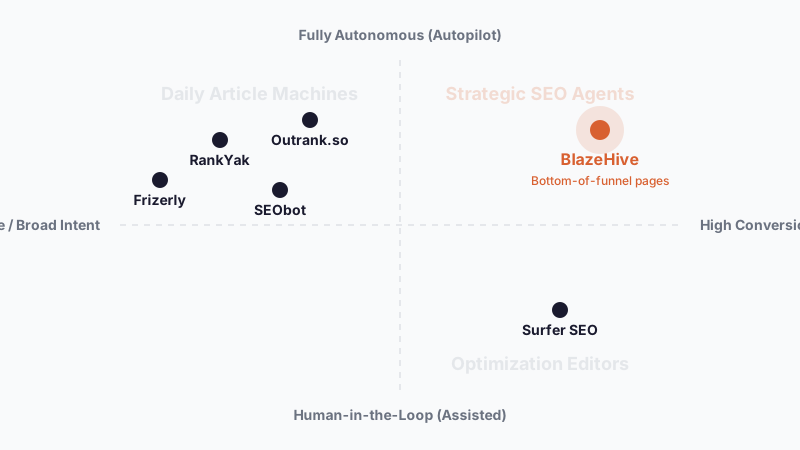
1. BlazeHive
BlazeHive is an autonomous SEO engine built for bottom-of-funnel keyword strategy and AI search visibility, replacing the strategist + writer + designer + dev stack with one $99/month engine.
Best for: Indie founders, bootstrapped SaaS teams, and agencies who need buyer-intent pages - comparisons, landing pages, FAQs, interactive tools - not daily article churn. Also fits medium-sized teams and SEO experts who want steerable control through the agentic SEO chat.
Strengths
- Six page types including interactive tool pages (engagement signals that compound authority) and conversion-optimized landing pages - not just blog articles
- Live Google SERP cannibalization detection: verdicts come from Google, not heuristics
- Humanization validated against 30,000+ documented AI writing patterns before every publish
- Technical SEO auto-fixing on WordPress: broken links, redirect chains, internal-linking leaks, heavy pages - handled by an agent
- Acyclic backlink network with per-site pattern avoidance: no reciprocal link exchanges by design
- Human monitoring: every customer's performance is tracked; stagnating sites get team intervention
- Publishes to 8+ CMS platforms: WordPress, Ghost, Webflow, Framer, Contentful, Storyblok, Strapi, webhooks
- Steerable AI chat agent for keyword research, planning, and analysis on demand
- Google Search Console integration for source-of-truth rankings and clicks
Where it's not the right fit
- Technical SEO auto-fixing is WordPress-only; other platforms are coming soon, not available now
- Not the volume play - if you need 30+ articles per month for a brand-new site, RankYak or Frizerly serve that better
- No explicit local SEO or Google Business Profile optimization
Pricing: $99/month all-in (as of August 2026). 3-day free trial, no card required. Done-For-You setup available at $3,000 one-time + $99/month.
When to choose it: You've already burned money on high-volume, low-conversion content and want strategic depth - bottom-of-funnel pages that rank for buyer queries, not browser queries. Especially strong for WordPress sites needing auto-fixed technical SEO.
2. RankYak
RankYak is a full-stack SEO autopilot that runs keyword discovery → content planning → daily article generation → publishing → backlink exchange → weekly audits in one unattended loop.
Best for: Teams who need consistent daily article output, multi-language publishing (40+ languages), or an established backlink exchange network without cold outreach.
Strengths
- Full autopilot mode: the entire loop runs unattended from research to publish
- 40+ language support - a genuine advantage for agencies serving non-English markets
- MCP server integration: works with Claude, Cursor, or any MCP client
- Automated backlink exchange network (no cold outreach required)
- Cannibalization audit: identifies competing pages, designates a winner, and produces a redirect list
- Copilot assistant for plain-language product changes
- Free tools included: Robots.txt Tester, Broken Link Checker, Schema Generator, Keyword Clustering
Where it's not the right fit
- Site audit fixes for non-RankYak pages require manual copy-paste - no agent auto-fixes technical issues
- Audit is CTR/title/description focused, not a full positional rank tracking dashboard
- Third-party review coverage is thin - zero verified G2 reviews noted as of mid-2026; pricing ambiguity across pages ($49 vs. $99) creates buyer confusion
Pricing: $99/month flat (as of 2026; a $49 entry tier is referenced on some pages but not clearly documented). 3-day free trial, no card required.
When to choose it: You're building a new site and need daily indexed content fast, serve multilingual audiences, or want a backlink network that runs entirely without cold outreach.
3. Outrank.so
Outrank.so is an automated blog SEO platform that bundles keyword research, long-form article creation (up to 3,000 words), publishing, AI images, and a backlink exchange into one subscription.
Best for: Solopreneurs, SaaS founders, and e-commerce operators who want high-volume long-form content and an easy way to test before committing.
Strengths
- Generates articles up to 3,000 words - longer than most autopilot competitors
- $1 for 3-day full trial - the lowest barrier to entry in this list
- G2 rating: 4.6/5
- Unlimited AI rewrites; brand voice customization
- 24/7 support
- Multi-user collaboration
Where it's not the right fit
- No local SEO layer - location-based businesses will hit a ceiling
- Backlink tracking opacity cited in user reviews; the exchange network is present but not transparently reported
- Per-article cost scales up at volume: $3.30/article at the 30-article baseline tier
Pricing: $99/month (30 articles), $149/month (60 articles), $199/month (90 articles). $1 for 3-day trial (as of 2026).
When to choose it: You want to test an autopilot SEO platform with minimal commitment and need long-form comprehensive guides rather than strategic conversion pages.
4. SEObot
SEObot is a fully autonomous SEO robot built by founder John Rush to power his own 11 SaaS projects and 20 directories - a product with genuine dogfooding credibility.
Best for: Founders managing multiple projects simultaneously who want a community-driven tool with strong founder responsiveness.
Strengths
- 200,000+ articles generated across the platform; 1.2 billion impressions driven
- Founder-led with high community engagement (CEO reads all DMs, responds to feedback)
- Designed specifically for founders running multiple sites at once
- Interactive SEO tools included
Where it's not the right fit
- CMS integrations, backlink strategy, and technical SEO features aren't well-documented publicly
- Early-stage feel: weekly releases and bug fixes mean infrastructure is still maturing
- Lacks the page-type breadth (landing pages, interactive tools, comparisons) that conversion-focused teams need
Pricing: Starting at $49/month (as of 2026; exact tier breakdown not fully public).
When to choose it: You're a founder with multiple SaaS projects or directories and want a lower-cost autonomous content engine with a responsive founder community behind it.
5. Frizerly
Frizerly is an autoblogging tool for WordPress and Shopify that automates daily publishing with AI-generated, SEO-optimized content - the budget-friendly option in this category.
Best for: Solo creators, small business owners, and Shopify merchants who need volume on a tight budget and primarily operate on WordPress.
Strengths
- $29/month on annual billing - 70% cheaper than BlazeHive or RankYak
- 30+ articles per month capability
- Local SEO features including Google Business Profile post support
- AI visibility optimization for ChatGPT, Gemini, and Perplexity
- Schema markup and technical SEO basics included
Where it's not the right fit
- WordPress and Shopify only - not built for Ghost, Webflow, Framer, or Contentful stacks
- Limited backlink building compared to RankYak or BlazeHive
- No bottom-of-funnel page types: defaults to blog articles, not comparison pages or landing pages
- Not designed for agencies managing multiple high-authority sites or teams needing deep editorial control
Pricing: $49/month monthly, $29/month billed annually (as of 2026). 3-day free trial.
When to choose it: You're a solo WordPress or Shopify site owner who needs simple autoblogging at the lowest price in the category, especially if local SEO matters for your business.
6. Surfer SEO
Surfer SEO is an on-page content optimization platform - not an autopilot engine. It scores and recommends improvements to content you or your writers produce, rather than generating and publishing autonomously.
Best for: Content teams with existing writers who want SEO scoring, recommendations, and optimization feedback built into their editorial workflow.
Strengths
- Content Editor with on-page scoring is best-in-class for optimization workflows
- AI SEO assistant (Surfy) for recommendations inside the editor
- AI visibility tracking for ChatGPT and Google AI Overviews
- Brand knowledge features for tone/voice consistency across a team
- Deep content reporting for agencies who need client-facing data
Where it's not the right fit
- Not an autopilot solution: requires human writers to produce content; Surfer optimizes it
- No autonomous publishing workflow
- Higher per-user cost when compared to flat-fee autopilot platforms
- Not designed for keyword research → writing → publishing pipelines
Pricing: From $49/month (Discovery, billed yearly) to $299/month (Peace of Mind, billed yearly). Monthly billing is ~17–20% higher (as of 2026).
When to choose it: You have a content team that loves writing and wants SEO feedback built in - not a tool to replace writers, but to make writers more effective.
Quick Comparison
| Tool | Best For | Starting Price | Free Tier | Standout Feature |
|---|---|---|---|---|
| BlazeHive | Bottom-of-funnel buyer-intent pages | $99/mo | 3-day trial (no card) | WordPress technical SEO auto-fixing + 6 page types |
| RankYak | Daily article volume + multilingual | $99/mo | 3-day trial (no card) | Full autopilot loop + 40+ languages |
| Outrank.so | Long-form content + easy trial | $99/mo | $1 for 3-day trial | Up to 3,000-word articles + 4.6/5 G2 rating |
| SEObot | Multi-project founders | $49/mo | Not specified | Founder-dogfooded, 200k+ articles live |
| Frizerly | Budget WordPress autoblogging | $29/mo (annual) | 3-day trial | Local SEO + $29/mo annual billing |
| Surfer SEO | Human-edited content optimization | $49/mo (annual) | No | Best-in-class on-page scoring |
Pricing as of August 2026. Check each tool's pricing page for current rates.
Which Alternative Should You Choose?
Most people searching for RankYak alternatives are already publishing content and not seeing the conversion results they expected. Start with that pain, not the feature list.
If you need daily article volume for a brand-new site...
RankYak is built for this. One article per day, full autopilot, no cold outreach for backlinks. For a site with zero authority that needs to build index coverage fast, RankYak's drumbeat wins.
If you're on a tight budget and operate a WordPress or Shopify site...
Frizerly at $29/month annual is the honest answer. It doesn't match BlazeHive or RankYak on strategic depth, but at 70% less cost with 30+ articles per month and local SEO support, it's the right fit for solo creators who need volume, not conversion architecture.
If you want to test an autopilot platform before committing...
Outrank.so's $1 for 3-day trial is the lowest barrier to entry in this list. If you're not sure whether autopilot SEO fits your workflow, start there before spending $99/month.
If you're a founder running multiple SaaS projects or directories...
SEObot was built by someone doing exactly that. The lower price point and founder-community feedback loop make it the natural fit for multi-project operators who want autonomous content without the full strategic stack.
If you have writers and want SEO guidance built into their workflow...
Surfer SEO is the answer. It doesn't generate content - it makes your writers better at SEO while they work. If your team loves producing content and wants real-time optimization feedback built into the editor, Surfer is the tool for that.
If you're a founder or agency that's done with top-of-funnel volume and needs pages that rank for buyer queries...
BlazeHive is the right fit. Six page types targeting every conversion angle - comparison pages, landing pages, FAQs, interactive tools, alternatives - live Google SERP cannibalization checks, WordPress technical SEO auto-fixing, humanization validated against 30,000+ AI patterns, and a team that monitors your growth and intervenes if you stagnate. $99/month, no add-ons, no agency invoice.
Ready to Try BlazeHive?
If you want pages that rank for buyer queries - not traffic that never converts - BlazeHive is built for that. Drop your URL, the engine maps your keyword strategy, and pages start going out. Start the 3-day free trial, no card required, and see the bottom-of-funnel keyword strategy before you spend anything.
Frequently Asked Questions
What should I look for in a RankYak alternative?
Any tool can publish daily articles, but the harder question is whether those articles target queries that buyers type when they're ready to decide-comparisons, alternatives pages, VS pages, feature-specific landing pages. Cannibalization detection using live Google SERP cross-checking matters more than similarity heuristics. Technical SEO auto-fixing, humanization processes with specific methodology (like BlazeHive's 30,000+ documented AI patterns), and CMS flexibility across Ghost, Webflow, Framer, and Contentful all separate strategic tools from volume players.
What makes a good SEO autopilot tool different from others?
Most autopilot tools publish articles on a schedule; the best ones target buyer-intent keywords and protect your existing authority from technical debt. BlazeHive's six page types-landing pages, comparisons, FAQs, interactive tools, alternatives, and listicles-each serve a specific conversion vector, whereas RankYak and Frizerly default to blog articles alone. Human-monitored growth and acyclic backlink networks without reciprocal exchanges are rare features that signal a tool built for agency-grade results, not just volume metrics.
Is RankYak still worth using?
Yes, RankYak is still valuable for the specific use case it was built for: consistent daily article output, 40+ language support, and full autopilot loops without cold outreach for backlinks. Teams building new sites from zero authority need index coverage fast, and RankYak's drumbeat delivers that. However, if you've noticed that traffic isn't converting-clicks from browsers instead of buyers-that's the signal to look elsewhere; RankYak targets high-volume top-of-funnel keywords, not buyer-intent queries that convert. For founders ready to trade volume for strategic depth, BlazeHive's bottom-of-funnel focus solves the conversion problem RankYak's approach leaves unaddressed.
Why is BlazeHive on this list?
BlazeHive earns its place by solving the conversion problem most RankYak users discover after months of daily publishing: high traffic that never turns into revenue. It targets buyer-intent keywords instead of broad category volume, offers six page types designed for conversion (comparisons, landing pages, FAQs, interactive tools), and auto-fixes technical SEO on WordPress-the infrastructure work that most tools leave to you. For indie founders and agencies tired of scaling content without scaling revenue, BlazeHive's combination of strategic depth, technical rigor, and human-monitored growth at $99/month replaces a $8,500+/month agency stack.
How does BlazeHive's cannibalization detection work differently from competitors?
BlazeHive uses live Google SERP cross-checking to detect when two of your own pages compete for the same query-the verdict comes directly from Google's rankings, not from similarity algorithms or ML estimates. Most competitors use heuristic-based tools that estimate overlap; BlazeHive's approach guarantees accuracy because it queries the source itself. This prevents the silent authority drain that happens when two pages split the ranking signals for one buyer query, a problem that high-volume tools like RankYak identify in audits but leave you to fix manually.
What's the difference between BlazeHive and Surfer SEO?
BlazeHive is a full-stack autonomous engine: it researches keywords, generates pages, humanizes content, auto-fixes WordPress technical issues, publishes directly to your CMS, and monitors performance with human oversight. Surfer SEO is an optimization-only tool for teams with existing writers; it scores and recommends improvements to content you already produced, rather than generating and publishing autonomously. Choose BlazeHive if you want to delegate the entire SEO function; choose Surfer if you have writers who love creating content and want real-time SEO feedback built into their editor.
When should I choose Frizerly over BlazeHive?
Frizerly at $29/month annual is 70% cheaper than BlazeHive and wins for solo WordPress or Shopify site owners who need simple autoblogging on a tight budget. It includes 30+ articles per month, local SEO features like Google Business Profile post support, and AI visibility optimization for ChatGPT and Perplexity. BlazeHive costs more because it adds six page types, technical SEO auto-fixing, live SERP cannibalization checks, and human-monitored growth-features agencies and SaaS teams value but solo creators on a tight budget may not need.
What's the advantage of Outrank's $1 trial over competitors?
Outrank's $1 for 3-day full trial is the lowest barrier to entry in this category, making it ideal if you want to test whether autopilot SEO fits your workflow before committing $99/month. Most competitors charge no money but require a card on file; Outrank's minimal stake removes friction for skeptical buyers. It also generates articles up to 3,000 words-longer than most autopilot competitors-and carries a 4.6/5 G2 rating, making it a low-risk way to validate the category before investing in BlazeHive's more strategic, page-type-focused approach.
Does BlazeHive work on non-WordPress platforms?
BlazeHive publishes to eight CMS platforms: WordPress, Ghost, Webflow, Framer, Contentful, Storyblok, Strapi, and generic webhooks. However, technical SEO auto-fixing-where BlazeHive auto-repairs broken links, redirect chains, and internal-linking leaks-is currently WordPress-only; other platforms are coming soon but not available now. If you operate on Webflow, Framer, or Contentful and need autonomous technical fixes, BlazeHive's publishing capability works, but the auto-repair advantage doesn't yet.
Why would I choose SEObot instead of BlazeHive?
SEObot costs $49/month starting price (versus BlazeHive's $99/month) and was built by a founder dogfooding it across 11 SaaS projects and 20 directories, giving it credibility for multi-project operators. The tool has generated 200,000+ articles across its network and driven 1.2 billion impressions with founder-led community engagement and weekly releases. Choose SEObot if you're running multiple sites simultaneously and want a lower-cost autonomous engine; choose BlazeHive if you need bottom-of-funnel strategic focus, page-type variety, and technical SEO auto-fixing on a single high-authority project.
What's the pricing trap in comparing these tools?
Entry pricing varies wildly: Frizerly at $29/month annual (budget), SEObot at $49/month, BlazeHive at $99/month (all-in), and Outrank at $99/month for 30 articles but scaling to $199/month for 90 articles. The trap is comparing absolute price without comparing what each tool includes: BlazeHive's $99/month includes all six page types, technical SEO fixes, and human monitoring; Outrank's $99/month covers 30 articles only-add volume and the per-article cost climbs. Frizerly's annual lock-in saves money but limits to WordPress and Shopify, and page-type flexibility is zero.
How does RankYak's 40+ language support matter?
RankYak's 40+ language support is a genuine advantage for agencies managing multilingual sites or publishers serving non-English markets; it publishes one article per day in each language without manual translation workflows. BlazeHive's language support is not explicitly documented, and Outrank, Frizerly, and SEObot don't publicize multilingual capability as a core feature. If you serve markets across EMEA, APAC, or LatAm and need autonomous publishing in local languages without translation friction, RankYak is the clear fit; for English-only or bilingual operators, this advantage is irrelevant.
What does BlazeHive's 30,000+ AI pattern library actually prevent?
BlazeHive validates content against 30,000+ documented AI writing patterns before publishing to catch common AI tells: repetitive phrasing, over-hedged qualifiers, unnatural sentence structures, and topical drift that signal machine-generated text. This is specific and measurable-even if competitors could replicate it, BlazeHive shipping it first matters for early buyers worried about AI detection. The library doesn't guarantee AI-free content, but it's a concrete process backed by a countable inventory, which is more credible than competitors' vague claims of "humanized" or "natural" writing.
Why would someone choose Surfer SEO if BlazeHive is cheaper and more automated?
Surfer SEO is for teams with existing writers who want to keep writing but get real-time SEO guidance built into the editor, rather than replacing writers with an autonomous engine. If your team loves creating content and wants optimization feedback-competitor analysis, content scoring, keyword placement checks-while they work, Surfer is the fit. BlazeHive removes the writer entirely; Surfer enhances writers' SEO skills. Choose BlazeHive if writing is a bottleneck; choose Surfer if writing is a strength and SEO is the learning curve.
Is BlazeHive's human monitoring a realistic service at $99/month?
BlazeHive's claim that every customer's performance is tracked and stagnating sites get team intervention is a service differentiator worth $99/month if the team executes it reliably at scale. The risk is operational: if customer success team doesn't grow proportionally to customer growth, the promise becomes a liability. For early customers or smaller teams, this is credible; for BlazeHive at 1,000+ customers, verify that monitoring is still active and not a marketing claim that collapsed under load. Ask during onboarding: what does intervention actually look like, and how fast does it happen?