TL;DR
Rankpill Alternatives come down to what you actually need from your SEO stack: BlazeHive is the top pick if you want ranked, AI-cited pages with technical SEO auto-fixing and human-monitored growth - not just published blog articles. Distribb wins if you need omni-channel social repurposing across 13+ platforms, and Frizerly is the right call for Shopify merchants who want email marketing bundled in at $29/month.

Rankpill Alternatives
RankPill is a genuinely solid content automation tool - it publishes ~30 articles a month, handles keyword research from live search data, and includes a backlink exchange and Reddit marketing feature most competitors skip. It's simple to set up and priced fairly at $99/month. But if your rankings are stagnating, your site has technical debt you don't know about, or you want pages that get cited by ChatGPT and Perplexity - not just indexed by Google - you're looking in the right place. This page gives you six honest alternatives with real pricing, real tradeoffs, and a clear verdict on which tool fits which situation.
Why People Look for RankPill Alternatives
The most common reason users start shopping around: articles are getting published but rankings aren't moving. RankPill automates the publishing step well. It doesn't diagnose why a page sits at position #15 instead of #3. If two pages are competing for the same query - a cannibalization problem - there's no automated check catching it. The user finds out weeks later, manually, if at all.
The second recurring pain point is the auto-publish default. RankPill ships content straight to your CMS without a review queue. That's a feature for users who trust the output completely, but it's a liability for brands in technical, niche, or compliance-heavy industries where a stray paragraph can cause real problems. Several users on RankPill's own reviews page note that post-publish editing is the norm rather than the exception.
The third driver is a ceiling on page types. RankPill publishes long-form blog articles - well-structured ones, with proper headings, schema markup, and internal linking. But ranking in 2025–2026 requires more: comparison pages, alternatives pages, FAQ pages, and interactive tools all target different ranking vectors and different parts of the buyer journey. Founders who want to dominate a niche - not just have a blog - hit this wall and start looking for tools that produce more than one kind of page.
What to Look for in an AI SEO Tool
Volume is vanity; buyer intent is revenue. A tool that fills your blog with "what is X" articles generates impressions, not customers. Look for explicit support for commercial and transactional keywords - terms that pull in people who are ready to pay, not just learn.
Google ranks pages, not just posts. A comparison page, an alternatives page, and a FAQ page each target a different query intent and compete in different SERP formats (featured snippets, AI Overviews, People-Also-Ask). A tool that only produces long-form articles forces you to leave those ranking slots empty.
The more pages you publish, the more likely two of them fight for the same query. That internal competition suppresses both. Good tools cross-check every new keyword against your existing published pages and stop the overlap before it ships - ideally using live SERP data, not just keyword-similarity heuristics.
Generic AI content is increasingly flagged by search engines and spotted by readers. Pre-publish humanization - not post-publish editing - is the higher bar. If a tool ships raw AI output and expects you to clean it up, you're doing the work the tool should do.
Content authority leaks from broken links, redirect chains, and weak internal linking. A tool that publishes 30 articles a month without touching your site's technical health is building on a cracked foundation. Auto-fixing issues - especially on WordPress where most SMBs live - compounds your content investment instead of eroding it.
Dashboards are not accountability. A tool that shows you impressions and clicks is useful. A team that tracks your GSC data and intervenes when rankings stagnate is different in kind, not degree. If rankings stop moving, you want a diagnosis, not a graph.
Your publishing stack matters. WordPress, Webflow, Ghost, Shopify, Framer, Contentful - these are not the same. Check that the tool's integration for your CMS is native (not manual-sync), and that it survives without requiring a developer to maintain.
The Best RankPill Alternatives
1. BlazeHive
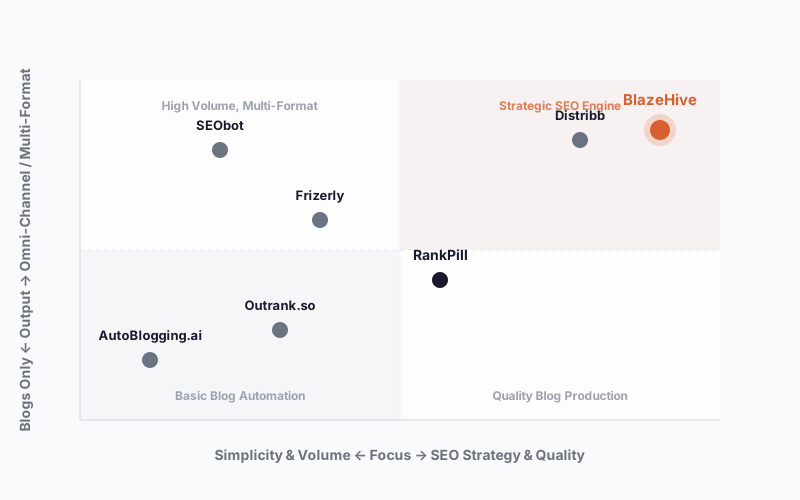
BlazeHive is an autonomous SEO engine that drops a URL, studies the business, discovers competitors, builds a bottom-of-funnel keyword strategy, and publishes one optimized page per day - straight into your CMS, built to rank on Google and get cited by AI answer engines.
Best for: Founders and SMB/SaaS teams who want ranked, AI-cited pages with technical SEO auto-fixing and human-monitored growth - not just a steady stream of published blog articles. Also fits medium-sized teams and SEO experts who want steerable control through the agentic SEO chat.
Strengths
- Six page types - landing pages, listicles, comparisons, alternatives, FAQ, and interactive tool pages, each targeting a different ranking vector. No other tool in this category matches this.
- De-AI humanization validated against 30,000+ documented AI writing patterns before a page ships - a pre-publish quality gate, not a post-publish editing task.
- Cannibalization detection from live Google SERPs - BlazeHive cross-checks every keyword against actual Google search results, not similarity heuristics, so two pages never compete for one query.
- Technical SEO auto-fixing (WordPress) - finds and auto-repairs broken links, redirect chains, heavy pages, and weak internal linking; other platforms coming.
- Safety-engineered backlinks - acyclic graph design with per-website pattern avoidance means no two sites ever exchange links, eliminating reciprocal footprints by construction.
- Human-monitored growth - the BlazeHive team tracks every customer's GSC data and intervenes if a site stagnates; you're not alone with a dashboard.
- Steerable agent - conversational chat interface with full context on keyword research, cannibalization, planning, and technical debt.
- Bottom-of-funnel keywords - buyer-intent terms cross-checked against live SERPs, not top-of-funnel vanity volume.
Where it's not the right fit
- Not built for social repurposing - if you need content auto-distributed across LinkedIn, TikTok, and Instagram, BlazeHive isn't that tool.
- Technical SEO auto-fixing is WordPress-only right now; other platforms are on the roadmap but not yet live.
- Simpler tools like RankPill are faster to first published article; BlazeHive's full value takes more setup to unlock.
Pricing: $99/month (Complete Engine) - everything included, no per-seat or per-article fees. 3-day free trial, no card required. Done For You: $3,000 one-time setup + $99/month. As of August 2026.
When to choose it: You're a founder, small team, or medium-sized team that needs compounding organic traffic and AI citations - not just published pages - and you want one system to handle strategy, production, technical health, and monitoring without an agency bill.
2. Distribb
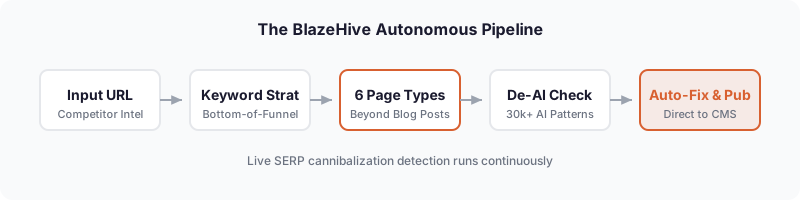
Distrbb (formerly Rebelgrowth) is an omni-channel content distribution engine that publishes AI-written articles and automatically repurposes them across 13+ social and community platforms, including a daily Reddit discovery agent.
Best for: DTC brands, community-driven SaaS, and creators whose buyers discover products on Reddit, TikTok, LinkedIn, and X - not just Google.
Strengths
- 13+ channel social repurposing - every published article becomes platform-specific posts for LinkedIn, X, Instagram, Facebook, TikTok, YouTube, Pinterest, Reddit, Threads, Bluesky, Telegram, Google Business, and Snapchat, automatically.
- Daily Reddit discovery agent - identifies high-intent threads and enables one-click posting to build brand mentions and earn AI citations; purpose-built for Reddit-first distribution.
- Accelerator plan ($290/month) - includes human QA, strategic keyword placement, and content polishing for teams that want managed service quality without hiring an agency.
- Buyer-intent content calendar - 30-day calendar built around commercial keywords; 4,000–5,000-word articles with internal linking and backlink exchange publishing.
Where it's not the right fit
- Not built for technical SEO depth - no auto-fixing, no cannibalization detection, no pre-publish AI validation gate.
- Social-first focus means the tool's value compounds faster for brands with active social audiences; pure-SEO plays get less marginal value.
Pricing: Pro Plan $97/month (30 articles/month); Accelerator $290/month (managed tier with human QA). 3-day free trial, card required. As of August 2026.
When to choose it: Your discovery funnel runs through Reddit and social, not just Google. You want every article to become a week's worth of social content automatically, and you're willing to pay for the managed tier when content quality needs to be airtight.
3. SEObot
SEObot is a fully autonomous AI agent that handles keyword research, content planning, article generation, backlinks, and publishing - with broad CMS support and multi-format output including news articles and YouTube-to-post conversion.
Best for: Bootstrapped founders and agencies managing multilingual or multi-format content who want to test SEO automation at the lowest entry price.
Strengths
- Cheapest credible entry point - $49/month for ~8 articles/month; a meaningful reduction from the $99/month tier most competitors require.
- Multi-format support - blog articles, news articles, and YouTube-to-post conversion; no other tool in this list converts video to blog content natively.
- Broad CMS integrations - 9+ platforms including WordPress, Shopify, Webflow, Wix, Ghost, Framer, Notion, HubSpot, plus Zapier, Make, and REST API; more extensible than most competitors.
- 50+ language support - strong choice for multilingual markets or international SEO plays.
- Over 200k articles created, 1.2 billion impressions and 30 million clicks reported across the user base.
Where it's not the right fit
- Not built for teams that need pre-publish humanization validation or cannibalization prevention - the automation is broad, but the quality gate is on you.
- $49/month delivers ~8 articles/month; if you need 30+, the per-article economics shift.
Pricing: $49/month (Pro, ~8 articles/month). Free plan available with limited features. Full refund if unsatisfied after the first article. As of August 2026.
When to choose it: Budget is tight, you want to test autopilot SEO before committing $99/month, and you need either multilingual output or a CMS that most tools don't natively support.
4. Frizerly
Frizerly is an automated SEO blog publishing tool with Shopify-native product integration and built-in AI email drafting - the only tool in this list that bundles email marketing with content automation.
Best for: Shopify merchants and e-commerce operators who want SEO traffic and email re-engagement from a single $29/month platform.
Strengths
- Cheapest tool in the category - $29/month (billed annually), or $49/month monthly; significant cost advantage for early-stage or bootstrapped operators.
- Shopify product integration - automatically pulls product context into articles; not a generic blog publisher bolted onto a store.
- Email marketing built in - AI-powered email drafting for customer re-engagement; no separate email tool required.
- AI visibility optimization - targets ChatGPT, Gemini, and Perplexity citations alongside Google rankings.
- Custom web tool builder - builds SEO mini-tools and lead generators; expands the tool's surface area beyond blog posts.
Where it's not the right fit
- Not built for teams that need more than blog articles - no comparison pages, no FAQ pages, no alternatives formats.
- Technical SEO support is basic compared to BlazeHive; no auto-fixing, no cannibalization detection.
Pricing: $29/month (annual) or $49/month (monthly). 3-day free trial. As of August 2026.
When to choose it: You run a Shopify store, email is part of your retention funnel, and you want the most affordable way to add consistent SEO content without hiring a writer or agency.
5. Outrank.so
Outrank is a blog-publishing automation platform that produces ~30 SEO articles per month from live keyword research. No frills, no complexity - just consistent publishing.
Best for: SMBs, SaaS teams, and agencies that want reliable blog volume at $3.30 per article without additional configuration or feature complexity.
Strengths
- Keyword research from live search data - not LLM guessing; validated against real search volume, which keeps content on rankable queries.
- Formatted, citation-backed articles - headings, schema markup, meta tags, AI-generated images, and real citations are included by default.
- Agency-friendly pricing - multi-site discounts of 10–20% on Enterprise plans for teams managing 5+ sites.
- Simple workflow - connect your CMS, set parameters, receive articles. Low cognitive overhead for non-technical operators.
Where it's not the right fit
- Not built for AI citation tracking - Outrank focuses on Google organic; it doesn't monitor or optimize for ChatGPT/Perplexity/Gemini visibility.
- No backlink network, no Reddit marketing, no social repurposing - content only.
- Article-cap model means burned drafts count against your 30/month limit.
Pricing: $99/month (Standard, 30 articles/month). $1 for 3-day trial. Enterprise: custom pricing with multi-site discounts. As of August 2026.
When to choose it: You want a clean, dependable blog publishing machine at $3.30 per article and you're not yet prioritizing AI search visibility or technical SEO depth.
6. AutoBlogging.ai
AutoBlogging.ai is a credit-based bulk content generation platform used by agencies and niche site portfolio operators who need to produce hundreds or thousands of articles per month - with optional DFY managed services.
Best for: Agencies, niche site networks, and portfolio builders who need to scale article production beyond the 30/month cap every other tool in this list applies.
Strengths
- Scales to thousands of articles/month - credit model allows top-ups at any tier; the Premium plan ($249/month) covers 80–100 articles, and DFY packages extend to 1,000 articles for $1,200–$4,000.
- DFY managed service - trained VAs handle generation, optimization, and publishing; the only tool with explicit human-managed bulk production.
- 35+ language support - strong for multilingual niche site builds.
- Entry-level pricing - $19/month for ~5 articles; lowest dollar entry in the category.
- Trusted by 40,000+ content creators; 1M+ articles generated.
Where it's not the right fit
- Not built for teams that want technical SEO depth, cannibalization prevention, or multiple page types - this is a content volume engine, not a full SEO strategy tool.
- WordPress-centric; CMS diversity is narrower than most competitors.
- No backlink network.
Pricing: Starter $19/month (~5 articles); Regular $49/month (~10–15 articles); Standard $99/month (~25–30 articles); Premium $249/month (~80–100 articles). $1 trial entry with 10 free credits/month. As of August 2026.
When to choose it: You're running a portfolio of niche sites and need volume that no fixed-cap tool can deliver, or you want a fully managed DFY service for a specific content sprint.
Quick Comparison
| Tool | Best For | Starting Price | Free Tier | Standout Feature |
|---|---|---|---|---|
| BlazeHive | Ranked + AI-cited pages, technical SEO | $99/mo | 3-day trial, no card | 6 page types + technical SEO auto-fix + human monitoring |
| Distribb | Omni-channel social + Reddit distribution | $97/mo | 3-day trial | Auto-repurposes every article across 13+ platforms |
| SEObot | Affordable entry, multilingual, broad CMS | $49/mo | Limited free plan | YouTube-to-post conversion; 9+ CMS integrations |
| Frizerly | Shopify merchants, email + SEO | $29/mo (annual) | 3-day trial | Built-in email marketing + Shopify product integration |
| Outrank.so | Reliable blog volume, simple workflow | $99/mo | $1 trial | Clean no-frills blog automation at $3.30/article |
| AutoBlogging.ai | Bulk volume, niche site portfolios | $19/mo | $1 trial, 10 free credits | Scales to 1,000s/month; DFY managed packages |
Pricing as of August 2026. Check each tool's pricing page for current rates.
Which Alternative Should You Choose?
Most founders searching for RankPill alternatives are solving one of five distinct problems. Here's who wins each one.
If you want ranked, AI-cited pages - not just published articles...
BlazeHive is the right tool. Six page types, cannibalization detection from live Google SERPs, de-AI humanization validated against 30,000+ patterns, technical SEO auto-fixing, and human-monitored growth tracking - no other tool in this list covers all of that. At $99/month all-in, it replaces a strategist, writer, designer, and technical SEO auditor.
If your buyers discover you on Reddit, TikTok, or LinkedIn...
Distribb is the stronger fit. Its daily Reddit discovery agent and 13-platform social repurposing are built for brands where community and social drive pipeline, not just Google rankings. If you need to show up everywhere, Distribb does that.
If you're on a tight budget and want to test SEO automation first...
SEObot at $49/month or Frizerly at $29/month (annually) are the sensible starting points. SEObot has broader CMS support and multi-format output; Frizerly wins if you're on Shopify and want email in the same tool. Both are genuine products with real user bases - they're not stripped-down trials.
If you run a Shopify store and email is part of your funnel...
Frizerly is the right call. Shopify product integration, AI email drafting, and AI visibility optimization for ChatGPT and Gemini are bundled at the lowest price in the category. You won't find that combination anywhere else at $29/month.
If you need to produce hundreds of articles a month across a niche site portfolio...
AutoBlogging.ai is built for this. No other tool scales credit-based to 1,000+ articles per month, and the DFY managed service handles the production pipeline for you. It's a volume engine, not a strategy tool - use it accordingly.
Ready to Try BlazeHive?
If your goal is pages that rank and get cited by AI answer engines - with technical SEO running in the background and a team watching your GSC data - BlazeHive is the right engine for that. Start a 3-day free trial at blazehive.io, no credit card required, and drop your URL to see what the system maps out for your site. Cancel anytime.
Frequently Asked Questions
What should I look for in an AI SEO tool?
Look for explicit support for buyer-intent keywords, not just search volume - terms that pull in customers, not just learners. A good tool produces multiple page types (comparisons, alternatives, FAQ, landing pages) to target different ranking vectors and SERP formats, not just blog articles. Automated cannibalization detection using live Google data prevents internal competition, and pre-publish humanization validates against AI patterns before shipping, not after publishing when it's too late to fix.
Why are rankings stagnating even though I'm publishing articles?
The most common culprit is internal cannibalization - two pages competing for the same query silently suppress both rankings. Without automated cross-checking against live Google SERPs, you won't discover the overlap until weeks later, if at all. Technical debt (broken links, redirect chains, weak internal linking) also leaks page authority; a tool that publishes 30 articles monthly without fixing these issues is building on a cracked foundation.
What makes BlazeHive different from RankPill?
RankPill publishes blog articles well; BlazeHive is an autonomous SEO engine that produces six page types (landing pages, comparisons, alternatives, FAQ, listicles, interactive tools), detects cannibalization from live Google SERPs, humanizes content against 30,000+ AI patterns before publishing, and auto-fixes technical SEO issues on WordPress. At $99/month, BlazeHive also includes human-monitored growth tracking - the team watches your GSC data and intervenes if rankings stagnate, not just showing you a dashboard.
How does cannibalization detection work, and why does it matter?
Cannibalization happens when two pages on your site compete for the same query - Google ranks one higher internally, suppressing both. BlazeHive cross-checks every new keyword against live Google SERP results to catch this before publishing, using Google as the source of truth instead of similarity heuristics. Without it, a founder publishing 30 articles per month can spend months wondering why a page ranks #15 instead of #3, then discover an internal competitor is eating its traffic.
Which alternative is best for Shopify stores?
Frizerly at $29/month (annual) is purpose-built for e-commerce - it integrates Shopify product context directly into blog articles, includes AI email drafting for re-engagement, and optimizes for AI visibility on ChatGPT and Gemini. You get email marketing bundled in without a separate tool, which is unique in this category. If your store runs email as part of your retention funnel, Frizerly's combination of features at the lowest price makes it the right fit.
Is RankPill still worth using?
Yes, if you want simplicity and fast time-to-first-article. RankPill's keyword research is solid (real search data, not guessing), and setup is straightforward - connect your CMS, set keywords, publish. But it doesn't catch cannibalization automatically, doesn't produce page types beyond blog articles, and doesn't include technical SEO fixes or AI citation optimization. If your priorities are volume and speed over depth, RankPill is still a credible choice.
What's the difference between BlazeHive and Distribb?
Distribb wins on omni-channel social repurposing - every article becomes platform-specific posts across 13+ channels (LinkedIn, TikTok, Reddit, etc.) automatically. BlazeHive wins on technical depth: six page types, cannibalization detection, de-AI validation, and WordPress technical SEO auto-fixing. Choose Distribb if your buyers discover you on Reddit and social; choose BlazeHive if you want ranked pages and Google + AI citations with technical health running in the background.
Why does pre-publish AI humanization matter more than post-publish editing?
Pre-publish validation (BlazeHive's model) prevents bad content from shipping in the first place - it's a quality gate. Post-publish editing (most competitors' model) means you're cleaning up every article after the tool publishes it, adding hours to your workflow. In an era where Google explicitly cracks down on AI content farms, validation against 30,000+ documented AI patterns before publishing is insurance - you're not relying on luck or manual review.
Should I switch from Distribb to BlazeHive if I only care about Google rankings?
Not necessarily. Distribb's articles rank fine on Google; what you'd lose is the social repurposing automation (13+ platforms auto-populated from every article). If you don't use social distribution, paying for that feature is wasteful. BlazeHive is the better fit if you want page-type diversity (comparisons, alternatives, FAQ), technical SEO fixes, and cannibalization prevention - features Distribb doesn't include.
What page types does BlazeHive produce that other tools don't?
BlazeHive generates six types: landing pages, listicles, comparisons, alternatives, FAQ, and interactive tool pages. Most competitors (RankPill, Distribb, SEObot, Outrank, AutoBlogging) focus on long-form blog articles only. The diversity matters because each page type targets a different query intent and SERP format - a FAQ page wins People-Also-Ask slots, a comparison page wins 'best [product] for [use case]' queries, an interactive tool raises engagement signals.
Which tool should I choose if budget is extremely tight?
Frizerly at $29/month (annual billing) is the absolute lowest entry point, bundling Shopify integration and email marketing. AutoBlogging.ai starts at $19/month (credit-based, covers ~5 articles). SEObot at $49/month offers more features and broader CMS support than AutoBlogging's entry tier. If you're bootstrapped and need to test SEO automation before committing higher budget, these three are where you start.
Does BlazeHive fix technical SEO issues on platforms other than WordPress?
Not yet. Technical SEO auto-fixing (broken links, redirect chains, internal linking) is currently WordPress-only; the roadmap includes other platforms but they're not live. On non-WordPress sites, BlazeHive still detects the issues and flags them, but you'll need to fix them manually or through a developer. If technical SEO depth on your specific platform is critical, verify BlazeHive's roadmap status before committing.
Why is human-monitored growth tracking valuable compared to a dashboard?
A dashboard shows you rankings and clicks; human monitoring diagnoses why they stopped moving. BlazeHive's team tracks every customer's Google Search Console data and intervenes when a site stagnates - they investigate whether the issue is content quality, domain authority, technical problems, or keyword competition. That service layer is different in kind from a self-service tool that leaves diagnosis entirely to you.