TL;DR
Rankability Alternatives come down to what part of the SEO stack you actually need: BlazeHive is the top pick for indie founders, small teams, and medium-sized teams who want strategy, content, publishing, technical fixes, and AI citation - all on autopilot for $99/month flat. Orchly.ai wins if you already have a content stack and only need AI search monitoring. Surfer SEO wins for editorial teams grading writers' output before publish.

Rankability Alternatives
Rankability has earned strong product-market fit - 136 verified 5.0-star reviews across G2, Google, and Capterra don't happen by accident. Its Serena AI workflow, AI visibility tracking across six search engines, and multi-client workspace architecture make it a genuine all-rounder for agency teams. But a specific set of friction points - credit cost unpredictability, a $99/month minimum that penalizes solo creators, and draft-only publishing - pushes enough users out the door that the alternatives are worth mapping carefully. The right one depends entirely on which part of Rankability's bundle you actually use.
Why People Look for Rankability Alternatives
The most common trigger is credit cost opacity. Rankability runs on credits for automation, and users consistently flag on G2 that they can't preview the cost of a routine before running it. When you're trying to budget monthly SEO spend, speculative credit burn is a real operational problem - and it's the top complaint across multiple Rankability review threads.
The second friction point is pricing structure versus actual usage. Rankability's Core tier starts at $99/month, which includes five workspaces, five routines, and unlimited users. That's excellent value for an agency with five active clients. It's poor value for a solo founder who needs one workspace and one content stream - they're paying for architecture they don't use. The jump to Scale ($199/month) for more than five routines hits growing bootstrappers especially hard.
The third issue is publishing workflow. Rankability sends content to CMS as a draft - it doesn't auto-publish. For teams that want true autopilot (write → publish → done, without a human in the loop), that final step creates enough friction to keep them searching. This isn't Rankability's failure - their quality-gate philosophy is a deliberate choice that makes sense for agency workflows where a client approves before publish. But for founders who want to wake up to a live page, not a draft, it doesn't fit.
What to Look for in an AI SEO Tool
Bottom-of-funnel keyword targeting. Keyword volume is vanity. Buyer intent is what converts. Look for tools that actively filter or enforce buyer-intent keyword selection - not just research and present all keywords, but default to the ones that drive transactions. If you're ranking top-of-funnel listicles that never see a checkout click, the tool failed you regardless of ranking position.
Cannibalization prevention. Two pages competing for the same query split authority and dilute rankings. Tools that detect this in retrospect (after the damage) are useful. Tools that prevent it in real time - cross-checking new keywords against existing pages before publishing - are better. Know which one you're buying.
Publishing automation. There's a spectrum from analysis-only (content stays in the tool, you export and paste), to draft-to-CMS, to full auto-publish. Know where you sit on that spectrum. A tool that sends to draft is great for agencies with approval workflows; it's friction for a two-person team moving fast.
AI citation readiness. Ranking on Google and appearing in ChatGPT or Perplexity are different tasks. Tools that track AI visibility tell you where you stand. Tools that architect content to be cited by LLMs (entity clarity, source attribution, answer structure) help you move that number. Tracking without production changes is monitoring, not optimization.
Technical SEO handling. Content builds authority. Technical debt leaks it. Broken links, redirect chains, and weak internal linking quietly drain the rankings your content earns. Look for whether a tool flags these issues or actually repairs them. Most do the former; few do the latter.
Predictable pricing. Credit-based tools create budgeting problems. Usage caps and per-credit charges at point-of-use create surprise invoices. Flat-rate all-inclusive pricing is predictable. Know which model you're signing up for before your first billing cycle.
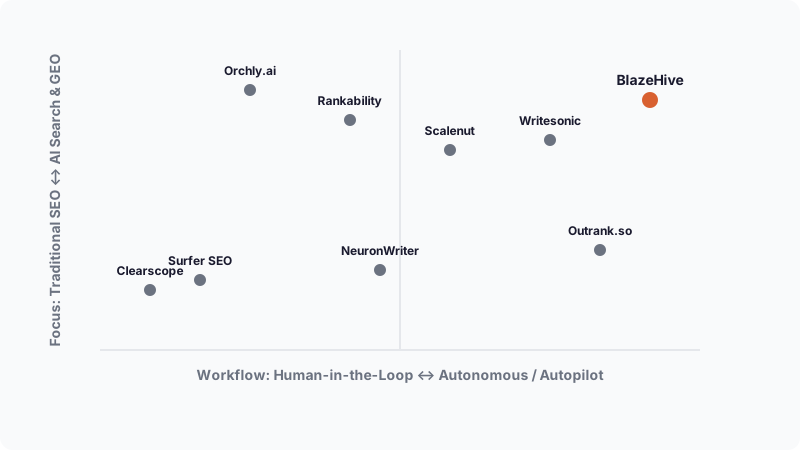
The Best Rankability Alternatives
1. BlazeHive
BlazeHive is an autonomous SEO engine that handles the entire content loop - bottom-of-funnel keyword research, six purpose-built page types, humanization, technical SEO auto-fixing, contextual backlinks, and direct CMS publishing - for $99/month flat, no credits.
Best for: Indie founders, bootstrappers, and 2–5 person marketing teams who want agency-quality SEO output on autopilot without managing multiple tools or making an SEO hire. Also fits medium-sized teams and SEO experts who want steerable control through the agentic SEO chat.
Strengths
- Bottom-of-funnel keyword research with live SERP cannibalization detection - no two pages ever target the same query, enforced by the system, not a report to review later
- Six purpose-engineered page types: landing pages, listicles/comparisons/VS pages built for LLM citation, FAQ pages for nested People-Also-Ask authority, and interactive tool pages that raise engagement signals and site authority
- Technical SEO auto-fixing on WordPress - broken links, redirect chains, weak internal linking repaired automatically, not just flagged
- Humanization validated against 30,000+ documented AI writing patterns before pages ship
- Autonomous publishing directly to CMS (WordPress, Ghost, Webflow, Framer, Contentful, Storyblok, Strapi, generic webhook) - content lives under your domain forever
- $99/month all-in, no per-seat fees, no credit system, no usage add-ons - budget is knowable
Where it's not the right fit
- Technical SEO auto-fixing is currently WordPress-only; other platforms are listed as coming soon
- Not built for agencies needing granular per-page human review before every publish - Rankability's draft workflow is better for that
- Not the right tool if you need deep on-page optimization scoring for human writers (Surfer SEO's interface is tighter for that use case)
Pricing: $99/month, all-in. 3-day free trial, no card required. Done-For-You setup available at $3,000 one-time + $99/month. As of August 2026.
When to choose it: You're a founder, small team, or medium-sized team that needs daily SEO output with no daily input - strategy, production, technical fixes, and publishing running autonomously while you build the product.
2. Surfer SEO
Surfer SEO is a content optimization platform that scores pages against live SERP data in real time, giving writers and editors a grading loop before they publish.
Best for: Editorial teams with in-house writers who need to score and improve content before it goes live.
Strengths
- Real-time Content Editor scoring against live SERP data - the tightest on-page optimization feedback loop in the category
- Audit tool for refreshing underperforming content (up to 100 pages/month on Scale)
- Surfy AI assistant for writing and optimization within the Content Editor
- AI visibility tracking for ChatGPT (added 2026) on Scale and Enterprise tiers
- Integrations with Google Docs and WordPress for editorial workflows
Where it's not the right fit
- Not designed for autonomous publishing - no auto-publish; requires human export and import at every step
- AI visibility tracking is a bolt-on, not core architecture; ChatGPT is the only tracked engine at entry price
- No backlink analysis; agencies still need Ahrefs or Semrush alongside
- No multi-client workspace structure - built for single-team use
Pricing: $99/month (Essential, monthly) or $79/month annual. Scale at $219/month monthly. As of August 2026.
When to choose it: You have writers on staff and need to raise their output quality before publish - you want a grading tool, not an autopilot.
3. Orchly.ai
Orchly.ai is a dedicated AI search visibility monitoring platform built around a monitor-diagnose-act workflow for tracking brand mentions and citations across ChatGPT, Gemini, Perplexity, and Google AI.
Best for: Teams that already have content creation and rank tracking tools and need only AI visibility monitoring and competitor benchmarking.
Strengths
- Native AI visibility tracking with competitor benchmarking and sentiment breakdown across ChatGPT, Gemini, Google AI, and Perplexity
- AI agents for autonomous diagnostics and action recommendations after monitoring reveals visibility gaps
- Monitor-Diagnose-Act workflow designed for operationalizing AI search presence
- MCP and API integration for technical teams building custom dashboards
- Lowest entry price in the set for pure AI visibility: $37/month annual
Where it's not the right fit
- Not designed for content creation or publishing - monitoring only; you'll need separate tools for writing and rank tracking
- No traditional SEO toolkit: no keyword research, no backlink analysis, no technical audit
- Best paired with Ahrefs or Semrush for traditional SEO signals, which fragments the toolstack
Pricing: $37/month (Essential, annual) or $89/month (Pro, annual). As of August 2026.
When to choose it: You already run a full SEO stack and need to add AI citation monitoring without switching platforms - Orchly is a lightweight overlay on top of what you already have.
4. Outrank.so
Outrank.so is a content automation platform that auto-publishes articles directly to your CMS - no draft stage, no human review gate - with brand voice configuration and automatic internal linking.
Best for: Volume-driven content operations (niche sites, affiliate content) where publish speed matters more than per-page quality control.
Strengths
- Full auto-publish to CMS without a draft stage - the rarest capability in this category
- Keyword research with AI clustering and prioritization
- Brand voice configuration baked into generation
- Automatic internal linking suggestions
- Supports WordPress, Ghost, and other CMS platforms
- Contextual backlink exchange network included
Where it's not the right fit
- Not designed for AI search visibility tracking - entirely Google-focused, no monitoring across ChatGPT or Perplexity
- No live SERP cannibalization detection; tracking duplicate targeting is a manual task
- Brand voice implementation is lighter than Rankability's brand knowledge system
- No technical SEO auditing or auto-fixing
Pricing: $99/month (Standard, ~30 auto-published articles/month). $1 trial for 3 days. As of August 2026.
When to choose it: You're running a niche site or affiliate operation and want articles published at volume without touching a draft queue - quality variance is an acceptable tradeoff for speed.
5. Clearscope
Clearscope is a content research and NLP optimization platform built for enterprise editorial teams, with a Content Inventory tied to Google Search Console and Topic Explorations for nested keyword families.
Best for: Large agencies and 20-plus-person content teams centralizing keyword strategy across multiple writers and clients.
Strengths
- NLP term recommendations that editorial teams consistently rate as the most accurate in the category
- Content Inventory linked to Google Search Console for tracking content decay and refresh needs
- Topic Explorations for mapping nested keyword families and question clusters
- Unlimited users on all tiers - no seat tax
- Enterprise compliance: SOC 2, SSO, crawler whitelisting on Enterprise plans
Where it's not the right fit
- Highest entry price in the set at $129/month - not designed for solo practitioners or small teams
- No publishing or CMS automation; content stays in Clearscope and requires manual export
- No backlink analysis; agencies still need Ahrefs or Semrush alongside
- No AI visibility tracking; entirely Google-SERP-focused
- AI Drafts capped at 20 at both Essentials and Business tiers despite a 3x price jump
Pricing: $129/month (Essentials). Business at $399/month. Enterprise pricing on request. As of August 2026.
When to choose it: You're a 15-plus-person agency that needs centralized keyword research and content scoring for multiple editorial teams - the project structure and NLP depth justify the premium.
6. NeuronWriter
NeuronWriter is an NLP-powered content optimization tool with real-time A–F content scoring, AI credit-based generation, and a Chrome extension for writing inside Google Docs, WordPress, and Shopify.
Best for: Freelancers and solo content creators testing SEO content optimization at the lowest possible entry price.
Strengths
- Lowest entry price in the set at $19/month annual for a functional optimization tool
- Real-time A–F content scoring with NLP keyword recommendations
- Internal linking suggestions with auto-insert functionality
- Chrome extension works inside Google Docs, WordPress, and Shopify
- Google Search Console integration for tracking existing rankings
- Lifetime deal option available for one-time purchase
Where it's not the right fit
- No AI search visibility tracking; entirely on-page and Google-focused
- AI credit consumption is the top G2 complaint - users can't predict costs before generating
- No publishing automation; content stays in NeuronWriter or exports to docs manually
- No multi-client workspace structure; project-based only (2 projects at Bronze tier)
- Not designed for the full content strategy-to-publish loop
Pricing: $19/month (Bronze, annual). Silver $37/month, Gold $57/month, Platinum $77/month, Diamond $97/month annual. As of August 2026.
When to choose it: You're a freelancer or solo blogger optimizing existing pages or testing AI content tooling for the first time - $99/month feels premature and you need NLP guidance without a major commitment.
Quick Comparison
| Tool | Best For | Starting Price | Free Tier | Standout Feature |
|---|---|---|---|---|
| BlazeHive | Indie founders, small teams on autopilot | $99/mo | No (3-day trial) | Full-loop autonomy: strategy → publish → technical fixes, one engine |
| Surfer SEO | Editorial teams grading writers before publish | $99/mo | No | Real-time SERP content scoring for human writers |
| Orchly.ai | AI visibility monitoring as a standalone layer | $37/mo (annual) | No | Monitor-diagnose-act workflow for AI citation benchmarking |
| Outrank.so | Volume niche sites needing full auto-publish | $99/mo | $1 trial | Full auto-publish to CMS - no draft stage, no queue |
| Clearscope | Enterprise agencies with large editorial teams | $129/mo | No | Content Inventory + Topic Explorations tied to Google Search Console |
| NeuronWriter | Freelancers testing NLP optimization cheap | $19/mo (annual) | No | Real-time A–F scoring with Chrome extension across Google Docs and WordPress |
Pricing as of August 2026. Check each tool's pricing page for current rates.
Which Alternative Should You Choose?
The most common search ends here: you're a founder or small team that has hit Rankability's friction points - credit opacity, draft-only publishing, or paying for multi-client architecture you don't use.
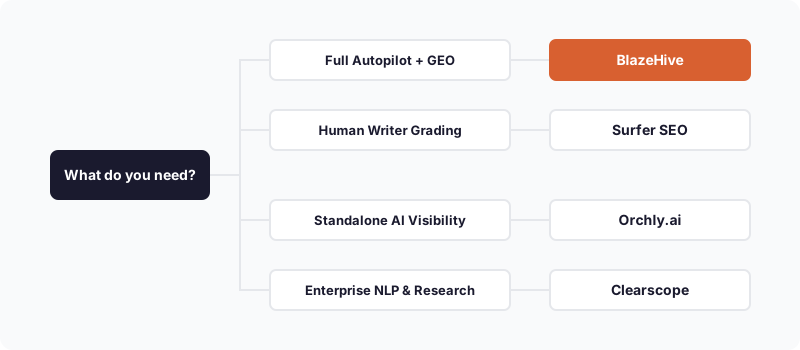
If you need a full autopilot SEO loop with no daily involvement...
BlazeHive is the right call. The engine handles keyword research, writing, humanization, technical fixes, backlinks, and publishing - $99/month flat, no credits, no surprises. One URL in; ranked pages out, daily.
If you have writers and need to improve their output before publish...
Surfer SEO is better suited. Its real-time SERP scoring and Content Editor interface are built for the human-in-the-loop workflow - grade the draft, hit publish when the score is green.
If you already run Ahrefs or Semrush and only need AI citation monitoring...
Orchly.ai fits at $37/month annual. It doesn't replace your content stack - it adds the AI visibility layer your existing tools don't cover, with competitor benchmarking and concrete next steps.
If you're running a niche site and want articles published at volume without a queue...
Outrank.so is the right fit. It's one of the only tools in the category that skips the draft stage entirely - auto-publish directly to CMS, no approval step.
If you're at a 15-plus-person agency centralizing keyword strategy across multiple editorial teams...
Clearscope justifies its $129–$399/month range. The Content Inventory, Topic Explorations, and NLP depth are purpose-built for large-team coordination at a scale where BlazeHive's indie-first architecture isn't the right fit.
If you're a solo freelancer testing content optimization under $25/month...
NeuronWriter at $19/month annual is the right starting point. Get the NLP feedback, optimize a few pages, and upgrade when the workflow justifies a bigger investment.
Ready to Try BlazeHive?
If you're a founder, small team, or medium-sized team that needs daily SEO output - real pages, published to your domain, built for buyer intent and AI citation - without touching a draft queue or managing a toolstack, BlazeHive is the right engine for that. Drop your URL, start the 3-day free trial with no card required, and let the system build your first keyword strategy and page. If it doesn't fit your workflow, you'll know in three days without spending a dollar.
Frequently Asked Questions
What should I look for in a Rankability alternative?
Bottom-of-funnel keyword targeting, cannibalization prevention, publishing automation, AI citation readiness, technical SEO handling, and predictable pricing are the six critical dimensions. Tools that enforce buyer-intent keywords instead of just presenting volume prevent you from ranking listicles nobody converts from. Tools that detect duplicate targeting before publishing stop authority leaks; tools that fix technical debt autonomously compound that advantage. Know where each alternative sits on the automation spectrum - from analysis-only to draft-to-CMS to full auto-publish - because that choice shapes your entire workflow.
What makes a good AI SEO tool in 2026?
An AI SEO tool should architect content for both Google and generative engines, not just track where you rank on search. That means understanding what LLMs actually cite - entity clarity, source attribution, answer structure - and building pages to be citation targets by default. It should also prevent cannibalization in real time rather than report it after you've published duplicate-targeting pages, and it should handle technical debt (broken links, redirect chains, weak internal linking) automatically so authority compounds instead of leaking. Predictable, flat-rate pricing is table-stakes; credit systems create budgeting chaos.
Is Rankability still worth using?
Yes, for agencies with five or more active clients and a human approval workflow before publish. Rankability's multi-client workspace structure, Serena AI workflow, and AI visibility tracking across six engines make it a genuine all-rounder for team coordination. Where Rankability friction emerges is in solo-founder pricing (paying $99/month for multi-client architecture you don't use), credit-cost opacity (budgeting becomes speculative), and draft-only publishing (no true autopilot for teams that want one-click publish). If none of those friction points describe your workflow, Rankability is still a solid all-rounder.
Why is BlazeHive on this list?
BlazeHive wins for indie founders, small teams, and medium-sized teams that need the entire SEO loop - keyword research, six purpose-engineered page types, humanization, technical SEO auto-fixing, backlinks, and CMS publishing - running autonomously on one $99/month flat rate with no credits. The specific audience is teams that have hit Rankability's friction points (credit opacity, multi-client pricing overhead, draft-only publishing) and want a simpler engine that handles strategy, production, technical debt, and publishing as a single system monitored by humans. If you're a two-person team that can't afford an SEO hire or an agency, BlazeHive replaces the entire stack for $99/month flat.
Can I auto-publish content directly to my CMS, or will it always be a draft?
Most alternatives send content to draft for human review - Rankability, Surfer, Clearscope, and NeuronWriter all gate publishing behind a draft stage. BlazeHive publishes directly to WordPress, Ghost, Webflow, Framer, Contentful, Storyblok, Strapi, and generic webhooks with no draft requirement; you can configure review gates if you want human approval before go-live, but the default is autonomous publish. Outrank.so is the only other tool in this set that ships a full auto-publish to CMS without a draft queue. If true autopilot is your requirement, BlazeHive and Outrank.so are the only two qualified answers.
How do BlazeHive and Surfer SEO compare for content teams?
Surfer is built for editorial teams with writers on staff who need tight on-page optimization scoring before every publish - real-time SERP content grading is its core strength. BlazeHive assumes pages are pre-optimized by agent and focuses on the full loop: buyer-intent keyword research, six page types, technical fixes, and autonomous publishing. Fit not failure: use Surfer if you're paying writers and want to grade their output before ship. Use BlazeHive if you don't have writers and need the system to research, write, optimize, fix technical debt, and publish autonomously while you build the product.
What's the difference between BlazeHive's page types and other tools' templates?
Most competitors ship templates as a formatting choice: feed a topic, get an article, listicle, or comparison. BlazeHive's six page types are purpose-engineered architectures designed for specific SEO goals - landing pages for buyer conversion, listicles and comparisons built for LLM citation readiness, FAQ pages for nested People-Also-Ask exploration, and interactive tools for engagement signals. A listicle built for AI citation has different entity clarity, source attribution, and answer structure than one built for on-page keyword density. This isn't templating; it's strategic design reversed from what LLMs actually cite and what Google rewards.
Does BlazeHive fix technical SEO issues automatically?
On WordPress, yes - BlazeHive auto-fixes broken links, redirect chains, heavy pages, and weak internal linking as pages publish. Other platforms like Ghost, Webflow, and Contentful are listed as coming soon. Tools like Rankability, Surfer, and Clearscope audit technical issues and flag them; they don't repair them. For small teams without a dev hire, this compounds: BlazeHive finds leaks and stops them automatically so authority the content builds doesn't evaporate into 404s and redirect chains. This is rare in the category because most platforms skip infrastructure repair and stay in the analysis-only lane.
How do I choose between Orchly.ai and BlazeHive for AI visibility?
Orchly.ai is a lightweight monitor-diagnose-act layer for tracking brand mentions and citations across ChatGPT, Gemini, Perplexity, and Google AI - monitoring only, at $37/month annual. BlazeHive bundles AI visibility into content creation: every page is architected to rank on Google and be cited by LLMs, with monitoring integrated into the growth report. If you already run Ahrefs or Semrush for content creation and keyword research, Orchly adds the AI tracking layer you're missing. If you need content creation plus AI visibility plus technical fixes plus publishing, BlazeHive consolidates all of it into one engine.
What's the entry price for each tool, and when does cost stop being the limiting factor?
NeuronWriter starts at $19/month annual (lowest), Orchly.ai at $37/month annual, BlazeHive and Outrank at $99/month, Surfer at $99/month, Clearscope at $129/month, and Writesonic at $14/month. Entry price stops being the limiting factor when you're shipping daily and need the full loop - strategy, production, technical fixes, and measurement - because no single cheap tool does all of that unsupervised. At that point, BlazeHive's $99/month all-in (no credits, no add-ons) is predictable and cheaper than running Rankability for credits, Surfer for optimization, and a dev for technical fixes. The right question isn't "which is cheapest" but "which is cheapest for my workflow."
How does cannibalization detection work, and why does it matter?
Cannibalization happens when two pages target the same keyword, splitting authority and diluting both rankings. Tools like Rankability detect this in retrospect (after pages are live, tracking drift). BlazeHive detects it in real time - when you research a new keyword, the system cross-checks it against all existing pages using live SERP data from Google itself, so duplicates are prevented before publishing. This is a workflow default, not a report to review later. For founders that have ranked top-of-funnel listicles that steal traffic from conversion pages, this is the difference between organic revenue and wasted content.
Can I use BlazeHive if I'm not on WordPress?
Yes - BlazeHive publishes to WordPress, Ghost, Webflow, Framer, Contentful, Storyblok, Strapi, and generic webhooks. Technical SEO auto-fixing (broken links, redirects, internal linking) is currently WordPress-only; other platforms are listed as coming soon. For non-WordPress sites, you get full keyword research, six page types, humanization, backlinks, and autonomous publishing - you just won't get automatic infrastructure repairs. If you're on Webflow or Ghost, the publication and SEO strategy layers still work end-to-end; you'll handle the occasional broken link manually or with a plugin.
How does BlazeHive handle brand voice and content quality?
Every page passes a de-AI pass checked against a library of 30,000+ documented AI writing patterns before it ships, so content doesn't sound AI-generated. The system also enforces keyword placement (slug, title, first sentence, meta description) on every page so positioning is never soft. For teams that have gotten stung by AI content that reads like AI or misses the keyword entirely, this is table-stakes. Content still lands in draft by default (configurable to auto-publish), so human review is an option if you want one more gate before go-live.
What happens if I want to switch from Rankability to BlazeHive mid-month?
There's no long-term contract - BlazeHive's subscription is month-to-month, cancel anytime. You'll keep Rankability's content on your site; BlazeHive will add new pages (one per day) alongside it. If you want to migrate existing Rankability content to BlazeHive's page types for consistency (listicle to comparison, for example), you can feed those into the system as refresh targets. There's no import/export automation; it's content-by-content, but the agent can help prioritize refresh targets from your existing stock.