TL;DR
Peec AI Alternatives come down to one question: do you need monitoring or execution? BlazeHive is the top pick for founders, small teams, and medium-sized teams who need ranked, AI-cited pages published every day - it replaces the entire strategist + writer + developer stack for $99/month. Peec AI is the better fit for enterprise and agency teams that only need visibility data. Otterly AI works for budget-conscious teams who need simple monitoring at $29/month.

Peec AI Alternatives
Peec AI is a genuinely good tool. Its 4.9/5 G2 rating and case studies - Merge saw a 7x increase in demo requests after acting on Peec's insights - back that up. But teams grow, needs shift, and monitoring alone doesn't rank pages. This guide maps the best alternatives by use case, with honest tradeoffs on every entry.
Why People Look for Peec AI Alternatives
The most common reason teams search for Peec AI alternatives is simple: the tool shows you gaps it can't fill. Peec tells you which AI engines are missing your brand, which competitors are being cited instead, and which prompts you're losing. What it doesn't do is fix any of that. You still need a writer, an SEO strategist, a developer to publish, and someone to build links. For teams without that bench, the dashboard becomes a list of problems with no built-in path to solutions.
The second trigger is pricing. Peec's Starter tier gives you 50 tracked prompts and 3 AI engines for €85/month - reasonable for a test. But as keyword sets grow, you hit the Pro tier at €199/month, then Advanced at €495/month for 350 prompts. Teams tracking competitive keywords across categories report costs scaling faster than the value delivered. That pricing pressure, flagged repeatedly in communities like TrafficThinkTank and Reddit, is the most common reason for the search.
A third pattern is tool fragmentation. Teams end up running Peec for monitoring, Surfer or Writesonic for content optimization, and a separate backlink tool - three subscriptions, three workflows, three bills. When the total exceeds $400/month, they start looking for a consolidated alternative that handles more of the stack in one place.
What to Look for in an AI Visibility Tool
Engine coverage: The core question is which AI engines matter to your audience. ChatGPT, Google AI Overviews, and Perplexity are table stakes. Claude, DeepSeek, Grok, and AI Mode matter more to technical and enterprise buyers. Check the base tier - several tools gate key engines to enterprise plans only.
Prompt quality: There's a meaningful difference between tools that fabricate prompts and tools that source them from real search behavior. Ahrefs Brand Radar sources prompts from "People Also Ask" data with measurable search volume - structurally more reliable than simulated queries. For strategy decisions, data quality matters more than dashboard polish.
Execution capability: Does the tool tell you what to fix, or does it fix it? Most monitoring platforms deliver recommendations that require a human writer to act on. If you have that human in-house, that's fine. If you don't, you need a tool that produces content, not just reports.
Cannibalization detection: As you create more content to capture AI citations, self-competition becomes a real risk. A tool that checks new pages against existing ones before publishing saves you from the slow authority bleed that comes from two pages fighting for the same query.
Pricing predictability: Credit-based and prompt-based pricing models scale unpredictably. Flat monthly pricing is easier to budget, especially when your keyword set is growing. Read the pricing page carefully - what counts as a "prompt" and how that number scales with real-world usage are the details that determine total cost.
Integration depth: The best monitoring data is useless if it lives in a silo. Look for CMS publishing integrations, Google Search Console connections, and API/MCP access that lets you feed insights into your existing workflows.
Technical SEO coverage: AI Overviews now trigger for 13.14% of Google queries and cause a 34.5% CTR drop for position-one organic results. That makes technical health - broken links, redirect chains, weak internal linking - more critical, not less, because every authority leak hurts your ability to rank and get cited by LLMs.
The Best Peec AI Alternatives
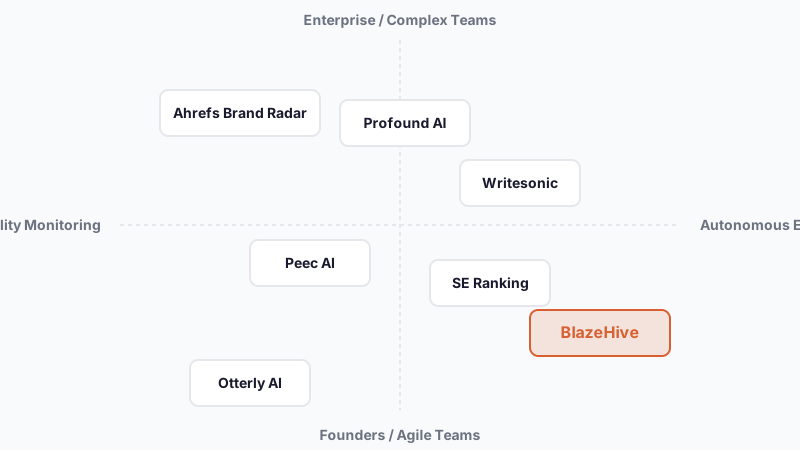
1. BlazeHive
BlazeHive is an autonomous SEO engine that runs the complete daily SEO workflow - strategy, content, technical fixes, backlinks, and monitoring - so small teams get agency-quality output without the agency bill.
Best for: Indie founders, bootstrapped SaaS teams, and SMBs who need ranked, AI-cited pages published every day without hiring a writer, strategist, or developer. Also fits medium-sized teams and SEO experts who want steerable control through the agentic SEO chat.
Strengths
- Full-loop automation: drop a URL, get keyword research → page generation → humanization → publishing → GSC-backed growth reporting, all in one $99/month engine
- Six specialized page types, including listicles and comparison pages built explicitly for LLM citations (GEO), plus FAQ pages, interactive tools, landing pages, and alternatives/compare formats
- Humanization validated against 30,000+ documented AI writing patterns - every page passes a de-AI pass before it ships
- Cannibalization detection via live SERP cross-checking - verdicts come from Google itself, not similarity heuristics
- Technical SEO auto-fixes on WordPress: broken links, redirect chains, heavy pages, and weak internal linking caught and fixed automatically
- Contextual backlink network built as an acyclic graph with per-site pattern avoidance - no reciprocal link exchanges, by construction
- Publishes directly to WordPress, Ghost, Webflow, Framer, Contentful, Storyblok, Strapi, and custom webhook - content lives under your domain forever
- Human team monitors every customer's GSC data; stagnating sites get direct intervention
Where it's not the right fit
- Not a pure monitoring dashboard - if you only need AI visibility analytics without autonomous publishing, BlazeHive is more engine than you need
- Technical SEO auto-fixes are WordPress-only as of August 2026; Ghost and Webflow auto-fix support is coming but not yet live
- Not designed for enterprise teams that need multi-region AI visibility data to brief a large in-house content department
Pricing: $99/month, everything included. No per-seat fees, no usage add-ons. 3-day free trial, no card required. Done-For-You setup available at $3,000 one-time + $99/month. As of August 2026.
When to choose it: You're a founder or 1–3 person marketing team that needs compounding organic traffic but can't pause shipping to do SEO manually every day. BlazeHive replaces the $8,500+/month agency stack with one flat-rate engine.
2. Profound AI
Profound AI is an enterprise-grade answer engine intelligence platform with a 400M+ conversation dataset, content tools, and SOC 2 Type II security certification.
Best for: Enterprise and growth-stage teams that need deep AI visibility analytics, shopping-level product tracking, and content optimization built into one platform.
Strengths
- 400M+ conversation dataset with hourly updates - deeper trend forecasting than most monitoring tools
- Built-in content tools: Growth plan includes 6 optimized articles/month
- Shopping visibility with product-level attribute scoring across AI engines - unique among monitoring tools
- Agent analytics for AI crawler behavior monitoring
- SOC 2 Type II compliance for enterprise security requirements
- Broader engine coverage at Growth tier than Peec's base Starter
Where it's not the right fit
- Entry price ($99/month for Starter, billed annually; $125/month monthly) is higher than Peec's base tier
- Claude, DeepSeek, and Grok are Enterprise-only - not included in Growth
- Six articles/month is a content tool, not autonomous publishing; you're still coordinating production
Pricing: $99/month (annual) or $125/month (monthly) for Starter; Growth at $399/month (annual) or $499/month (monthly). Enterprise custom. As of August 2026.
When to choose it: Your team needs AI visibility forecasting, product-level tracking for e-commerce, and enterprise-grade security - and you have budget above $300/month.
3. SE Ranking AI Visibility
SE Ranking bundles AI visibility tracking with a full traditional SEO platform - keyword rankings, backlinks, site audits, and content optimization - in one subscription.
Best for: Growing SMBs and agencies that want to eliminate tool fragmentation by combining GEO monitoring and traditional SEO in a single platform under $200/month.
Strengths
- Integrated SEO + GEO eliminates the need for a separate keyword/backlink tool
- Tracks AI visibility across 5 platforms with multi-language support
- More affordable than Profound ($129/month vs. $399/month at comparable tiers)
- Content optimization tools included
Where it's not the right fit
- Less specialized in AI visibility depth than pure GEO tools like Peec or Profound
- Not an autonomous publishing engine - content optimization tools still require a human writer
- AI visibility module is bundled, not purpose-built; power users may find it lacks GEO analytics depth
Pricing: Starts at $129/month. 14-day free trial. As of August 2026.
When to choose it: You're already paying for a separate keyword tool and want to consolidate SEO + GEO into one subscription - especially if multi-language monitoring matters to your team.
4. Otterly AI
Otterly AI is the most affordable option in the AI visibility space: prompt-based monitoring with daily tracking and sentiment analysis.
Best for: Budget-conscious SMBs and solo marketers who need straightforward AI visibility monitoring without agency-level budgets.
Strengths
- Lowest entry price in the category at $29/month
- Daily tracking on the base tier - faster data refresh than Peec Starter
- Sentiment analysis included
- Covers ChatGPT, Google AI Overviews, Perplexity, and Copilot on the base plan
- Clean, simple interface without enterprise complexity
Where it's not the right fit
- Gemini and AI Mode require add-ons - not included at base
- No content optimization, publishing, or technical SEO capability
- Less feature-rich than Peec Pro at comparable price points - trade-off is simplicity vs. depth
Pricing: Lite plan at $29/month. As of August 2026.
When to choose it: You have a writer and SEO strategy in place and only need affordable, reliable monitoring to track your AI visibility - without the cost of a full GEO analytics platform.
5. Writesonic GEO
Writesonic offers a GEO monitoring module that tracks real AI crawlers - rather than simulating prompts through the UI - combined with integrated content optimization and SEO tools.
Best for: Teams that want GEO monitoring accuracy backed by real AI crawler data, bundled with content creation tools in a single platform.
Strengths
- Real AI crawler tracking (more structurally accurate than UI-scraping methods)
- Integrated content optimization and SEO tools in one subscription
- Better price-to-capability ratio than buying Peec + a separate content tool
- Prompt and topic-level visibility reporting
Where it's not the right fit
- GEO module is relatively new - historical data depth may lag established competitors
- Not an autonomous publishing engine; content tools still require human coordination
- At $199/month, more expensive than Peec Starter or Otterly for teams that only need monitoring
Pricing: Free trial available; GEO paid plans start at $199/month. As of August 2026.
When to choose it: You need GEO monitoring and content optimization in one platform and are willing to pay for the bundle - especially if data accuracy at the crawler level matters more than price.
6. Ahrefs Brand Radar
Ahrefs Brand Radar is an AI visibility module backed by Ahrefs' 110B+ keyword database, with prompts sourced from real search behavior rather than fabricated queries.
Best for: Enterprise teams already on Ahrefs who want AI visibility data anchored in verified search volume, with YouTube, Reddit, and TikTok mention tracking included.
Strengths
- 243M+ real prompts sourced from "People Also Ask" data with measurable search volume - highest data quality in the category
- Tracks 6 AI engines: ChatGPT, Perplexity, Gemini, Copilot, Google AI Overviews, AI Mode
- YouTube, Reddit, and TikTok mention tracking alongside AI engine data
- Third-party citation mapping - shows which external sources shape your AI reputation
- Integrated with Ahrefs' full keyword and backlink database
Where it's not the right fit
- Significantly more expensive: requires base Ahrefs subscription ($129/month minimum), then Brand Radar add-ons bring realistic entry to $329+/month - one reviewer called it "wildly overpriced"
- No content creation or publishing tools
- No shopping-level visibility tracking
Pricing: Base Ahrefs plan from $129/month required; full AI visibility adds $199+/month per engine. Realistic minimum: $329+/month. As of August 2026.
When to choose it: You're an enterprise team already invested in Ahrefs and need AI visibility data sourced from real search behavior - not simulated prompts - with full competitive intelligence integration.
Quick Comparison
| Tool | Best For | Starting Price | Free Tier | Standout Feature |
|---|---|---|---|---|
| BlazeHive | Daily autonomous SEO execution | $99/mo | 3-day trial | Full-loop: strategy → publish → monitor, $99/mo all-in |
| Profound AI | Enterprise AI analytics + content | $99/mo (annual) | No | 400M+ conversation dataset, shopping visibility |
| SE Ranking | Bundled SEO + GEO monitoring | $129/mo | 14-day trial | Traditional SEO + AI visibility in one platform |
| Otterly AI | Budget monitoring | $29/mo | No | Lowest entry price, daily tracking |
| Writesonic GEO | Content + real crawler GEO data | $199/mo | Free trial | Real AI crawler tracking (not simulated) |
| Ahrefs Brand Radar | Enterprise research + monitoring | $329+/mo | Demo | 243M+ real search-sourced prompts, YouTube/Reddit tracking |
Pricing as of August 2026. Check each tool's pricing page for current rates.
Which Alternative Should You Choose?
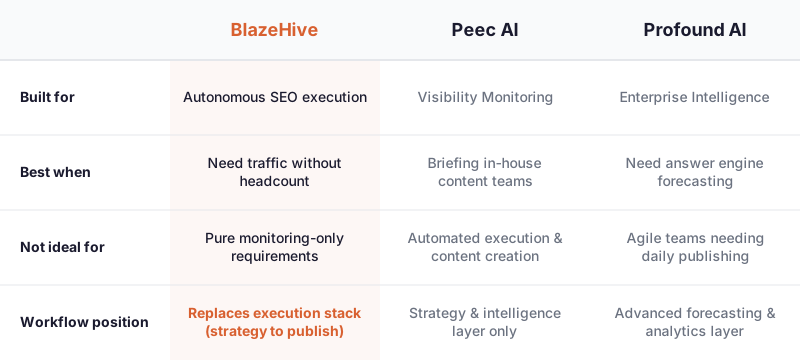
For most readers, the answer comes down to one question: do you need the data, or do you need the pages?
If you need daily ranked pages published automatically...
BlazeHive is the right pick. It's the only tool in this list that handles the full loop - keyword research, content production, humanization, technical SEO fixes, backlinks, and publishing - for $99/month flat. If you're a founder, small team, or medium-sized team and your core problem is "we have no organic traffic because we can't do SEO consistently," BlazeHive solves that without adding headcount.
If you need pure AI visibility monitoring for an in-house content team...
Peec AI is still the best monitoring tool in this category. If your team has writers and strategists on staff who just need visibility data to brief their work, Peec's prompt analytics and multi-engine coverage are clean and purpose-built. The agency tier with centralized billing and multi-project management is particularly well-designed for consultants running GEO for clients.
If you're on a tight budget and only need simple monitoring...
Otterly AI at $29/month is the honest answer. You give up depth and engine breadth, but you get daily tracking and sentiment analysis for less than a streaming subscription. A good choice for early-stage founders who just want to see whether they're showing up in ChatGPT and Perplexity.
If you need GEO monitoring and content optimization in one platform...
Writesonic or SE Ranking both bundle these. SE Ranking is cheaper ($129 vs. $199) and adds traditional SEO. Writesonic has better content tools and real crawler tracking. Both eliminate the fragmentation cost of separate subscriptions for monitoring and writing.
If you're an enterprise team with $300+/month and need advanced forecasting...
Profound AI is built for you - 400M+ conversation dataset, SOC 2 Type II compliance, shopping-level product visibility. Or if you're already in the Ahrefs ecosystem, Ahrefs Brand Radar gives you the highest-quality prompt data in the category at enterprise pricing.
If you need to automate PR, content gaps, and Reddit simultaneously...
Chosenly is worth evaluating - it's execution-focused with named-entity-level recommendations and automated content/PR workflows. Pricing isn't public, so it requires a sales conversation.
Ready to Try BlazeHive?
If you're a founder, small team, or medium-sized team that needs compounding organic traffic without the agency overhead, BlazeHive is the right tool - it runs the entire daily SEO loop for $99/month, publishes six specialized page types directly to your CMS, and fixes the technical issues leaking your existing authority. Start with the 3-day free trial, no card required. If it's not generating real keyword movement, cancel with one click.
Frequently Asked Questions
What is the best Peec AI alternative overall?
BlazeHive is the best overall alternative for founders, small teams, and medium-sized teams because it handles the complete SEO workflow-keyword research, content production, technical fixes, backlinks, and publishing-for $99/month flat. Most Peec users end up needing a second tool for content creation and a third for backlinks, whereas BlazeHive bundles all three into one autonomous engine. For enterprise teams that only need monitoring data to brief in-house writers, Peec AI itself remains the stronger fit, but for execution-driven teams without dedicated staff, BlazeHive compounds value every single day it runs.
What should I look for in an AI visibility monitoring tool?
Engine coverage matters most: ChatGPT, Google AI Overviews, and Perplexity are table stakes; Claude and DeepSeek signal reach into technical audiences. Prompt quality determines strategy reliability-tools sourcing from real search behavior (like Ahrefs' 243M People Also Ask prompts) outperform simulated queries. Finally, check whether the tool only monitors or also executes: pure monitoring platforms are cheaper but require a human writer downstream, while execution engines like BlazeHive eliminate that bottleneck by publishing directly to your CMS and tracking GSC performance daily.
Why would I still choose Peec AI over other alternatives?
Peec AI remains the best choice for enterprise and agency teams because it's purpose-built for pure monitoring: 4.9/5 G2 rating, proven case studies (Merge saw 7x demo lift), GDPR compliance, and a dedicated agency tier with centralized billing and multi-project dashboards. If your team has writers and SEO strategists in-house and only needs visibility data to guide their work, Peec's clean analytics interface and multi-engine tracking are more focused than a full execution engine that adds complexity you don't need. The strategic value of monitoring-only becomes clear at enterprise scale, where dozens of keyword tracks across regions justify the specialized depth.
What makes BlazeHive different from Peec AI?
Peec is a monitoring and analytics layer that answers 'where are we appearing in AI search?' BlazeHive is an execution engine that answers 'I need ranked, AI-cited pages published every day without hiring a team.' Peec shows you visibility gaps; BlazeHive fills those gaps automatically by publishing listicles, comparison pages, and FAQ pages built explicitly for LLM citations, then tracking their SERP movement in Google Search Console daily. A team could use both (Peec for insights, BlazeHive to execute), but they solve fundamentally different problems: data strategy versus autonomous production.
How does BlazeHive's pricing compare to Peec AI?
BlazeHive is $99/month all-in: keyword research, all six page types, humanization, technical SEO, publishing, and monitoring included with no per-seat fees or usage add-ons. Peec's Starter tier costs €85/month for 50 prompts and 3 engines, but scales to €199/month (Pro) and €495/month (Advanced) as keyword sets grow. Teams tracking competitive keywords across categories find Peec's usage-based pricing balloons quickly, while BlazeHive stays flat at $99/month regardless of how many keywords or pages you publish-making budgeting predictable at scale.
What are the main reasons teams look for Peec AI alternatives?
The most common reason is that Peec shows visibility gaps but doesn't fix them-teams still need a writer, strategist, and developer to act on recommendations. The second trigger is pricing: as keyword sets grow beyond 50 tracked prompts, cost jumps from €85 to €199+ per month. The third pattern is tool fragmentation: teams end up running Peec for monitoring, Surfer or Writesonic for content, and a backlink tool separately-three subscriptions at $300+/month combined-which triggers the search for a consolidated alternative that handles more of the stack in one place.
Does BlazeHive handle technical SEO issues like broken links and redirects?
Yes, BlazeHive identifies and auto-fixes technical SEO issues on WordPress sites: broken links, redirect chains, heavy pages, and weak internal linking are caught and corrected automatically without manual intervention. This is a unique strength among autonomous SEO engines because authority leaks directly reduce ranking velocity and AI citation likelihood-fixing them automatically means faster compounding gains. The auto-fix feature is currently WordPress-only as of August 2026; Ghost and Webflow support is coming, and other platforms are on the roadmap.
Can BlazeHive detect and prevent keyword cannibalization?
Yes, BlazeHive checks every keyword against live Google SERPs before publishing, ensuring no two pages on your site compete for the same query. This verdict comes from Google itself, not similarity algorithms, making the cannibalization detection structurally more reliable than content-matching heuristics. This prevents the slow authority bleed that happens when two pages fight for one ranking position-each BlazeHive page has a clear, non-overlapping keyword target by design.
What page types does BlazeHive create for AI search visibility?
BlazeHive publishes six specialized page types, including listicles and comparison pages built explicitly for Generative Engine Optimization (LLM citations), plus FAQ pages that explore nested People-Also-Ask questions, interactive tools that keep visitors engaged to build authority signals, landing pages for conversion, and alternatives/compare pages. Each format has proven on-page patterns and internal-linking strategies that help rank faster for its specific intent-comparison pages are particularly effective at earning AI engine citations, while FAQ pages build topical authority that compounds across your site's ranking power.
How does BlazeHive publish content and where does it live?
BlazeHive publishes directly to your CMS-WordPress, Ghost, Webflow, Framer, Contentful, Storyblok, Strapi, or custom webhook-so content lives under your domain forever and builds authority that compounds on your own property. You're not dependent on a third-party platform's infrastructure to maintain your results, and all the domain authority earned flows back to your site, not a SaaS vendor's network. This is structurally different from monitoring-only tools that show you insights but don't own the published pages.
What is Generative Engine Optimization (GEO) and why does it matter?
Generative Engine Optimization is the practice of getting your brand and content cited by AI answer engines like ChatGPT, Perplexity, Google AI Overviews, and Claude instead of traditional organic search rankings. AI Overviews now trigger on 13.14% of Google queries and cause a 34.5% CTR drop for position-one organic results, making GEO critical alongside traditional SEO. BlazeHive embeds GEO optimization through six page types designed specifically for LLM citation likelihood-listicles and comparison pages rank highly in AI answers because they aggregate authoritative sources, which is what LLMs cite.
How is BlazeHive's humanization validated?
Every page generated by BlazeHive passes a de-AI pass checked against a library of 30,000+ documented AI writing patterns before it ships to your CMS. This validation ensures content reads naturally and isn't flagged as AI-generated by detection tools or reader instinct, which is critical for both Google rankings and AI engine citation likelihood. Teams that publish obviously AI-written content get lower ranking velocity and fewer LLM citations because the patterns trigger both algorithmic and curator skepticism.
What is BlazeHive's backlink network and how is it different from reciprocal link exchanges?
BlazeHive builds a contextual backlink network engineered as an acyclic graph with per-website pattern avoidance-meaning no two sites ever exchange links with each other, eliminating reciprocal link footprints that search engines penalize. This safety-by-construction approach prevents the visibility penalties that come from obvious link-buying schemes, which has historically hurt autonomous SEO tools. The result is that every customer's backlink profile looks organic and compounds in value without the risk of algorithmic punishment.
Which alternative is best for teams on a strict budget?
Otterly AI at $29/month is the most affordable option, offering daily tracking, sentiment analysis, and monitoring across ChatGPT, Google AI Overviews, Perplexity, and Copilot on the base plan. You trade depth and engine breadth (Gemini and AI Mode require add-ons) for simplicity and price-a good choice for early-stage founders who just want to see whether they're showing up in AI responses. However, if you also need content created or published, $29/month only covers monitoring; you'll need a separate writer, making BlazeHive's $99/month all-in pricing actually cheaper when you factor in headcount.
Should I choose SE Ranking or Writesonic if I want bundled SEO and GEO monitoring?
SE Ranking at $129/month bundles traditional keyword rankings, backlinks, site audits, and AI visibility tracking in one platform, making it ideal if you want to eliminate separate keyword and backlink tools. Writesonic at $199/month integrates real AI crawler tracking (structurally more accurate than UI scraping) with content optimization tools included. SE Ranking is cheaper and adds traditional SEO depth; Writesonic has better content creation capability and crawler-level data accuracy-choose SE Ranking if you're already doing traditional SEO and want to add GEO monitoring, or Writesonic if content production and data quality matter more than price.