TL;DR
Outrank Alternatives come down to what you're actually missing: content quality, AI-search visibility, or the complete automated loop. BlazeHive is the top pick for indie founders, small teams, and medium-sized teams who need a full SEO engine - bottom-of-funnel keyword strategy, humanized pages, technical SEO fixes, and human-monitored growth at $99/month. ContentMonk wins for teams that need daily citation tracking across ChatGPT, Claude, Perplexity, and Google AI Overviews; Frase wins for the cheapest GEO-native entry point at $39/month.
Outrank Alternatives
Outrank is a real product doing real things: 30 AI-generated articles per month, automatic CMS publishing, AI image generation, and a backlink exchange network - all for around $99/month. If raw article volume is the primary goal, it ships. But a specific set of friction points drives people to look elsewhere. This page maps the six best options to the situations where each one actually wins.

Why People Look for Outrank Alternatives
The most common reason users leave Outrank is content quality. Hands-on testing gives Outrank's output a 2.8–3.2/5 quality score - "generic AI slop" with excessive keyword stuffing, robotic transitions, and a heavy reliance on phrases like "Here's the truth," "Let's dive into," and "In today's digital landscape." Google and Bing now treat those phrases as AI signals. Publishing 30 articles a month that read like AI training data is not a content moat; it's a liability.
Keyword cannibalization is the second recurring complaint. Outrank's automated topic suggestions don't cluster near-identical queries - it will happily generate separate articles for "hot tub sanitizer" and "hot tub water sanitizer," splitting authority across two pages that both underperform. Reviewers who documented this note there's no mechanism to catch it before publishing.
The third pattern: post-publish ghosting. Outrank publishes and moves on. There's no content refresh cycle, no stagnation alert, and no visibility into whether a page is losing rank three months after going live. For teams that can't afford to babysit a 90-article archive, this is a real operational gap. The users who keep searching after hitting these walls tend to be the same ones: small teams with limited bandwidth who need automation that actually stays working, not automation that requires a second job to maintain.
What to Look for in an AI SEO Tool
Keyword intent targeting: Volume is easy to optimize for. Buyer intent is harder. A tool that targets top-of-funnel keywords by default will drive impressions and bounces - not trials and demos. Look for whether the platform explicitly filters for bottom-of-funnel queries (comparisons, pricing searches, use-case specifics) or whether it defaults to whatever gets the most searches.
Cannibalization detection method: Heuristic similarity checks miss near-identical queries that read differently. Live SERP cross-checking - actually querying Google and seeing which URL it ranks for a candidate keyword - is more accurate. Two pages competing for one query is an authority-splitting mistake that compounds over time.
Content humanization: Google's quality algorithms are increasingly sensitive to AI writing patterns. Passing a de-AI layer is not optional if you're publishing programmatically. Ask specifically: what does the tool actually check, and how?
Post-publish monitoring: Publishing is the beginning of SEO, not the end. A platform that doesn't track rankings, flag decay, or trigger refresh cycles requires you to build that ops layer yourself. If you have an SEO operator, that's fine. If you don't, it's a hidden cost.
Technical SEO scope: Content ranking on a technically broken site leaks authority constantly. Broken links, redirect chains, slow pages, and weak internal linking all drain the ranking power your content builds. Most content tools ignore this entirely. Some audit it. Few fix it automatically.
GEO / AI-citation optimization: 51% of B2B software buyers now start research in AI chatbots. If your pages aren't structured to be cited by ChatGPT, Claude, and Perplexity, half your addressable audience may never see them. That's a real gap between tools built before 2024 and tools built for how search actually works now.
Backlink safety: Link velocity and reciprocal exchange patterns are Google policy risks. Understand exactly how a platform acquires links, whether the network is reciprocal (risk: flagged as link scheme), and whether there's per-site pattern avoidance.
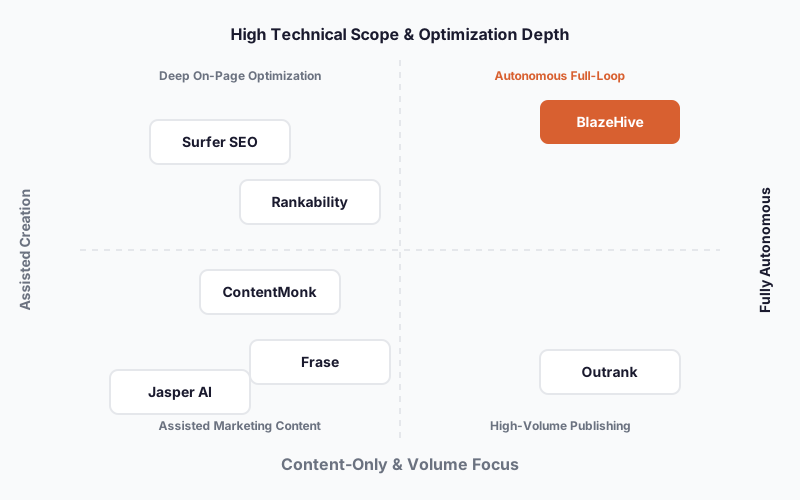
The Best Outrank Alternatives
1. BlazeHive
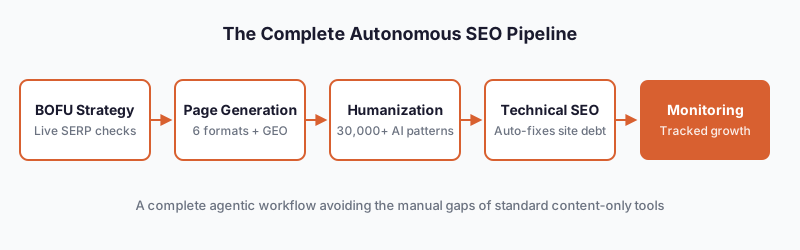
BlazeHive is an autonomous SEO engine that covers the full loop - bottom-of-funnel keyword strategy, six page types, humanization validated against 30,000+ AI writing patterns, technical SEO fixes, acyclic backlink building, and human-monitored growth - for $99/month.
Best for: Indie founders, bootstrappers, and small SaaS/e-commerce teams who need agency-quality SEO output running independently, without an agency budget or a dedicated SEO hire. Also fits medium-sized teams and SEO experts who want steerable control through the agentic SEO chat.
Strengths
- Bottom-of-funnel keyword research with live SERP cross-checking for cannibalization: Google's own results determine whether two keywords compete, not similarity heuristics
- Six page types - landing pages, listicles, comparison/VS pages, FAQ pages, alternatives pages, and interactive tool pages - each targeting a different part of the buying funnel and optimized for LLM citation
- Technical SEO auto-fixes on WordPress: finds broken links, redirect chains, heavy pages, and internal-linking gaps, then fixes them automatically (not just reports them)
- Humanization pass checked against a library of 30,000+ documented AI writing patterns before every page ships
- Acyclic backlink network with per-site pattern avoidance - no two customers ever exchange links, eliminating the reciprocal footprint Google looks for
- Human-monitored growth: the team tracks every customer's GSC data; stagnating sites trigger direct intervention, not silence
- All-in at $99/month: no per-seat fees, no usage add-ons, 3-day free trial with no card required
Where it's not the right fit
- Technical SEO auto-fixing is currently WordPress-only; other platforms are on the roadmap but not live yet
- One page per day is the cadence - if you need a burst of 30 articles published this week, Outrank ships faster
- Less granular optimization control than Surfer SEO; the agent decides structure, not you
Pricing: $99/month all-in, as of August 2026. Done For You setup (technical audit + engine configuration + direct team access): $3,000 one-time + $99/month ongoing. 3-day free trial, no card required.
When to choose it: You're a small team that needs SEO running in the background every day without a strategist, writer, or technical SEO person on payroll - and you want content that converts, stays ranked, and doesn't get flagged as AI slop.
2. ContentMonk
ContentMonk is an AI content marketing platform built for brands that need high-quality, brand-voice-consistent content tracked daily across ChatGPT, Claude, Google AI Overviews, and Perplexity - on every plan, including the $99 Starter.
Best for: Teams for whom AI-search citation metrics are a first-class KPI - especially those reporting LLM visibility to executives or clients.
Strengths
- Tracks AI citation across four LLMs (ChatGPT, Claude, Google AI Overviews, Perplexity) daily on all plans, not just enterprise tiers
- Quality scores of 4.2–4.8/5 across content types in hands-on testing - the clearest quality gap vs. Outrank
- Max article cost capped at $9.90 regardless of length - predictable per-unit economics for planning
- Strong across TOFU, BOFU, ebooks, success stories, and LinkedIn content formats
Where it's not the right fit
- No technical SEO scope; content-only platform
- Requires more brand voice setup than fully autonomous tools
- Less suitable as a single autopilot solution; benefits most when paired with a content strategist
Pricing: Starter $99/month (10 articles/month, 200 tracked keywords, 50 daily AI prompts); Pro $199/month (15 articles, 400 keywords, 3 users); Scale $449/month (30 articles, 600 keywords). As of August 2026. 7-day free trial.
When to choose it: AI citation tracking is in your reporting stack and you need provable LLM visibility, not just Google rankings.
3. Surfer SEO
Surfer SEO is the industry-standard on-page optimization tool for content teams that want real-time scoring against 500+ ranking factors and granular control over article structure, entity coverage, and keyword density.
Best for: Experienced SEO writers and content teams who own the editorial process and want optimization data layered in as they write.
Strengths
- Real-time Content Score powered by 500+ ranking factors - the deepest optimization feedback in the category
- SERP Analyzer breaks down top-ranking pages for structure, length, keywords, and entities
- Audit Tool (Scale plan) flags published pages losing rank and triggers refresh workflows
- 4.7/5 on G2; genuinely the tool content professionals reach for first
Where it's not the right fit
- Content optimization tool, not a publishing engine - requires a human writer or separate AI integration
- Add-ons stack fast: AI Detection ($29/mo) + SERP Analyzer ($29/mo) + Rank Tracker ($8.50 for 100 keywords) more than doubles the base Essential price
- No GEO / AI-citation features; built for Google ranking, not LLM retrieval
Pricing: Essential $99/month (15 content credits, 20 audits); Scale $219/month (100 credits, 5 team members); Enterprise $999/month+. Annual billing saves ~20%. As of August 2026.
When to choose it: Your team has a dedicated SEO writer and wants the deepest optimization guidance available - with full control over every structural decision.
4. Frase
Frase is a brief-first content optimization platform with native dual scoring for both Google rankings and AI-search visibility - the cheapest entry point on the market for GEO-native tooling.
Best for: Content teams with a writer in the loop who want AEO/GEO optimization built in from the start, at the lowest price in this comparison.
Strengths
- GEO scoring built into the platform natively - differentiator vs. Surfer, which doesn't track AI-search visibility
- Entry at $39/month with transparent, predictable pricing (annual) vs. credit-based systems
- SERP research and brief generation from top-ranking pages; Rank-Ready auto-optimized drafts at $3.50 each
- 7-day free trial; AI tracking on Scale+ plans covers ChatGPT, Claude, Perplexity
Where it's not the right fit
- Brief-first architecture still requires a human to write or heavy LLM integration - not a hands-off autopilot
- Credit-based AI character limits become a constraint at publishing scale
- Less SEO depth than Surfer; the GEO focus is the tradeoff
Pricing: Starter $39/month (annual) or $49/month monthly; Professional $103/month annual; Scale $239/month annual. As of August 2026. 7-day free trial.
When to choose it: Budget is the primary constraint, you have a writer, and you need AI-search optimization built into the workflow from day one.
5. Jasper AI
Jasper is a generalist marketing AI platform - Brand Voice engine, multi-format content creation (blogs, ads, email, social), campaigns - built for marketing organizations that need tone consistency across every channel, not just SEO.
Best for: B2B SaaS and brand teams creating marketing content across multiple formats who need consistent tone more than autonomous SEO ranking.
Strengths
- Brand Voice engine is purpose-built for tone consistency across blogs, ads, emails, and social - no equivalent elsewhere in this list
- Broad format coverage: blogs, landing pages, email campaigns, social posts all from one platform
- Jasper's own case studies report 50% reduction in content creation time
- Creator plan at $49/month; lower entry than most multi-format alternatives
Where it's not the right fit
- No integrated SEO workflow - keyword research, optimization, and ranking measurement are separate from Jasper's writing environment
- Quality issues at scale: reviewers note it "tends to repeat arguments, hallucinate, and provide inaccurate figures" on complex topics
- Heavy post-generation editing required; not a one-prompt-to-published tool
- No GEO / AI citation scope
Pricing: Creator $49/month; Pro $59/month annual ($69/month monthly); Business custom. As of August 2026.
When to choose it: Your primary need is marketing-wide tone consistency across every content format - and SEO-specific automation is secondary.
6. Rankability
Rankability is an SEO platform covering content research, optimization, copywriting, auditing, and promotion - built for agencies running research-write-optimize-report cycles.
Best for: Agencies needing a full workflow platform with optimization depth, content quality, and client reporting built into one interface.
Strengths
- Single platform covering optimization guidance, client reporting, and editorial workflow
- Content optimization depth is a standout in head-to-head agency comparisons
- Built for multi-client agency operations, not solo autopilot use
Where it's not the right fit
- Pricing not publicly disclosed; requires sales contact - harder to evaluate without a call
- Not built for hands-off autopilot; assumes a team running the workflow manually
- No backlink or technical SEO auto-fix scope mentioned
Pricing: Custom / sales-driven. Contact Rankability for current rates. As of August 2026.
When to choose it: You're running a multi-client SEO agency and need a workflow platform with optimization depth and reporting over pure automation.
Quick Comparison
| Tool | Best For | Starting Price | Free Tier | Standout Feature |
|---|---|---|---|---|
| BlazeHive | Full-loop SEO autopilot for small teams | $99/mo | 3-day trial (no card) | Technical SEO auto-fixes + acyclic backlinks + human monitoring |
| Outrank | High-volume blog publishing fast | ~$99/mo | No | 30 articles/month with AI images + backlink exchange |
| ContentMonk | AI citation tracking across 4 LLMs | $99/mo | 7-day trial | Daily ChatGPT, Claude, Perplexity, AI Overviews tracking on every plan |
| Surfer SEO | On-page optimization depth + editorial control | $99/mo | No | Real-time Content Score from 500+ ranking factors |
| Frase | Cheapest GEO-native entry point | $39/mo | 7-day trial | Native dual scoring for Google rankings AND AI-search visibility |
| Jasper AI | Multi-format brand voice consistency | $49/mo | No | Brand Voice engine across blogs, ads, email, and social |
| Rankability | Full-workflow agency platform | Custom | No | Research-write-optimize-report cycle in one interface |
Pricing as of August 2026. Check each tool's pricing page for current rates.
Which Alternative Should You Choose?
If you need raw article volume published fast...
Outrank still ships 30 articles per month with images and CMS publishing. If the goal is high-velocity content and you're not worried yet about quality differentiation or AI-search visibility, Outrank delivers volume.
If you need AI citation metrics in your reporting stack...
ContentMonk is the clearest answer - it tracks ChatGPT, Claude, Google AI Overviews, and Perplexity daily on every plan, including the $99 Starter. No other tool on this list provides that breadth at entry pricing.
If you have a writer and want the deepest Google optimization guidance...
Surfer SEO is the standard. Real-time Content Score, SERP Analyzer, and the Scale plan's Audit Tool for refreshing underperforming content. Nothing else on this list goes deeper for teams that own the editorial process.
If you need GEO built in from the start and budget is tight...
Frase is the right call at $39/month. It's brief-first, not autopilot, but it's the cheapest native GEO tool available and significantly cheaper than any competitor here.
If you're a marketing team creating content across every format...
Jasper AI handles blogs, ads, email, and social with a unified Brand Voice engine. SEO is not Jasper's core; cross-channel tone consistency is.
If you're a founder or small team who needs SEO running on autopilot - with no agency, no writer, and no time to babysit it...
BlazeHive is built for this case specifically. Drop a URL; the engine builds a bottom-of-funnel keyword strategy, writes and humanizes pages against 30,000+ AI patterns, fixes technical SEO on WordPress automatically, builds safe backlinks, and has humans watching your rankings. One tool replacing a $8,500+/month agency stack - at $99/month.
If you run a multi-client SEO agency and need a full workflow platform...
Rankability is built for the research-write-optimize-report cycle across client accounts. Contact them for pricing.
Ready to Try BlazeHive?
If you're a founder, small team, or medium-sized team that needs SEO running every day without a strategist, writer, or technical SEO hire, BlazeHive is the only tool in this list that closes the full loop - strategy, writing, humanization, technical fixes, links, and monitoring - at $99/month. Start the 3-day free trial with no card required. The engine crawls your site, discovers your competitors, and starts building a keyword strategy before you finish the onboarding call.
Frequently Asked Questions
What makes BlazeHive different from Outrank?
BlazeHive targets bottom-of-funnel keywords with live SERP cross-checking to prevent cannibalization, while Outrank generates 30 articles monthly without buyer-intent filtering. BlazeHive also fixes technical SEO automatically on WordPress, validates humanization against 30,000+ AI patterns, and has humans monitoring your rankings for decay-Outrank publishes and ghosts. For small teams, this complete loop replaces a $8,500+/month agency stack at $99/month.
Is Outrank still worth using compared to these alternatives?
Yes, if raw article volume matters more than conversion intent or quality. Outrank ships 30 articles per month with AI images and CMS publishing, making it the fastest way to build content volume at scale. But it trades off content quality (2.8–3.2/5 vs. ContentMonk's 4.2–4.8/5), has no cannibalization detection, and no post-publish refresh strategy-so volume alone often doesn't translate to sustained rankings or demos.
What should I look for in an AI SEO tool?
Prioritize buyer-intent keyword targeting over top-of-funnel volume, live SERP cannibalization detection instead of heuristic similarity, and humanization validation against documented AI patterns. Post-publish monitoring-ranking alerts and refresh triggers-separates tools that stay ranked from tools that require constant manual maintenance. Technical SEO scope (broken links, redirect chains, internal linking) and AI-search optimization are increasingly table stakes; ask specifically how each platform handles them.
Which alternative is best for teams that need AI citation tracking?
ContentMonk is the only platform tracking ChatGPT, Claude, Google AI Overviews, and Perplexity daily across all plans, including the $99 Starter-making it the clear choice if LLM visibility is a reportable KPI. Its quality scores (4.2–4.8/5) are the highest in hands-on testing, and article cost is capped at $9.90 regardless of length. For teams reporting AI-search metrics to executives, ContentMonk solves a gap no other tool on this list fills.
What is the cheapest GEO-native entry point?
Frase at $39/month annual billing is the most affordable tool with native dual scoring for both Google rankings and AI-search visibility. It's brief-first, so it requires a writer in the loop or LLM integration, but the transparent pricing and built-in GEO optimization make it the lowest barrier to entry for teams that want AI-search focused content without agency costs. Scale plans add ChatGPT, Claude, and Perplexity tracking at $239/month.
Does BlazeHive fix technical SEO automatically?
On WordPress only-BlazeHive finds broken links, redirect chains, heavy pages, and internal-linking gaps, then auto-fixes them without manual intervention. This is unique among alternatives on this list; most SEO tools either ignore technical debt or report it and leave fixes to you. Other platforms are on the roadmap but not live yet.
Why would I choose Surfer SEO over Outrank or BlazeHive?
Surfer is best for teams with a dedicated SEO writer who want the deepest optimization feedback available-real-time Content Score from 500+ ranking factors and granular control over every structural decision. BlazeHive automates structure; Surfer lets you tune it precisely. Outrank ships volume; Surfer prioritizes quality per page. If your team owns the editorial process and optimization depth is the bottleneck, Surfer's depth is unmatched.
What's the difference between BlazeHive and Frase pricing?
BlazeHive is $99/month all-in with one autopilot engine per site; Frase starts at $39/month annual but is brief-first (requires a writer) and charges per-character for AI generation, so total cost depends on publishing volume. At 10+ articles monthly, BlazeHive's flat rate becomes cheaper than Frase's credit stacking. BlazeHive's Done For You tier adds $3,000 setup plus $99/month for technical audit and team access.
Can I use Jasper AI as my primary SEO tool?
No-Jasper is built for marketing-wide tone consistency across blogs, ads, emails, and social, not as a standalone SEO engine. It lacks integrated keyword research, cannibalization detection, technical SEO scope, and ranking measurement. Use Jasper if multi-format brand voice is your primary need; pair it with a dedicated SEO tool (Surfer, Frase, or BlazeHive) for ranking and strategy.
How does BlazeHive's backlink network differ from Outrank's?
BlazeHive builds an acyclic backlink network where no two sites ever exchange links, eliminating the reciprocal footprint Google looks for in link schemes. Outrank uses a backlink exchange model (Site A links to Site B, Site B links to Site A), which reviewers flag as a policy edge case. BlazeHive's design is safe by construction; Outrank's relies on hope-for-compliance.
Why choose BlazeHive if it only publishes one page per day?
One page per day ranked beats 30 per month generic-BlazeHive's bottom-of-funnel focus and quality mean 30/month typically ranks more keywords than Outrank's 30/month volume spray. Plus BlazeHive automates the entire loop: strategy, writing, humanization, technical SEO fixes, backlinks, and monitoring. If you need a burst of 30 articles published this week, Outrank ships faster; if you need compounding, ranked growth on limited time, BlazeHive's focus wins.
Does Rankability work for small teams or just agencies?
Rankability is built for multi-client agencies running research-write-optimize-report cycles, not solo founders or small in-house teams. Pricing is custom/sales-driven, making it harder to evaluate quickly, and it assumes a team manually running the workflow rather than autopilot running independently. For a 5-person SaaS team, BlazeHive or Frase are better fits; Rankability is for agencies scaling SEO across clients.
What does BlazeHive's humanization actually check for?
Every page passes a de-AI validation checked against a library of 30,000+ documented AI writing patterns before publishing-targeting phrases like "Here's the truth," "Let's dive into," and "In today's digital landscape" that Google now treats as AI signals. This is a core differentiator; Outrank publishes without this pass, which is why its quality scores land 2.8–3.2/5. The exact patterns in the library aren't published (competitive protection), but the scope is broader than spot-check editing.
When should I choose ContentMonk over BlazeHive?
Choose ContentMonk if daily AI-citation metrics across ChatGPT, Claude, Perplexity, and Google AI Overviews are a first-class reporting requirement-BlazeHive assumes you want to be cited but doesn't expose per-page citation counts. ContentMonk's quality (4.2–4.8/5) is higher than Outrank, and tracking is on every plan including Starter at $99/month. BlazeHive wins if you need technical SEO fixes, human monitoring, and bottom-of-funnel strategy; ContentMonk wins if AI visibility metrics drive your reporting stack.