TL;DR
OTTO SEO alternatives come down to what's actually slowing your growth. BlazeHive is the top pick for indie founders and SaaS teams who need a full-stack autonomous engine: bottom-of-funnel keywords, humanized content, technical fixes, and AI citation coverage at $99/month all-in. ClickRank wins for budget-first solopreneurs who only need on-page fixes, and OnCited wins for brands already ranking on Google that now need to own the AI answer engine results.
OTTO SEO Alternatives

OTTO SEO by Search Atlas is a genuinely capable product. 5,000+ agencies use it, and a JavaScript pixel that deploys title tags, schema, and internal links without a developer is real value. But it isn't the right fit for every situation, and in 2026, a meaningful share of buyers searching for alternatives have a specific reason. This page maps the tools that serve those situations honestly, starting with the one that wins for most indie founders and small teams.
Why People Look for OTTO SEO Alternatives
The most common complaint in long-term OTTO SEO reviews is a version of the same frustration: rankings went up, but revenue didn't. OTTO's automated optimizations improve technical signals and on-page scores quickly, but the platform doesn't specialize in buyer-intent keywords. A site can rank for 200 new queries and still see flat leads if those queries belong to researchers 6 months pre-purchase. For teams that need conversions, not just rankings, OTTO's broad-scope keyword approach is a genuine fit problem.
The second recurring friction is the JavaScript pixel architecture. Independent reviewers in 2026 keep landing on the same issue: crawlers that don't execute JavaScript - including the bots behind several major AI engines - can't see JavaScript-injected changes. OTTO's fixes are real for Google. For ChatGPT, Perplexity, and Google AI Overviews, those fixes may as well not exist. As AI answer engines become a meaningful source of buyer discovery, that gap matters.
A third pattern: OTTO is priced and architected for agencies managing portfolios. Starter is $99/month but white-label features require the $399/month Pro tier. For a founder running one or two properties, that's money spent on portfolio features they'll never use. These buyers start looking for something built at their scale.
What to Look for in an Autonomous SEO Tool
Keyword intent specificity. A tool that produces top-of-funnel volume will generate traffic before it generates revenue. Look for systems that filter for buyer-intent keywords explicitly: comparisons, alternatives, best-for queries, transactional modifiers. High volume means nothing if the searcher is 6 months from a purchase.
Full-stack vs. point solution. Most tools do one thing - technical fixes, content generation, or AI visibility. Each leaves a gap the others don't fill. Before buying, identify which lever you're missing and decide whether you'll stitch a multi-tool stack or pay $99/month for a system that covers all of them.
AI citation coverage. Google rankings are table stakes in 2026. The real competitive surface is AI answer engines: ChatGPT, Perplexity, Gemini, Google AI Overviews. A tool that only optimizes for traditional search ignores the fastest-growing discovery channel. Ask whether the platform publishes content formats that AI engines pull from, not just monitors them.
Humanization quality. Generic AI content is a liability. Google's guidance is clear: content that signals low effort loses ranking momentum over time. Look for platforms that validate against documented AI writing patterns, not ones that publish and hope. A 30,000-pattern validation library is meaningfully different from "we add some variation."
Backlink safety architecture. Reciprocal link exchanges are fast but create footprints that manual reviewers and algorithms flag as unnatural. An acyclic backlink graph - where no two sites ever exchange links in both directions - removes that risk by design. Verify this before assuming "built-in backlinks" is a benefit rather than a liability.
Technical auto-fix vs. audit-only. Many platforms tell you what's broken. Fewer fix it. Broken links, redirect chains, and internal-linking leaks silently drain page authority every day they persist. Auto-remediation (even if WordPress-only today) is a different category than a crawl report sitting in a dashboard.
Human oversight on stagnation. Pure autopilot fails silently. A platform that monitors performance and intervenes when a site stops ranking catches failures in weeks, not quarters. Ask whether human eyes are on your account or whether you're on your own after onboarding.
The Best OTTO SEO Alternatives
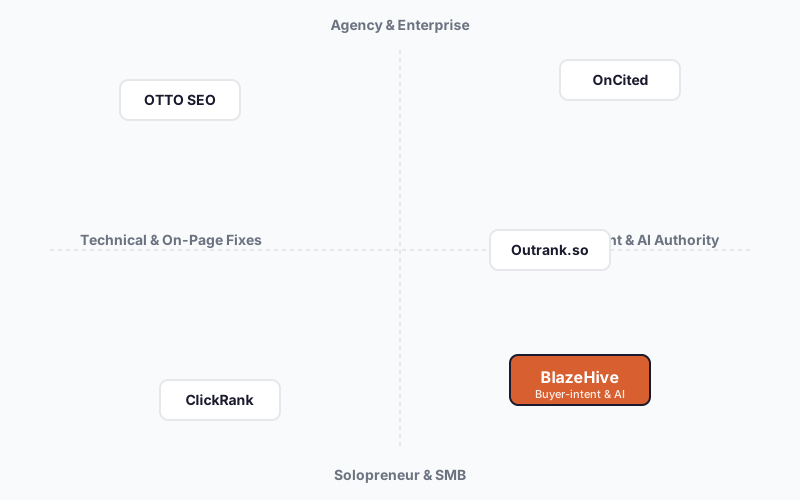
1. BlazeHive
BlazeHive is an autonomous SEO engine that builds, writes, humanizes, and publishes one optimized page per day to your CMS, targeting buyer-intent keywords built to rank on Google and get cited by AI answer engines.
Best for: Indie founders, bootstrappers, and SaaS teams under 20 people who need agency-quality SEO on autopilot without the agency budget or a dedicated SEO hire. Also fits medium-sized teams and SEO experts who want steerable control through the agentic SEO chat.
Strengths
- Bottom-of-funnel keyword research cross-checked against live Google SERPs - no vanity top-of-funnel volume
- De-AI humanization validated against 30,000+ documented AI writing patterns before every page ships
- Six page types including interactive tool pages, FAQ pages, listicles, landing pages, comparison, and alternatives pages - each targeting a different ranking and citation surface
- Technical SEO auto-fixes on WordPress (broken links, redirect chains, internal-linking leaks); other platforms coming
- Acyclic backlink network with per-site pattern avoidance - no reciprocal exchanges, by design
- Human-monitored growth: the BlazeHive team tracks every customer's performance and intervenes if a site stagnates
- Direct CMS publishing to WordPress, Ghost, Webflow, Framer, Contentful, Storyblok, Strapi, and generic webhook; content lives under your domain permanently
- $99/month all-in - no per-seat fees, no usage add-ons, 3-day free trial with no card required (as of August 2026)
Where it's not the right fit
- Technical SEO auto-fixing is WordPress-only today; non-WordPress sites get audit output, not auto-remediation
- English-focused; not the right tool for multilingual content programs needing 20+ languages
- Earlier-stage product vs. OTTO's 5,000+ agency base - fewer contractors who already know the platform
Pricing: $99/month all-in. Done For You: $3,000 one-time setup + $99/month. 3-day free trial, no card required. As of August 2026.
When to choose it: You're an indie founder, small SaaS team, or medium-sized team that needs the full stack - keyword research, daily content, technical fixes, backlinks, and AI citation coverage - without hiring an agency or stitching five separate tools together at $400–$1,000/month.
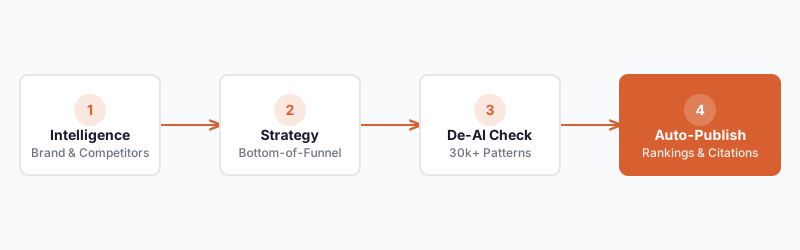
2. OTTO SEO by Search Atlas
OTTO SEO is an autonomous technical SEO agent that deploys via a JavaScript pixel and continuously applies fixes (title tags, schema, internal links, canonical issues) across managed sites without developer tickets.
Best for: Digital marketing agencies managing 10+ client sites who need fast technical deployment, multi-platform coverage, and white-label reporting bundled in one platform.
Strengths
- JavaScript pixel deploys instantly on WordPress, headless Shopify, and via universal connector across other platforms
- Atlas Agent handles multi-channel workflows (SEO, PPC, local SEO, AI visibility) via natural language
- LLM Visibility Tracker monitors brand appearance in ChatGPT, Perplexity, and other AI engines (higher tiers)
- 5,000+ agencies as customers - contractor familiarity and ecosystem gravity
- Deep Freeze feature preserves OTTO-applied changes even if you cancel
Where it's not the right fit
- JavaScript-injected changes aren't visible to crawlers that don't execute JavaScript, including bots behind several major AI engines
- White-label dashboard requires the $399/month Pro tier - Starter and Growth are excluded
- Platform stability and ranking volatility after bulk changes are recurring themes in longer-term reviews
- Not built for bottom-of-funnel keyword specialization; better suited for broader optimization at portfolio scale
Pricing: Starter $99/month, Growth $199/month, Pro $399/month. 7-day free trial. As of August 2026.
When to choose it: You run an agency managing dozens of client sites, need white-label reporting, and want a platform the SEO contractor market already knows how to operate.
3. ClickRank
ClickRank is an AI-driven on-page SEO automation tool focused on title tag optimization, meta description generation, schema markup, and internal linking fixes. It's priced and scoped as a leaner option than OTTO for small sites.
Best for: Solopreneurs and freelancers managing 1–3 sites who have content and link building covered and need only on-page technical fixes at the lowest possible monthly cost.
Strengths
- Entry price of $59/month (Solo tier) - nearly three times cheaper than OTTO SEO Starter
- Real-time Google Search Console integration baked in - decisions come from live GSC data, not estimates
- One-click batch fixes for title tags, meta descriptions, headings, and internal links
- AI SEO agent provides plain-English fix recommendations based on actual search performance
- Tracks citations in Google AI Overviews and monitors AI model compatibility
Where it's not the right fit
- No content generation - it optimizes pages but doesn't create them
- No backlink strategy or link building capability at any tier
- Not designed for teams that need full-stack automation; scope is intentionally narrow
- Limited independent review data; still an early-stage platform with thin long-term track record
Pricing: Solo $59/month (1 site), Business $79/month (3 sites), Agency $399/month (10 sites). 7-day money-back guarantee. As of August 2026.
When to choose it: Your content strategy is solid, your links are covered, and you just need someone to stop the on-page leaks without paying $99/month for features you'll never touch.
4. Outrank.so
Outrank.so is an automated blog content platform that writes, optimizes, and publishes up to 90 articles per month directly to your CMS on a fixed schedule - AI images included.
Best for: Established brands with strong conversion funnels that want high-volume top-of-funnel content in multiple languages without any editorial involvement.
Strengths
- Publishes 30–90 articles per month automatically - G2 rating of 4.6/5 with consistency and automation as standout positives
- 150+ language support - the only platform on this list built for multilingual programs at scale
- Built-in backlink exchange network for fast authority building
- Truly hands-off: no steering, no strategy calls, no briefing
- Integrates with WordPress, Shopify, Notion, Wix, and Framer
Where it's not the right fit
- Backlink exchange model creates reciprocal footprints that SEO professionals flag as higher-risk than acyclic networks
- No technical SEO fixes - broken links, redirect chains, and internal linking issues stay broken
- Limited customization in content templates; users report this as the primary frustration
- Not optimized for bottom-of-funnel buyer-intent keywords; volume-first approach
Pricing: Standard $99/month (~30 articles), ~$149/month (~60 articles), ~$199/month (~90 articles). $1 three-day trial. As of August 2026.
When to choose it: You need multilingual content volume at scale, you have a strong funnel that converts top-of-funnel traffic, and you're comfortable with a reciprocal backlink model.
5. OnCited
OnCited is a done-for-you AI visibility and citation platform that tracks how ChatGPT, Perplexity, Gemini, and seven other AI engines answer queries about your brand - and then publishes citations on Reddit, Quora, YouTube, niche forums, and a purpose-built blog network to improve your appearance in those answers.
Best for: Mid-market and enterprise brands that have already solved Google ranking and now need to own AI answer engine citations with a managed execution team.
Strengths
- Tracks 10+ AI engines daily using real apps (not APIs) - ChatGPT, Perplexity, Gemini, Claude, Copilot, Grok, Google AI, DeepSeek, Meta AI
- Done-for-you execution: OnCited's team publishes content; buyer doesn't DIY anything
- 4.9/5 on G2 across 400+ brands
- Share-of-voice and sentiment tracking per AI engine vs. named competitors
- White-label reporting on Scale tier for agencies
Where it's not the right fit
- Price floor of $399/month excludes most indie founders and small teams
- No Google SEO optimization, technical audit, or content generation for SERP ranking
- Done-for-you model means no DIY self-service path; you're buying managed execution, not a software tool
- Not built for teams that need Google revenue before AI visibility - OnCited is AI-first
Pricing: Starter $399/month, Growth $999/month, Scale $2,499/month. Free 60-second AI Visibility Audit, no card required. As of August 2026.
When to choose it: You're a brand already ranking well on Google, you have budget above $399/month, and your next growth lever is owning the ChatGPT and Perplexity answers in your category.
Quick Comparison
| Tool | Best For | Starting Price | Free Tier | Standout Feature |
|---|---|---|---|---|
| BlazeHive | Indie founders & SaaS teams needing full-stack autonomy | $99/mo | 3-day trial, no card | Bottom-of-funnel keywords + 30,000-pattern de-AI humanization |
| OTTO SEO | Agencies managing 10+ client sites | $99/mo | 7-day trial | JavaScript pixel deploys fixes without developer tickets |
| ClickRank | Solopreneurs needing on-page fixes only | $59/mo | 7-day money-back | Real-time GSC-driven one-click batch optimization |
| Outrank.so | Multilingual brands wanting content volume | $99/mo | $1 3-day trial | 150+ languages, up to 90 auto-published articles/month |
| OnCited | Enterprises targeting AI answer engine citations | $399/mo | Free audit | Done-for-you Reddit/Quora/forum citations across 10+ AI engines |
Pricing as of August 2026. Check each tool's pricing page for current rates.
Which Alternative Should You Choose?
Most people reading this page are running one brand, not a 50-client portfolio. Start there.
If you need the full stack at one price...
BlazeHive is the call. $99/month covers keyword research, daily content production, de-AI humanization, technical SEO auditing (with WordPress auto-fixes), a contextual backlink network, and human-monitored growth reporting. It replaces a multi-tool stack that would otherwise cost $400–$1,000/month.
If you manage an agency portfolio of 10+ client sites...
OTTO SEO is better suited. Its multi-user seats, portfolio-level management, Atlas Agent for multi-channel execution, and white-label dashboard on Pro ($399/month) are built for that operational model. BlazeHive is not the right fit for managing 50 clients.
If you only need on-page fixes and already have content covered...
ClickRank at $59/month wins. It's purpose-built for exactly that scope - batch title tags, meta descriptions, schema, and GSC-driven recommendations - without paying for features you don't need.
If you need multilingual content at volume...
Outrank.so is the only platform on this list with 150+ language support at scale. BlazeHive is English-focused. If your program requires content in 20+ languages, Outrank handles the volume; just monitor your backlink profile.
If AI answer engines are your primary growth channel...
OnCited is the right tool. It's built from the ground up for ChatGPT, Perplexity, and Gemini citation dominance with a managed team executing on Reddit, Quora, and niche forums. It does not do Google SEO - that's by design. If you're already ranking and need to own AI answers, $399/month buys real execution, not a dashboard.
Ready to Try BlazeHive?
If you're an indie founder, small SaaS team, or medium-sized team that needs one ranked, buyer-intent page per day - with humanized content, technical SEO coverage, and AI citation optimization - all under your domain, BlazeHive is the right tool for that. Drop your URL, and the engine handles the rest: strategy, writing, validation, and publishing. Three-day free trial, no card required.
Frequently Asked Questions
What should I look for in an autonomous SEO tool?
Look for systems that filter explicitly for buyer-intent keywords-comparisons, alternatives, best-for queries-rather than vanity top-of-funnel volume. Full-stack solutions covering keyword research, content generation, technical fixes, and backlinks eliminate the pain of stitching five separate tools together. Verify whether the platform validates content against documented AI writing patterns and whether backlinks are built safely (acyclic, no reciprocal exchanges). Human oversight on stagnation matters: a platform that monitors performance and intervenes when rankings plateau catches failures in weeks, not quarters.
How does BlazeHive differ from OTTO SEO?
BlazeHive targets buyer-intent keywords and publishes one humanized page per day; OTTO SEO optimizes existing pages for technical signals at portfolio scale. OTTO's JavaScript pixel deploys instantly across many platforms but isn't visible to AI crawlers that don't execute JavaScript-a gap that matters as ChatGPT and Perplexity become discovery channels. BlazeHive auto-fixes broken links and redirects on WordPress directly; OTTO's changes are invisible to non-JavaScript crawlers. For indie founders needing the full stack at $99/month, BlazeHive wins; for agencies managing 50 client sites, OTTO's portfolio features and white-label tier justify the higher cost.
Is OTTO SEO still worth using?
Yes, for agencies and teams managing 10+ client sites who need fast technical deployment and multi-platform coverage under one white-label dashboard. OTTO's JavaScript pixel, Atlas Agent for natural-language workflows, and 5,000+ agency user base create real operational gravity that solo founders don't need. The platform excels at portfolio-level management and multi-user coordination-places where BlazeHive, ClickRank, and Outrank don't compete. If you're a solo founder, small team, or hands-on SEO expert, OTTO's portfolio features and higher price ($99–$399/month depending on tier) make it overkill; if you're managing dozens of client sites, it's the right tool.
Why does BlazeHive focus on bottom-of-funnel keywords?
Bottom-of-funnel keywords-best CRM for 50-person teams, alternatives to Salesforce-capture buyers ready to move this month, not researchers six months pre-purchase. A site ranking 50 top-of-funnel keywords often sees flat traffic and leads because those queries belong to people early in their journey; one ranked buyer-intent keyword converts faster. BlazeHive's algorithm filters for conversion intent explicitly because indie founders and SaaS teams have no room for vanity volume-they need ranked pages that sell. OTTO SEO's broader keyword database (5.2 billion keywords) scales across agencies; BlazeHive's smaller, curated set prioritizes signal clarity over raw volume.
What is de-AI humanization and why does it matter?
De-AI humanization is validation that published content doesn't trigger AI-detection heuristics-checked against 30,000+ documented patterns before shipping. Generic AI writing loses ranking momentum over time; Google's guidance makes clear that content signaling low effort gets penalized gradually. BlazeHive validates every page against this pattern library; competitors like Outrank and OTTO publish and hope. As of 2026, authenticity-validated content holds rank better than generic AI output, making this the difference between stable long-term rankings and silent erosion.
How do BlazeHive's backlinks compare to Outrank's?
BlazeHive deploys an acyclic backlink network where no two sites ever exchange links bidirectionally, eliminating the reciprocal footprint that manual reviewers and algorithms flag as unnatural. Outrank's backlink exchange model is faster but creates exactly the footprint Google's textbook "unnatural link" guidance warns against. For brands that can't afford a backlink penalty, BlazeHive's design removes that risk by construction; Outrank accepts the risk in exchange for speed. Neither platform is objectively "better"-the choice depends on your risk tolerance and timeline.
What is the best OTTO SEO alternative overall?
For indie founders and SaaS teams: BlazeHive at $99/month all-in-keyword research, daily content, de-AI humanization, technical auditing, backlinks, and human-monitored growth. For agencies managing 50+ clients: OTTO SEO's white-label dashboard and portfolio features still justify the cost. For solopreneurs needing only on-page fixes: ClickRank at $59/month. For multilingual volume: Outrank at $99/month for 30–90 articles across 150+ languages. For AI answer engine dominance: OnCited at $399/month with managed Reddit/Quora execution. The "best" alternative is determined by your team size, budget, and which growth lever is currently slowing you down.
Which OTTO SEO alternative is best for indie founders?
BlazeHive is built for exactly this audience-indie founders and bootstrapped SaaS teams needing agency-quality output on autopilot without hiring or the agency budget. At $99/month all-in, it eliminates the cost of stitching keyword research, content production, technical SEO, backlinks, and growth monitoring into a multi-tool stack. The platform publishes one buyer-intent page per day to your CMS (WordPress, Webflow, Ghost, and others) with humanization validated against 30,000+ AI patterns. If you're running one or two properties and need the full stack, BlazeHive's pricing and scope are built for your situation; OTTO's portfolio features and higher tiers add cost you won't use.
What is the difference between autonomous SEO and agent-based SEO?
Autonomous SEO platforms run on fixed schedules-every day they publish content, optimize pages, or run audits regardless of business signals. Agent-based SEO systems respond to steering-you ask the agent to research keywords, adjust strategy, or diagnose stagnation, and it executes on-demand with full context. BlazeHive's engine runs autonomously (one page daily) but is steerable via a chat agent that has full context on your site, keywords, and performance. OTTO SEO's Atlas Agent is natural-language steering for multi-channel workflows (SEO, PPC, local SEO) but doesn't autonomously publish. The distinction matters: pure autonomy is "set and forget"; steering allows course correction when rankings stagnate or strategy needs to shift.
Does BlazeHive include backlink building?
Yes. BlazeHive's contextual backlink network is automated and built as an acyclic graph-no site ever exchanges links bidirectionally, which eliminates the reciprocal footprint that flags pages as paid-link schemes. This is included in the $99/month all-in pricing, unlike platforms where link building is a separate add-on or tier. The network grows link equity more slowly than reciprocal exchange models (like Outrank) but carries zero penalty risk by design. For founders who need safe, compounding authority growth without manual outreach or developer involvement, this is foundational rather than a luxury feature.
Why is technical SEO auto-fixing important?
Technical debt-broken links, redirect chains, heavy pages, weak internal linking-silently drains page authority every single day it persists, even when content is ranking well. Most platforms audit and report; BlazeHive fixes directly on WordPress (broken links, redirects, internal-linking issues) without a developer ticket. This eliminates the common scenario where a page ranks #2 for 100 keywords but loses authority because 50 broken internal links leak ranking signals. On non-WordPress platforms, this feature isn't available yet; on WordPress, it's table-stakes for compounding long-term authority. OTTO SEO also auto-fixes via pixel, but JavaScript-injected changes aren't visible to AI crawlers, so the fixes don't help with ChatGPT or Perplexity citations.
Can I run BlazeHive and OTTO SEO in parallel?
Yes, and many buyers testing alternatives do exactly this for 30 days before switching. BlazeHive publishes to standard CMS platforms (WordPress, Webflow, Ghost, etc.); OTTO works via JavaScript pixel on the same sites. You can run both engines simultaneously, see which performs better for your traffic and conversion goals, then commit to one. The risk of switching away from OTTO is lower if your rankings are already performing well-moving established pages to another platform can cause ranking volatility. If OTTO's pages are stagnant on revenue despite ranking, that's the signal to try BlazeHive's buyer-intent focus and human monitoring instead.
What is ClickRank best for?
ClickRank at $59–$79/month is purpose-built for solopreneurs and freelancers who have content and link building covered but need on-page fixes without paying for features they'll never use. It optimizes title tags, meta descriptions, headings, schema, and internal links in batch mode using live Google Search Console data as the source of truth. If your content strategy is solid and your only gap is cleaning up on-page signals, ClickRank wins on cost and focus. The trade-off: no content generation, no link building, no technical crawling-it's intentionally narrow, which is why it's cheaper than BlazeHive or OTTO.
Should I choose Outrank or BlazeHive?
Choose Outrank if you need 30–90 auto-published articles per month in 150+ languages and you have a strong conversion funnel that monetizes top-of-funnel traffic. Choose BlazeHive if you need one daily page targeting buyer-intent keywords, humanization validated against AI patterns, technical fixes, and human-monitored growth. Outrank's backlink exchange is faster but creates reciprocal footprints; BlazeHive's acyclic network is safer. Outrank is set-and-forget volume; BlazeHive is steerable authority. For English-only brands prioritizing conversion over volume, BlazeHive wins. For multilingual programs or established brands that monetize top-of-funnel, Outrank wins.
Why would I choose OnCited over BlazeHive?
Choose OnCited if you've already solved Google ranking and your next growth lever is owning the ChatGPT and Perplexity answers in your category. OnCited tracks 10+ AI engines daily and executes managed placements on Reddit, Quora, and niche forums; BlazeHive publishes to your domain for Google and AI visibility secondary. At $399/month minimum, OnCited targets mid-market and enterprise brands with budgets beyond what indie founders can spend. For teams that measure success in AI mentions first and Google rankings second, OnCited is right. For founders who need Google revenue before AI visibility, BlazeHive wins-then layer OnCited later as a second motion once baseline rankings are stable.
Why is human monitoring part of BlazeHive's model?
Pure autopilot fails silently-a content page publishes but never ranks, draining budget without visible failure signals. BlazeHive's team tracks every customer's performance and intervenes if a site stagnates (no new rankings in 30+ days), diagnosing whether the issue is keyword selection, technical drift, or external competition shifts. This is operational overhead that true "set-and-forget" platforms like OTTO and Outrank skip; it's why BlazeHive's support footprint is smaller but why early-stage founders who bought autopilot and got burned by silent underperformance choose it. For small teams without internal SEO expertise, this human layer catches failures early and resteers strategy-turning autopilot from a liability into a safety feature.