TL;DR
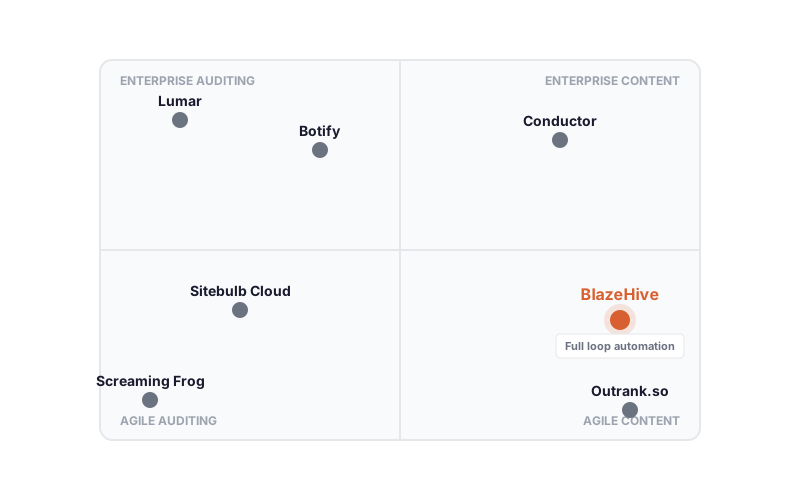
Lumar alternatives split into two categories: tools that crawl and audit, and tools that create and publish. BlazeHive is the top pick if you need daily, hands-off SEO content production at $99/month - roughly 27x cheaper than Lumar's estimated floor. Screaming Frog wins for affordable technical crawling; Botify or Conductor for enterprise-scale technical depth plus content.

Lumar Alternatives
Lumar (formerly Deepcrawl) is genuinely excellent at what it does: crawling millions of URLs, automating QA in CI/CD pipelines, and keeping enterprise sites technically clean. But if you're here, you're either priced out of it, missing content production tools, or both. This page maps the real alternatives - by use case, not just feature count - so you can make the right call for your situation.
Why People Look for Lumar Alternatives
Lumar's pricing is the most common trigger. There are no public tiers; estimates put the floor at roughly $2,667/month, and enterprise contracts can run $30,000–$400,000+ annually depending on URL volume and modules. For most small and mid-market teams, that's not a line item - that's a hiring decision they can't justify.
Beyond price, the scope mismatch bites hard. Lumar is a technical auditing platform: it finds issues, monitors site health, and automates QA. It doesn't do keyword research, content creation, or link building. Teams that expected a comprehensive SEO platform often discover they still need separate tools for everything that drives traffic - writing, research, and publishing. Lumar tells you what's broken; it doesn't build the content that brings visitors in.
A third group leaves because Lumar's complexity assumes technical expertise. The platform's power - 350+ KPIs, GraphQL API, log file ingestion, custom metrics tables - is a feature for large engineering-backed teams. For a two-person SaaS or a solo founder, the interface is overkill, and the learning curve doesn't pay off for the job they're actually trying to do. These users aren't looking for a lighter version of Lumar; they want a different kind of SEO tool entirely.
What to Look for in an SEO Tool
Crawl depth vs. content output: Some tools crawl and audit; others create and publish. Be clear which problem you're solving. If your site is technically broken at scale, you need a crawler. If your site is technically fine but invisible because you're not publishing optimized content, you need a content engine. Most teams need both - and the best approach is often a cheap crawler plus a content automation tool, not one expensive platform.
Pricing transparency: Enterprise-only pricing means you won't know the number until a sales call - which means budget uncertainty until late in the evaluation. If you're a small team or agency, tools with published pricing (even if imperfect) give you real planning data. Surprises at contract time are a workflow tax.
Automation depth: "AI-assisted" usually still means a human briefs, edits, and publishes. True automation means the tool handles keyword research, writing, humanization, validation, and CMS publishing without you in the loop. Know what the tool hands back to you and what it does itself.
Technical SEO coverage: Crawlers vary enormously. A £199/year desktop tool finds broken links and redirects. An enterprise crawler finds JavaScript rendering failures, log file anomalies, and CI/CD deploy issues. Know what size and complexity your site actually needs.
AI citation targeting (GEO): Ranking on Google is no longer the only goal. ChatGPT, Perplexity, and Google AI Overviews now pull from the web - and the pages they cite are specifically structured ones. If you care about being cited in AI answer engines, check whether the tool builds for that or just monitors it.
Humanization and content quality: Generic AI content gets penalized and often cannibalizes itself. Look for tools that validate against documented AI writing patterns and detect keyword cannibalization against live SERPs - not similarity heuristics. The difference between a page that ranks and one that silently competes with three others on your own site is in the validation step.
Integration and publishing: A tool that writes but doesn't publish adds a manual step that compounds weekly. Direct CMS publishing (WordPress, Webflow, Ghost, Contentful, etc.) is the difference between autopilot and semi-manual.
The Best Lumar Alternatives
1. BlazeHive
BlazeHive is an autonomous SEO engine that replaces the strategist + writer + designer + publisher stack with a single $99/month agent - running keyword research, writing, humanization, technical SEO, backlinks, and CMS publishing daily, with no human in the loop.
Best for: Indie founders, bootstrapped SaaS teams, SMBs, and agencies who need daily optimized content published to their CMS without hiring writers or paying agency rates. Also fits medium-sized teams and SEO experts who want steerable control through the agentic SEO chat.
Strengths
- Full loop automation: keyword research → content writing → humanization → validation → CMS publishing in one pipeline
- Humanization validated against 30,000+ documented AI writing patterns - pages don't read like AI
- Cannibalization detection via live SERP cross-checking (verdicts from Google itself, not guesswork)
- Six page types targeting different ranking angles: landing pages, listicles, comparisons, VS pages, FAQ pages, and interactive tool pages
- Built for AI citations (GEO) from day one - structured specifically for ChatGPT, Perplexity, and Google AI Overviews
- Technical SEO auto-fixing on WordPress; validation across all CMS platforms
- Contextual backlink network with acyclic design - no reciprocal link exchanges by construction
- Google Search Console integration for source-of-truth growth reporting
- Dogfooded: BlazeHive uses BlazeHive to grow blazehive.io in real time
Where it's not the right fit
- Not built for crawling millions of URLs or enterprise-scale technical auditing
- Technical SEO auto-fixing is WordPress-only currently (other platforms coming)
- Not a CI/CD pre-deploy QA tool - teams needing deploy-gate automation should look at Lumar Protect
Pricing: $99/month (all-in, as of August 2026). 3-day free trial, no card required. Done For You: $3,000 one-time setup + $99/month with direct team access and technical SEO analysis.
When to choose it: You're a small or mid-market team that needs compounding organic traffic but can't pause shipping to do SEO daily. BlazeHive delivers one ranked, AI-cited page per day for $99/month - the whole loop, not just one piece of it.
2. Screaming Frog SEO Spider
Screaming Frog is a desktop-based website crawler that finds technical SEO issues - broken links, redirect chains, duplicate content, missing metadata - at a price point accessible to any team.
Best for: Individual SEO professionals, small agencies, auditing contractors, and teams managing sites under 1M pages who want affordable technical crawling with full desktop control.
Strengths
- Free tier covers up to 500 URLs with basic crawl features - genuinely useful for small sites
- Paid license at £199/year (~$279 USD) with unlimited crawl size; volume discounts available for agencies
- 300+ SEO issues identified per crawl; breadth-first crawl algorithm mimics Googlebot behavior
- Near-duplicate content detection with AI-powered semantic similarity
- JavaScript rendering, custom extraction, and API integrations on the paid tier
- Trusted by Apple, Google, Disney, Amazon, and NASA - not a toy
Where it's not the right fit
- Desktop-only: no cloud collaboration, no shared team dashboards
- Not built for continuous monitoring - you crawl on demand, it doesn't alert when things break
- No content creation, keyword research, or publishing capabilities
Pricing: Free (500 URLs); £199/year (~$279 USD) paid license, as of 2025.
When to choose it: You need a capable technical crawler at a fraction of enterprise costs. Pair it with BlazeHive for content production and you've covered both sides of SEO for roughly $380/month combined.
3. Botify
Botify is an enterprise SEO platform built for large-scale technical crawling, log file analysis, and AI search optimization. It targets the same Fortune 500 segment as Lumar.
Best for: Enterprise websites with millions of pages (e-commerce, publishing, travel), large agencies managing multiple high-volume client sites.
Strengths
- Crawling, log file analysis, and content optimization in one platform (SiteCrawler, LogAnalyzer, RealKeywords, EngagementAnalytics)
- Botify Activation modules (SpeedWorkers, FastIndex) for indexing optimization at scale
- Rated "Strong Performer" in Forrester Wave: SEO Solutions Q3 2025 with highest possible scores in 11 criteria including AI-integrated SEO and workflow automation
- G2 rating 4.4/5; 500+ enterprise clients including Expedia, Nike, and Marriott
- AI performance metrics and content optimization recommendations
Where it's not the right fit
- No self-serve tier; custom pricing only - budget uncertainty until sales engagement
- Typical range $30,000–$400,000+ annually; not accessible for SMBs or indie founders
- Content optimization gives recommendations; a human still writes and publishes
Pricing: Custom enterprise; typical range $30,000–$400,000+/year, as of 2025.
When to choose it: You're an enterprise brand with millions of pages, a technical SEO team, and need a crawl-to-content analytics stack that goes as deep as it gets. If Lumar is on your shortlist, Botify is the closest feature-parity competitor.
4. Outrank.so
Outrank is an AI-powered SEO content automation platform that publishes daily articles, generates 30-day content calendars, and bundles an opt-in backlink exchange network.
Best for: Digital marketers, solopreneurs, and SEO specialists seeking hands-off daily blog content with an integrated backlink program.
Strengths
- Automated daily article publishing with SERP-aware optimization and 30-day calendar generation
- AI content up to 3,000 words per article; support for 150+ languages
- Integrated backlink exchange (customer-to-customer opt-in) - backlinks come bundled, not as a separate build
- CMS integrations: WordPress, Shopify, Notion, Wix, Framer, Webflow, and others
- G2 rating 4.6/5; praised for ease of use and automation
Where it's not the right fit
- No humanization pass equivalent to BlazeHive's de-AI validation against 30,000+ documented patterns
- No cannibalization detection - two articles can compete for the same query without warning
- No technical SEO auto-fixing or structured GEO targeting
Pricing: Standard $99/month (~30 articles); $149/month (~60 articles); $199/month (~90 articles), as of 2025.
When to choose it: You want daily automated content and value having a backlink exchange bundled in. If the backlink network is a priority over deep humanization and cannibalization safeguards, Outrank is the comparable-priced alternative.
5. Conductor
Conductor is an enterprise platform that combines AI content creation, SEO intelligence, AI search visibility (AEO), and 24/7 technical monitoring.
Best for: Mid-market and enterprise organizations with dedicated SEO teams who need content creation, traditional rankings, and AI search visibility (AEO) in one platform.
Strengths
- Unified content + SEO + AEO: Conductor Creator, Intelligence, and Monitoring in one platform
- AI search visibility tracking across Google, ChatGPT, Perplexity, and others
- 24/7 technical SEO monitoring with unlimited users
- Broad integrations and enterprise support tier
- Median annual contract around $49,510 (Vendr data)
Where it's not the right fit
- Custom pricing only; $3,000–$10,000+/month for platform access, $20,000–$100,000+/month with agency partnerships
- Not self-serve; implementation requires significant onboarding
- Content generation still requires human editorial oversight - not a true autopilot
Pricing: Custom enterprise; typical $3,000–$10,000+/month, as of 2025.
When to choose it: You're mid-market or enterprise, need AEO and SEO under one roof with human-reviewed content, and can justify the spend. The unified reporting on AI citation visibility is genuinely differentiated at the enterprise tier.
6. Sitebulb Cloud
Sitebulb is a cloud-based SEO audit tool that sits between Screaming Frog's price point and Lumar's enterprise depth, with both desktop and cloud deployment options.
Best for: Growing agencies and mid-market marketing teams that need cloud collaboration on technical audits without paying enterprise prices.
Strengths
- Cloud deployment enables team collaboration (vs. Screaming Frog's desktop-only model)
- 100+ SEO audit checks with JavaScript rendering
- Desktop and cloud options give teams deployment flexibility
- 14-day free trial on cloud version
Where it's not the right fit
- Not built for crawling sites with millions of URLs at enterprise scale
- No content creation, publishing, or keyword research capabilities
- Cloud version starts at ~£95/month ($134 USD) - more than Screaming Frog for similar crawl coverage
Pricing: Cloud from £95/month ($134 USD); 14-day free trial, as of 2025.
When to choose it: You want shared team access to technical audits without paying enterprise prices - and Screaming Frog's desktop-only model is the main friction in your workflow.
Quick Comparison
| Tool | Best For | Starting Price | Free Tier | Standout Feature |
|---|---|---|---|---|
| BlazeHive | Daily content automation + GEO | $99/mo | No (3-day trial) | Full loop: strategy → write → publish → links → fix |
| Screaming Frog | Affordable technical crawling | £199/yr (~$279) | Yes (500 URLs) | 300+ issues found at desktop-control price |
| Botify | Enterprise crawl + AI performance | Custom ($30K+/yr) | No | Log file + crawl + content optimization unified |
| Outrank.so | Hands-off daily blog + backlinks | $99/mo | No ($1 trial) | Bundled customer-to-customer backlink exchange |
| Conductor | Enterprise AEO + content creation | Custom ($3K+/mo) | No | Unified AI + traditional search visibility reporting |
| Sitebulb Cloud | Mid-market team auditing | No (14-day trial) | Desktop + cloud deployment in one product |
Pricing as of August 2026. Check each tool's pricing page for current rates.
Which Alternative Should You Choose?
If you need daily content published to your CMS without hiring writers...
BlazeHive is built exactly for this. At $99/month it handles keyword research, writing, humanization, validation, and CMS publishing autonomously. No briefing, no editing queue, no publishing step. One page per day, compounding over time.
If you need affordable technical crawling for site audits...
Screaming Frog is the right call. At £199/year it covers 300+ issue types, runs unlimited crawls (paid tier), and doesn't require a sales call. For teams managing sites under 1M pages, it handles most of what Lumar does in the technical audit dimension - at a fraction of the cost.
If you need enterprise-scale crawling with content optimization...
Botify is the closest direct competitor to Lumar. It adds AI performance metrics and content recommendations on top of deep crawling and log file analysis. If you're choosing between Botify and Lumar, the deciding factor is usually whether your priority is QA automation (Lumar) or content optimization intelligence (Botify).
If you want both content and AEO in one enterprise platform...
Conductor consolidates AI search visibility, content creation, and technical monitoring. Mid-market and enterprise teams that need unified reporting on how they rank in both Google and AI answer engines - and have the budget for custom pricing - will find it fits the bill.
If you want automated content with a bundled backlink exchange...
Outrank.so includes an opt-in customer-to-customer backlink network alongside its daily article publishing. If integrated backlinks are a priority over deep humanization and cannibalization safeguards, it's the comparable-priced option to BlazeHive.
If you need cloud-based team auditing at a mid-market price...
Sitebulb Cloud sits between Screaming Frog's desktop-only model and Lumar's enterprise cost. Teams that need shared audit access without paying five figures a year should start here.
Ready to Try BlazeHive?
If you're a founder, small marketing team, or medium-sized team that needs daily, ranked, AI-cited pages without hiring writers or paying agency rates, BlazeHive is the direct answer. Start a 3-day free trial - no card required - and have your first page researched, written, and ready to publish before the trial ends. If you stagnate, the team intervenes. If it's not the right fit, you've lost nothing.
Frequently Asked Questions
What should I look for in a Lumar alternative?
The best alternative depends on whether you're solving for technical auditing or content production-most teams actually need both. If your blocker is broken links and redirect chains costing traffic, you need a crawler like Screaming Frog or Botify. If your blocker is publishing enough optimized content to rank, you need BlazeHive or Outrank. Look for pricing transparency, true automation (not just "AI-assisted"), and whether the tool publishes to your CMS or hands work back to you.
Is there a free Lumar alternative?
Screaming Frog's free tier covers up to 500 URLs and identifies 300+ SEO issues-genuinely useful for small sites under that limit. BlazeHive offers a 3-day free trial with no card required, and you'll have your first page researched and written before it expires. For most small teams, Screaming Frog free + BlazeHive trial gives you both technical crawling and content automation tested before spending anything.
What makes BlazeHive different from other Lumar alternatives?
BlazeHive is the only alternative that automates the entire SEO loop in one $99/month product: keyword research, writing, humanization against 30,000+ AI patterns, validation against live Google data, technical SEO fixes (WordPress), backlinks, and CMS publishing-daily, with no human in the loop. Most alternatives excel at one dimension (Screaming Frog at crawling, Outrank at content scheduling); BlazeHive chains them together and publishes autonomously. Lumar focuses on technical auditing and QA automation; BlazeHive focuses on compounding content velocity and AI citations.
How much cheaper is BlazeHive than Lumar?
Lumar's estimated floor is roughly $2,667/month with no public pricing; BlazeHive is $99/month all-in, making it approximately 27 times cheaper. That $99/month includes keyword research, content writing, humanization, technical validation, backlink building, and CMS publishing-the entire content production stack that Lumar doesn't cover at all. For small teams and agencies, the price difference isn't just a line item; it's the difference between affording daily SEO output and needing to hire writers or pay agency rates.
Should I use Lumar or BlazeHive?
Choose Lumar if you're an enterprise managing millions of pages and need pre-deploy QA automation, WCAG compliance auditing, or single-view monitoring across 50+ client sites. Choose BlazeHive if you're a small team or agency that needs daily, ranked, AI-cited pages published without hiring writers or paying $8,500+/month for an agency. They solve different problems: Lumar audits and prevents breakage; BlazeHive builds compounding content. Most teams benefit from using both-BlazeHive for content production and Screaming Frog (£199/year) for technical crawling.
Can BlazeHive fix technical SEO issues like Lumar does?
BlazeHive auto-fixes technical SEO issues on WordPress-broken links, redirect chains, internal linking problems, page weight-and validates pages against live Google data across all CMS platforms. For WordPress sites, this covers most of what drives authority leakage. For other platforms (Webflow, Contentful, etc.), BlazeHive identifies issues and guides you; auto-fixes on non-WordPress platforms are coming. Lumar goes deeper at enterprise scale (millions of URLs, log file analysis); BlazeHive prioritizes the technical debt that bleeds authority from content you publish.
Does BlazeHive target AI citations like Lumar does?
BlazeHive was built specifically for AI citations (Generative Engine Optimization) from day one-every page is structured to rank in ChatGPT, Perplexity, and Google AI Overviews, not just traditional Google search. Lumar added GEO tools recently and monitors where you get cited; BlazeHive targets citations at page creation, building for LLM preference patterns in title, structure, and answer depth. For teams betting on AI search visibility, BlazeHive's GEO-first design means you compound AI citations daily rather than discovering them in monitoring reports.
What's the best free or cheap alternative to Lumar?
For technical crawling: Screaming Frog free tier (500 URLs, £199/year unlimited). For content automation: BlazeHive at $99/month beats paying $5,000–$10,000/month for an agency or hiring writers. For both together: Screaming Frog (£199/year) + BlazeHive ($99/month) = ~$380/month for technical + content SEO-one-tenth of Lumar's estimated floor. The "best" depends on your blocker: if it's technical issues, Screaming Frog. If it's content velocity, BlazeHive.
Is Botify or Outrank a better Lumar alternative?
Botify is the closer Lumar competitor-enterprise crawling, log file analysis, and content optimization in one platform for teams managing millions of pages. Outrank is closer to BlazeHive in price ($99/month) and focus (daily automated content), but adds a bundled backlink exchange instead of deep humanization. Choose Botify if you're enterprise-scale and need feature parity with Lumar; choose Outrank if you want cheaper daily content and value bundled backlinks; choose BlazeHive if you want the deepest humanization and the full production loop.
Can I use multiple tools instead of Lumar?
Yes-and it's often better. Pair Screaming Frog (£199/year) for technical crawling with BlazeHive ($99/month) for content production and you've covered both sides of SEO for less than Lumar's entry point. Add Google Search Console monitoring and you have a complete stack for under $400/month. This modular approach also reduces lock-in: if one tool doesn't fit, swap it without losing your entire SEO infrastructure. Most high-performing teams run exactly this hybrid model.
Does Screaming Frog replace Lumar?
No-Screaming Frog is a technical crawler that finds issues; Lumar is a monitoring platform that prevents them from shipping (QA automation, CI/CD integration, WCAG compliance auditing). Screaming Frog is excellent for one-time audits and small-to-medium sites under 1M pages; Lumar is built for continuous monitoring and enterprise pre-deploy gates. Screaming Frog is ideal as the technical half of a hybrid stack alongside BlazeHive for content production.
Why would I keep using Lumar instead of switching to BlazeHive?
If you're an enterprise managing millions of pages, Lumar's strength in large-scale crawling, CI/CD integration, and WCAG compliance auditing is irreplaceable-BlazeHive isn't built for that scope. If your blocker is technical correctness at deploy time, Lumar Protect prevents broken pages from shipping. If you need single-view monitoring across 50+ client sites, Lumar's stakeholder reporting and multi-domain dashboards are purpose-built for agencies at scale. BlazeHive solves a different problem: daily compounding content for teams that can't afford agency rates or full-time writers.
Does BlazeHive include keyword research like Lumar does?
BlazeHive includes bottom-of-funnel keyword research-buyer-intent keywords checked against live Google SERPs with cannibalization detection (so two pages never compete for the same query). Lumar includes keyword monitoring and search visibility metrics as part of its broader technical platform. BlazeHive's research feeds directly into writing and publishing; Lumar's feeds into your monitoring dashboard. For daily content production, BlazeHive's integration means keywords drive writing immediately-no manual handoff.
What page types can BlazeHive publish that Lumar can't?
BlazeHive publishes six page types: landing pages, listicles, comparisons, versus pages, FAQ pages, and interactive tool pages-each targeting a different ranking angle and built for AI citations. Lumar doesn't publish pages at all; it audits and monitors existing content. The interactive tool pages (newest) keep visitors on-site longer, raising engagement signals so Google trusts the next pages to rank faster. For teams building organic authority from zero, this variety of page types means you can test what resonates with your audience without writing six different pages manually.