TL;DR
Lovarank alternatives come down to your workflow: BlazeHive is the top pick for founders, SMB teams, and medium-sized teams who want the full SEO loop on autopilot - keyword strategy, page generation, technical auto-fixing, backlinks, and human monitoring at $99/month. Outrank wins for speed-first publishers who want daily articles with minimal setup, and Rankability wins for agencies managing 50+ clients who need deep auditing across brands.

Lovarank Alternatives
Lovarank does one thing well: drop a URL, publish SEO articles daily with zero human input. For teams with no in-house SEO and no agency budget, that's a real value proposition. But the autonomous SEO space has moved fast since Lovarank launched in 2025, and teams keep hitting the same gaps: no technical SEO fixes, limited page types, no backlink building, no GEO tracking, and no way to know if the content is actually ranking. This page compares the six strongest alternatives across those dimensions so you can pick the right fit.
Why People Look for Lovarank Alternatives
Lovarank's CMS support is narrow. As of mid-2026, it supports WordPress and Ghost, with "more coming soon" - a phrase that doesn't help teams on Webflow, Framer, Contentful, or Strapi who need publishing now. Teams with established tech stacks hit this wall quickly and start searching for platforms with broader integrations.
The second friction point is page type. Lovarank, like most autonomous SEO tools that launched in 2024–2025, generates blog articles. That works for top-of-funnel reach, but it leaves conversion-optimized landing pages, comparison pages, FAQ pages, and interactive tools on the table - formats that often rank faster and convert better than generic articles. Teams building content moats for B2B SaaS or competitive niches notice this gap when traffic arrives but leads don't.
The third recurring reason is technical debt. Autonomous publishing engines generate content, but they don't fix the underlying site issues that leak authority - broken links, redirect chains, heavy pages, weak internal linking. Teams that have been publishing for 6–12 months and plateaued often trace the problem to technical health, not content volume. Lovarank doesn't touch that layer. Neither do most competitors, which is why teams that have hit a ceiling keep looking.
What to Look for in an AI SEO Automation Tool
True autonomy vs. human-in-the-loop. Some tools generate content; you still brief, review, and publish. Others publish daily without human input. Know which you're buying. Full autonomy saves time but reduces editorial control. If you have writers, a briefs-and-optimization tool may serve you better than a pure autopilot.
Keyword strategy quality. Volume is the wrong metric. Bottom-of-funnel keywords - the ones buyers actually search before a purchase - have lower volume but far higher conversion. Tools that optimize for volume will flood your site with traffic that never converts. Look for platforms that filter by buyer intent and check cannibalization against live SERP data, not similarity heuristics.
Page type variety. Blog articles alone won't build a content moat. Comparison pages, alternatives pages, FAQ pages, and landing pages each capture different search intents and ranking surfaces. Interactive tools raise engagement signals that speed up ranking on subsequent pages. A platform limited to articles is leaving ranking real estate empty.
Technical SEO coverage. Content generates authority. Technical issues leak it. If your tool discovers broken links and redirect chains but doesn't fix them, you're still paying a developer or spending your own time. Auto-fixing is rare. If you're on WordPress and you've got one, that's one less thing to hand off to a developer.
GEO / AI citation tracking. Google AI Overviews, ChatGPT, and Perplexity now answer queries that used to send users to search results. If your content isn't structured to get cited by LLMs, you're invisible in a growing share of searches. Track it. Scalenut, NeuronWriter, Rankability, and Writesonic all have some version of this. Most pure-autopilot tools don't.
CMS integration breadth. Content that lives in the platform is content you don't own. Look for direct publishing to your CMS - WordPress, Ghost, Webflow, Framer, Contentful - so pages live under your domain permanently and you're not locked in.
Monitoring and intervention. Autonomous publishing is only as good as what happens when a site stagnates. Some platforms ship content and stop. The better ones track rankings through Google Search Console and alert you - or their team alerts you - when something goes wrong.
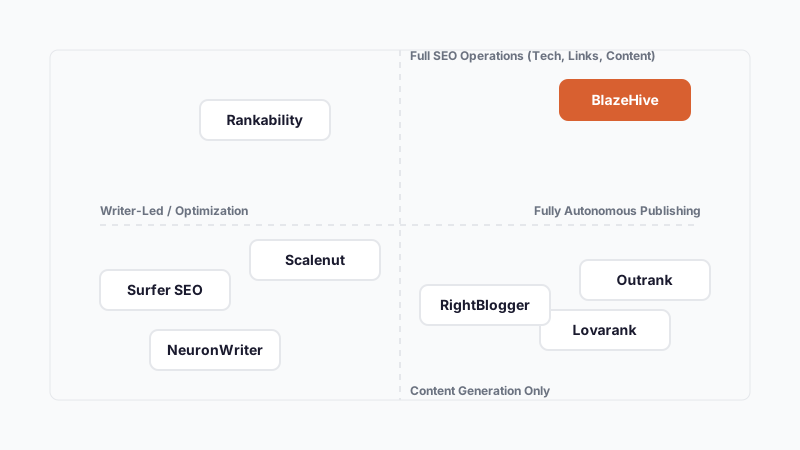
The Best Lovarank Alternatives
1. BlazeHive
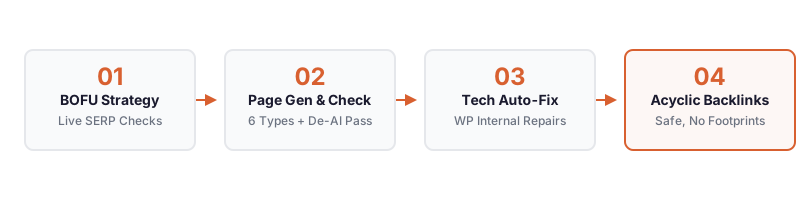
BlazeHive is a fully autonomous SEO engine. Drop a URL and it handles keyword strategy, page generation, humanization, technical SEO auto-fixing, contextual backlinks, and human-monitored reporting - for $99/month.
Best for: Indie founders, bootstrappers, and SMB/SaaS teams who need agency-quality SEO output without an agency budget or an in-house SEO hire. Also fits medium-sized teams and SEO experts who want steerable control through the agentic SEO chat.
Strengths
- Six page types including landing pages, listicles, comparisons, alternatives, FAQs, and interactive tool pages - the only autonomous platform in this list that builds interactive content; those pages raise engagement signals that help subsequent pages rank faster
- WordPress technical SEO auto-fixing - agent crawls for broken links, redirect chains, heavy pages, and internal linking gaps, then repairs them automatically; no developer required
- Bottom-of-funnel keyword strategy with live SERP cannibalization detection - verdicts come from Google itself, not similarity scores
- Humanization validated against 30,000+ AI writing patterns before any page publishes, reducing Google helpful-content risk at scale
- Acyclic backlink network with per-site pattern avoidance - no two sites ever exchange links; reciprocal footprints are impossible by design
- Human monitoring on every account - BlazeHive's team watches GSC data and intervenes if a site stagnates
- Direct publishing to 8 CMS platforms: WordPress, Ghost, Webflow, Framer, Contentful, Storyblok, Strapi, generic webhook
Where it's not the right fit
- Technical SEO auto-fixing is WordPress-only as of August 2026; other CMS platforms are listed as "coming soon"
- If you have in-house writers who need second-by-second on-page guidance (keyword density, NLP scoring), Surfer SEO's Content Editor is more tailored to that workflow
- GEO / AI citation dashboard is not yet a feature; if tracking ChatGPT or Perplexity citations is a primary need, Scalenut or NeuronWriter have dedicated dashboards
Pricing: $99/month (Complete Engine, as of August 2026). 3-day free trial, no card required. Done For You onboarding: $3,000 one-time + $99/month.
When to choose it: You want one $99/month engine to replace the full strategist + writer + technical SEO + backlink stack - especially if you're on WordPress and want issues auto-fixed while content publishes daily.
2. Outrank
Outrank is a speed-optimized autonomous SEO platform built for affiliate publishers and niche site owners who want daily article publishing with minimal hands-on management.
Best for: Affiliate site owners and niche publishers who prioritize ranking volume over brand consistency, and teams that need native Shopify integration.
Strengths
- Fast path from input to published article - set it once, run daily with minimal review
- Native Shopify integration, rare among autonomous SEO platforms
- Competitor-informed keyword gap analysis for content that targets ranking pages directly
- Multi-language support broader than most alternatives
- 750M+ organic views generated for customers (platform-claimed)
Where it's not the right fit
- No AI citation tracking - no visibility into ChatGPT, Perplexity, Gemini, or Claude citations (per Keytomic's comparison)
- Not built for teams that need technical SEO fixes alongside content generation
- Advanced page formats like entity-structured comparisons require workarounds
Pricing: $99/month (Standard Plan, as of August 2026). Higher agency tiers available.
When to choose it: You want to publish as many articles as possible with minimal setup and you're running an affiliate or niche content site where volume matters more than brand voice.
3. Surfer SEO
Surfer SEO is an on-page optimization platform that gives writers real-time guidance - NLP scoring, keyword density, structural recommendations - to build content that competes on Google.
Best for: Content teams with in-house writers who need detailed SEO briefs and live on-page optimization feedback, and agencies managing multiple clients with white-label reporting needs.
Strengths
- Content Editor with real-time NLP-driven scoring guides writers at the sentence level
- Audit tool refreshes declining content and surfaces technical SEO recommendations
- AI visibility tracking in higher tiers (ChatGPT citation monitoring)
- WordPress and Google Docs integrations built into the workflow
- 4.5–4.7 rating on Capterra; widely adopted by professional SEO teams
Where it's not the right fit
- Not built for autonomous publishing - designed for a human sitting in the editor, not hands-off daily output
- No autonomous backlink building; link strategy is left entirely to the user
- Learning curve is real; the feature-rich dashboard requires training to use efficiently
Pricing: Essential at $99/month ($79/month billed annually); Scale at $219/month; Enterprise at $999/month. As of August 2026.
When to choose it: You have writers on staff and want the most detailed on-page optimization guidance in the market - Surfer is the benchmark tool for this use case.
4. NeuronWriter
NeuronWriter is a budget-first SEO content optimization platform with NLP-driven briefs, multi-model AI writing (GPT-4o, Claude, Gemini), and a dedicated AI Score for Generative Engine Optimization.
Best for: Budget-conscious solo creators and small teams who want GEO/AEO optimization and multi-model AI access without paying $99/month.
Strengths
- Entry price at €19/month (~$20 USD) is the lowest on this list - Bronze plan includes 2 projects and 25 analyses/month
- AI Score for GEO - dedicated scoring for LLM citation optimization, not just keyword ranking
- Multi-model AI: GPT-4o, Claude, Gemini accessible without separate subscriptions
- Lifetime deals periodically available for long-term cost savings
- 300,000+ users reported
Where it's not the right fit
- Not built for autonomous publishing - requires manual content strategy, briefing, and publishing
- Fewer CMS integrations than BlazeHive or RightBlogger
- Smaller team and newer platform means fewer enterprise-grade features vs. Surfer or Rankability
Pricing: Bronze €19/month ($20 USD) through Diamond €97/month ($105 USD). As of August 2026.
When to choose it: Your budget is under $50/month, you want GEO scoring built in, and you're comfortable doing the keyword strategy and publishing yourself.
5. Scalenut
Scalenut is an integrated AI content and SEO platform with a GEO Watchtower dashboard that tracks how your content gets cited by ChatGPT, Claude, Perplexity, and Gemini - one of the few tools in this price range that actually surfaces AI citation data.
Best for: Small content teams that need integrated SEO, AI visibility tracking, and a backlinks marketplace without paying agency retainer rates.
Strengths
- GEO Watchtower (Growth+ tiers) tracks AI citations across major LLMs - useful if you're a B2B SaaS team that needs to know whether ChatGPT is recommending you
- Integrated backlinks marketplace - one of few platforms with internal link-building tools
- Social UpReach component for content distribution and repurposing
- 7-day free trial, no card required
- Starts at $49/month, which works for early-stage teams without agency budgets
Where it's not the right fit
- Not fully autonomous - requires human review and editing before publishing
- Promoted pricing has caveats: annual rates are limited-time offers; true cost-per-article climbs when editing time is factored in
- Feature-dense interface can feel overwhelming for solo operators
Pricing: Essential Max $49/month; Growth Max $103/month; Pro Max $193/month. As of August 2026.
When to choose it: GEO citation tracking is a priority and you want it bundled with content generation and a backlinks marketplace - without paying Writesonic enterprise rates.
6. Rankability
Rankability is an agency-first SEO platform with a credit-based system, technical auditing, AI content briefs, and unlimited clients on all pricing tiers.
Best for: Agencies and in-house teams managing multiple brands who need technical SEO auditing and content creation under one roof, with white-label reporting.
Strengths
- Unlimited clients and unlimited users on all tiers - purpose-built for agency billing structures
- 5-star rating on G2 from verified users - highest satisfaction on this list
- Auditor module covers technical SEO, Core Web Vitals, GBP audits, competitor benchmarking
- AI Search Analyzer for GEO/AEO performance tracking
- Flexible credit system allocates usage across content, auditing, or research as needed
Where it's not the right fit
- Not built for autonomous publishing - requires human approval and editing; briefs + writing infrastructure, not autopilot output
- Credits don't translate cleanly to cost-per-article; pricing complexity can obscure true monthly spend
- Starter at $99/month vs. BlazeHive's $99/month: Rankability caps by credits, BlazeHive includes unlimited publishing
Pricing: Starter $99/month ($79/month annual); Growth $199/month; Master $449/month. 7-day free trial. As of August 2026.
When to choose it: You're an agency managing 20+ clients who need full technical SEO audits, white-label reports, and content briefs - Rankability's unlimited-client model is built for that structure.
Quick Comparison
| Tool | Best For | Starting Price | Free Tier | Standout Feature |
|---|---|---|---|---|
| BlazeHive | Founders & SMB teams, WordPress auto-fix | $99/mo | 3-day trial (no card) | WordPress technical SEO auto-fixing + 6 page types |
| Outrank | Affiliate/niche publishers, Shopify sites | $99/mo | No | Native Shopify integration + maximum publishing speed |
| Surfer SEO | In-house writers needing on-page guidance | $99/mo | No | Real-time NLP Content Editor with live scoring |
| NeuronWriter | Budget-conscious teams, GEO focus | €19/mo (~$20) | No (lifetime deals) | Lowest entry price + dedicated AI Score for GEO |
| Scalenut | Teams tracking AI citations + backlinks | $49/mo | 7-day trial (no card) | GEO Watchtower tracking citations across 4 LLMs |
| Rankability | Agencies with 20+ clients | $99/mo | 7-day trial | Unlimited clients on all tiers + 5★ G2 rating |
Pricing as of August 2026. Check each tool's pricing page for current rates.
Which Alternative Should You Choose?
Most teams searching for Lovarank alternatives already know they want autonomy - the question is what else they need alongside it.
If you're a founder or SMB team running SEO without an agency...
BlazeHive is the right fit. At $99/month it covers keyword strategy, six page types, humanization, technical SEO auto-fixing on WordPress, contextual backlinks, and human monitoring - the full loop. You're not stitching together four tools.
If you want the fastest path to daily published articles...
Outrank wins on setup speed. Input a topic, it publishes. If you're running an affiliate or niche content site and want maximum volume with minimal configuration, Outrank's autopilot is hard to beat.
If you have in-house writers who need real-time SEO guidance...
Surfer SEO is purpose-built for this. No other tool matches its Content Editor depth. Writers get keyword density targets, NLP suggestions, and structural feedback in real time - Surfer makes good writers faster and better.
If your budget is under $50/month...
NeuronWriter at €19/month is the entry-level pick, with the bonus of AI Score for GEO. If you're early-stage and can do the publishing and strategy manually, it's the most cost-effective optimization tool here.
If AI citation tracking (GEO) is your primary requirement...
Scalenut has the most accessible GEO Watchtower in this price range - tracking citations across ChatGPT, Claude, Perplexity, and Gemini from $103/month on the Growth tier.
If you're an agency managing 20+ client sites...
Rankability is designed for your billing structure. Unlimited clients and users on all tiers, white-label reports, and a solid technical audit module make it the agency-first pick in this comparison.
Ready to Try BlazeHive?
If you're a founder, SMB team, or medium-sized team that wants SEO on autopilot - without stitching together a keyword tool, a writer, a technical SEO audit, a backlink agency, and a monitoring dashboard - BlazeHive is the one engine that covers all of it at $99/month. Start with the 3-day free trial (no card required), drop your URL, and see the keyword strategy and first pages in motion before you commit.
Frequently Asked Questions
What makes BlazeHive different from Lovarank?
BlazeHive covers the entire SEO loop - keyword strategy, six page types, humanization, technical SEO auto-fixing, backlinks, and human monitoring - all for $99/month, whereas Lovarank focuses on autonomous blog publishing with limited CMS support and no technical fixes. BlazeHive's WordPress auto-fixing is rare; no competitor at this price point repairs broken links, redirect chains, and internal linking issues automatically. If you're on WordPress with technical debt, BlazeHive eliminates the need to hire a developer alongside your SEO tool.
Should I use Outrank or BlazeHive?
Choose Outrank if you want the fastest setup and maximum publishing volume with minimal configuration-ideal for affiliate or niche content sites. Choose BlazeHive if you need strategy, multiple page types, technical SEO fixes, and human monitoring alongside autonomous publishing. Both cost $99/month, but Outrank trades depth for speed, while BlazeHive trades speed for ownership of the entire loop. For B2B SaaS or branded content where quality and monitoring matter, BlazeHive wins.
Can I use these tools if I don't have a WordPress site?
Yes, most alternatives support multiple CMS platforms. BlazeHive publishes to WordPress, Ghost, Webflow, Framer, Contentful, Storyblok, Strapi, and webhooks; Outrank supports WordPress, Ghost, and Shopify; Surfer integrates with WordPress and Google Docs; Rankability and NeuronWriter support broader platforms but require more manual publishing steps. The key tradeoff: CMS support breadth vs. technical automation-BlazeHive's auto-fixing works only on WordPress as of August 2026.
What should I look for in an AI SEO automation tool?
Prioritize keyword strategy quality, page type variety, and CMS support breadth over publishing speed alone. Bottom-of-funnel keywords (buyer-intent, not volume-focused) convert better than generic traffic. Tools that discover broken links but don't fix them leave authority leaking-technical SEO coverage is underrated. If you care about AI citations (ChatGPT, Perplexity), track GEO/AEO performance; most pure-autopilot tools skip this.
Is NeuronWriter worth it at €19/month compared to $99/month alternatives?
NeuronWriter at €19/month (~$20 USD) is the lowest entry price and includes dedicated AI Score for GEO, making it excellent for budget-conscious teams with in-house SEO skill. You trade off autonomous publishing, technical SEO auto-fixing, backlink building, and human monitoring for the lower cost-you'll still handle keyword strategy, content review, and publishing yourself. For early-stage founders testing a category, NeuronWriter wins; for teams ready to automate fully, BlazeHive's all-in approach is clearer despite the higher price.
Do any of these tools build backlinks for you?
BlazeHive and Scalenut are the only platforms here that actively build backlinks. BlazeHive's backlink network is acyclic with per-site pattern avoidance-no two sites ever exchange links, eliminating reciprocal footprints that Google flags. Scalenut offers a backlinks marketplace where you arrange links semi-manually. Surfer, Rankability, NeuronWriter, and Outrank don't include backlink building; they focus on content and optimization, leaving link strategy to external tools or agencies.
Can I use Surfer SEO if I don't have writers on staff?
Surfer is purpose-built for in-house writers needing real-time on-page guidance, not for autonomous publishing. If you don't have writers, Surfer's Content Editor becomes overhead-you'd still need to produce drafts or use a separate AI writing tool, then paste them into Surfer for optimization. BlazeHive or Outrank are better fits if you need to replace writers entirely; Surfer is best if you want to make existing writers faster.
Which tool is best for agencies managing multiple client sites?
Rankability is purpose-built for agencies: unlimited clients and users on all pricing tiers, white-label reporting, and a robust technical audit module covering Core Web Vitals, GBP audits, and competitor benchmarking. RightBlogger (not detailed here) is also strong for multi-site WordPress management. For solo founders or SMB teams with one or two brands, BlazeHive's focused approach is simpler; Rankability's complexity and credit system pays off only when you're billing across 20+ clients.
Does Scalenut track AI citations from ChatGPT and Perplexity?
Yes, Scalenut's GEO Watchtower (available on Growth+ tiers) tracks how your content gets cited by ChatGPT, Claude, Perplexity, and Gemini-one of the few affordable tools that surface this data. This is valuable for B2B SaaS teams that need to know whether AI answers are recommending them in generative search results. BlazeHive, Outrank, and NeuronWriter don't yet offer dedicated GEO dashboards, making Scalenut the stronger pick if AI citation visibility is a primary requirement.
Is Rankability worth $99/month given the credit-based pricing model?
Rankability at $99/month (Starter, as of August 2026) is feature-rich for agencies but uses credits rather than straightforward per-article pricing, which can obscure true monthly spend. If you're managing 20+ clients, the unlimited-client structure and technical audit suite justify the cost; the 5-star G2 rating confirms user satisfaction. For solo founders or SMB teams, BlazeHive's $99/month all-in pricing is clearer, and you get full autonomy plus monitoring without credit tracking overhead.
Why would I choose Outrank over BlazeHive if they're both $99/month?
Choose Outrank if you prioritize publishing speed and maximum volume over page type diversity and technical fixes. Outrank is built for affiliate and niche publishers who want to feed it once and publish daily with minimal oversight; setup takes minutes. BlazeHive takes 1-2 days to set up correctly (keyword strategy, internal linking audit, technical fixes) but delivers all six page types, auto-fixes on WordPress, and human monitoring. Outrank wins on velocity; BlazeHive wins on sustainability.
Do I need separate tools for keyword research with any of these platforms?
BlazeHive includes bottom-of-funnel keyword research built into the engine with live SERP cannibalization detection, so no separate tool needed. Rankability, NeuronWriter, and Scalenut include keyword research but require more manual strategy. Outrank and Surfer can work with your own keyword tool or integrate with Ahrefs/Semrush, but neither includes dedicated research as a built-in feature. For hands-off operation, BlazeHive eliminates the need for a separate research tool.
Which alternative is best for B2B SaaS teams?
BlazeHive is the strongest fit for B2B SaaS: bottom-of-funnel keyword focus, six page types optimized for buyer decision-making, GEO awareness via humanization against AI patterns, and human team monitoring of performance. Scalenut is second-best if GEO/AI citation tracking is a critical requirement; Surfer is strong if you have marketing writers and need detailed on-page briefs. Outrank and NeuronWriter are better for volume-focused content; Rankability is better for multi-brand agencies than single SaaS companies.
Can any of these tools fix technical SEO issues automatically?
Only BlazeHive auto-fixes technical SEO on WordPress, repairing broken links, redirect chains, heavy pages, and internal linking gaps automatically as part of the standard $99/month engine. Rankability's Auditor module identifies technical issues but requires manual fixes. Surfer, Outrank, NeuronWriter, and Scalenut all surface technical recommendations but leave fixes to you or an external developer. If technical debt is holding back your site's performance, BlazeHive's auto-fixing saves developer time and cost.
Is there a free alternative to these tools?
No free tier is offered by any of these platforms at full capability. NeuronWriter occasionally runs lifetime deals at discount rates that approximate free long-term access; Scalenut and Rankability offer 7-day free trials; BlazeHive offers a 3-day free trial. If budget is your only constraint and you're willing to use open-source or free tools, you'd need to stitch together separate keyword research, AI writing, and publishing workflows outside this comparison set.