TL;DR
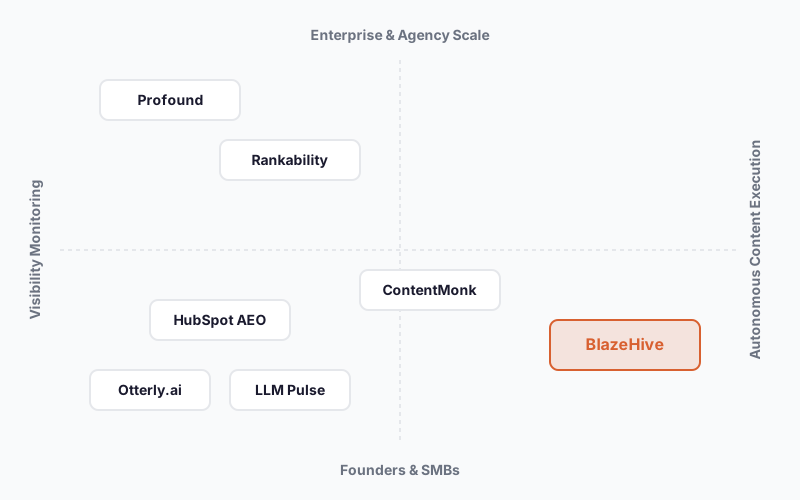
HubSpot AEO Alternatives come down to whether your bottleneck is visibility or execution: BlazeHive is the top pick for founders, SMBs, and medium-sized teams that need content published daily to show up in AI answers - one autonomous page per day, $99/month all-in, no agency required. ContentMonk wins for teams that want AEO tracking plus content creation in one place, and Rankability wins for agencies managing multiple clients across up to 9 AI engines.
HubSpot AEO Alternatives
HubSpot AEO launched in April 2026 as a CRM-native answer engine optimization platform - and if you're already deep in the HubSpot ecosystem, the appeal is obvious. But 25 tracked prompts, just 3 AI engines, and zero content generation leave meaningful gaps for teams that need more than a monitoring dashboard. This page is a decision guide: what's available, what each tool actually does, and which one fits your specific situation.

Why People Look for HubSpot AEO Alternatives
The most common complaint is the 25-prompt cap. At 25 monitored prompts, a mid-size SaaS company tracking its product category, its feature keywords, and its competitor comparisons runs out of room immediately. There's no published path to more prompts without bundling Marketing Hub Pro, which starts at $800/month - a 16x price jump from the $50/month standalone product.
The engine gap is the second recurring frustration. HubSpot AEO tracks ChatGPT, Gemini, and Perplexity. It misses Claude entirely - a material omission for B2B audiences where Claude's usage is high - and it skips Google AI Overviews, which are embedded directly in Google SERPs and arguably the highest-visibility placement a brand can earn. Dedicated AEO tools cover 4 to 9 engines at the same entry price.
The third issue is structural: HubSpot AEO is a monitoring tool only. It tells you where you appear (or don't). It gives no content generation, no publishing workflow, and no execution path to fix the gaps it surfaces. Users who need the answer to "we're not appearing - now what?" have to source a separate content tool. That gap is what most alternatives on this list exist to close.
What to Look for in an AEO Tool
AI engine coverage is the first number to check. Three engines misses Claude and Google AI Overviews - both matter depending on your audience. B2B teams have a real blind spot without Claude. Consumer-facing brands can't skip Google AI Overviews. Look for tools that cover at least 5 engines with a clear list of which ones.
Prompt scale is the second. A prompt is a tracked question or topic. At 25 you're rationing coverage. A multi-product brand tracking its own features plus competitor comparisons needs 50–200+ at minimum. Check whether limits are monthly or daily, and what it costs to add more.
Content generation is where monitoring tools split from execution tools. Tracking tells you where you're losing. Generation is how you fix it. If your team can't write 15–20 pages a month, a tool that publishes autonomously is a different category entirely - not just a feature.
Technical SEO matters more than most AEO buyers realize. AI visibility and Google rankings reinforce each other. A page with broken internal links or a redirect chain will underperform regardless of how well it's written. Most AEO tools skip the technical layer; the ones that address it have a real edge for sites carrying accumulated debt.
Agency and multi-brand support comes down to pricing model. Check whether it's per-brand or per-seat, and whether white-label reporting is available. Some tools charge per workspace; others offer unlimited clients on a flat tier. That difference matters a lot at scale.
Pricing transparency is a signal in itself. Several tools here publish clear pricing pages; others bury higher tiers behind "contact sales." If you can't see what you'll pay in 12 months, that's a procurement risk worth taking seriously.
Integration depth determines where data lands. HubSpot's CRM integration is a real advantage for teams already in that ecosystem. Standalone tools connect via API or webhook to most CRMs. Publishing integrations matter too - if a tool generates content but can't push it to your CMS, you've just added a manual step.
The Best HubSpot AEO Alternatives
1. BlazeHive
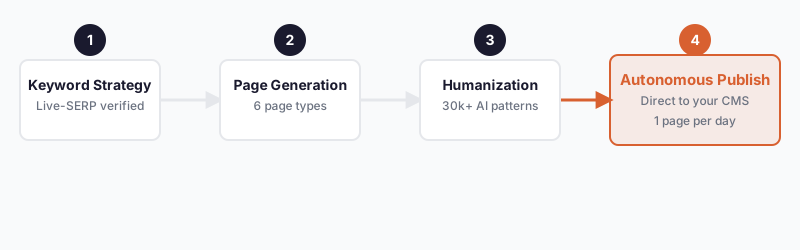
BlazeHive is an autonomous SEO engine that publishes one optimized page per day into your CMS - built to rank on Google and get cited by AI answer engines like ChatGPT, Perplexity, and Google AI Overviews.
Best for: Founders, bootstrappers, and SMB/SaaS teams who need AI-search-ready content published at scale without a content team or agency budget. Also fits medium-sized teams and SEO experts who want steerable control through the agentic SEO chat.
Strengths
- One page per day published autonomously to WordPress, Ghost, Webflow, Framer, Contentful, Storyblok, Strapi, or a generic webhook - no manual step between research and publish
- Bottom-of-funnel keyword research cross-checked against live Google SERPs, with cannibalization detection so two pages never compete for the same query
- Humanization pass validated against 30,000+ documented AI writing patterns - content that doesn't read as AI slop and doesn't trigger AI content penalties
- Technical SEO auto-fixing on WordPress: finds and closes broken links, redirect chains, heavy pages, and weak internal linking
- Contextual backlink network built as an acyclic graph - no reciprocal link exchanges, safe by engineering design
- $99/month all-in replaces what an agency would charge $8,500/month to deliver
Where it's not the right fit
- Does not track brand visibility across AI engines - if you need a dashboard showing how often you're cited in ChatGPT vs. Gemini today, you need a monitoring tool alongside BlazeHive
- Technical SEO auto-fixing is currently WordPress-only; other CMS platforms are coming
- Not built for large agencies managing 50+ clients at volume; per-account pricing scales linearly
Pricing: $99/month as of August 2026. 3-day free trial, no credit card required. Done-for-you setup available at $3,000 one-time + $99/month.
When to choose it: Your bottleneck is content production, not visibility reporting. You know you need to publish consistently to win AI search citations - and you don't have a writer, strategist, or agency on retainer to make that happen.
2. ContentMonk
ContentMonk is an all-in-one AEO, SEO, and content creation platform that closes the loop between visibility tracking and publishing in one $99/month entry tier.
Best for: Content teams that want AEO monitoring, SEO rank tracking, and content creation without switching tools between insight and execution.
Strengths
- 50 daily tracked prompts vs. HubSpot's 25 - double the monitoring headroom at the same price point
- 4 AI engines covered (vs. HubSpot's 3), including coverage of Claude and/or Google AI Overviews
- 10 articles/month generated at Starter tier, plus integrated content repurposing for LinkedIn and newsletters
- 200 keyword positions tracked for traditional SEO rank visibility alongside AEO data
- 5 competitors tracked; proprietary Knowledge Base for content generation
- Direct testing showed ContentMonk surfaced 20+ AEO recommendations and hundreds of SEO opportunities within 5 minutes - HubSpot AEO produced zero actionable recommendations after several days on the same domain
Where it's not the right fit
- 10 articles/month is a hard limit for teams that need high-volume content velocity (30+ pages/month)
- No technical SEO fixing - site health issues fall outside the platform's scope
- No white-label reporting for agency resale
Pricing: Starter $99/month as of August 2026. 7-day free trial. 15% discount for annual billing.
When to choose it: You want one tool for tracking AI visibility, ranking keywords, and publishing optimized content - and your content volume sits comfortably at 10 pieces/month.
3. Rankability
Rankability combines traditional Google rank tracking with AEO monitoring across up to 9 AI platforms, plus white-label client reporting built specifically for agencies.
Best for: Agencies managing multiple brands who need both traditional SEO ROI and AI visibility data rolled into one client-ready dashboard.
Strengths
- Tracks up to 9 AI platforms on Agency plans: Google AI Overviews, Google AI Mode, ChatGPT, Gemini, Perplexity, and others - vs. HubSpot's 3
- Traditional rankings + AI mentions + AI citations in a single dashboard; no tool-switching to prove SEO value
- Unlimited clients and unlimited users at all tiers - no per-seat or per-client surcharge
- White-label client reporting built in; multi-brand dashboards ready for resale
- Integrated SEO workflow: keyword research, content optimization, audits, GSC integration
Where it's not the right fit
- No autonomous content generation or publishing - monitoring and reporting only; writing is still your job
- No technical SEO auto-fixing
- For agencies with 50+ clients, the Agency tier ($399+/mo) is the right level; Starter ($99/mo) caps usage
Pricing: Starter $99/month, Growth $199/month, Scale $399/month as of August 2026. Agency tier available on request.
When to choose it: You're an agency - or an in-house team that needs to prove SEO ROI - and you want traditional rankings and AI visibility in one dashboard with white-label reporting for stakeholders.
4. Profound
Profound is an enterprise-grade AEO platform built on real-user prompt data, with SOC 2 Type II compliance, content optimization agents, and citation analysis that goes further than any other tool on this list.
Best for: Enterprise marketing teams and compliance-required organizations that need real-user data, board-level reporting, and automated content workflows - not just prompt tracking.
Strengths
- Real user prompt data sourced from hundreds of millions of real AI conversations - not sampled or synthetic
- Up to 9 answer engines tracked; includes ChatGPT Shopping visibility
- SOC 2 Type II compliance, SSO/SAML support for enterprise procurement
- Content optimization agents that automate content workflows, not just flag gaps
- Citation drift tracking (40–60% month-over-month volatility is well-documented in the category)
- Google Analytics integration, API access, dedicated Slack support on Enterprise
Where it's not the right fit
- Significant learning curve; reviewers note it requires longer onboarding to deploy successfully
- Growth tier at $399/month is where the platform's real depth becomes accessible - $99/month Starter is limited
- Built for enterprise budgets and timelines, not indie founders or early-stage startups
Pricing: Starter $99/month, Growth $399/month, Enterprise custom as of August 2026.
When to choose it: You're at Series C or beyond, need SOC 2 compliance for procurement, and require real-user prompt data with full attribution for executive reporting.
5. Otterly.ai
Otterly.ai is a lightweight AEO tracker focused on brand sentiment, multi-country monitoring, and a clean entry price - the most affordable dedicated AEO tool on this list.
Best for: Budget-conscious teams that need brand sentiment tracking across multiple countries and don't need deep content integration or agency workflows.
Strengths
- $29/month entry price - the lowest dedicated AEO entry point available, half of HubSpot AEO's cost
- Per-prompt, per-model brand sentiment analysis with multi-country monitoring built in
- Unlimited user seats even at entry tier, which makes it easy to share reports across stakeholders
- Looker Studio integration for custom reporting dashboards
- Has been around long enough to have reviews across G2, Capterra, and Product Hunt - not a new entrant
Where it's not the right fit
- No content generation or publishing capability - monitoring only
- Fewer AI engines tracked than Rankability or Profound; depth is limited at the lower price
- Not built for complex agency workflows or white-label client reporting
Pricing: $29/month as of August 2026. 14-day free trial.
When to choose it: Your budget is tight, you need basic brand sentiment and multi-country monitoring, and you're not yet ready to invest in content generation or agency-scale reporting.
6. LLM Pulse
LLM Pulse is a continuous AEO monitoring platform purpose-built for teams graduating from HubSpot's free AEO Grader - with unlimited seats, flexible custom prompts, and white-label options.
Best for: Teams that outgrew the free HubSpot AEO Grader and want a paid continuous monitoring tool with unlimited user seats and deep prompt customization.
Strengths
- Unlimited custom prompts (50 to 2,400+ depending on plan) - a direct contrast to HubSpot's hard 25-prompt cap
- 5 standard AI engines + 5 paid add-ons for expanded coverage
- Per-prompt, per-model brand sentiment analysis with historical trends and citation tracking
- Unlimited seats at fixed price - no per-user pricing games
- White-label support available for agency and enterprise arrangements
- API access for custom reporting pipelines
Where it's not the right fit
- €49/month pricing is in euros, which adds currency conversion friction for US-based teams
- No content generation or technical SEO capabilities
- Less depth than Profound for enterprise compliance or complex citation attribution needs
Pricing: €49/month as of August 2026. Unlimited seats included. 14-day trial available.
When to choose it: You used HubSpot's free Grader and hit its limits, you want continuous monitoring with flexible prompt volume, and you need to share access across a team without per-seat costs.
Quick Comparison
| Tool | Best For | Starting Price | Free Tier | Standout Feature |
|---|---|---|---|---|
| BlazeHive | Autonomous daily content for AI search | $99/mo | 3-day trial | 1 page/day published autonomously to CMS |
| ContentMonk | AEO + SEO + content creation in one tool | $99/mo | 7-day trial | 50 daily prompts + 10 articles/month at entry |
| Rankability | Agencies needing traditional + AI tracking | $99/mo | No | Up to 9 AI engines + unlimited clients at all tiers |
| Profound | Enterprise compliance + real-user data | $99/mo | No | SOC 2 Type II + real-user prompt datasets |
| Otterly.ai | Budget-conscious brand sentiment tracking | $29/mo | 14-day trial | Cheapest AEO entry point with unlimited seats |
| LLM Pulse | Grader graduates needing continuous monitoring | €49/mo | 14-day trial | Unlimited custom prompts at a flat seat price |
Pricing as of August 2026. Check each tool's pricing page for current rates.
Which Alternative Should You Choose?
If you need to know where your brand stands in AI answers right now...
Rankability is the starting point. At $99/month it tracks 9 AI engines plus traditional Google rankings - the broadest visibility picture available at entry price. Run it for 60–90 days to quantify the gap before deciding how to close it.
If you're an agency managing multiple clients...
Rankability's Agency tier ($399/month, unlimited clients) was built for this workflow. White-label reporting, multi-brand dashboards, and traditional + AI tracking in one client-ready interface. No per-seat or per-client fees.
If you need enterprise compliance, board-level reporting, or real-user data...
Profound at $399/month (Growth tier) is the only viable option. SOC 2 Type II, SSO/SAML, real user prompt datasets from hundreds of millions of conversations, and content optimization agents that automate workflow beyond dashboarding.
If your bottleneck is producing content - not tracking it...
BlazeHive is the right tool. Monitoring tells you you're invisible in AI answers; BlazeHive fixes it by publishing one optimized, humanized page per day to your CMS at $99/month - the execution layer that monitoring tools leave blank. Pair it with Rankability if you want to see your visibility improve over time.
If you want AEO tracking and content creation without switching tools...
ContentMonk at $99/month covers 50 daily prompts, 4 AI engines, traditional rank tracking, and 10 published articles per month - the only entry-tier tool on this list that handles both tracking and publishing without a separate subscription.
If your budget is tight and you just need basic brand monitoring...
Otterly.ai at $29/month is the lowest-friction entry. Brand sentiment, multi-country tracking, unlimited seats. Use it to learn the category before investing in a deeper platform.
Ready to Try BlazeHive?
If your real problem is "we know we're not showing up in AI answers, and we don't have the team to publish 20 pages a month to fix it," BlazeHive is the tool for that - autonomous keyword research, page generation, humanization, and CMS publishing at $99/month, with no agency required. Start a 3-day free trial, no credit card needed, and see a page built for your business on day one.
Frequently Asked Questions
What should I look for in an AEO tool?
Check AI engine coverage first-three engines misses Claude and Google AI Overviews, which matter depending on your audience. Prompt scale matters equally; at 25 tracked prompts you're rationing coverage across product features and competitors. Then evaluate content generation capability, technical SEO support, agency pricing models, and publishing integrations to see whether the tool solves visibility tracking alone or execution too.
What makes a good answer engine optimization alternative to HubSpot AEO?
A strong AEO alternative either expands engine coverage beyond HubSpot's three platforms, removes the 25-prompt cap that forces bundling into expensive tiers, or adds capabilities HubSpot doesn't include at all. The best alternatives solve one specific bottleneck-whether that's content production, multi-brand reporting, enterprise compliance, or technical SEO fixing-rather than claiming to do everything equally.
Is HubSpot AEO still worth using?
Yes, for teams already deep in the HubSpot ecosystem and willing to stay within its 25-prompt limit. HubSpot AEO's real edge is CRM-native prompt suggestions based on your sales data-a capability no other AEO tool offers. However, the moment you need more than 25 tracked prompts or AEO engines beyond ChatGPT, Gemini, and Perplexity, the pricing jumps to $800/month Marketing Hub Pro, which is where you evaluate whether a standalone alternative makes financial sense.
How does BlazeHive differ from monitoring-only AEO tools?
Most AEO tools-Rankability, ContentMonk, Profound-tell you where you're losing visibility in AI answers. BlazeHive solves a different problem: it publishes one optimized page per day to close those visibility gaps autonomously, without requiring a writer or agency. If your bottleneck is knowing you're invisible versus actually fixing it at scale, BlazeHive is the execution layer that monitoring tools don't provide.
Why would I choose BlazeHive over Rankability or ContentMonk?
Choose BlazeHive if you need content velocity-one page per day shipped autonomously-and can't hire or afford a writer or agency. At $99/month it replaces what agencies charge $8,500+/month to deliver: keyword strategy, page generation, humanization, technical SEO fixing, and CMS publishing. Rankability and ContentMonk excel at visibility tracking and reporting; BlazeHive excels at production speed and elimination of the writing bottleneck entirely.
What is the difference between content generation volume across these tools?
BlazeHive publishes one page per day with no monthly cap-30+ pages per month autonomously. ContentMonk limits you to 10 articles per month at entry tier. Rankability and Profound don't generate content at all; they're monitoring and optimization tools that assume you have a writing team. Volume matters: if you need 20+ pages monthly and lack a content team, only BlazeHive and ContentMonk can deliver, and BlazeHive triples ContentMonk's output.
Which AEO alternative is best for agencies managing multiple clients?
Rankability at the Agency tier ($399+/month, unlimited clients) was built for agency workflows with white-label reporting and multi-brand dashboards. All other tools charge per-account or per-seat, which scales linearly as you add clients. For agencies with 50+ clients, Rankability's flat unlimited-client pricing is far more cost-efficient than BlazeHive's per-account model or ContentMonk's per-workspace approach.
Can I use BlazeHive with my existing CMS?
BlazeHive publishes directly to WordPress, Ghost, Webflow, Framer, Contentful, Storyblok, Strapi, or a generic webhook-it lives under your domain, forever. Technical SEO auto-fixing is currently WordPress-only; other CMS platforms are coming. If your site is on a platform not in that list, the generic webhook allows custom integration work, or contact the team about custom integration options.
Does BlazeHive's content actually rank for buyer-intent keywords?
BlazeHive's keyword research is cross-checked against live Google SERPs at generation time, so every page targets keywords with real commercial intent and verified ranking potential. Cannibalization detection ensures two pages never compete for the same query, which prevents self-sabotage. The combination of bottom-of-funnel focus and live-SERP validation means pages are built to rank from day one, not guessed at.
What does BlazeHive's humanization pass actually do?
The de-AI pass filters every page against 30,000+ documented AI writing patterns to ensure content doesn't read as obvious AI slop or trigger AI-detection penalties from Google or ChatGPT. This is a critical edge because both Google and AI engines are actively penalizing bot-generated content. Pages that pass humanization retain credibility and avoid the algorithmic filters designed to suppress low-quality AI content.
Why doesn't BlazeHive track AI visibility like Rankability or ContentMonk?
BlazeHive's focus is content production, not performance monitoring-a deliberate product choice to keep pricing at $99/month all-in. If you need visibility dashboards showing how often you're cited in ChatGPT versus Gemini, pair BlazeHive with Rankability ($99/mo) for the tracking layer. This modular approach lets you choose exactly which tools solve your specific bottleneck without paying for overlap.
What is the cost difference between BlazeHive and a traditional SEO agency?
BlazeHive is $99/month all-in for keyword strategy, page generation, humanization, technical fixes, backlink strategy, and CMS publishing. A mid-tier SEO agency charges $3,000–$5,000/month for the strategist and writer alone, plus $3,500–$5,000/month for design, dev, and link building-totaling $8,500+/month minimum. BlazeHive replaces that entire stack at roughly 1% of the cost, which is why it appeals to founders, SMBs, and medium-sized teams that can't afford agency retainers.
When should I choose Profound over other AEO alternatives?
Profound is the right choice at the $399/month Growth tier if you need SOC 2 Type II compliance, real-user prompt datasets from hundreds of millions of conversations, or automated content optimization agents. These capabilities exist for enterprise teams building board-level reporting and compliance-required workflows. Startups and SMBs should start with Rankability or BlazeHive; Profound's value unlocks above Series C scale.
Is there a free AEO tool I can try before paying?
HubSpot offers a free AEO Grader to diagnose your current AI visibility, which is the best zero-cost starting point. After that, most paid tools offer free trials: BlazeHive (3-day, no card), ContentMonk (7-day), Otterly.ai (14-day), and LLM Pulse (14-day). Rankability and Profound don't have free trials but are worth requesting a demo if you're considering their paid tiers.
Why would I pair BlazeHive with another tool instead of choosing one all-in-one platform?
Because the category has split into two roles: visibility tools (Rankability, ContentMonk, Profound) and execution tools (BlazeHive). Most teams benefit from pairing-use Rankability for 60 days to diagnose where you're losing to competitors, then deploy BlazeHive to publish 30 pages per month into those gaps, measuring your improving visibility over time with Rankability's dashboard. All-in-one tools like ContentMonk force compromise on either volume or tracking; the stack approach gives you the strongest tool in each role without paying for features you don't need.