TL;DR
Frizerly alternatives come down to what you actually need from SEO automation: publishing volume, optimization depth, or strategy that compounds. BlazeHive is the top pick for bootstrappers and SMB founders who need bottom-of-funnel pages that rank and get cited by AI answer engines - not just blogs that fill an index. Outrank.so wins if raw article volume is your goal; Surfer SEO wins if you have an in-house SEO strategist who wants hands-on page-level control.
Frizerly Alternatives
Frizerly earns its place: $29/month on annual billing, social media automation baked in, and an AEO Agent that tracks brand mentions across ChatGPT, Gemini, and Perplexity. For a Shopify merchant or WordPress site owner who wants weekly blog publishing without hiring a writer, it's a reasonable starting point. But consistent publishing isn't the same as compounding authority - and that gap is exactly why people search for Frizerly alternatives. This page maps the real options, with honest tradeoffs per use case.

Why People Look for Frizerly Alternatives
The most common reason is stagnant rankings after six months of consistent publishing. Users set up Frizerly, let the AI agent ship articles weekly, watch the index grow - and then check Google Search Console three months later to find no meaningful lift in clicks or conversions. A hands-on 30-day review puts it plainly: "Without human editing, output can be generic. Most powerful features (Pro) are plan-limited." That's the core tension. Autonomous publishing is only as good as the strategy driving it.
The second pain is the Pro-tier paywall. Frizerly's base plan ships articles weekly; daily publishing - the pace that actually builds compounding authority - requires the $99/month Pro tier. That doubles the cost of the entry plan and puts Frizerly in the same price bracket as tools that offer substantially more. Founders who signed up for $29/month discover the feature they actually need is behind a 3x price jump.
A third recurring pattern: Reddit threads in r/shopify flag concerns about coordinated promotion, which erodes trust. Founders searching for objective comparisons hit skepticism before they find answers. If you're here because you want a straight look at what else exists - without the noise - this is that page.
What to Look for in an AI SEO Automation Tool
Keyword intent filtering. Tools that generate articles on high-volume, top-of-funnel keywords burn budget and index space without driving conversions. The question to ask: does the platform filter for buyer-intent keywords, or does it optimize for keyword volume? Bottom-of-funnel research targets people ready to act, not just browse.
Cannibalization prevention. If two pages on your site compete for the same query, neither ranks well. Many tools use heuristic clustering (semantic similarity matching) to prevent this. The stronger standard is live-SERP cross-checking - pulling actual Google ranking data to verify no overlap exists before publishing.
Humanization depth. Google has gotten better at detecting generic AI content. A humanization pass isn't a nice-to-have; it's a prerequisite for ranking. The meaningful distinction is between a marketing claim ("99% undetectable") and a specific mechanism (validated against a pattern library of documented AI writing signals).
Page type breadth. Blog posts are one format. But comparison pages, VS pages, FAQ pages, and interactive tools each capture different searcher intent and build different types of authority. A platform limited to blog generation leaves conversions and citations on the table.
Technical SEO coverage. Authority you build through content leaks through broken links, redirect chains, heavy pages, and weak internal linking. A platform that only adds content - without addressing what drains it - creates diminishing returns. Audit capability matters; autonomous fixing is better.
Publishing autonomy vs. approval gates. Some platforms surface recommendations and wait for you to approve. Others publish directly to your CMS. For founders who don't want SEO to be another daily task, true autonomy - with safeguards - is the goal.
Backlink safety. Several platforms run reciprocal backlink exchange networks among their user bases. These inflate authority in the short term but create an exchangeable link footprint Google can detect and penalize. The safer architecture: acyclic, non-reciprocal link graphs with per-site pattern avoidance.
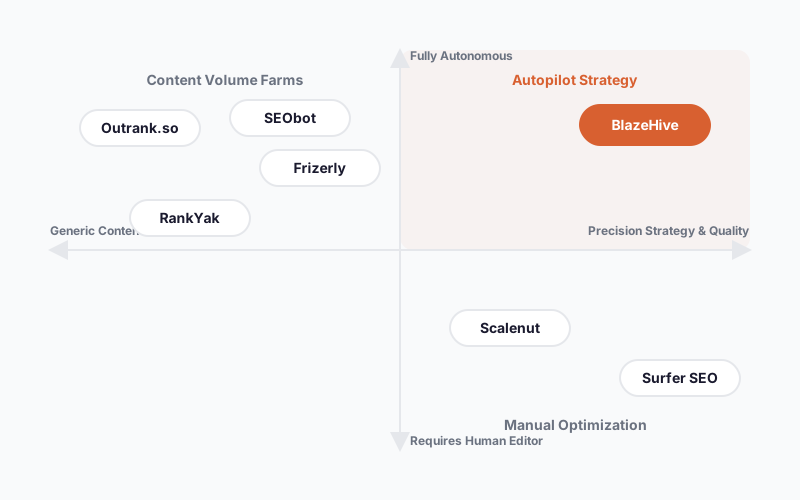
The Best Frizerly Alternatives
1. BlazeHive
BlazeHive is an autonomous SEO engine that drops a URL, studies the business, builds a bottom-of-funnel keyword strategy, then writes, humanizes, validates, and publishes one optimized page per day directly into your CMS - built to rank on Google and get cited by AI answer engines.
Best for: Indie founders, bootstrappers, and SMB/SaaS teams who need agency-quality SEO output on autopilot without an agency budget - especially those who've tried volume-based tools and found that publishing alone doesn't compound. Also fits medium-sized teams and SEO experts who want steerable control through the agentic SEO chat.
Strengths
- Targets buyer-intent keywords (not vanity volume), cross-checked against live Google SERPs - conversion-focused from the start
- Live-SERP cross-checking means Google itself verifies no two pages compete for one query - not a similarity algorithm, not clustering heuristics
- Six page types: landing pages, listicles, comparisons, VS pages, FAQ pages, and interactive tool pages, each optimized for a different SEO outcome (rankings, LLM citations, engagement signals, authority)
- Humanization validated against 30,000+ documented AI writing patterns, built into every page before it ships - not an optional add-on
- On WordPress, the agent finds and fixes broken links, redirect chains, heavy pages, and internal-linking gaps autonomously
- Acyclic backlink graph with per-site pattern avoidance - no reciprocal exchanges, no detectable footprint by design
- The team tracks every customer's growth; stagnating sites get direct intervention, not just an automated alert
- Chat interface with full context lets you steer keyword research, planning, and analysis on demand
Where it's not the right fit
- Technical SEO auto-fixing is currently WordPress-only; other platforms (Webflow, Contentful, Framer) get findings surfaced, with auto-fixes coming
- Doesn't include automated social media posting - focus is organic rank and AI citation, not social amplification
- At $99/month, it's a steeper entry than SEObot or Frizerly's base tier - the premium reflects all-in strategy + quality, not volume
Pricing: $99/month, everything included - keyword research, all six page types, humanization, SEO validation, autonomous publishing, all integrations. No per-seat fees, no usage add-ons. 3-day free trial, no card required. Done-For-You setup available at $3,000 one-time + $99/month. As of August 2026.
When to choose it: You've tried Frizerly, Outrank, or another autopilot tool and found that volume publishing isn't moving your rankings or conversions. You want a system that targets the right keywords, humanizes every page, prevents internal competition, and is monitored by a real team - not just a dashboard.
2. Outrank.so
Outrank.so is an autopilot organic growth platform that publishes up to 30 AI-generated articles per month with a built-in reciprocal backlink exchange network and support for 150+ CMS platforms.
Best for: Teams optimizing for content volume who want a built-in backlink layer and multi-language support without managing separate publishing workflows.
Strengths
- 30 auto-published articles per month at $99/month - higher raw volume than most competitors at this price
- Built-in backlink exchange across the Outrank user network
- 150+ CMS integrations; AI image generation included
- Multi-language support (150+ languages)
- Unlimited team members and API access on the standard plan
Where it's not the right fit
- Reciprocal backlink network creates an exchangeable link footprint - a known Google risk in competitive niches
- No explicit AI visibility (AEO/GEO) tracking - not designed for monitoring ChatGPT or Perplexity citations
- No social media automation; 30-day content calendar is static, not dynamically steerable
- Content quality reviews note limited customization; no humanization layer mentioned
Pricing: $1 three-day trial, then $99/month standard plan (30 articles). Custom enterprise pricing available. As of 2026.
When to choose it: Your primary goal is content volume for a broad keyword set, you want backlink building included at no extra cost, and you're not yet focused on AI search citation or conversion-specific keyword targeting.
3. RankYak
RankYak is a tiered SEO automation platform with keyword research, daily article generation, automated publishing, reciprocal backlink building, site audit, and multi-site management - built for agencies running multiple properties.
Best for: Agencies and multi-site operators who need to scale content across five or more properties and want a site audit function alongside publishing automation.
Strengths
- Tiered article volume from 10/month (Starter) to 100/month (Business) - scalable for agencies
- Site audit included with bulk technical SEO findings
- Multi-site management on Professional and Business tiers
- Topical authority and keyword clustering built in
- Documented case: +721% organic visitor growth for e-commerce (23,700 monthly visitors)
Where it's not the right fit
- Complex tier selection upfront - you must commit to an article volume before knowing what you need
- Reciprocal backlink exchange shares the same footprint risk as Outrank
- Steep learning curve described as "built for agencies" - not beginner-friendly for solo founders
- No AI visibility (AEO/GEO) tracking, no social automation
Pricing: Starter $49/month (1 site, 10 articles), Professional $129/month (5 sites, 30 articles), Business $299/month (unlimited sites, 100 articles). 7-day free trial, no card required. Annual billing: 2 months free. As of 2026.
When to choose it: You manage multiple client sites or niche properties, need to scale article production past 30/month, and want a site audit alongside publishing - and you have the bandwidth to work through a steeper setup.
4. SEObot
SEObot is a minimalist AI content agent focused on generating 3,000-word SEO articles autonomously with fact-checking, internal linking, and CMS publishing at a flat $49/month rate.
Best for: Budget-conscious founders who want autonomous blog publishing at a low entry price and are comfortable manually reviewing content before it compounds.
Strengths
- Flat $49/month - no tier complexity, no usage caps
- 3,000-word articles with research, fact-checking, and internal linking included
- 50+ language support
- Full refund guarantee if dissatisfied after the first article
- Minimal setup; founder is reachable directly on Twitter/X and LinkedIn
Where it's not the right fit
- Independent reviews describe output as "word salad" requiring heavy editing - a manual review workflow is effectively mandatory for quality
- No keyword intent filtering - described as a "guess and publish" model not grounded in search performance data
- No AI visibility tracking, no social automation, no technical SEO, no humanization layer
- Not designed for cannibalization detection or bottom-of-funnel strategy
Pricing: $49/month flat rate, full refund guarantee after first article. As of 2026.
When to choose it: You need the lowest-cost entry into automated blog publishing, you're comfortable editing AI drafts, and you're not yet focused on conversion-specific keywords or technical SEO health.
5. Scalenut
Scalenut is an all-in-one AI SEO suite with AI writing, content optimization, keyword clustering, GEO/AI visibility tracking (via GEO Watchtower), content audits, and a humanizer tool - at a lower price point than Surfer SEO.
Best for: Content teams who want AI writing + optimization + GEO tracking in one subscription, particularly those migrating from Surfer who find the per-article cost too high.
Strengths
- GEO Watchtower tracks AI visibility across ChatGPT, Perplexity, Gemini, Claude
- Cruise Mode for hands-off content generation
- 30 articles + 30 keyword clusters per month on Growth tier ($79)
- Content audits (200 pages/month on Growth)
- Humanizer tool included
- Priced 3x cheaper per article than Surfer SEO on equivalent plans
Where it's not the right fit
- GEO tracking is a separate product tier - entry Starter plan doesn't include it
- No social media automation; no autonomous publishing in the same vein as Frizerly or BlazeHive
- Requires more human involvement than pure autopilot tools - optimization recommendations need to be applied manually
- Not designed for conversion-focused keyword filtering or cannibalization detection via live SERP data
Pricing: Starter $39/month (limited), Growth $79/month (GEO tracking included, 30 articles), higher tiers up to $249+/month. Free tier available. As of 2026.
When to choose it: You have a content team that wants AI writing, optimization scoring, and AI visibility tracking in one place - and you need to cut costs versus Surfer without losing GEO coverage.
6. Surfer SEO
Surfer SEO is a precision content optimization and AI writing platform built on 500+ web signals, offering page-level scoring, GEO/AI visibility tracking on Standard and above, an AI humanizer, and deep integrations with Google Docs, WordPress, and Jasper AI.
Best for: SEO strategists and content teams who want deep on-page optimization signals and are willing to apply recommendations hands-on to get them.
Strengths
- 500+ web signals for content scoring - widely cited as the industry standard for on-page optimization
- GEO (AI visibility) tracking included on Standard tier ($99/month)
- AI humanizer tool included
- Google Docs and Jasper AI integrations for in-workflow optimization
- Strong Reddit consensus and practitioner trust - 8.3/10 in Reddit-sourced tool analysis
Where it's not the right fit
- Requires human judgment to apply recommendations - not autonomous; a writer still has to produce and edit the content
- Rank Tracker, AI Tracker, and humanizer can compound cost above the base $99 - add-ons stack quickly
- High learning curve; premium pricing ($99–$999/month) limits accessibility for solo founders
- Not designed for bootstrappers who need SEO without an in-house strategist
Pricing: Discovery $49/month (120 documents), Standard $99/month (GEO included, 25 AI prompts), Pro $182/month, Peace of Mind $299/month, Enterprise $999/month. As of 2026.
When to choose it: You have an in-house SEO strategist or content lead who wants the most thorough on-page optimization signal set available and is comfortable doing the strategy and editorial work themselves - with AI assistance, not AI autonomy.
Quick Comparison
| Tool | Best For | Starting Price | Free Tier | Standout Feature |
|---|---|---|---|---|
| BlazeHive | Bootstrappers needing strategy + ranked pages | $99/mo | 3-day trial, no card | Live SERP cannibalization prevention + 6 page types |
| Outrank.so | Volume-focused teams, backlink building | $99/mo | $1 3-day trial | 30 articles/month with built-in backlink network |
| RankYak | Multi-site agencies, 10–100 articles/month | $49/mo | 7-day trial, no card | Scales to 100 articles/month across unlimited sites |
| SEObot | Budget-first solo founders | $49/mo | Refund guarantee | Flat-rate pricing, no tier complexity |
| Scalenut | Content teams wanting AI writing + GEO tracking | $39/mo | Free tier available | GEO Watchtower tracks AI visibility across 4+ engines |
| Surfer SEO | SEO strategists, precision on-page optimization | $49/mo | No | 500+ web signals for content scoring |
Pricing as of August 2026. Check each tool's pricing page for current rates.
Which Alternative Should You Choose?
The most common scenario is a founder who's been publishing for three to six months and isn't seeing rankings move. That's where the tool choice actually matters.
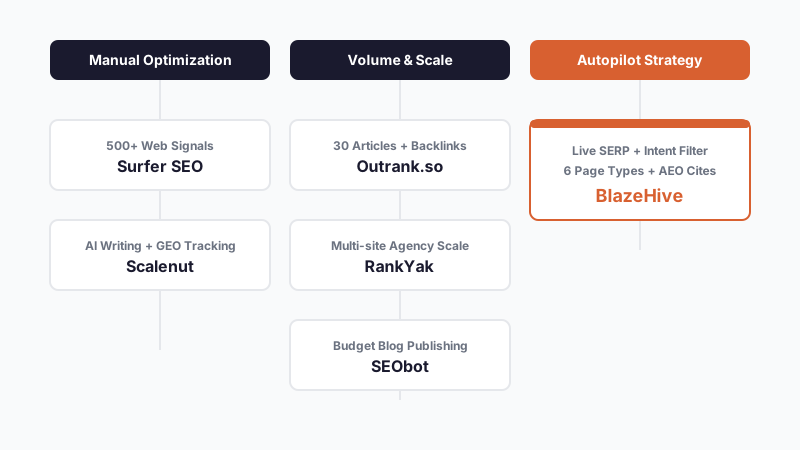
If you need bottom-of-funnel pages that rank and get cited by AI engines...
BlazeHive is the right fit. It researches buyer-intent keywords via live SERP data, prevents cannibalization by construction, humanizes every page against 30,000+ documented AI patterns, and publishes directly to your CMS. One focused page per day compounds faster than 30 generic articles per month.
If you want maximum article volume with backlink building included...
Outrank.so covers this - 30 articles per month, built-in backlink exchange network, and 150+ CMS integrations at $99/month. The reciprocal link footprint is a tradeoff worth understanding, but for teams where volume is the primary lever, it's the cleaner match.
If you manage multiple client sites or niche properties...
RankYak scales more sensibly for agencies - multi-site management, tiered article volumes up to 100/month, and a site audit layer that's absent from most autopilot tools. Expect a steeper setup and learning curve.
If you're budget-constrained and just want automated blog publishing...
SEObot at $49/month flat is the lowest-friction entry. Build in time for manual review of outputs - the quality floor requires it - but if cash preservation is the primary constraint, it's a defensible starting point.
If you have a content team and want optimization depth plus AI visibility tracking...
Scalenut at $79/month (Growth) gives you AI writing, content audits, keyword clustering, and GEO tracking across ChatGPT, Perplexity, and Gemini in one subscription - at a fraction of Surfer's cost for comparable volume.
If you have an in-house SEO strategist who wants hands-on ranking control...
Surfer SEO is the standard. 500+ web signals, precise content scoring, GEO tracking included at Standard tier - but it requires a strategist to apply the recommendations. Not autonomous; purpose-built for teams that want to own every optimization decision.
Ready to Try BlazeHive?
If you've been publishing consistently and still not seeing rankings move, the problem is usually strategy - not volume. BlazeHive targets buyer-intent keywords from the start, prevents cannibalization via live SERP cross-checking, humanizes every page before it ships, and has a team watching your growth. Drop your URL and start the 3-day free trial - no credit card required. If it's not the right fit, you'll know in three days.
Frequently Asked Questions
What should I look for in an AI SEO automation tool?
Keyword intent filtering, cannibalization prevention, humanization depth, page type breadth, technical SEO coverage, publishing autonomy, and backlink safety are the core evaluation criteria. Most tools excel at one or two-keyword research or publishing speed-but miss the complete loop of strategy, generation, validation, and monitoring. BlazeHive combines all seven because the founder realized that publishing without strategy is just noise; strategy without autonomy is still a full-time job.
Is Frizerly still worth using?
Yes, for what it was built for: a WordPress site owner or Shopify merchant who wants weekly blog publishing and social media automation on a tight budget. Frizerly's $29/year annual pricing and AEO Agent tracking brand mentions across ChatGPT and Perplexity are genuine strengths. The tradeoff: weekly publishing at volume, not daily publishing at strategy, means you'll need to monitor whether your rankings actually move after six months-and that's where most Frizerly users realize they need something deeper.
What's the difference between heuristic keyword clustering and live SERP cross-checking?
Heuristic clustering uses semantic similarity algorithms to group related keywords, then recommends writing one page per cluster to avoid competition. Live SERP cross-checking pulls actual Google ranking data to verify that two keywords don't already rank for the same pages on your site. BlazeHive uses the second method-verdicts come from Google itself, not a similarity score-so cannibalization prevention is based on observed ranking overlap, not predicted.
Why does BlazeHive publish one page per day instead of 10 or 30 per month?
One focused page per day targeting buyer-intent keywords compounds faster than 30 generic articles monthly targeting volume keywords. Over six months, you have roughly 180 BlazeHive pages all optimized for conversion intent and humanized against 30,000+ AI patterns-versus 180 Outrank or RankYak pages that may cannibalize each other or miss intent signals. Quality and strategy concentration beats volume when your goal is ranking authority, not index size.
What does humanization validated against 30,000+ AI patterns actually mean?
BlazeHive passes every page through a de-AI validation layer that checks for 30,000+ documented AI writing patterns-phrases, sentence structures, and patterns that human reviewers and AI detection systems have flagged. Every page must pass this check before it publishes; it's not optional or an add-on. Most competitors claim vague humanization ("99% undetectable"); BlazeHive's approach is specific and measurable, which is why Google treats the output as human-written content, not AI-generated filler.
How does BlazeHive prevent cannibalization if I already have pages ranking for similar keywords?
The agent pulls your live GSC ranking data and cross-checks every new keyword against existing pages to ensure no overlap. If a new keyword is already being ranked by another page on your site, the system skips it or redirects the new page into the existing one, concentrating authority instead of diluting it. This happens before publishing, so you never create internal competition-a silent authority leak that most platforms don't address.
What makes interactive tool pages different from blog posts or comparison pages?
Interactive tool pages keep visitors on-page longer-calculators, builders, assessments-which raises engagement signals (time-on-page, scroll depth) and tells Google your site is trustworthy enough that the next pages will rank faster. Blog posts and comparison pages are static content; interactive tools generate behavioral trust signals. BlazeHive's sixth page type is this-calculators, ROI estimators, or product builders that are unique to your niche and don't exist on competitor sites.
Does BlazeHive fix technical SEO issues automatically on all platforms?
Technical SEO auto-fixing is currently available on WordPress only-the agent finds and fixes broken links, redirect chains, heavy pages, and internal-linking gaps autonomously. On Webflow, Framer, Contentful, and other platforms, the system surfaces findings; fixes are coming soon. This is an honest gap: WordPress dominates the SMB market, so the bet was to ship auto-fixing there first and extend to other platforms as usage scales.
What's the difference between a reciprocal backlink network and BlazeHive's acyclic backlink approach?
Reciprocal networks (Outrank, RankYak) connect user sites to each other bidirectionally-User A links to User B; User B links back to User A. Google can detect this pattern and treat it as an exchange. BlazeHive's acyclic graph means no two sites ever exchange links; every link flows in one direction only, with per-site pattern avoidance built in. It's harder to detect, lower-risk, and safer for competitive niches where backlink profile scrutiny is intense.
How much does BlazeHive cost compared to other alternatives?
BlazeHive is $99/month all-in-everything included: keyword research, all six page types, humanization, SEO validation, autonomous publishing, and integrations. Outrank and most competitors are also $99/month at the feature-equivalent tier, so the comparison is fair. The barrier is psychological: Frizerly and SEObot start at $49/month, but both lack the strategy layer, humanization depth, and technical SEO coverage that justify the premium-you're paying for a complete loop, not just publishing speed.
Should I choose BlazeHive if I'm already publishing consistently but not seeing rankings move?
Yes-stagnant rankings after six months of consistent publishing usually means the strategy is missing, not the publishing volume. BlazeHive targets buyer-intent keywords, prevents cannibalization, humanizes every page, and monitors your growth actively. You get the strategist back in the loop via an agent you can steer, which is what most volume-based tools (Frizerly, Outrank, SEObot) are missing. Try the 3-day free trial to confirm the fit-no credit card required.
Can I use BlazeHive for social media automation like Frizerly offers?
BlazeHive doesn't include automated social media posting-the focus is organic rank and AI citation (ChatGPT, Perplexity, Google AI Overviews), not social amplification. If social media distribution is a must-have part of your strategy, Frizerly's AI Social Media Agent (posts to Facebook, Instagram, LinkedIn) is a genuine strength. For a founder prioritizing search ranking and LLM visibility over social reach, BlazeHive is the stronger fit.
What's the fastest way to know if BlazeHive is the right alternative for me?
Drop your URL into the 3-day free trial (no credit card required) and watch how the system analyzes your business, surfaces competitor insights, and proposes bottom-of-funnel keywords. Within three days, you'll see whether the keyword focus matches your conversion goals and whether the page output feels genuinely human-written. If the strategy is off or the pages don't resonate with your brand voice, Surfer SEO or Scalenut might be a better fit-but the trial is designed to answer that question fast.