TL;DR
Dashword alternatives come down to your workflow: BlazeHive is the top pick for indie founders, small teams, and medium-sized teams who want SEO on autopilot - keyword research, page generation, technical fixes, backlinks, and publishing all handled by one $99/month engine, no writers required. Surfer SEO wins for teams who want real-time optimization while they write. Rankability is the agency choice when you need multi-client workspaces and AI visibility dashboards.

Dashword Alternatives
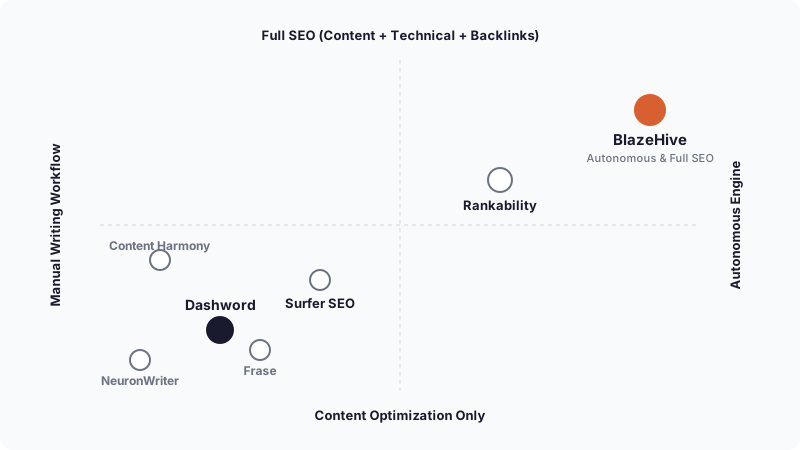
Dashword alternatives come down to whether you need a better brief tool or a fundamentally different model. Dashword is genuinely good at what it does - it pulls the top 20–30 SERP results for a keyword, generates a clean content brief, and scores your draft as you write. At $99/month with shared report access and no seat fees, it's one of the more transparent pricing structures in the category. But for teams that have outgrown the brief-then-write workflow, or never had writers to hand briefs to in the first place, better options exist. This page maps the real alternatives across each use case.
Why People Look for Dashword Alternatives
Report caps hit first. Dashword's $99/month Startup plan includes 30 content reports per month. For a solo creator or small team publishing weekly, that's fine. For a marketing team scaling to 10+ pieces a month - across briefs, rewrites, and refreshes - 30 reports disappears fast. Moving to the Business tier at $349/month for 100 reports is a steep jump without much incremental value in between.
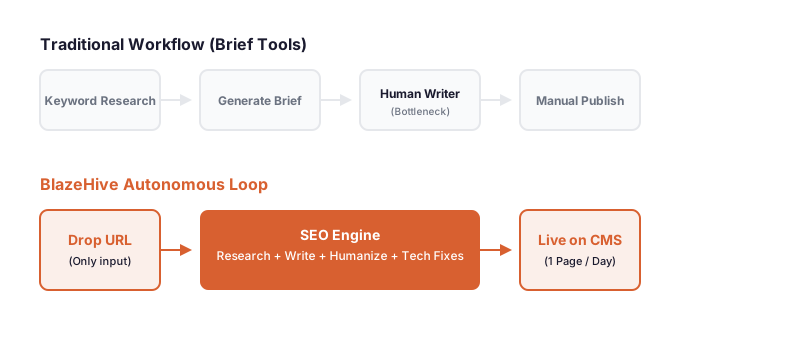
The write-it-yourself wall comes next. Dashword generates a great brief. Then it stops. You still need a writer to read that brief, draft the article, optimize it in the editor, and publish it. For teams without in-house writers - indie founders, bootstrapped SaaS teams, small agencies - this is the core friction. The tool does the research; the execution bottleneck is entirely human.
Technical SEO blind spots compound over time. Dashword is a content optimization tool, full stop. Broken links, redirect chains, heavy pages, weak internal linking - the authority leaks that quietly undermine every new article - aren't in scope. Teams that have been publishing for a year or more often realize their rankings are flat not because the content is bad, but because the site architecture is bleeding authority. Dashword has no answer for that. Neither do most of its direct competitors. Those two gaps - site architecture and AI search visibility - are why experienced SEOs keep shopping.
What to Look for in a Content Optimization Tool
Brief quality and SERP depth. A good brief tells you what to write, not just how long to write it. Look for tools that analyze the top 20–30 results, surface related questions (People Also Ask, semantic terms), and give you a structured outline - not just a word count target. Content Harmony and Dashword are benchmarks here.
AI content generation. If you're researching Dashword alternatives, you're probably doing this because writing is a bottleneck. Check whether the tool actually generates content - and whether that content is the finished article or a first draft that still needs heavy editing. Surfer SEO bundles AI article generation on the Scale tier. BlazeHive generates the full published page autonomously.
Cannibalization detection. Most tools catch cannibalization after publishing, using word count overlap or topic similarity. The more precise method is live-SERP cross-checking - where verdicts come directly from Google, not heuristics. If keyword cannibalization has already hurt your rankings, this is worth prioritizing.
Technical SEO coverage. Brief tools are useless if your site's internal links are broken, your redirects chain three deep, or your crawl budget is being eaten by heavy pages. Check whether the tool audits these and - ideally - whether it can auto-fix them, at least on your CMS.
AI visibility tracking. "AI search" is no longer optional to track. Frase, Clearscope, and Rankability all monitor whether your content is cited by ChatGPT, Perplexity, Claude, and Google AI Overviews. If you're producing content at scale, you want to know where it's showing up in AI answers, not just in Google's blue links.
Pricing per unit of output. The comparison that matters isn't monthly price - it's effective cost per published piece. A $99/month tool that requires two hours of writer time per article costs more per post than a $99/month engine that publishes autonomously. Always run the math on actual output.
Publishing workflow. How many steps sit between the tool and your live CMS? Manual copy-paste is still the norm for most tools. Direct CMS integration (WordPress, Ghost, Webflow, Framer, Contentful) removes one more friction point in the chain.
The Best Dashword Alternatives
1. BlazeHive
BlazeHive is an autonomous SEO engine that takes a URL as input and handles the entire publishing loop - keyword research, page generation, humanization, technical SEO, backlinks, and CMS publishing - without a human writer in the workflow.
Best for: Indie founders, bootstrapped SaaS teams, and small agencies that need compounding organic traffic on autopilot without hiring writers or paying agency fees. Also fits medium-sized teams and SEO experts who want steerable control through the agentic SEO chat.
Strengths
- Generates one optimized page per day autonomously across six page types (landing pages, listicles, comparisons, FAQ, interactive tools, alternatives/VS pages) - all for $99/month
- Live-SERP cannibalization detection pulls verdicts directly from Google, not similarity heuristics
- Technical SEO auto-fixes on WordPress: broken links, redirect chains, heavy pages, weak internal linking - the authority leaks competitors ignore
- Acyclic backlink network with per-site pattern avoidance; no reciprocal link exchanges, engineered safe by construction
- Humanization validated against 30,000+ documented AI writing patterns before a page ships
- Direct CMS publishing to WordPress, Ghost, Webflow, Framer, Contentful, Storyblok, Strapi, and generic webhooks - content lands under your domain
- Growth reporting tied to Google Search Console with human monitoring; stagnating sites get team intervention
Where it's not the right fit
- Not designed for teams with in-house writers who want to write and optimize manually - there's no live content editor
- Technical SEO auto-fixing is WordPress-only; other CMSes are on the roadmap but not yet available
- Requires trusting agent autonomy; if hands-on editorial control is non-negotiable, the workflow mismatch is real
Pricing: $99/month (all-in: keyword research, all six page types, humanization, publishing, backlinks, monitoring). Done-For-You setup at $3,000 one-time + $99/month. 3-day free trial, no card required. As of August 2026.
When to choose it: If you need 30+ optimized pages published per month and don't have writers, BlazeHive is the only tool that handles research, production, technical SEO, and backlinks in one loop. The effective cost per published article is ~$3.30 all-in - vs. $99+/article when you factor in writer time on a brief-first workflow.
2. Surfer SEO
Surfer SEO is a real-time content optimization platform built around its Content Editor - a live-scoring environment where your NLP score rises as you write and embed recommended terms.
Best for: Content marketers and in-house teams that draft articles in real time and want live optimization feedback as they write.
Strengths
- Fastest SERP analysis in the category - pulls the top 50 results and delivers scores quickly
- Content Editor gives a live numerical score as you type, with clear NLP term recommendations
- Scale AI tier ($219/month) bundles 30 AI-written articles per month with embedded scoring
- Google Docs and WordPress integrations; 5-seat team access on Scale
Where it's not the right fit
- Not designed for teams without writers - the tool optimizes drafts; it doesn't replace the person writing them
- Add-on structure inflates real cost: SERP Analyzer and AI detection aren't bundled on the Essential plan, pushing effective monthly spend above $150
- No technical SEO auto-fixing, no backlink strategy, no autonomous publishing
Pricing: Essential $99/month, Scale $219/month, Enterprise $999+/month. Annual billing: $79 and $175 respectively. As of August 2026.
When to choose it: You have writers producing multiple articles per week and you want real-time optimization feedback as they write. The Scale AI tier makes sense if you want AI generation plus live scoring in one workflow.
3. Rankability
Rankability covers keyword research, AI brief and content creation, optimization, AI search visibility tracking, and performance monitoring. It's built for agencies that need to manage Google rankings and AI search citations at the same time.
Best for: Agencies and multi-client content teams that need structured workflows, white-label reporting, and visibility across Google and AI search platforms like ChatGPT, Perplexity, and Google AI Overviews.
Strengths
- Tracks AI visibility across ChatGPT, Perplexity, Claude, Gemini, and Google AI Overviews - one of the more complete LLM tracking setups available
- Unlimited users on all plans - no per-seat charges
- API and MCP server access on all tiers (Claude and Cursor compatible)
- Core plan ($99/month annual) includes 30 new assets, 30 optimizations, and 10 full rewrites per month
- 5-star G2 ratings from verified agency users
Where it's not the right fit
- Not designed for completely autonomous publishing - someone still has to run the workflow
- No technical SEO auto-fixing; the platform tracks rankings and content but doesn't repair site-level issues
- Annual billing required for the $99 entry price; monthly billing runs $149/month
Pricing: Core $99/month (annual) / $149/month (monthly); Scale $299/month (annual); Advanced $799/month (annual). As of August 2026.
When to choose it: You're running SEO for multiple clients and need a platform that connects Google rankings with AI search visibility, handles team workflows, and produces white-label reports.
4. Frase
Frase is a fast, affordable SERP research and briefing tool that bundles GEO tracking across 8 AI platforms at a price point that undercuts almost everyone in the category.
Best for: Solo creators, freelancers, and lean startup teams that want fast outlines and SERP-grounded briefs without paying mid-market prices.
Strengths
- Tracks 8 AI platforms for GEO: ChatGPT, Perplexity, Claude, Gemini, Grok, Google AI Overview, Google Search, and Bing - more than any other tool at this price
- Professional plan includes 100k AI words per month
- Clean brief structures with topic lists, headings, related questions, and links from top-ranking pages
- Starts at $14.99/month - lowest legitimate entry point in this space
Where it's not the right fit
- Not designed for autonomous content generation - you still write from the brief
- Project limits on lower plans; advanced AI documents incur additional costs
- No technical SEO features, no backlink strategy, no direct CMS publishing
Pricing: Starter $14.99/month, Professional $49/month. As of August 2026.
When to choose it: You're a solo creator or small team managing your own writing, budget is tight, and AI search visibility tracking matters to you. Frase's 8-platform GEO tracking at $49/month is the best value in the space for that specific need.
5. Content Harmony
Content Harmony is a brief-first platform built for agencies and teams that manage external writers. It covers structured briefs, topic modeling, and workflow management without requiring a full content ops tool.
Best for: Agencies and editorial teams coordinating multiple freelance writers who need detailed, structured briefs and light project management without moving to a full content ops platform.
Strengths
- Best-in-class brief structures: topic modeling, full SERP analysis, auto-generated headings and outline, competitor insights
- Unlimited users on all plans - no per-seat pricing
- $10 trial for 10 briefs, no auto-renewal (deliberate: low-friction test before committing)
- Growth tier ($299/month) adds advanced competitor insights, project management, and priority support
Where it's not the right fit
- Not designed for teams without writers - the tool generates briefs, not finished articles
- Content optimization is lighter than Surfer SEO or NeuronWriter; stronger on planning than on-page scoring
- No technical SEO, no backlink analysis, no autonomous publishing
Pricing: Starter $99/month (10 workflows), Growth $299/month (30 workflows), Professional $499/month (50 workflows). As of August 2026.
When to choose it: Your agency manages 5+ external writers and brief quality is the bottleneck. Content Harmony's brief structures and collaboration tools are better designed for this workflow than Dashword, Surfer SEO, or anything else in the mid-market.
6. NeuronWriter
NeuronWriter is a semantic SEO and AI content tool with the lowest all-in pricing in the category - and one of the few budget tools that includes plagiarism detection by default.
Best for: Budget-conscious SEOs and individual content creators who want semantic NLP analysis and AI writing credits without paying $99/month for features they won't use.
Strengths
- Starts at $23/month with 25 analyses and AI writing credits - lowest serious entry price in the space
- Plagiarism detection included on all plans (Dashword and Clearscope both lack this)
- Real-time content scoring on a 1–100 scale with semantic term recommendations
- WordPress integration and internal linking suggestions on higher tiers
Where it's not the right fit
- Not designed for teams: collaboration tools and brief structures are weaker than Dashword or Content Harmony
- AI credits scale with plan tier; the Bronze plan ($23/month) has limited AI writing volume
- No autonomous publishing, no technical SEO, no backlink strategy
Pricing: Bronze $23/month, Silver $45/month, Gold $69/month, Platinum $93/month, Diamond $117/month. Annual billing: $19–97/month. As of August 2026.
When to choose it: You're an individual creator optimizing content on a tight budget, you write your own articles, and you want semantic SEO scoring plus plagiarism detection without committing to a $99/month platform.
Quick Comparison
| Tool | Best For | Starting Price | Free Tier | Standout Feature |
|---|---|---|---|---|
| BlazeHive | Founder-led SEO on autopilot | $99/mo | 3-day trial, no card | Autonomous daily page + technical SEO auto-fixes |
| Surfer SEO | Real-time optimization while writing | $99/mo | No | Live NLP scoring as you type |
| Rankability | Agency multi-client SEO + AI tracking | $99/mo (annual) | No | 8-platform AI visibility tracking, unlimited users |
| Frase | Budget solo creator + GEO tracking | $14.99/mo | No (first doc free) | 8-platform GEO tracking at lowest price |
| Content Harmony | Brief-first agency workflow | $99/mo | $10 trial (10 briefs) | Best brief structures + unlimited users all plans |
| NeuronWriter | Solo semantic SEO on a budget | $23/mo | No | Plagiarism detection included from entry tier |
Pricing as of August 2026. Check each tool's pricing page for current rates.
Which Alternative Should You Choose?
Most teams searching for Dashword alternatives are hitting one of a handful of specific friction points. Here's where each tool fits.
If you're a founder or small team that needs organic traffic but can't pause to write...
BlazeHive is the right tool. It's the only option here that handles keyword research, writing, technical SEO, backlinks, and CMS publishing autonomously at $99/month - no writer required. If execution is the bottleneck, not research, that's your answer.
If you have writers and want real-time optimization feedback while they draft...
Surfer SEO is better designed for this. Its live Content Editor scores improve as writers embed recommended NLP terms - tighter feedback loop than Dashword's brief-then-review workflow. The Scale AI tier ($219/month) also bundles 30 AI articles per month if you want to supplement human output.
If you're running SEO for multiple clients and need AI search visibility data...
Rankability is the agency-grade choice. Unlimited users, MCP and API access on all tiers, and AI visibility tracking across ChatGPT, Perplexity, Claude, Gemini, and Google AI Overviews. Nothing else in this price range covers all five AI platforms plus Google rankings in one dashboard.
If you're a solo creator on a budget who cares about AI search placement...
Frase at $49/month tracks 8 AI platforms including Grok and Bing AI - more than Rankability or Clearscope at this price. It still requires you to write, but the research layer is fast and the GEO tracking is genuinely useful.
If your agency coordinates multiple external writers and brief quality is the bottleneck...
Content Harmony is the best match. Its brief structures and topic modeling are more detailed than Dashword's, and unlimited users on all plans means you won't pay extra as your writer roster grows.
If you want semantic SEO scoring and plagiarism detection at the lowest possible price...
NeuronWriter at $23/month covers the basics - NLP scoring, internal linking suggestions, and plagiarism checks that Dashword doesn't include. Not a power tool, but the value-per-dollar ratio is hard to beat for individual creators.
Ready to Try BlazeHive?
If you're done reading briefs and want ranked, AI-cited pages published to your CMS every day - without a writer, without an agency, and without touching a keyboard - BlazeHive is the right call. Drop your URL, and the engine handles the rest: keyword strategy, writing, humanization, technical SEO, backlinks, and publishing, all at $99/month. Start your 3-day free trial - no credit card required.
Frequently Asked Questions
What should I look for in a Dashword alternative?
A good Dashword alternative depends on your workflow: if you have writers, prioritize real-time optimization tools like Surfer SEO; if you need autonomous publishing, choose BlazeHive; if you manage multiple clients, look for AI visibility tracking and white-label reporting like Rankability offers. Beyond that, evaluate brief quality, cannibalization detection accuracy, technical SEO coverage, and effective cost per published article-not just monthly price. The best tool solves your specific bottleneck, whether that's research, writing, optimization, or scaling across teams.
Is Dashword still worth using in 2026?
Yes, Dashword remains excellent for teams with in-house writers who need research-quality briefs and optimization scoring-the brief-then-write workflow it's designed for is genuinely good. The friction point is at scale: the 30-report limit on the Startup plan fills fast, and moving to the $349/month Business tier is a steep jump. If you have 3+ writers publishing 10+ pieces per month and brief quality is your priority, Dashword's value holds up. For teams without writers, or those drowning in technical SEO debt, you'll need something else.
What makes a good SEO content optimization tool?
The best content optimization tools combine four core capabilities: accurate SERP analysis (top 30 results minimum), live or structured cannibalization detection, technical SEO auditing, and direct CMS publishing integration. Beyond those, strong tools track AI search visibility across multiple platforms, offer pricing that scales to your output volume, and measure cost per published piece, not just monthly fees. If a tool excels at research but leaves you writing and fixing broken internal links by hand, you've optimized for the wrong bottleneck.
How does BlazeHive differ from Dashword?
Dashword is a brief-generation and optimization platform-you read the brief, write the article, score it in the editor, and publish manually. BlazeHive is an autonomous SEO engine that handles keyword research, page generation, humanization, technical SEO auto-fixes (WordPress), backlinks, and CMS publishing without a writer in the loop. Dashword costs $99–$349/month and requires human production; BlazeHive costs $99/month all-in and outputs one ranked page per day autonomously. Choose Dashword if you have writers; choose BlazeHive if you don't and need scaling without hiring.
Which Dashword alternative is best for autonomous SEO?
BlazeHive is the only alternative here designed for fully autonomous SEO-it generates one optimized page per day across six page types (landing pages, listicles, comparisons, FAQ, interactive tools, alternatives), validates content against 30,000+ AI writing patterns, auto-fixes technical debt on WordPress, manages backlinks safely, and publishes directly to your CMS. Rankability and Surfer SEO still require someone to run the workflow; they're better for semi-automated content ops where humans guide the process. For "set it and forget it" SEO on a $99/month budget, BlazeHive is the only match.
Can Dashword alternatives detect keyword cannibalization?
Most tools detect cannibalization using similarity heuristics-word count overlap, topic modeling, or semantic matching-which catch obvious conflicts but miss nuanced edge cases. BlazeHive uniquely uses live-SERP cross-checking: it checks Google's actual results to see whether two keywords are competing for the same position, so verdicts come directly from Google, not guesses. This removes false negatives and gives you actionable confidence before publishing. Rankability and Surfer SEO offer cannibalization checks too, but both rely on heuristics rather than live SERP data.
Do any Dashword alternatives include technical SEO auto-fixes?
BlazeHive is the only tool in this category that auto-fixes technical SEO issues-broken links, redirect chains, heavy pages, weak internal linking-all by design on WordPress. Other competitors either don't address technical SEO at all (Dashword, Frase, NeuronWriter) or audit without fixing (Rankability, Surfer SEO mention audits but don't auto-repair). On non-WordPress platforms, BlazeHive audits but auto-fixes are on the roadmap. If technical debt is eroding your rankings and you use WordPress, BlazeHive's auto-fixing capability is a unique advantage.
Which Dashword alternative tracks AI search visibility?
Rankability and Frase both track multiple AI platforms: Rankability monitors ChatGPT, Perplexity, Claude, Gemini, and Google AI Overviews on its Core plan ($99/month annual); Frase tracks 8 platforms including Grok and Bing AI at $49/month. Neither Dashword nor Surfer SEO publicly expose AI visibility tracking. For teams publishing at scale and needing to know where content appears in AI answers-not just Google's blue links-Rankability's comprehensive tracking or Frase's budget option are essential. BlazeHive's positioning promises AI citation capability but doesn't publicly expose per-platform tracking yet.
Is Surfer SEO better than Dashword for content optimization?
Surfer SEO and Dashword serve different workflows: Dashword excels at brief generation and team collaboration on research; Surfer SEO's Content Editor gives live NLP scoring as you type-better if your team drafts in real time and wants immediate optimization feedback. Surfer's Scale tier ($219/month) also bundles AI article generation, where Dashword doesn't. For writers who want live feedback, Surfer is stronger; for teams coordinating external writers from research briefs, Dashword is cleaner. The choice depends on whether you optimize-while-writing or brief-then-write.
What is the cost per article across Dashword alternatives?
Effective cost per article varies dramatically by workflow: Dashword at $99/month with 30 reports/month = ~$3.30 per brief, but requires writer time on top (add $50–100 per article). BlazeHive at $99/month outputs ~30 ranked articles all-in = ~$3.30 per article, labor included. Frase at $49/month is $1.63 per brief but still requires you to write. Rankability's Core at $99/month (annual) covers 30 assets but assumes someone manages the workflow. Always multiply monthly price by writer hours needed to find true cost per published piece-most brief-first tools hide the real expense.
Should I choose BlazeHive or Rankability for my team?
Choose BlazeHive if you're a founder, small team, or medium-sized team that needs organic traffic autonomously without writers or operational overhead-keyword research through publishing happens without human intervention. Choose Rankability if you're an agency managing multiple clients and need structured team workflows, white-label reporting, AI visibility tracking across five platforms, and API/MCP access. Rankability assumes someone orchestrates content ops; BlazeHive assumes you want it all done for you. The question isn't which is "better"-it's whether you need autonomy (BlazeHive) or control (Rankability).
Is Content Harmony better than Dashword for agencies?
Content Harmony and Dashword both serve agencies, but differently: Content Harmony's strength is brief quality-topic modeling, structured outlines, and competitor insights are more detailed-and it includes unlimited users across all plans, so growing your writer roster costs nothing. Dashword's strength is simplicity and team collaboration on research without project management overhead. For agencies managing 5+ external writers where brief quality is the bottleneck, Content Harmony edges Dashword. For lean agencies that just need clean briefs and plan to manage workflow elsewhere, Dashword's simplicity wins.
Which Dashword alternative is cheapest?
NeuronWriter at $23/month is the lowest legitimate entry price, covering semantic SEO scoring, AI writing credits, and plagiarism detection-the last included by default where Dashword lacks it entirely. Frase at $49/month adds 8-platform AI search visibility tracking, which NeuronWriter doesn't expose. At the entry tier, neither touches the features of $99/month tools like Dashword or Rankability. Budget matters most if you're a solo creator writing your own content; if you're scaling output or managing teams, the math favors higher-priced all-in platforms like BlazeHive.
Why would I choose Frase over Dashword?
Frase's main edge is AI search visibility: it tracks ChatGPT, Perplexity, Claude, Gemini, Grok, Google AI Overview, Google Search, and Bing AI-eight platforms total-at just $49/month, cheaper than Dashword's $99/month and without LLM tracking. Frase's briefs are clean but lighter than Dashword's optimization scoring; its real value is knowing where your content shows up in AI answers. Choose Frase if you're a solo creator or small team on a budget who cares deeply about GEO (Generative Engine Optimization) tracking. Choose Dashword if you want deeper SERP analysis and team collaboration tools.
Does BlazeHive work for teams with writers?
BlazeHive is not designed for teams with writers-there's no live content editor, no brief-to-draft handoff workflow, and no collaborative scoring layer where writers optimize together. If your team includes multiple in-house writers producing regular content, Surfer SEO's Content Editor or Rankability's workflow tools are better fits. BlazeHive's autonomy is a strength for founder-led or lean teams without writers; it's a weakness for teams that already have writing capacity and want optimization collaboration. The mismatch is real, not a limitation-it's a different model.