TL;DR
Byword Alternatives come down to what's actually blocking you. BlazeHive is the top pick for teams who want strategy, writing, humanization, and publishing handled autonomously - no 20–45 minute editing queue. Frase wins for SERP research and native AI search tracking; Rytr wins when $9/month is the hard constraint.
Byword Alternatives
Byword Alternatives are worth a hard look once you've priced in what Byword actually costs: 20–45 minutes of editing per article, no in-app refinement, and a 2.8/5 Trustpilot rating driven by CMS integration failures and support that replies with auto-generated emails. Byword's multi-model speed is real - 60–90 seconds with GPT-5.4, Claude Opus 4.6, and Gemini 3.1 Pro on every tier - but fast generation into a broken publishing workflow is not throughput. Below are six alternatives, each matched to the situation where it's the right call.

Why People Look for Byword Alternatives
The editing tax is the single biggest driver. A team generating 80 articles/month on Byword's Standard plan ($299/month) faces 25–60 hours of monthly editor overhead just to get content to publishable quality. At $50/hour, that's a $1,250–$3,000 hidden monthly cost stacked on top of the subscription. The per-article economics collapse fast.
CMS integration reliability is the second recurring pain. Trustpilot reviewers describe verification code failures, unpredictable publishing errors, and support that routes to templated auto-replies. When your content pipeline is automated, a flaky integration isn't a minor inconvenience - it's a broken pipeline that silently fails at 2am.
The third signal is strategic: Byword generates articles but doesn't do SEO. There's no cannibalization detection, no bottom-of-funnel keyword strategy, no humanization module for AdSense or E-E-A-T sensitive sites, and no tracking for where your brand appears in ChatGPT, Perplexity, or Google AI Overviews. Teams that started on Byword for speed eventually realize they still need a strategist, an editor, and an AI detection tool - the stack they were trying to replace.
What to Look for in an AI SEO Content Tool
Editing overhead. The right tool reduces the time between generation and publish-ready, not just the time to generate. Look for built-in content briefs, humanization validation, and on-page SEO enforcement (keyword in slug, title, first sentence, meta description). A tool that generates in 90 seconds but requires 40 minutes of fixes has worse real throughput than one that takes 5 minutes and ships clean.
AI search visibility. In 2026, ranking on Google is half the job. Google AI Overviews, ChatGPT, and Perplexity generate answers that skip the ten blue links entirely. A tool that optimizes only for traditional SEO misses the fastest-growing traffic channel. Ask whether GEO (Generative Engine Optimization) scoring and AI citation tracking are built in, or whether you need a separate tool for that.
Cannibalization detection. Multiple pages targeting the same or overlapping queries will compete against each other in Google's index. Most tools don't check this. The ones that do use similarity heuristics; the best ones cross-check against live SERPs so the verdict comes from Google itself, not a guess.
Integration reliability. Broken CMS publishing is the silent killer of content automation. Check whether the tool's integrations are battle-tested at your CMS (WordPress, Webflow, Ghost, HubSpot) and whether the team tracks publishing errors actively. A feature list is not a reliability signal - Trustpilot reviews and direct support responsiveness are.
Total cost. The subscription price is only the start. Factor in per-seat fees, usage caps, overage charges, and the cost of any tools you still need to add (AI detection, keyword research, link building, rank tracking). A $99/month tool that requires a $200/month supporting stack is a $299/month tool.
Technical SEO. Content authority leaks through broken links, redirect chains, heavy pages, and weak internal linking. Most content tools ignore this entirely. If your domain has existing technical debt, it quietly undermines every page you publish, regardless of content quality.
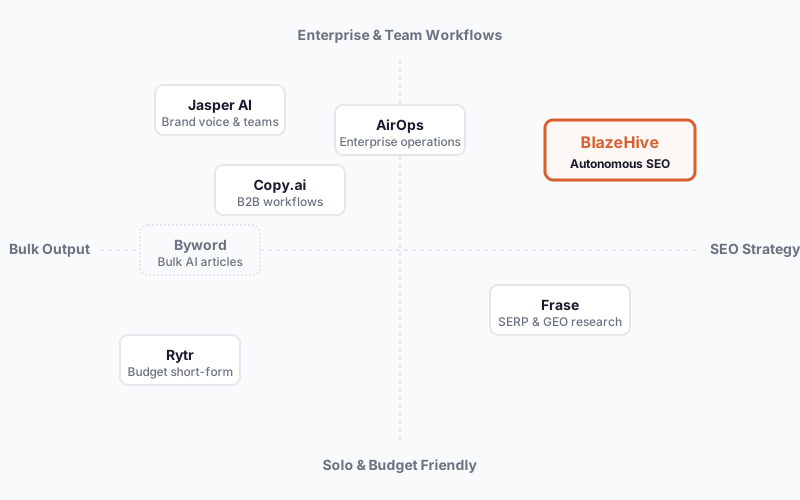
The Best Byword Alternatives
1. BlazeHive
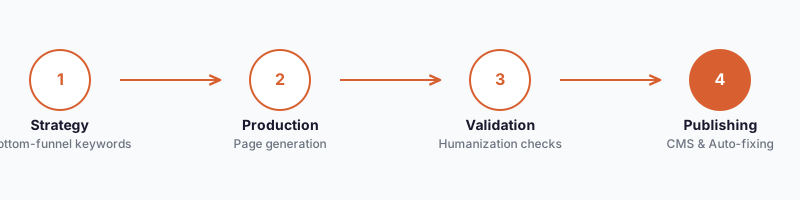
BlazeHive is an autonomous SEO engine that handles strategy, writing, humanization, technical SEO, backlinks, and publishing as one $99/month loop - no editor queue required.
Best for: Indie founders, SMB/SaaS marketing teams, and agencies who want agency-quality SEO output on autopilot without the agency bill or an in-house SEO hire. Also fits medium-sized teams and SEO experts who want steerable control through the agentic SEO chat.
Strengths
- Autonomous bottom-of-funnel keyword research cross-checked against live Google SERPs - no vanity traffic, no cannibalizing your own pages
- Humanization validated against 30,000+ documented AI writing patterns before every page ships
- Six page types: landing pages, listicles, comparisons, VS pages, FAQ pages, and interactive tool pages (the only type in this list that builds engagement signals and dwell time)
- Technical SEO agent finds and auto-fixes broken links, redirect chains, and internal linking gaps on WordPress (other CMSes coming)
- Safety-engineered backlink network with acyclic graph structure - no reciprocal link exchanges by design
- Publishes directly to WordPress, Ghost, Webflow, Framer, Contentful, Storyblok, Strapi, and generic webhook
- Human monitoring: the team tracks every customer's GSC performance and intervenes if a site stagnates
Where it's not the right fit
- Not optimized for raw bulk article generation speed - if you need 300 articles this week with no strategic filter, Byword's throughput wins
- Technical SEO auto-fixing is WordPress-only today; other CMS platforms are on the roadmap
- Not designed for short-form copywriting (ads, email subject lines, social posts) - purpose-built for SEO content
Pricing: $99/month all-in, 3-day free trial, no card required. Done-For-You setup available at $3,000 one-time + $99/month. As of August 2026.
When to choose it: You're a founder, small marketing team, or medium-sized team that needs compounding organic traffic and AI citation presence but can't pause product work to run SEO manually every day. BlazeHive is the whole loop - strategy to published, humanized, optimized page - without building an agency stack.
2. Frase
Frase is a SERP research and content brief platform with built-in dual SEO + GEO scoring - the only tool in this list that natively tracks where your brand appears in ChatGPT and Perplexity.
Best for: SEO-first content teams that need data-driven briefs and AI search visibility in a single platform, at under $100/month.
Strengths
- Dual SEO + GEO scoring: no other tool in this set offers native Generative Engine Optimization tracking
- AI search tracking (ChatGPT, Perplexity) built in on Scale+ plans, no third-party tool required
- Automated content briefs from live SERP data: target length, headers, and on-page elements calculated from what's actually ranking
- Competitive pricing: Starter at $39/month (annual) undercuts Surfer SEO ($99) and MarketMuse ($149)
- 7-day free trial, no credit card required
Where it's not the right fit
- Not optimized for bulk generation speed - generating 80+ articles/month is slower and more workflow-intensive than Byword
- Still requires human quality review and editing; it reduces rewrite depth but doesn't eliminate it
- AI search tracking is only on Scale+ (custom pricing); lower plans don't include it
Pricing: Starter $39/month (annual) or $45/month (monthly), Professional $98/month (annual) or $115/month (monthly). Scale: custom. As of August 2026.
When to choose it: Your team produces 10–40 articles/month, you care about appearing in AI answers (not just Google), and you want briefs backed by SERP data instead of generating blind.
3. Jasper AI
Jasper is a marketing content platform built around brand voice consistency and team workflows, with the most mature multi-seat collaboration in this set.
Best for: Marketing teams and agencies that need strong brand voice enforcement across multiple contributors and campaign types.
Strengths
- Brand Voice 2.0 engine learns tone patterns from uploaded samples and holds them across the whole team - more consistent than any other tool here
- Multi-seat collaboration on Pro (5 users at $69/month) and Business; team workflow is built in, not bolted on
- Mature CMS integrations (WordPress, HubSpot) with a Chrome extension that works inside Google Docs, Gmail, and LinkedIn
- Broad template library covering blog content, ad copy, email, and social in a single platform
Where it's not the right fit
- 3.4/5 Trustpilot with recurring billing complaints and misleading trial terms - worth knowing before you enter card details
- Not designed for autonomous SEO strategy; a human still selects keywords, builds briefs, and approves drafts
- Creator plan ($49/month) is single-seat; team workflows require Pro ($69/month) or above
Pricing: Creator $49/month, Pro $69/month (monthly) or $59/month (annual), Business custom. 7-day free trial, credit card required. As of August 2026.
When to choose it: You manage a 3–10 person content team, brand voice consistency is non-negotiable, and you need campaign-level features (not just article generation) in one platform.
4. Rytr
Rytr is a budget-first AI writing assistant with 40+ use cases, a 4.5/5 Trustpilot rating, and the lowest entry price in this comparison set - $9/month for 100,000 characters.
Best for: Freelancers, solopreneurs, and small business owners producing high-volume short-form content with minimal budget.
Strengths
- 4.5/5 Trustpilot across 2,454 reviews - the highest trust score in this entire comparison, by a wide margin
- $9/month Unlimited plan for 100,000 characters/month; Premium at $29/month adds unlimited characters and 35+ languages
- SemRush integration for keyword research on higher plans
- Plagiarism checking built in (50 checks/month on Unlimited, 100 on Premium)
- Chrome extension on all tiers; no friction to get started
Where it's not the right fit
- Not built for deep long-form SEO articles - user reviews and research both flag this as its core limitation
- No SERP research, no content briefs, no AI search tracking
- Not suitable for teams needing programmatic SEO at scale or strategic keyword targeting
Pricing: Free (10,000 characters/month), Unlimited $9/month, Premium $29/month. As of August 2026.
When to choose it: Your budget is genuinely constrained, you're producing short-form copy (social posts, email, product descriptions, short blog intros), and you don't need the strategic SEO layer.
5. AirOps
AirOps is an enterprise-grade content operations platform with multi-model AI access and content grids for bulk management. It also runs AirOps Academy, a cohort-based training program with recognized SEO practitioners - unusual for a SaaS tool in this space.
Best for: Mature content and SEO teams with large-scale publishing needs, multi-region campaigns, or 5+ person teams that have outgrown simpler tools.
Strengths
- 30+ AI models on Pro/Enterprise tier; Pro includes ChatGPT, Gemini, Perplexity, and Google AI Studio
- Content operation grids for managing bulk creation runs - actually useful once you're past 100+ articles/month
- Direct publishing to WordPress, Webflow, Ghost, and HubSpot; described as more battle-tested than Byword's integrations
- AirOps Academy runs cohort-based training with recognized SEO practitioners - most tools at this price ship a help center and call it done
- Unlimited seats on Pro; at 5+ users it's cheaper per seat than Jasper Pro
Where it's not the right fit
- Steeper learning curve than any other tool on this list; setup requires real workflow architecture
- The jump from Solo ($200/month) to Pro ($2,000/month) with no mid-tier creates a harsh decision point for growing teams
- Solo plan is ChatGPT-only - multi-model access requires the $2,000/month Pro plan
Pricing: Insights (Free), Solo ~$200/month, Pro ~$2,000/month, Enterprise custom. 14-day trial with limited credits. As of August 2026.
When to choose it: You're running content operations at a scale where $2,000/month is cheaper than the full-time hire it replaces, and you need multi-model access, unlimited seats, and dedicated account management.
6. Copy.ai
Copy.ai is a workflow automation platform with 2,000+ integrations built for B2B teams running content pipelines across sales and marketing simultaneously.
Best for: B2B SaaS teams and growth agencies that need to connect content creation to CRM, outreach, and lead processing in a single automated workflow.
Strengths
- 2,000+ pre-built and API integrations - far deeper than any other tool here for workflow automation
- Multi-model AI (OpenAI, Anthropic, Gemini) on all tiers
- Unlimited words in Chat and Chat projects
- Agent-based architecture supports multi-step automation from brief to published content and beyond
Where it's not the right fit
- 2.0/5 Trustpilot (195 reviews) - billing and cancellation issues are the dominant complaint, and it's the lowest trust score in this set
- Not designed for SEO-first content; strongest when used for B2B sales + marketing automation, not article publishing
- ROI requires real investment in workflow architecture; out-of-the-box it's not a Byword replacement
Pricing: Chat $29/month (monthly) or $24/month (annual, 5 seats), Agents $249/month (10 seats), Enterprise custom. As of August 2026.
When to choose it: Your team runs multi-step B2B workflows where content creation is one step in a broader automation (outbound sequences, CRM enrichment, lead nurturing) - not standalone article generation.
Quick Comparison
| Tool | Best For | Starting Price | Free Tier | Standout Feature |
|---|---|---|---|---|
| BlazeHive | Autonomous SEO on autopilot | $99/month | 3-day trial, no card | Full loop: strategy → publish → humanized → links |
| Frase | SERP research + AI search tracking | $39/month (annual) | 7-day trial | Native dual SEO + GEO scoring |
| Jasper | Brand voice + team workflows | $49/month | 7-day trial | Brand Voice 2.0 with multi-seat collaboration |
| Rytr | Budget short-form content | $9/month | Yes, 10K chars/month | 4.5/5 Trustpilot; lowest cost entry |
| AirOps | Enterprise content operations | ~$200/month | Free (1,000 tasks) | 30+ AI models + unlimited seats on Pro |
| Copy.ai | B2B workflow automation | $29/month (5 seats) | Limited | 2,000+ integrations for multi-step pipelines |
Pricing as of August 2026. Check each tool's pricing page for current rates.
Which Alternative Should You Choose?
Most teams looking at this page fall into one of five situations. Here's the honest routing.
If you need AI search visibility alongside Google rankings...
Frase is the only tool here with native dual SEO + GEO scoring and built-in ChatGPT/Perplexity tracking. If your content strategy includes being cited in AI answers - not just ranking on page one - Frase is the clear choice at $39–$98/month.
If editing overhead is crushing your team...
BlazeHive eliminates the edit queue by running humanization validation (30,000+ AI patterns) and on-page SEO enforcement before anything publishes. Pages are built to rank and pass detection - no separate review tool needed, no export-to-Docs step.
If budget is the hard constraint...
Rytr at $9/month for 100,000 characters is the honest answer - with a 4.5/5 Trustpilot to back it up. It's not built for long-form SEO, but for short-form copy at volume with a tight budget, nothing in this set competes on cost.
If brand voice and team collaboration are non-negotiable...
Jasper has the most refined brand voice engine (Brand Voice 2.0) and the most mature multi-seat workflow. At $69/month for 5 users on Pro, it's the right call for 3–10 person marketing teams where tone consistency is a real business requirement.
If you're running enterprise-scale content operations...
AirOps Pro at $2,000/month is cheaper per seat than Jasper for larger teams, adds 30+ AI models, and includes dedicated account management. The learning curve is real, and the $200→$2,000 pricing cliff is brutal. But at true enterprise scale, it undercuts the cost of a full-time content operations hire.
If you're an indie founder who needs SEO to compound without daily involvement...
BlazeHive is built exactly for this. Drop a URL; the engine builds the keyword strategy, generates pages across six formats, humanizes output, fixes technical SEO, and publishes direct to your CMS. One engine, $99/month, no agency required.
Ready to Try BlazeHive?
If your main frustration with Byword is the editing overhead, the missing SEO strategy layer, or the lack of AI citation tracking - BlazeHive replaces the whole stack. The 3-day free trial requires no credit card. Start here at blazehive.io and the engine will study your site, build a keyword strategy, and have your first page published before your trial ends.
Frequently Asked Questions
What should I look for in a Byword alternative?
The right tool reduces time from generation to publish-ready, not just generation speed alone-look for built-in content briefs, humanization validation, and on-page SEO enforcement so keyword placement is automatic. AI search visibility matters in 2026; check whether GEO scoring and ChatGPT/Perplexity tracking are native, or whether you need a separate tool. Cannibalization detection using live SERPs (not just similarity heuristics) prevents your own pages from competing on Google, and integration reliability-tracked via Trustpilot and support responsiveness-is non-negotiable because a flaky CMS publisher silently breaks your pipeline at 2am.
Why is Byword losing users to alternatives?
The editing tax is the single biggest driver: 80 articles per month on Byword's Standard plan ($299) requires 25–60 hours of monthly editor time to reach publishable quality-a hidden $1,250–$3,000 cost stacked on the subscription. CMS integrations are notoriously flaky with verification code failures and unpredictable publishing errors, compounded by support that routes to templated auto-replies. A third wave of departures stems from Byword's lack of strategic SEO: no cannibalization detection, no bottom-of-funnel keyword research, and no humanization module, so teams still need a strategist, editor, and AI detection tool-the stack they thought Byword would replace.
What makes BlazeHive different from other Byword alternatives?
BlazeHive operates as a full autonomous loop: it researches bottom-of-funnel keywords cross-checked against live Google SERPs, writes six page types (landing, listicle, comparison, versus, FAQ, interactive tool), validates every page against 30,000+ documented AI patterns for humanization, auto-fixes technical SEO on WordPress, and publishes direct to your CMS-all for $99/month with no editor queue. Most alternatives generate articles that still require 20–45 minutes of editing; BlazeHive ships clean. The backlink network is safety-engineered with an acyclic graph structure so no two sites ever exchange links, preventing the reciprocal footprint that triggers Google's link penalties.
Is Frase better than Byword for SEO content?
Frase wins decisively for SERP research and AI search visibility: it's the only tool in this comparison with native dual SEO + GEO scoring and built-in ChatGPT/Perplexity tracking-no third-party tool required. At $39–$98/month, it undercuts Byword's baseline and generates data-driven content briefs from live SERP analysis, reducing rewrite depth by targeting length, headers, and on-page elements that are already ranking. Frase still requires human quality review and editing, so it's not optimized for raw bulk generation speed like Byword, but for teams that care about appearing in AI answers (not just Google), it's the better fit.
How does Rytr compare to Byword on cost?
Rytr's Unlimited plan at $9/month for 100,000 characters per month is 11x cheaper than Byword's baseline, with a 4.5/5 Trustpilot rating versus Byword's 2.8/5. The catch is that Rytr is built for short-form content (social posts, email, product copy) not long-form SEO articles-user reviews consistently flag this as its core limitation. If your content is high-volume short-form and budget is genuinely constrained, Rytr wins; if you need strategic SEO content at scale, Byword's cost disadvantage disappears once you factor in Rytr's unsuitability for the task.
Does Jasper have better team collaboration than Byword?
Jasper's Pro plan ($69/month for 5 users) includes multi-seat collaboration built in, with Brand Voice 2.0 that learns tone patterns from your samples and enforces them across every team member-Byword has no team features at all. Jasper's workflow is mature for 3–10 person marketing teams where brand voice consistency is a real requirement. However, Jasper has a 3.4/5 Trustpilot with recurring billing complaints and misleading trial terms, whereas Byword's main pain is execution reliability, not feature depth-so Jasper wins on collaboration but not on trust.
What is the best Byword alternative overall?
There's no universal best; it depends on your actual bottleneck. If editing overhead is crushing you, BlazeHive ($99/month) eliminates the edit queue with pre-validated humanization and on-page SEO enforcement. If you need AI search visibility, Frase ($39–$98/month) is the only native GEO tracking tool in this set. If budget is hard-constrained, Rytr ($9/month) has the highest Trustpilot (4.5/5) for short-form work. For teams that need autonomy plus strategy plus SEO monitoring, BlazeHive's full loop-keyword research, humanization, technical fixes, backlinks, publishing-addresses more pain points than any single alternative.
Which Byword alternative is best for agencies?
For smaller agencies (3–10 people) managing multiple client voices, Jasper Pro at $69/month (5 users) offers the most refined brand voice engine and multi-seat workflow. For larger agencies or teams running content operations at scale, AirOps Pro ($2,000/month with unlimited seats) is cheaper per seat than Jasper above 5 users and includes 30+ AI models, content operation grids, and dedicated account management. BlazeHive ($99/month) can also work for agencies if white-label publishing to client domains is your model-it publishes directly to client WordPress/Ghost/Webflow instances with full autonomy, no manual handoff.
Does any alternative offer both speed and quality like Byword claims?
No tool in this set matches Byword's 60–90 second generation speed while also shipping publish-ready content. BlazeHive takes longer to generate but ships with humanization pre-validated and on-page SEO enforced, cutting total time-to-publish by eliminating the edit step. Frase trades generation speed for SERP-driven brief quality, reducing rewrite depth rather than eliminating editing. The honest framing is: Byword generates fast but requires heavy editing; alternatives either slow generation to reduce edits (BlazeHive) or provide better research to improve quality (Frase), but the "fast and perfect" promise doesn't exist in this category.
What is GEO scoring and why does it matter?
GEO (Generative Engine Optimization) scoring measures whether your content is optimized to appear in AI-generated answers on ChatGPT, Perplexity, and Google AI Overviews-not just Google's traditional blue links. In 2026, these AI answers are growing faster than traditional search and can completely bypass the ten blue links, so ranking on Google alone is half the job. Frase is the only tool in this comparison with native GEO tracking; all others require you to use a separate monitoring tool like Perplexity API or ChatGPT Plus, adding cost and workflow friction. If your content strategy doesn't include AI citation visibility, you're optimizing for yesterday's search.
Why is integration reliability so important for content automation?
When your content publishing is automated, a flaky CMS integration isn't a minor inconvenience-it silently fails at 2am and you don't discover it until your analytics show zero new pages published. Byword's Trustpilot reviews document recurring verification code failures, unpredictable publishing errors, and support that routes to auto-replies instead of fixing the root cause. AirOps' integrations are described as more battle-tested; Jasper has mature WordPress and HubSpot support. Before choosing a tool, check Trustpilot reviews specifically for integration failure reports and ask the vendor whether the team actively monitors publishing errors-a feature list doesn't tell you if it actually works at 2am.
Can I use BlazeHive as a white-label platform for my agency?
Yes. BlazeHive publishes directly to your client's domain (WordPress, Ghost, Webflow, Framer, Contentful, Storyblok, Strapi, or generic webhook), so content lives under the client's domain forever-no domain sharing, no platform lock-in. The engine handles keyword research, page generation across six formats, humanization, technical SEO fixes (on WordPress), and backlink contextual placement autonomously, meaning you can offer your clients "SEO on autopilot" without building that stack yourself. You'd still own the client relationship and billing; BlazeHive is the execution engine under the hood, not a white-label dashboard-so it works best if you're comfortable with that layer of separation.
Is Byword still worth using for any workflow?
Yes, for teams that have in-house editing resources and prioritize raw generation speed over end-to-end automation. Byword's multi-model inclusion (GPT-5.4, Claude Opus, Gemini 3.1 Pro on all tiers) and 60–90 second generation time are genuine strengths if your bottleneck is draft speed, not editing or publishing. The real question is whether the 20–45 minute per-article editing tax is worth it; if your team has spare editorial capacity and can absorb CMS integration hiccups, Byword's speed advantage still holds. For everyone else-teams without editing staff or where reliability matters-alternatives like BlazeHive, Frase, or Jasper remove more total friction.
How much does BlazeHive cost compared to Byword's total cost?
BlazeHive is $99/month all-in for the complete engine; Byword starts at $99/month but that doesn't include the editing overhead (20–45 min per article, roughly $2–3.50 in labor per draft) or separate tools for humanization, AI detection, or technical SEO fixes. Byword's true all-in cost is closer to $300–$500/month once you factor in editorial labor and supporting tools. BlazeHive's $99 is genuinely all-in: keyword research, all six page types, humanization validation, technical SEO, backlinks, and publishing. If your editing team costs $50/hour and you're editing 80 Byword articles monthly, the hidden monthly tax is $1,250–$3,000-making Byword far more expensive than the alternatives.
Why is cannibalization detection important for SEO?
When two pages target the same or overlapping keywords, they compete against each other in Google's index rather than both ranking-you're cannibalizing your own authority. Most content tools ignore this entirely; the ones that check use similarity heuristics (comparing text patterns), which are unreliable. BlazeHive cross-checks every new keyword against live Google SERPs for existing site presence, so the cannibalization verdict comes from Google itself, not a guess. If you publish 80+ articles per month without cannibalization detection, you're guaranteeing that multiple pages will fight each other instead of dominating-a silent but massive ROI leak that alternatives like Byword don't even attempt to prevent.