TL;DR
Blawgy alternatives come down to how much of your SEO workflow you want automated: BlazeHive is the top pick for founders, SMB teams, and medium-sized teams who need strategy, writing, humanization, technical SEO, backlinks, and publishing handled in one $99/month engine. SEObot wins for solopreneurs who want cheap, fire-and-forget posting. Surfer SEO wins for writers who already publish and want data-driven optimization guidance.

Blawgy Alternatives
Blawgy does one thing well: it generates blog posts and auto-publishes them, backed by real case studies (Natureva hit 1,962% US traffic growth; MyFoodBuddy went from zero to 3.65M impressions in 16 months). If you're searching for alternatives, you probably want more automation depth, transparent pricing, or a tighter integration with your broader SEO stack. This page maps the real options.
Why people look for Blawgy alternatives
Pricing opacity is the most common friction. Blawgy doesn't publish its pricing tiers publicly - you have to request a quote or go through a call. For bootstrapped founders comparing tools, that's a dead end. When every competitor shows a pricing page and Blawgy doesn't, most people move on.
The second driver is scope. Blawgy is a blog-generation tool. It writes posts and publishes them. That's useful, but it doesn't address keyword cannibalization, technical SEO debt, internal linking structure, or whether content will get cited by ChatGPT and Perplexity. As AI search becomes a real traffic channel, teams need more than content volume - they need content that's structurally built to get pulled into AI Overviews and LLM answers.
The third reason is automation depth. Founders searching after Blawgy often want a system that handles keyword strategy itself - not just execution - so they don't have to brief a tool, they just point it at their URL and let it run. If you've outgrown blog-generation-as-a-service and want something closer to an autonomous SEO agent, that's a different product category entirely.
What to look for in an AI SEO tool
End-to-end automation matters more than any single feature. A tool that writes but doesn't publish, or publishes but doesn't research, still requires human coordination. The best tools close the full loop: keyword research → content generation → humanization → publishing → monitoring. Every manual handoff is overhead your team absorbs.
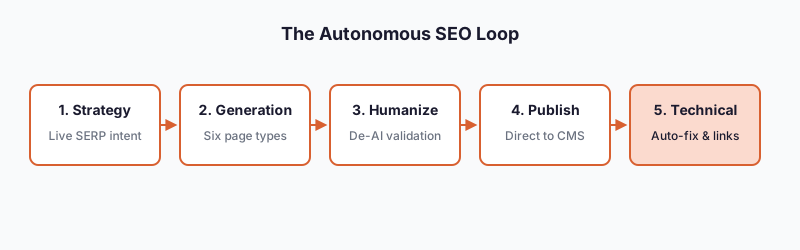
Bottom-of-funnel focus is where most tools fall short. Top-of-funnel content drives traffic that never buys. Buyer-intent keyword research - comparison pages, alternatives lists, use-case pages - converts. Ask whether the tool targets ToF volume or BoFU intent, and whether it cross-checks keywords against live Google SERPs to prevent cannibalizing its own pages.
AI citation readiness (GEO) is no longer optional. Google AI Overviews, ChatGPT, and Perplexity now answer queries directly. If your content isn't structured for LLM citation - right page types, right on-page structure, right entity coverage - you're invisible to a growing share of search. Look for tools that explicitly build for Generative Engine Optimization, not just traditional ranking signals.
Humanization quality separates tools that actually work from ones that just produce output. Generic AI content is easy to detect and easy to ignore. Tools that validate against documented AI writing patterns before publishing produce content that reads like a person wrote it. Ask what the humanization process actually is - a vague claim is different from a library of 30,000+ AI patterns cross-checked before every publish.
Technical SEO coverage is what makes or breaks the content you're already publishing. Content builds authority; technical debt leaks it. Broken links, redirect chains, heavy pages, and weak internal linking silently drain the ranking power your content earns. The best tools either fix these issues automatically or surface them before they compound.
Backlink safety is easy to overlook until it isn't. Exchanges are common in this category. Customer-to-customer reciprocal links create footprint risk at scale. Acyclic link graphs with per-site pattern avoidance are safer by construction - no reciprocal exchanges, ever.
Transparent pricing sounds obvious, but half this category doesn't do it. If you can't see what you'll pay before a sales call, budget planning is guesswork. Prefer tools with published tiers, clear per-seat or flat pricing, and visible trial terms.
The best Blawgy alternatives
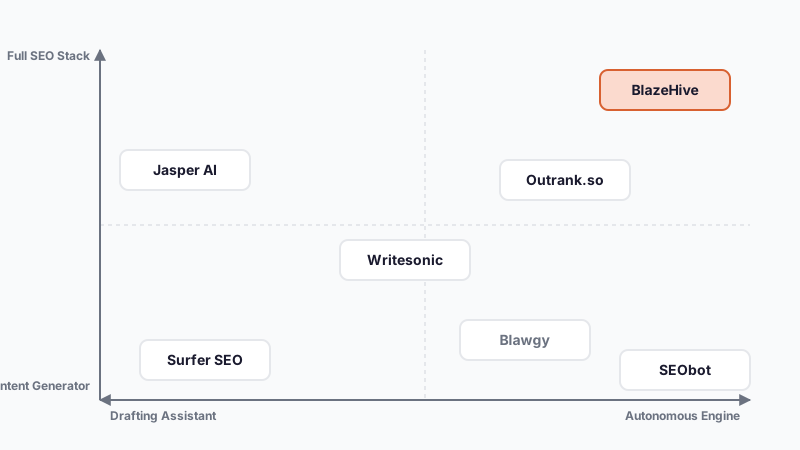
1. BlazeHive
BlazeHive is an autonomous SEO engine that takes a URL, studies your business, discovers competitors, builds a bottom-of-funnel keyword strategy, and writes, humanizes, validates, and publishes one optimized page per day directly into your CMS - built to rank on Google and get cited by AI engines.
Best for: Indie founders, bootstrappers, and SMB/SaaS marketing teams who need agency-quality SEO output without an agency budget or in-house hire. Also fits medium-sized teams and SEO experts who want steerable control through the agentic SEO chat.
Strengths
- Full-loop automation: strategy, writing, humanization, publishing, technical SEO, backlinks, and GSC-backed growth reporting - no manual handoffs
- De-AI validation against 30,000+ documented AI writing patterns before every publish, so content doesn't read like a template
- Cannibalization detection via live SERP cross-checking (Google's own verdicts, not similarity heuristics) - two pages never compete for the same query
- WordPress technical SEO auto-fixing: broken links, redirect chains, heavy pages, weak internal linking resolved automatically
- Acyclic backlink network with per-site pattern avoidance - no reciprocal link exchanges, by construction
- Six strategic page types optimized for BoFU conversion and LLM citation: landing pages, listicles, comparisons, VS pages, FAQ pages, and interactive tool pages
- Human monitoring team tracks every customer's GSC data and intervenes if a site stagnates
Where it's not the right fit
- WordPress-only for auto-fixing technical SEO (other platforms coming soon)
- No free tier; $99/month is a higher entry point than budget tools like SEObot
- Not designed for large content teams that need seat-based collaboration
Pricing: $99/month all-in (as of August 2026). 3-day free trial, no card required. Done For You: $3,000 one-time setup + $99/month.
When to choose it: You want one engine that replaces the strategist, writer, optimizer, tech auditor, and backlink manager - and you want it monitored by humans, not just fired and forgotten.
2. Outrank.so
Outrank.so is an automated blog SEO platform that writes, optimizes, and publishes articles directly to your CMS on a scheduled drip.
Best for: E-commerce and SaaS teams on Shopify or Wix who want maximum article volume and accept post-publication editing.
Strengths
- 150+ language support for international content strategies
- Broad CMS coverage: WordPress, Shopify, Notion, Wix, Framer
- Volume-focused tiers: 30 articles/month at $99, scaling to 90 articles/month at $199
- Agency multi-site dashboard with volume discounts (10–20% off for 2+ sites)
Where it's not the right fit
- User reviews cite 2–4 hours of editing per piece to reach publication quality
- No humanization validation layer - content ships as-generated
- Backlink exchange is customer-to-customer, not documented as acyclic
- No technical SEO auditing or site health fixes
Pricing: $99/month for 30 articles (as of August 2026). Free 3-day trial with watermarked articles.
When to choose it: You're on Shopify or Wix, you want 30+ articles per month, and you have bandwidth to edit each piece before it represents your brand.
3. Writesonic
Writesonic is an all-in-one AI content and SEO platform combining an AI Article Writer with a GEO suite that monitors brand citations across ChatGPT, Gemini, Claude, and Perplexity.
Best for: Content teams that prioritize monitoring AI citations and want multiple AI model options.
Strengths
- GEO tracking suite: monitor brand mentions across ChatGPT, Gemini, Claude, Perplexity with sentiment analysis
- Multiple AI model selection (GPT-4o, Claude, GPT-3.5) - not locked to one
- Broad template library across content types
- SEO checker and optimizer built in
Where it's not the right fit
- GEO features locked behind Professional ($199/month annually) and above
- Content quality issues flagged by users: voice drift and repetition in articles over 1,200 words
- No autonomous publishing workflow - requires manual CMS integration
- No technical SEO auditing or backlink management
Pricing: Starter at $79/month billed annually; Professional at $199/month annually (as of August 2026). Limited free credits available.
When to choose it: You want to track where your brand appears in AI-generated answers and are willing to manage publishing manually.
4. Jasper AI
Jasper AI is an enterprise-grade AI writing platform built for content teams needing seat-based, unlimited-generation workflows with brand voice control.
Best for: Agencies and enterprises with 5+ content creators who need consistent brand voice and don't want shared word limits.
Strengths
- Seat-based pricing with unlimited generation under fair-use policy
- Access to multiple LLMs - not locked to one model
- Brand Voices and Knowledge Assets for consistent tone at scale
- Collaborative Canvas editor for team writing
Where it's not the right fit
- No SEO automation - no keyword research, no CMS publishing, no technical SEO
- Seat-based pricing scales quickly for larger teams
- Not built for bottom-of-funnel keyword strategy or AI citation optimization
Pricing: Creator at $39/month; Pro at $69/month; Business custom (as of August 2026). 7-day free trial requires a credit card.
When to choose it: Your team has 3–10 writers who need unlimited drafting capacity and brand voice enforcement, and you have a separate publishing workflow in place.
5. Surfer SEO
Surfer SEO is a content optimization platform that analyzes top-ranking pages and scores your drafts against live SERP ranking factors in real time.
Best for: Content writers and SEO specialists who already have a publishing workflow and want data-driven optimization guidance.
Strengths
- Content Editor scores drafts in real time against top-ranking pages
- Unlimited keyword research included in all plans
- NLP-powered optimization suggestions
- Integrates with Google Docs and WordPress
Where it's not the right fit
- Not a content generator or publisher - you write, Surfer scores
- Designed for traditional Google ranking signals; limited LLM discoverability features
- No automated publishing, backlink management, or technical SEO fixing
Pricing: Essential at $99/month (or $79/month annually); Scale at $219/month (as of August 2026). No free trial currently.
When to choose it: You have writers producing content manually and want data-driven optimization to improve rankings - you're not looking for automation, you're looking for a smarter feedback loop.
6. SEObot
SEObot is a lightweight AI SEO agent that automates keyword research and article creation on a weekly schedule.
Best for: Solopreneurs managing one site who want hands-off content posting at the lowest price in the category.
Strengths
- Lowest price point in the category: $9.99–$19.99/month
- Automated keyword research and internal linking
- Hands-off weekly article cadence
- Full refund guarantee after first article
Where it's not the right fit
- Sparse feature documentation - unclear CMS support, humanization, or quality controls
- No technical SEO auditing, backlink management, or GEO optimization
- Not built for teams, agencies, or multi-site management
Pricing: Pro at $9.99/month; Business at $19.99/month (as of August 2026). Free tier available.
When to choose it: You run one site, budget is tight, and you want automated posting without needing to understand what's happening under the hood.
Quick comparison
| Tool | Best For | Starting Price | Free Tier | Standout Feature |
|---|---|---|---|---|
| BlazeHive | Autonomous full-loop SEO for founders | $99/mo | No (3-day trial) | De-AI validation + WordPress auto-fix + acyclic backlinks |
| Outrank.so | High-volume publishing on Shopify/Wix | $99/mo | No (3-day trial) | 30 articles/mo, 150+ languages, Shopify native |
| Writesonic | GEO citation monitoring | $79/mo (annual) | 25 credits | Track brand in ChatGPT, Gemini, Perplexity |
| Jasper AI | Enterprise team content at scale | $39/mo | No (7-day trial) | Unlimited generation, multi-LLM, seat-based |
| Surfer SEO | Real-time content scoring vs. SERPs | $79/mo (annual) | No | Live SERP scoring against top-ranking pages |
| SEObot | Budget solopreneur autopilot | $9.99/mo | Yes | Lowest-cost automated posting in category |
Pricing as of August 2026. Check each tool's pricing page for current rates.
Which alternative should you choose?
Most people searching for Blawgy alternatives fall into one of these buckets. Here's the honest answer for each.
If you want fire-and-forget SEO at the lowest possible cost...
SEObot is the right call. At $9.99–$19.99/month, it's the cheapest autonomous posting option in this list. Feature documentation is thin, but if budget is the deciding factor and you have one site, SEObot fits.
If you're on Shopify or Wix and want article volume...
Outrank.so is built for this. Native Shopify and Wix publishing, 30+ articles per month at $99, and volume discounts for multi-site agencies. Accept that you'll spend 2–4 hours editing each piece.
If you want to track where your brand appears in AI answers...
Writesonic's GEO suite is the most developed in this category. Professional tier ($199/month annually) gives you ChatGPT, Gemini, Claude, and Perplexity citation tracking with sentiment analysis. No other tool on this list matches that monitoring depth.
If you run a content team with multiple writers...
Jasper AI is the right fit. Unlimited generation per seat, multiple LLMs, brand voice enforcement - it's built for teams who draft at high volume and need consistency without per-word pricing anxiety.
If you already have a publishing workflow and want smarter optimization...
Surfer SEO scores your drafts in real time against the top-ranking pages for your target keyword. If you're not looking to automate the writing, just improve it, Surfer is the right tool.
If you want a complete autonomous SEO engine that handles everything - strategy through ranked, AI-cited pages...
BlazeHive is the only tool in this list that closes the full loop: keyword research, writing, humanization against 30,000+ AI patterns, CMS publishing, WordPress technical auto-fix, acyclic backlinks, and human-monitored GSC growth - all for $99/month. No stack assembly, no incident response, no editing queue.
Ready to try BlazeHive?
If you need SEO on autopilot - not a drafting assistant, not a scoring tool, but a system that handles strategy through publishing without a weekly editing queue - BlazeHive is built for that. Start with the 3-day free trial, no card required, and point it at your URL. The engine does the rest.
Frequently Asked Questions
What should I look for in a Blawgy alternative?
End-to-end automation matters more than any single feature-a tool that writes but doesn't publish or publishes but doesn't research still requires human coordination. Look for bottom-of-funnel keyword focus (comparison pages, alternatives, use-case content that converts) rather than top-of-funnel volume, and verify the tool cross-checks keywords against live Google SERPs to prevent cannibalizing its own pages. AI citation readiness (built for ChatGPT, Perplexity, Google AI Overviews) and humanization validation against documented AI patterns separate tools that actually work from ones that just produce output. Technical SEO coverage-broken links, redirect chains, heavy pages, weak internal linking-either gets fixed automatically or silently drains the authority your content earns.
Is Blawgy still worth using?
Blawgy works well for what it was built for: generating and auto-publishing blog posts, backed by real case studies like Natureva's 1,962% US traffic growth. The friction point is scope-Blawgy handles posting, not strategy, cannibalization prevention, technical SEO fixes, or AI citation optimization. If your goal is volume and you're comfortable with 2–4 hours of editing per piece, Blawgy is valid; if you need ranked pages that don't leak authority and get cited by AI engines, you need more than a content generator.
What is the best Blawgy alternative overall?
BlazeHive is the top choice for founders, SMB teams, and medium-sized teams who need strategy, writing, humanization, technical SEO, backlinks, and publishing handled as one autonomous loop for $99/month. It's the only tool in this category that closes the full end-to-end workflow-keyword research → content generation → de-AI validation against 30,000+ patterns → CMS publishing → WordPress technical auto-fix → acyclic backlink network → human-monitored GSC growth. Outrank wins on CMS breadth and per-article cost if you're on Shopify or Wix; Writesonic wins on GEO citation monitoring; Jasper wins for multi-seat team collaboration. But if your goal is ranked pages that don't require a weekly editing queue and don't leak authority, BlazeHive is built for that.
Which Blawgy alternative is best for WordPress?
BlazeHive is the best fit for WordPress teams because it auto-fixes technical SEO issues on WordPress-broken links, redirect chains, heavy pages, weak internal linking-before they silently drain the authority your content builds. Most competitors document none of this; it's a gap only BlazeHive addresses. If you're on WordPress and you've seen rankings vanish due to site health or internal keyword competition, BlazeHive's autonomous technical debt resolution is table-stakes.
What is the cheapest Blawgy alternative?
SEObot is the lowest-cost option in this category at $9.99–$19.99/month, designed for solopreneurs managing one site who want hands-off weekly posting without needing to understand what's happening under the hood. At that price, feature documentation is sparse and transparency is limited-you don't get full clarity on CMS support, humanization validation, or quality controls. For a bootstrapped solo founder with one site and a tight budget, SEObot's trade-off (lowest cost for blind fire-and-forget automation) is the right call.
Which Blawgy alternative works best with Shopify?
Outrank.so has native Shopify publishing built in, alongside Wix, Notion, and Framer-it's the best fit if you're e-commerce on Shopify and want maximum article volume without platform integration friction. At $99/month you get 30 articles per month; user reviews note you'll spend 2–4 hours editing each piece to reach publication quality. If you're on Shopify and volume is your goal, Outrank is built for that workflow.
Do any Blawgy alternatives include AI citation tracking?
Writesonic's GEO (Generative Engine Optimization) suite is the most developed in this category-it monitors where your brand appears across ChatGPT, Gemini, Claude, and Perplexity with sentiment analysis included. This feature lives on the Professional tier ($199/month billed annually), so it's not available in lower tiers. BlazeHive doesn't track citations in-platform, but positions content for citation readiness by design: it builds six strategic page types optimized for LLM pulldown, then lets Google Search Console and human monitoring show you the results.
What is the difference between BlazeHive and Outrank?
BlazeHive handles the full autonomous loop-keyword research, writing, de-AI validation against 30,000+ patterns, CMS publishing, WordPress technical auto-fix, acyclic backlinks, and human-monitored growth-for $99/month. Outrank writes and publishes articles on a schedule but requires 2–4 hours of editing per piece and offers no humanization validation layer, technical SEO fixes, or backlink management. BlazeHive targets fewer, ranked pages that compound; Outrank targets volume (30+ articles/month) on Shopify or Wix. Choose Outrank if you're e-commerce and have editing bandwidth; choose BlazeHive if you want one engine that replaces the entire SEO stack.
Why is BlazeHive on this list?
BlazeHive is the only product that replaces the entire SEO agency stack-strategist, writer, optimizer, tech auditor, backlink manager, and monitor-for one price ($99/month), all dogfooded on its own properties, and all monitored by humans. It's built specifically for indie founders, SMB teams, and medium-sized teams who've seen competitors publish more and rank higher but can't afford an agency or hire a full SEO team. The core differentiation is autonomous end-to-end orchestration plus humanization validation before publishing plus WordPress technical debt auto-fix-scope no competitor in this list combines.
What does de-AI validation mean, and why does it matter?
De-AI validation is a pre-publishing quality gate that checks every page against a documented library of 30,000+ known AI writing patterns before it goes live. Generic AI content is easy for readers and search engines to detect and dismiss; BlazeHive validates against these patterns so content reads like a person wrote it, not a template. Most competitors either have no humanization layer (Outrank, SEObot) or mention it vaguely (Writesonic) without detail on the validation process. For SMBs worried about brand voice consistency or AI detection, BlazeHive's pre-publication validation is a genuine differentiator that survives Google's AI content penalties.
How does BlazeHive prevent keyword cannibalization?
BlazeHive's cannibalization detection uses live SERP cross-checking-it queries Google itself for each keyword to see what's ranking, then cross-checks new keywords against the results to ensure two pages never compete for the same query. This approach pulls verdicts from Google's own index, not from similarity heuristics or keyword synonym lists, which are error-prone at scale. No other competitor in this list addresses cannibalization detection; most tools ignore it entirely. For teams publishing multiple pages per week, this prevents silent authority leakage to your own internal competitors.
Can I use BlazeHive if I'm not on WordPress?
BlazeHive publishes directly to WordPress, Ghost, Webflow, Framer, Contentful, Storyblok, Strapi, and generic webhooks-so non-WordPress platforms are supported for publishing. The constraint is technical SEO auto-fixing: BlazeHive auto-fixes broken links, redirect chains, heavy pages, and internal-linking problems on WordPress only; other platforms are listed as "coming soon." If you're on another platform and don't need auto-fixing of technical debt, the full autonomous loop still works-you just handle site health manually.
How much does BlazeHive cost compared to other alternatives?
BlazeHive is $99/month all-in for strategy, writing, humanization, publishing, technical SEO, backlinks, and monitoring (as of August 2026). This is equivalent to Outrank's $99/month for 30 articles but includes humanization validation and technical SEO fixes Outrank doesn't offer; it's higher than SEObot ($9.99–$19.99/month) but SEObot offers no scope beyond posting; it's equivalent to Surfer SEO ($79–$99/month annually) but Surfer is optimization-only, not autonomous publishing. When compared to stacking tools (Surfer $99 + Jasper $59 + Zapier $25 = $183), BlazeHive at $99 is the lowest total cost for a complete loop.
What makes BlazeHive's backlink network different from competitors?
BlazeHive's backlink exchange is engineered as an acyclic graph with per-site pattern avoidance-no reciprocal link exchanges ever occur, so there's no footprint risk at scale. Outrank offers a customer-to-customer backlink exchange but doesn't document whether it's acyclic, creating reciprocal link risk that emerges over time. Competitors like Surfer, Jasper, and Writesonic have no backlink management at all. For brands paranoid about Google penalties or SEO footprint, BlazeHive's safety-by-design approach (acyclic by construction) removes the risk.
Should I choose Jasper AI or BlazeHive?
Jasper is seat-based with unlimited generation per user, multiple LLM access, and brand voice control-it's built for teams with 3+ writers who draft at high volume and need consistency without per-word limits. BlazeHive is a flat-rate autonomous SEO engine designed for founders, SMB teams, and medium-sized teams who need strategy through published, ranked pages without a weekly editing queue. Jasper excels at drafting; BlazeHive closes the full loop from research to publication to monitoring. If your team needs unlimited drafting capacity and you have a separate publishing workflow, choose Jasper; if you want one engine that replaces the entire SEO stack, choose BlazeHive.