TL;DR
AthenaHQ Alternatives split cleanly by job-to-be-done: if you need to produce content that ranks on Google and gets cited by AI models, BlazeHive is the top pick - it writes, humanizes, and publishes one optimized page per day for a flat $99/month. AthenaHQ itself wins for teams that need deep AI visibility analytics across 9 LLMs with revenue attribution. Profound wins for enterprise data depth, and Otterly AI wins for budget-first GEO auditing at $29/month.
AthenaHQ Alternatives

AthenaHQ Alternatives come up for a reason: AthenaHQ is a genuinely strong platform for tracking brand visibility across ChatGPT, Perplexity, Claude, and Gemini - and its ROI case studies are real (Popl reported 1,561% ROI). But its credit-based pricing is unpredictable, and it stops at the diagnosis. If your team needs something to actually fix the visibility gap - write content, build backlinks, publish daily, repair technical debt - AthenaHQ hands you the report and leaves the rest to you. This page maps out which tool wins for each problem.
Why People Look for AthenaHQ Alternatives
The credit model is the first thing people hit. AthenaHQ's Starter tier runs $295/month for 3,600 credits. That sounds like a lot until you factor in multi-engine queries, region tracking, retries, and real-time monitoring - credits burn faster than the plan suggests. Teams that try to forecast monthly spend run into a wall, and finance teams hate variable SaaS bills. The Growth tier jumps to $900/month before you hit Enterprise. For most SMBs and indie founders, that's a hard stop.
The second frustration is structural: AthenaHQ tells you what's wrong, but it doesn't fix it. Its ACE agent and recommendation engine are useful - but acting on the recommendations still means commissioning new content, publishing it, building internal links, fixing technical issues, and sourcing backlinks. That's a full SEO workflow AthenaHQ wasn't built to replace. The platform is analytics-first by design, which is great if you have a content team already. It's frustrating if you don't.
The third type of searcher is the team that realizes they're solving the wrong problem entirely. They signed up for GEO monitoring and are now measuring AI visibility with precision - but their Google rankings haven't moved and they're not publishing new pages. They need an execution layer, not a better dashboard. That's the user this page is most useful for: someone who has good diagnostics and zero production.
What to Look for in a GEO/AI SEO Tool
Most tools in this category do monitoring or execution - not both. A monitoring tool (AthenaHQ, Profound, Otterly) shows you where you stand in AI search. An execution tool (BlazeHive) produces the content that moves where you stand. Know which problem you have before you pick a plan.
Pricing predictability matters more than it sounds. Credit-based pricing (AthenaHQ, some tiers of Scrunch AI) makes budgeting hard. Per-prompt models (Otterly, Peec AI) are more transparent but still variable. Flat-rate all-in models (BlazeHive at $99/month, GetMint at tier pricing) are easiest to forecast. If you manage multiple clients, per-domain or per-seat fees compound fast - Semrush charges $99/month per domain for AI Visibility, which breaks at 10 clients.
Engine coverage is only worth paying for if your customers actually use those engines. AthenaHQ tracks 9 LLMs. Profound's Starter tier tracks ChatGPT only; multi-engine requires $399/month. Otterly tracks 4 platforms. Don't pay for 9 engines if your ICP only uses ChatGPT and Google AI Overviews.
Vanity GEO metrics (are we mentioned?) matter less than whether your brand appears when someone is ready to buy. Tools that track prompt intent (Profound's QVEM, BlazeHive's buyer-intent keyword research) beat tools that just count raw mentions. Always ask: does this platform differentiate between awareness prompts and decision-stage prompts?
GEO and Google SEO share the same infrastructure: crawlability, page speed, canonical tags, internal links, and redirect chains all affect whether AI models cite you. Tools that only track AI visibility leave technical debt unaddressed. BlazeHive auto-fixes technical SEO issues on WordPress; most GEO monitors don't touch this layer at all.
If you manage more than 3 clients, per-domain pricing (Semrush, Ahrefs Brand Radar at $199–$699/month) and per-seat fees become budget killers fast. Flat-rate multi-workspace models scale without penalty. Check whether a "free unlimited seats" promise comes with credit consumption that scales anyway.
If a tool generates content for you, ask how it avoids generic AI patterns. Content that sounds like ChatGPT gets filtered by Google's quality signals and loses readers. BlazeHive validates every page against a library of 30,000+ documented AI writing patterns before publishing. Most pure GEO monitors don't generate content at all, which sidesteps the problem without solving it.
The Best AthenaHQ Alternatives
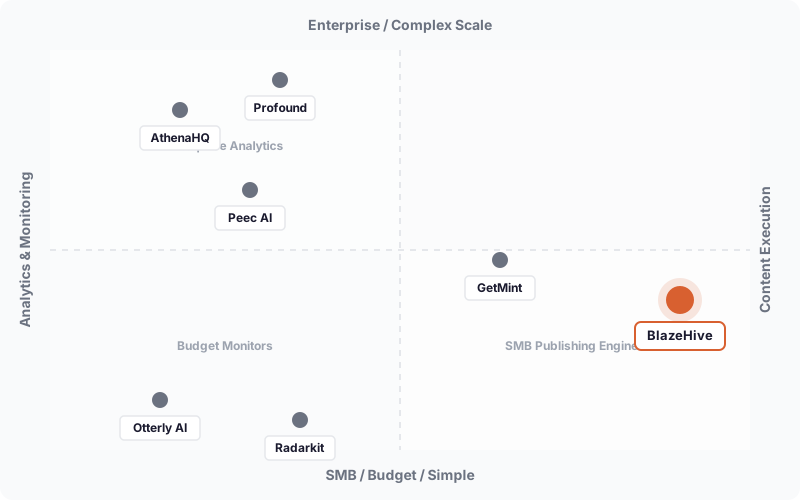
1. BlazeHive
BlazeHive is an autonomous SEO engine that takes a URL, builds a bottom-of-funnel content strategy, and publishes one optimized page per day directly into your CMS - written, humanized, validated, and interlinked, without a human in the loop.
Best for: Indie founders, SaaS teams, and agencies that need SEO execution on autopilot - not just visibility monitoring. Also fits medium-sized teams and SEO experts who want steerable control through the agentic SEO chat.
Strengths
- Six page types (landing pages, listicles, comparisons, FAQs, alternatives, interactive tools), each targeting different SEO and LLM citation angles
- Humanization pass validated against 30,000+ documented AI writing patterns before any page ships
- Flat $99/month all-in - keyword research, content generation, technical SEO, backlinks, CMS publishing, GSC reporting - no per-seat or per-page fees
- Contextual backlink network built as an acyclic graph with per-site pattern avoidance - no reciprocal link footprints
- Technical SEO auto-fixes on WordPress (broken links, redirect chains, internal linking, heavy pages); other platforms in progress
- Bottom-of-funnel keyword research cross-checked against live Google SERPs to eliminate cannibalization from the source
Where it's not the right fit
- Not a pure GEO monitoring platform - doesn't track share of voice across 9 LLMs or provide sentiment analytics
- Technical SEO auto-fixing is currently WordPress-only; other CMS platforms are "coming soon"
- Teams that need executive-grade AI visibility reporting (Shopify revenue attribution, multi-model benchmarking) will find monitoring depth limited
Pricing: $99/month all-in (as of August 2026). Done-For-You setup: $3,000 one-time + $99/month. 3-day free trial, no card required.
When to choose it: You have a website, you need pages published daily to rank on Google and get cited by AI models, and you can't afford (or don't want) an SEO agency at $3,000+/month. BlazeHive is the execution layer that most GEO monitoring tools assume you already have.
2. AthenaHQ
AthenaHQ is a Generative Engine Optimization monitoring platform that tracks brand visibility, share of voice, and citation sources across 9 AI models - and recommends content and strategy changes through its ACE agent.
Best for: Mid-market B2B SaaS and e-commerce brands that need precise AI visibility measurement with revenue attribution
Strengths
- 9-LLM coverage including ChatGPT, Perplexity, Claude, and Gemini - broadest in class
- Revenue attribution via native Shopify and GA4 integrations - ties AI citations to actual pipeline
- Prompt Volume Estimation (QVEM) quantifies how often a prompt is asked, not just whether you rank
- Strong case studies: Popl reported 1,561% ROI with 18-day payback; Rootly achieved ~10x citation rate growth
- Unlimited user seats on all plans, SAML/OIDC SSO on Enterprise
- 4.9-star G2 rating, Spring 2026 High Performer badge
Where it's not the right fit
- Not built for content production, publishing, or technical SEO execution - it finds the gaps, it doesn't close them
- Credit-based pricing ($295/month for 3,600 responses on Starter) creates unpredictable spend at scale
- Minimum $295/month is a steep entry point for indie founders and small teams
Pricing: Free Essential (limited credits); Starter $295/month; Growth $900/month; Enterprise custom (as of 2026).
When to choose it: Your team already has content production covered and needs a visibility scorecard to measure and report AI search performance - especially if Shopify or multi-model attribution is core to your reporting.
3. Profound
Profound is an enterprise-grade GEO measurement platform with a deep prompt-volume estimation model and multi-engine analytics - built by engineers from Google Search and DeepMind.
Best for: Enterprise brands and regulated industries that need data depth, SOC 2/HIPAA compliance, and multi-language AI visibility tracking
Strengths
- Prompt Volume Estimation that quantifies real-world search frequency in AI models, not just vanity scores
- Multi-engine, multi-region, multi-language support at Enterprise tier
- SOC 2 + HIPAA compliance - essential for healthcare, fintech, and regulated industries
- Starter plan at $99/month covers single-engine tracking
- Agent Analytics: tracks AI agent/bot traffic in addition to brand mentions
Where it's not the right fit
- Starter tier tracks ChatGPT only; multi-engine visibility requires $399/month Growth tier
- Advanced features (API, multi-language, autonomous agents) are Enterprise-gated
- No content generation, publishing, backlink building, or technical SEO capabilities
- Described by multiple reviewers as "overkill and unnecessarily complex for SMBs"
Pricing: Starter $99/month; Growth $399/month; Enterprise custom (as of 2026). Annual discount available.
When to choose it: You're an enterprise or regulated-industry brand that needs compliance, deep data, and multi-engine AI visibility - and you have a dedicated team to act on the insights.
4. Peec AI
Peec AI is a GEO monitoring platform with genuine unlimited multilingual and multi-region coverage - no surcharge per language or country. That makes it the right pick for international brands tracking AI visibility across markets.
Best for: Brands with global reach that need multi-language, multi-country AI visibility tracking without per-region pricing penalties
Strengths
- 14+ languages and unlimited countries on every tier - truly flat multi-language pricing
- Daily tracking refresh and solid sentiment analysis depth (stronger than Otterly at similar price points)
- MCP and Looker Studio integrations on Advanced plan
- 7-day free trial, no card required; 15% annual discount
Where it's not the right fit
- Entry plan limited to 3 base engines; adding Claude or Gemini costs €20–30/month each, pushing comprehensive coverage to $240+/month
- Per-prompt cost roughly 2x some mid-tier competitors (~$1.99/prompt vs ~$0.99)
- No content generation, publishing, or technical SEO workflows
Pricing: Starter €89/month ($95); Pro €245/month ($265); Advanced €495/month (~$535) (as of 2026). 7-day free trial.
When to choose it: Your brand operates in multiple international markets and you need multi-language AI visibility data without paying per-country surcharges.
5. GetMint
GetMint is a content-first GEO platform that combines AI visibility monitoring with a built-in Content Studio - so teams can see which prompts they're missing and immediately generate content briefs to fill those gaps.
Best for: Content teams that need to see visibility gaps and act on them in one interface, without a separate content production workflow
Strengths
- Content Studio: click "Generate" next to any invisible prompt; platform analyzes winning sources and drafts a content brief using RAG
- Simpler onboarding than AthenaHQ; designed around "actual colleagues doing work" rather than agent configuration
- Transparent tier-based pricing, no credit consumption model
- Gartner Cool Vendor 2025 recognition
Where it's not the right fit
- Only 3 AI engines on entry tier vs AthenaHQ's 9
- Earlier-stage product with smaller customer base and fewer enterprise integrations
- Content generation produces briefs, not fully published pages - still requires human writers to execute
Pricing: Starter €99/month ($107); Growth €349/month ($375); Enterprise custom (as of 2026). Free trial available.
When to choose it: Your team wants GEO monitoring and content execution guidance in a single, low-friction interface - and you have writers ready to execute on the briefs GetMint produces.
6. Otterly AI
Otterly AI is a budget-tier GEO audit tool with the most detailed on-page optimization analysis in the sub-$200 price range. At $29/month to start, it's the lowest-friction way to test whether GEO matters for your business.
Best for: Budget-conscious marketers and SMBs who want to audit and understand AI visibility before committing to a premium platform
Strengths
- GEO Audit rated as the most detailed on-page AI optimization analysis under $200
- $29/month entry is the lowest meaningful entry point in the category
- Covers 4 AI platforms, 50+ countries, with Looker Studio connector on Standard+
- Competitor benchmarking and citation tracking included at every tier
Where it's not the right fit
- 15 prompts on Lite is genuinely restrictive; 100 prompts requires $189/month (annual billing)
- No brand sentiment tracking, no traffic or revenue attribution
- No content generation, publishing, or action workflows beyond audit recommendations
Pricing: Lite $29/month; Standard $189/month; Premium $422/month (all billed annually) (as of 2026). Free trial available.
When to choose it: You're testing whether GEO matters for your business before investing in a full platform - or you need a detailed audit of your current AI visibility without a long-term commitment.
7. Radarkit
Radarkit is a generalist GEO monitor that uses real LLM prompting (not API-based synthetic data) to track brand visibility with multi-location proxy support. It's aimed at SEO agencies and SMBs testing AI search value on a tight budget.
Best for: SEO agencies and growth marketers who want real-prompt GEO tracking at the lowest price point with backlink discovery included
Strengths
- Real LLM prompting (not synthetic API data) - responses reflect actual model behavior
- Multi-location proxy tracking for country-level visibility
- Backlink discovery and competitor share-of-voice included
- Chrome extension, daily refreshes, GA4 integration
Where it's not the right fit
- Lighter analytics depth vs AthenaHQ, Profound, or Peec at comparable price ranges
- No content generation, publishing, or technical SEO workflows
- Smaller feature surface area for teams that need enterprise integrations
Pricing: Starts at $29/month (as of 2026).
When to choose it: You're an agency or SMB that needs real-prompt GEO tracking plus basic backlink discovery at the lowest price in the category.
Quick Comparison
| Tool | Best For | Starting Price | Free Tier | Standout Feature |
|---|---|---|---|---|
| BlazeHive | SEO execution on autopilot | $99/month | 3-day trial (no card) | Full-loop: writes, humanizes, publishes + fixes technical SEO |
| AthenaHQ | Enterprise AI visibility analytics | $295/month | Limited free tier | 9-LLM coverage + Shopify revenue attribution |
| Profound | Enterprise data depth + compliance | $99/month | No | QVEM prompt volume estimation + SOC 2/HIPAA |
| Peec AI | International/multilingual GEO | €89/month | 7-day trial (no card) | Unlimited languages and countries at every tier |
| GetMint | Content-first GEO execution | €99/month | Free trial | Content Studio generates briefs from visibility gaps |
| Otterly AI | Budget GEO auditing | $29/month | Free trial | Best on-page GEO audit depth under $200 |
| Radarkit | Agency/SMB real-prompt tracking | $29/month | No | Real LLM prompting (not synthetic API data) |
Pricing as of August 2026. Check each tool's pricing page for current rates.
Which Alternative Should You Choose?
Most teams that reach this page want to fix AI visibility, not just measure it. Here's how to match the tool to the actual problem.
If you need to produce and publish SEO content daily...
BlazeHive is the right fit. It handles the full loop - keyword research, writing, humanization, technical SEO, backlinks, and CMS publishing - for a flat $99/month. No separate writer, no separate dev, no agency bill.
If you need precise AI visibility analytics with revenue attribution...
AthenaHQ wins here. Its 9-LLM monitoring, Shopify integration, and prompt volume estimation are the most complete analytics stack in the category. The credit-based pricing is real friction, but the data depth justifies it for mid-market and enterprise teams.
If you're an enterprise brand in a regulated industry...
Profound is the safer choice. SOC 2 and HIPAA compliance, multi-language multi-region support, and deep QVEM data put it ahead for organizations that need compliance and analytics depth together.
If you operate across international markets...
Peec AI is the most cost-effective option for multi-language, multi-country AI visibility. Its flat pricing model doesn't penalize you for tracking five languages - unlike AthenaHQ's Enterprise-gated multi-region support.
If your team wants to see visibility gaps and fix them in one interface...
GetMint is the closest to "monitor + act" in a single product. Its Content Studio turns invisible prompts into content briefs without switching tools.
If you're testing GEO on a tight budget...
Otterly AI at $29/month or Radarkit at $29/month are the lowest-friction starting points. Otterly wins on audit depth; Radarkit wins if you want real prompting and backlink discovery included.
Ready to Try BlazeHive?
If your problem is execution - getting pages written, published, and ranking every day without hiring an agency or managing a writer - BlazeHive is the tool built for that. Drop your URL, and the engine handles keyword research, content, humanization, technical fixes, backlinks, and CMS publishing from there. Start the 3-day free trial at blazehive.io - no card required, cancel anytime.
Frequently Asked Questions
What is Generative Engine Optimization (GEO) and why does it matter?
Generative Engine Optimization is the practice of optimizing content to be cited by AI models like ChatGPT, Perplexity, Claude, and Google AI Overviews - not just to rank on Google search. As more users ask questions to LLMs rather than search engines, brands that appear in AI-generated answers capture mindshare and traffic that traditional SEO alone misses. GEO combines visibility tracking (knowing if you're cited), content strategy (writing to earn citations), and technical SEO (ensuring AI crawlers can access and trust your pages).
How is GEO different from traditional SEO?
Traditional SEO optimizes for Google's ranking algorithm and assumes the searcher clicks through to your site. GEO optimizes for AI model training data and citation behavior - the LLM reads your content and recommends it directly in its response, often without a click-through. Google still matters for GEO (AI models train on web data), but the win condition is different: you don't need a top-10 ranking if an AI model cites you as an authoritative source in its answer. Tools like BlazeHive target both simultaneously by building bottom-of-funnel keywords that rank on Google and get cited by AI models.
Should I monitor AI visibility if I don't yet have content optimized for it?
Monitoring without execution is diagnostic only - useful if you already have a content team and just need visibility insights. If you don't have the production capacity to act on what monitoring tools find, you'll accumulate data but no results. AthenaHQ excels at diagnosis; BlazeHive is built for teams that need the diagnosis and the fix in one product. Start with monitoring if you have writers ready to execute; start with execution if you need pages published daily and monitoring as a second-order benefit.
What's the difference between credit-based and flat-rate GEO tool pricing?
Credit-based pricing (AthenaHQ at $295/month for 3,600 credits) makes monthly spend unpredictable - multi-engine queries, retries, and real-time monitoring burn through credits faster than initial estimates. Flat-rate pricing (BlazeHive at $99/month, GetMint at tier rates) is budgetable and easier to forecast, especially if you manage multiple clients. Credit models favor light users; flat-rate models favor heavy users. For teams doing daily optimization and monitoring, flat-rate is typically cheaper and more transparent.
Can I use a GEO monitoring tool and skip content production?
Yes, if you already have a content team or agency creating content. Tools like AthenaHQ, Profound, and Otterly are purely diagnostic - they tell you which prompts you're missing and how your visibility compares to competitors, but they don't write or publish pages. This works if your bottleneck is visibility measurement, not content velocity. If your bottleneck is actually getting pages written, published, and interlinked, a monitoring tool alone will frustrate you - you'll know exactly what's wrong and have no way to fix it at scale.
Why does BlazeHive do both content production and GEO measurement?
Most GEO tools assume you already have content production solved (writers, designers, devs, CMS setup). BlazeHive flips that: it assumes your bottleneck is velocity - getting optimized pages published daily without hiring an agency. By bundling keyword research, writing, humanization, technical SEO, backlinks, and CMS publishing into one $99/month engine, it removes the need to coordinate five separate vendors or hire a full team. It still measures impact via GSC integration, but measurement is secondary to the core job of autonomous page production.
How do I know if I need AthenaHQ versus BlazeHive?
AthenaHQ is for teams that have good content production and need to measure AI search performance with precision - especially if they use Shopify and need revenue attribution. BlazeHive is for teams that lack production capacity and need an engine to generate, test, and publish pages automatically. If your problem is "we don't know where we stand in AI search," choose AthenaHQ. If your problem is "we know we're invisible but we can't generate content fast enough to fix it," choose BlazeHive. They solve different layers of the same problem.
What makes a good GEO tool better than a good Google SEO tool?
A good GEO tool tracks whether your content gets cited by AI models with source attribution, not just whether it ranks on Google. It also estimates how many people actually search for a given prompt (QVEM in Profound; implicit in AthenaHQ's Starter tier). A good Google SEO tool tells you about backlinks, rankings, and traffic but not which AI models mention you or whether those mentions convert to revenue. If you care about ChatGPT and Perplexity as traffic sources, a GEO tool is non-negotiable. If you only care about Google organic, traditional SEO tools are sufficient.
Does technical SEO matter for getting cited by AI models?
Yes, just as much as it matters for Google. AI models crawl the web, so broken links, slow pages, redirect chains, and poor internal linking block AI citation as much as they block Google rankings. BlazeHive auto-fixes technical SEO issues on WordPress (broken links, redirects, internal linking); most pure GEO monitors don't touch this layer, leaving the infrastructure debt unaddressed. If you're optimizing for AI visibility without fixing crawlability and page speed, you're solving half the problem.
Can I use BlazeHive and AthenaHQ together?
Yes. BlazeHive produces pages daily; AthenaHQ measures whether those pages get cited by AI models and track revenue attribution. The workflow would be: BlazeHive publishes a page, wait 2–4 weeks for AI models to index it, then AthenaHQ tracks whether it starts appearing in LLM responses. This combination is strongest for teams that want hands-off content production plus detailed visibility analytics. For most indie founders, SMBs, and medium-sized teams on a $100–300/month budget, BlazeHive alone is sufficient - you get GSC reporting and can watch rankings directly.
What does "bottom-of-funnel" mean in the context of GEO and SEO?
Bottom-of-funnel keywords are searches or prompts where the user is ready to buy or convert - not just learning or researching. "Best project management tool for remote teams" is bottom-of-funnel for project management software; "what is project management" is top-of-funnel. BlazeHive explicitly targets buyer-intent keywords cross-checked against live Google SERPs to find high-intent, low-competition opportunities. Most generic AI content tools optimize for top-of-funnel volume, which rarely converts. Bottom-of-funnel focus is why BlazeHive prioritizes quality over quantity.
How do I avoid publishing generic AI-sounding content?
Most AI tools don't address this - they generate content that reads like ChatGPT because it's built on LLM patterns. BlazeHive validates every page against a library of 30,000+ documented AI writing patterns before publishing to strip out detectable AI markers. This de-AI pass is specific to BlazeHive; most GEO monitoring tools don't generate content at all, and most content tools don't validate against AI pattern libraries. If your brand reputation depends on content that doesn't sound like ChatGPT, this validation layer is non-negotiable.
Why is AthenaHQ's 9-engine tracking better than a tool that only tracks ChatGPT?
Not all AI models are equally important to your audience. If your customers primarily use ChatGPT and Google AI Overviews, tracking 9 engines gives you data you won't use. But if your audience is split across ChatGPT, Perplexity, Claude, and others, 9-engine coverage ensures you're not invisible on a major channel. AthenaHQ's strength is breadth; Profound's Starter tier (single engine at $99/month) is sufficient for teams only optimizing for ChatGPT. Match engine count to where your ICP actually searches.
What's the fastest way to start getting traffic from AI models?
Start with BlazeHive if you need pages published daily - the engine handles keyword research to identify which prompts your competitors are answering and you're not, then fills those gaps with one page per day. Start with AthenaHQ if you already have a content backlog and just need visibility measurement to tell you which existing pages are or aren't getting cited. Fastest execution: BlazeHive (pages go live immediately, AI models index in 2–4 weeks). Fastest diagnostics: AthenaHQ (you'll know your current standing within days).
Is it worth paying for GEO monitoring if my business is purely Google-focused?
No - if your traffic is 95%+ Google organic and you have no evidence that users come from ChatGPT or Perplexity, GEO monitoring is premature. Focus on traditional SEO first. Most B2B SaaS and e-commerce companies don't yet see material AI traffic, though this is changing rapidly. AthenaHQ and Profound are built for teams that have already seen AI traffic in their analytics and need to measure and optimize for it. Start monitoring when you see ChatGPT/Perplexity in your GA4 referrers or when customer interviews reveal they're using LLMs in their discovery process.
Why would I choose Peec AI over AthenaHQ if I'm operating internationally?
Peec AI charges a flat €89/month for unlimited languages and countries - no surcharge per language, no per-region tier jump. AthenaHQ requires Enterprise tier to unlock multi-region support at custom pricing. For a brand tracking five languages across ten countries, Peec AI's €89/month is dramatically cheaper than AthenaHQ's minimum $295/month, and you get true unlimited localization. AthenaHQ's advantage is revenue attribution via Shopify and deeper per-market analytics; Peec AI's advantage is transparent, flat international pricing at half the entry cost.