TL;DR
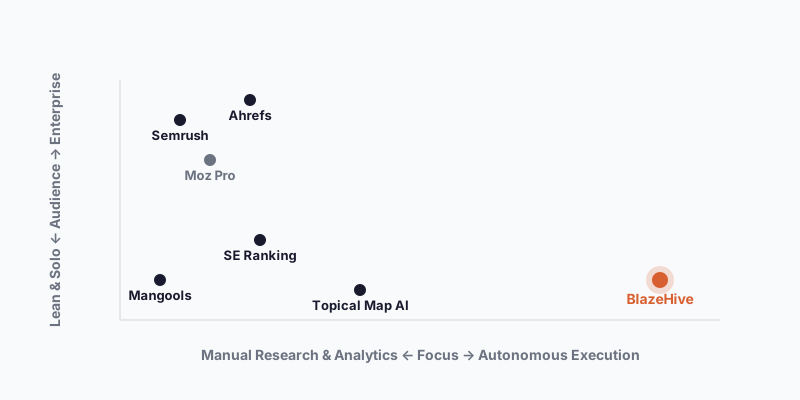
The best Moz alternative depends on what you actually need. Semrush wins for teams that need a deeper analytics suite; Mangools wins for solo SEOs who want affordable research without the complexity; and BlazeHive wins for bootstrappers and SMBs who don't need another research dashboard - they need someone (or something) to actually publish daily SEO content without hiring a writer.

Moz Alternatives
Moz Pro is genuinely good at what it does - keyword research, backlink analysis, rank tracking, and site audits have made it a staple for SEO professionals since 2004. But Moz is a research and analytics tool. It shows you what to do; it doesn't do it for you. If you're searching for Moz alternatives, you're likely hitting one of a handful of real friction points - and this page will help you identify which tool actually fits your situation.
Why People Look for Moz Alternatives
Moz Pro's interface is the most common complaint. Users on review sites and Reddit describe it as "clunky and difficult to navigate" - especially compared to newer tools built with modern UX. When you're paying $99–$299/month, friction is expensive.
Price relative to value is the second recurring pain point. At $49/month for the Starter tier, Moz feels limited. At $299/month for the Large tier, the jump is steep for solo marketers and small teams. Users frequently report comparing Moz head-to-head with Semrush and Ahrefs and finding that Moz's data accuracy and crawl limits don't justify the premium at higher tiers.
The analytics-to-execution gap is the third pain - and the most underacknowledged. Many users searching for Moz alternatives aren't really looking for a better analytics dashboard. They're realizing that months of keyword research, competitive audits, and rank tracking have produced a big spreadsheet but no actual traffic. Moz, Ahrefs, and Semrush all tell you what to publish. None of them publish it. For bootstrappers, solo founders, and SMBs without dedicated content teams, that gap is where SEO goes to die.
What to Look for in an SEO Tool
An SEO tool is only as good as the index it pulls from. Look for tools that update their backlink and keyword databases frequently, ideally daily or weekly. Outdated data leads to bad decisions on keyword difficulty and competitive gap analysis.
If you're running link-building campaigns or doing competitive authority research, backlink data is non-negotiable. Ahrefs, Semrush, and Moz have proprietary link indexes measured in the trillions. Lighter tools trade depth for price - that's a real tradeoff, not a bug.
Tracking keyword positions over time is how you measure whether any SEO effort is actually working. Check how many keywords each tool tracks per plan and how often it refreshes rankings. Daily vs. weekly makes a real difference for active campaigns.
Most SEO tools stop at research. Ranking on Google requires publishing optimized pages consistently, not just knowing which topics to cover. If your bottleneck is execution (writing, publishing, optimizing), a research-only tool won't fix it. Ask whether the tool helps you produce content or just analyze it.
Google is no longer the only search channel. AI answer engines like ChatGPT, Claude, and Perplexity now surface SEO content as cited sources. Tools built before 2023 weren't designed for this. If organic traffic from AI search is part of your growth model, check whether the tool optimizes for AI engine citation, not just Google rankings.
Enterprise SEO suites like Semrush and Ahrefs reward users who invest time in mastering them. If you have an in-house SEO strategist, that's fine. If you're a solo founder or small team, weeks of onboarding delay every result. Tools with lower skill floors get you to value faster.
Hidden add-ons, per-link charges, and seat-based pricing inflate what looks like a low entry point. Read the pricing page carefully before committing. The tools worth paying for are upfront about what's included.
The Best Moz Alternatives
1. Semrush
Semrush is the most comprehensive SEO platform on the market. It covers keyword research, AI-powered visibility tracking, backlink analysis, competitive intelligence, site audits, and content tools in one subscription.
Best for: Marketing teams and agencies that need deep competitive intelligence, multi-client dashboards, and the broadest possible feature set.
Strengths
- Keyword Magic Tool with AI-powered keyword clustering and intent classification
- AI Visibility Overview - tracks brand presence in AI-generated search results (emerging feature)
- Largest keyword database among Moz alternatives; consistently scores well in third-party accuracy comparisons
- All-in-one: ranks, backlinks, site health, PPC, and content tools under one subscription
Where it's not the right fit
- Not designed for solo founders or bootstrappers - the interface rewards SEO specialists, not generalists
- Starting at $199/month for Semrush One, it's not built for cost-sensitive users comparing against Moz's $49 Starter
- Doesn't execute content - it surfaces opportunities that still require a human (or separate tool) to act on
Pricing: Starting at $199/month (as of 2025). 14-day free trial available.
When to choose it: You're running SEO for multiple clients or a large site, you need PPC and organic data in one platform, and budget is secondary to feature completeness. If depth matters more than cost, Semrush wins.
2. Ahrefs
Ahrefs built its reputation on backlink analysis and has since expanded into a full SEO research suite: keyword explorer, site audits, rank tracker, and content gap tools.
Best for: SEO professionals who prioritize backlink research, competitor link intelligence, and content gap analysis.
Strengths
- Industry-leading backlink index with near-daily crawl frequency
- Content Explorer surfaces high-performing content topics across the web
- Site Audit tool is thorough and developer-friendly
- Keyword difficulty scores are well-regarded for accuracy
Where it's not the right fit
- Pricing has moved upmarket; users note it has "ditched the very customer segment that brought them success" - solo and small agency SEOs - as costs rose
- Not designed for users who need content execution - research only
- No native publishing or content automation capabilities
Pricing: Starting at $99/month (as of 2025). No free tier; limited free tools available.
When to choose it: Your SEO strategy is heavily link-building-focused and you need solid backlink data for client reporting or competitive research. Ahrefs is the go-to for authority and link analysis.
3. Mangools
Mangools is a lightweight SEO toolkit for solo bloggers and small teams who want keyword research and rank tracking without paying enterprise prices.
Best for: Budget-conscious bloggers and solo SEOs who need keyword research and rank tracking without a heavy interface.
Strengths
- Clean, fast interface with a notably lower learning curve than Semrush or Ahrefs
- Free account available with no credit card required
- Users explicitly cite better pricing and usage limits for batch workflows vs. Moz
- KWFinder is well-regarded for long-tail keyword discovery
Where it's not the right fit
- Not designed for agencies managing multiple client accounts at scale
- Backlink database is shallower than Ahrefs or Semrush - less useful for competitive link intelligence
- No content execution capabilities; still requires manual writing and publishing
Pricing: Free tier available (no credit card). Paid plans start at competitive rates below Moz's Standard tier (check Mangools pricing for current rates).
When to choose it: You're a blogger or solo marketer who found Moz expensive or overly complex. Mangools is the most accessible entry point for functional keyword research without the enterprise price tag or the onboarding headache.
4. SE Ranking
SE Ranking is an all-in-one SEO platform for small businesses and growing teams that want Semrush-style capabilities at a lower price.
Best for: Small business owners and growing marketing teams that need rank tracking, keyword research, and site audits without Semrush's pricing tier.
Strengths
- Full-stack platform (keywords, audits, backlinks, rank tracking) starting well below Semrush
- White-label reporting - useful for freelancers managing client accounts
- Competitor analysis tools with keyword overlap and traffic estimation
- Regular platform updates; the product is actively developed
Where it's not the right fit
- Data depth on backlinks and keyword index is smaller than Ahrefs or Semrush - not ideal for high-stakes competitive link research
- Not designed for autonomous or automated content publishing
- Interface can feel overwhelming without an SEO background
Pricing: Starting at $44/month (as of 2025). Free trial available.
When to choose it: You're a small business owner or freelancer who needs a real SEO platform at sub-Moz pricing. SE Ranking is the right call for users who've outgrown free tools but can't justify $199/month.
5. Topical Map AI
Topical Map AI is a content strategy platform focused on topical authority mapping, keyword clustering, and content brief generation, built for teams that want to build deep topical coverage systematically.
Best for: Content strategists, consultants, and publications that need a structured content planning layer - keyword clusters, topical maps, and brief creation - before writing begins.
Strengths
- Topical authority mapping produces content clusters organized around subject-matter depth, which is what Google's helpful content system actually rewards
- Keyword clustering groups topics logically rather than spitting out a flat list
- Can be paired with free tools (Google Search Console + MozBar free) to create a $56/mo stack vs. Moz Pro's $99/mo
- Built for content-first SEO strategy, not backlink-focused campaigns
Where it's not the right fit
- Not designed for users who need backlink analysis or domain authority tracking
- Planning tool only - content still requires a writer or separate publishing platform
- Overkill for users who just need rank tracking or a simple keyword tool
Pricing: $56–$374/month (as of 2025). Check Topical Map AI pricing for current tiers.
When to choose it: You're a content strategy consultant or editor-led publication that needs topical mapping before executing content. Most SEO suites treat the strategy layer as an afterthought. Topical Map AI doesn't.
6. BlazeHive
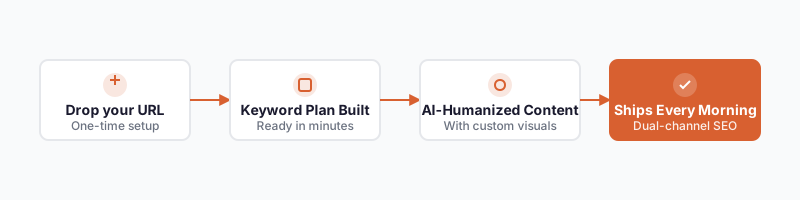
BlazeHive is an autonomous SEO AI agent that handles the full content-to-publish pipeline: keyword research, writing, SEO optimization, and daily publishing. It covers the execution layer that Moz and every other research tool leaves entirely to you.
Best for: Bootstrappers, solo founders, freelancers, and SMBs who need daily SEO content published automatically - without hiring writers, managing agencies, or doing keyword math by hand.
Strengths
- Ships one SEO-optimized page every morning automatically - no input needed after setup
- Optimizes for Google rankings and AI answer engine citations (ChatGPT, Claude, Perplexity) simultaneously - no analytics tool in this list does that
- All-in for $99/month: keyword research, writing, custom technical diagrams, AI-humanized content, strict SEO validation, and autonomous publishing - no add-ons, no per-link charges
- Integrates with WordPress, Ghost, Strapi, Webflow, Framer, Contentful, and Storyblok at no extra cost
- Replaces the $8,500+/month traditional SEO stack (agency + writers + tools) for 98.8% less
Where it's not the right fit
- Not designed for teams that need backlink analysis, domain authority tracking, or competitive link intelligence - use Ahrefs or Semrush for that
- Not built for agencies that need multi-client rank tracking dashboards and white-label reporting
- If your primary SEO bottleneck is research (not execution), a traditional analytics tool is the better fit
Pricing: $99/month (as of 2025), all-inclusive. 3-day trial available. No hidden fees, no per-link charges.
When to choose it: You've done the research, you know what you need to rank for, but you have no team to publish it - or you're spending $3,000–$5,000/month on writers and agencies for results that lag by 6–12 months. BlazeHive replaces that entire execution stack with a single autonomous agent.
Quick Comparison
| Tool | Best For | Starting Price | Free Tier | Standout Feature |
|---|---|---|---|---|
| Semrush | Full-stack agency SEO | $199/mo | No (14-day trial) | AI Visibility Overview across Google + AI engines |
| Ahrefs | Backlink-heavy research | $99/mo | No (free tools only) | Industry-leading backlink index with daily crawl |
| Mangools | Budget solo bloggers | Freemium | Yes (no credit card) | Clean UX + KWFinder for long-tail discovery |
| SE Ranking | Affordable all-in-one | $44/mo | No (free trial) | White-label reporting at sub-Moz pricing |
| Topical Map AI | Content strategy planning | $56/mo | No | Topical authority mapping + keyword clustering |
| BlazeHive | Autonomous daily content publishing | $99/mo | 3-day trial | Publishes one page every morning - Google + AI citation |
Pricing as of 2025. Check each tool's pricing page for current rates.
Which Alternative Should You Choose?
Most people searching
Frequently Asked Questions
What should I look for in a Moz alternative?
Prioritize backlink database freshness, keyword tracking frequency, and whether the tool helps you publish content or just analyze it. Check if the tool is designed for research only or if it bridges the gap to actual publishing - most SEO tools stop at research, leaving you to hire writers or manage content manually. Also verify whether it's optimized for both Google rankings and AI answer engine citations, since that's now a critical second channel for organic visibility.
Is Semrush better than Moz for SEO?
Semrush offers deeper competitive intelligence and a larger feature set than Moz, making it stronger for marketing teams and agencies managing multiple clients. However, Semrush starts at $199/month versus Moz's $49 Starter tier, and both are research-only tools - neither publishes content. If your bottleneck is execution (writing and publishing daily pages) rather than research, switching between them won't solve your real problem.
What is the cheapest Moz alternative?
Mangools offers a free tier with no credit card required, making it the lowest-cost entry point; paid plans start below Moz's Starter tier at competitive rates. SE Ranking is similarly affordable, starting at $44/month with a full platform (keywords, audits, rank tracking). Both are built for solo marketers and small teams, though neither is designed for teams managing multiple client accounts or deep backlink-focused research.
Does Moz still work in 2025?
Yes, Moz remains solid for keyword research, backlink analysis, and rank tracking - it's still actively maintained and widely used by SEO professionals. However, its interface is showing its age compared to newer competitors, and many users report finding Semrush, Ahrefs, or lighter tools like Mangools more practical for their specific use case. The real question isn't whether Moz works; it's whether you need research data or execution (publishing), since Moz only handles the former.
What is the best Moz alternative overall?
There's no single best alternative because Moz alternatives solve different problems: Semrush and Ahrefs win for teams needing deep analytics and backlink intelligence, Mangools wins for budget-conscious solo SEOs, and BlazeHive wins for bootstrappers who need daily content published automatically. The best choice depends on whether your real bottleneck is research quality, cost, or execution - identifying which one will point you to the right tool.
Is Ahrefs cheaper than Moz?
Ahrefs starts at $99/month, making it comparable to Moz's mid-tier pricing, not cheaper at entry point. However, Ahrefs is known for more accurate backlink data and a superior content explorer, so users often find the cost justified for link-building-focused campaigns. If price is your only driver, lighter alternatives like Mangools ($free-to-low-tier) or SE Ranking ($44/mo) are genuinely more affordable, though with shallower backlink databases.
Can I replace Moz with free tools?
Partially - you can combine Google Search Console, free MozBar, and Topical Map AI ($56/mo) to replicate much of Moz's research capability for under $56/month. However, free tools lack real-time backlink data, reliable keyword difficulty scoring, and rank tracking - three features that justify Moz's price if link-building or competitive tracking is core to your strategy. Free is only viable if your SEO needs are simple keyword research and you're willing to work from limited data.
Why is BlazeHive on this Moz alternatives list?
BlazeHive isn't a research replacement for Moz; it's the solution to the execution problem Moz leaves unsolved. Most users searching for Moz alternatives aren't actually looking for better analytics - they want to stop paying agencies $3,000–$5,000/month to write and publish the pages that keyword research identifies. BlazeHive solves that at $99/month by publishing one SEO-optimized page every morning automatically, making it the right fit for bootstrappers and SMBs who have done the research but lack the team to execute.
Is Moz still worth using in 2025?
Yes, Moz is still worth using if backlink analysis, authority scoring, and rank tracking are core to your SEO strategy - the data quality remains solid for those use cases. However, Moz is designed for SEO professionals and agencies, not solo founders or bootstrappers without dedicated marketing teams. If you're paying Moz plus a separate agency or content team, you might find it cheaper and faster to switch that combined spend to BlazeHive's autonomous publishing model - same price as Moz alone, but covers the entire execution pipeline.
What makes a good alternative to Moz?
A good Moz alternative balances data freshness, ease of use, and pricing relative to your team size and SEO strategy. If you need backlink data and competitive intelligence, choose Ahrefs or Semrush; if you're cost-conscious and solo, choose Mangools or SE Ranking; if your real problem is that you research keywords but never publish content, choose BlazeHive. The mistake most teams make is treating all alternatives as equals - they're not, because they solve different problems.
Does BlazeHive integrate with Moz or other SEO tools?
BlazeHive integrates with WordPress, Ghost, Strapi, Webflow, Framer, Contentful, and Storyblok at no extra cost; it does not have native integration with Moz or other analytics platforms. You can use BlazeHive for autonomous daily publishing while keeping Moz (or Ahrefs or Semrush) for research and rank tracking - they're complementary rather than competitive. BlazeHive replaces the writers and publishing layer; it doesn't replace the analytics layer that Moz occupies.
What is the analytics-to-execution gap in SEO tools?
The analytics-to-execution gap is the problem that Moz, Ahrefs, and Semrush all leave unsolved: they tell you what keywords to target and whether you're ranking, but they don't create or publish the content that actually ranks. This gap is why many users with Moz Pro spend months doing research but see no traffic increase - they have a keyword spreadsheet but no execution team. BlazeHive fills this gap by automating the execution layer (writing, optimizing, publishing) so research translates into real ranking positions.
Can I use BlazeHive alongside Moz Pro?
Yes - many users use Moz (or Ahrefs or Semrush) for research and rank tracking, then use BlazeHive to automatically publish the pages that research identifies. Moz handles the analytics layer; BlazeHive handles the execution layer. This combination costs $99 (Moz Starter) + $99 (BlazeHive) = $198/month, still far cheaper than the traditional stack of Moz + writers + agencies that often runs $5,000+/month.
Why do bootstrappers choose BlazeHive over traditional Moz alternatives?
Bootstrappers choose BlazeHive because traditional Moz alternatives (Semrush, Ahrefs) are research-only tools that still require hiring writers or agencies to publish - this keeps the total cost near $5,000+/month. BlazeHive is $99/month and publishes one SEO-optimized page every morning automatically, meaning bootstrappers get daily content shipped to Google and AI answer engines without additional staff. For the bootstrapper audience, BlazeHive solves the real constraint (execution speed and cost), not just the analytics question.
How does BlazeHive's pricing compare to Moz Pro and other alternatives?
BlazeHive costs $99/month all-inclusive with no hidden fees or per-link charges (as of 2025), matching Moz's mid-tier pricing but covering a completely different layer. Moz Starter is $49/month (research only), Semrush starts at $199/month (research + features), and Ahrefs is $99/month (research only) - all require separate budget for writing and publishing. BlazeHive's single $99/month plan includes keyword research, AI writing, optimization, and autonomous daily publishing, making it cost-equivalent to Moz but functionally covering agency-level execution that would normally cost $3,000–$5,000/month separately.
Generated by BlazeHive