SEO for Restaurants
Most restaurant owners pay $1,000–$5,000 a month to agencies just to rank for a handful of location keywords, and wait 6–12 months to see results. BlazeHive is an autonomous SEO agent that publishes one new, location-optimized page every morning for $99/month, with no writers, no agency contracts, and no waiting. A restaurant group that starts today could have 90+ neighborhood-targeted pages live within three months, covering keywords like "Italian in Brooklyn," "brunch near Prospect Park," and "late-night tacos in Austin" - pages that rank on Google and get cited by AI search engines like Perplexity and ChatGPT.

How BlazeHive Does Restaurant SEO
BlazeHive automates the entire content-to-publish pipeline for restaurant SEO: keyword research, page writing, SEO optimization, and daily publishing - all from a single URL submission. For restaurants, that means one new location-specific or cuisine-specific page ships every morning without anyone at the restaurant lifting a finger. The agent targets the hyper-local keyword combinations that drive restaurant discovery: location + cuisine + intent phrases that Google and AI engines surface when someone searches "best sushi in Tribeca" or "farm-to-table dining near the Marais."
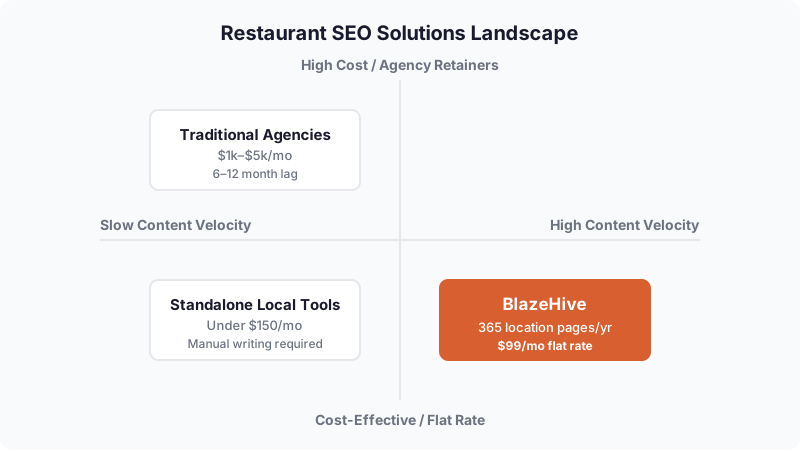
The core differentiator for restaurants is content velocity at flat-rate cost. Traditional agencies can produce 4–8 location pages per month per location - 32–64 for a 10-location group annually. BlazeHive can produce 365+ pages per location per year, at $99/month total regardless of how many locations you operate. Semrush Local Essentials charges $50/month per location - a 10-location restaurant group pays $500/month for keyword data alone, before any content is written.
Every page BlazeHive generates is AI-humanized content backed by strict SEO validation and custom in-content visuals. That matters because Google's helpful content updates have penalized thin AI pages 34 times since 2022, and templated paragraphs won't cut it. BlazeHive produces substantive, location-grounded content that passes quality filters while targeting the long-tail local keywords that drive reservation clicks and driving-directions requests.
No other restaurant SEO tool covers both channels: BlazeHive optimizes simultaneously for Google Search and AI answer engines (ChatGPT, Perplexity, Claude). When someone asks Perplexity "where should I eat in Chicago tonight?", BlazeHive-generated content puts your restaurant in the cited sources, not buried on page 2 of a traditional SERP.
Key Benefits
365 Location Pages Per Year - One Every Morning BlazeHive ships one SEO-optimized page per day automatically after setup. A restaurant group can cover hundreds of neighborhood + cuisine + intent keyword combinations in a single quarter. An agency producing 6–8 pages per month needs four years to hit that same number.
$99/Month Flat Rate vs. $1,000–$5,000/Month Agency Fees Traditional local SEO agencies charge $1,000–$5,000/month for content + strategy + management. BlazeHive replaces the content production layer entirely for $99/month - a 10–50x cost reduction. For multi-location groups, the savings compound: no per-location fees, no add-on charges, no hidden costs.
Content That Ranks on Google and Gets Cited by AI Engines Every page is optimized for both Google's ranking algorithm and AI search engines (Perplexity, ChatGPT, Claude). AI-driven restaurant discovery is real now, and content that only targets blue-link rankings misses the citation layer entirely.
AI-Humanized Content Built to Survive Algorithm Updates Google has released 34 core algorithm updates since 2022, many targeting thin AI-generated content. BlazeHive's AI-humanization layer and strict SEO validation produce content designed to pass quality filters, not trigger penalties.
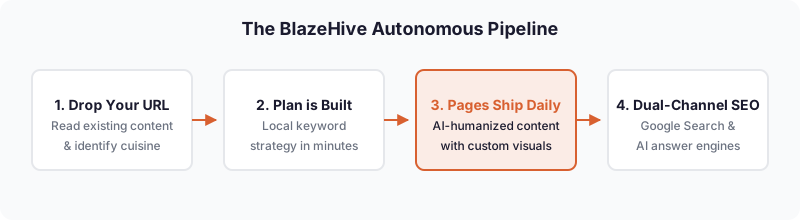
No Writers, No Briefings, No Management Overhead Drop your URL. BlazeHive builds the keyword plan and starts shipping pages. There are no content briefs to write, no freelancers to manage, and no agency account managers to chase for updates.
How It Works
Step 1: Submit Your Restaurant URL Drop your restaurant website URL into BlazeHive. The agent reads your existing content, identifies your cuisine type, locations, and current keyword footprint, and begins building your SEO content plan in minutes.
Step 2: BlazeHive Builds Your Keyword Plan The agent performs full keyword research targeting location + cuisine + intent combinations relevant to your restaurant: neighborhood guides, cuisine-specific searches, "near me" variants, and seasonal or event-based queries. The plan is ready within minutes, not weeks.
Step 3: Pages Ship Every Morning One new SEO-optimized page publishes automatically every day. Each page targets a specific keyword combination - "best ramen in the East Village," "private dining near Union Square," "farm-to-table brunch in Portland" - and is formatted for both web publishing and CMS integration.
Step 4: Content Publishes to Your CMS BlazeHive integrates directly with WordPress, Webflow, Ghost, Framer, Strapi, Contentful, and Storyblok at no extra cost. Pages land in your CMS ready to publish - no copy-pasting, no manual formatting.
Step 5: Content Feeds Google and AI Engines Simultaneously Every published page is indexed for Google Search and structured to be cited by AI answer engines. As Perplexity, ChatGPT, and Claude increasingly answer restaurant discovery queries, your location guides and neighborhood content show up as cited sources - referral traffic from a channel most restaurant SEO tools ignore entirely.
Who This Is For
Multi-location restaurant groups frustrated by agency costs and content lag. If you operate 5, 10, or 20+ locations, you already know the math doesn't work: agencies charge per-location rates or lump-sum retainers that make comprehensive local content unaffordable. You have hundreds of viable keyword opportunities - "tacos in Mission District," "brunch near Navy Pier," "sushi Midtown lunch" - and you're ranking for almost none of them because no one has time to write the pages. BlazeHive covers that keyword surface area in months, not years, at a flat $99/month regardless of location count.
Independent restaurant owners who've tried DIY SEO and given up. You've claimed your Google Business Profile, asked for reviews, maybe updated your meta tags - and you're still not showing up when someone searches for what you serve three blocks from your front door. The missing piece is content: location-specific, keyword-targeted pages that give Google something substantive to rank. BlazeHive generates those pages automatically, so you can focus on the restaurant instead of learning keyword research.
Restaurant marketers or operations managers who've outgrown their current tools. You use Semrush or Ahrefs to identify keyword opportunities - but the tool tells you what to write, not write it for you. Your team still has to brief writers, review drafts, manage publishing, and track results. BlazeHive compresses that entire workflow into a single autonomous agent. Use your keyword insights as input, and let BlazeHive execute the production at scale.
Common Use Cases
Building location landing pages for every neighborhood you serve A 12-location pizza chain needs a dedicated, keyword-optimized page for each location targeting "pizza in [neighborhood]" - but writing 12 unique, substantive pages takes months. BlazeHive generates those pages automatically, one per day, each targeting the specific neighborhood modifiers and cuisine keywords that drive local discovery clicks.
Covering seasonal menus and food trend searches When "pumpkin spice brunch" or "Valentine's Day tasting menu" becomes a searchable query, restaurants that have content live before the wave rank while competitors scramble. BlazeHive can generate trend-timed content targeting seasonal keyword spikes - content that captures short-window search surges that drive real reservations.
Ranking for cuisine + city combinations competitors haven't covered Searches like "Peruvian food in Nashville" or "Michelin-starred omakase in Austin" have lower competition but strong buyer intent. Most restaurants never pursue long-tail cuisine + city keywords because writing individual pages for each combination isn't scalable. BlazeHive makes it scalable: each combination becomes its own page, published automatically, and the rankings compound over time.
Positioning restaurant content to appear in AI search answers A customer asks Perplexity: "What's a great romantic Italian restaurant in the West Village?" Perplexity pulls cited sources - it answers with restaurant content it can verify and link. BlazeHive generates pages structured to be cited by AI engines, so your restaurant appears in that answer instead of being absent from a high-intent channel most competitors haven't touched yet.
Building a local food blog that drives organic traffic without a writer Neighborhood guides ("Best Brunch Spots in Capitol Hill"), cuisine explainers ("What Makes Neapolitan Pizza Different"), and event roundups ("Where to Eat Before a Concert at Madison Square Garden") drive top-of-funnel traffic to restaurant websites. BlazeHive auto-publishes this content daily, building a content library that grows domain authority without a content hire.
Replacing agency content production for a fraction of the cost A regional restaurant group paying a $3,000/month content agency to produce location guides switches to BlazeHive at $99/month. The agency produced 6–8 pages per month. BlazeHive produces 30 pages per month - nearly 4x the output at 3% of the cost. The savings fund a Local SEO Bot subscription ($49/month) for GBP management, leaving $2,852/month in recovered budget.
What Is SEO for Restaurants?
SEO for restaurants is the practice of optimizing a restaurant's online presence - website content, Google Business Profile, local citations, and review signals - so that the restaurant appears prominently when potential customers search for nearby dining options. Unlike broad SEO, restaurant SEO is almost entirely local and intent-driven: the goal is to appear in Google's Local 3-Pack for neighborhood searches, rank on page one for cuisine + location keyword combinations, and increasingly, to be cited by AI answer engines when customers ask conversational restaurant-discovery questions.
Local SEO drives measurable restaurant revenue. According to a 2025 Malou study, local SEO delivered +160% organic traffic growth for restaurant groups in just three months - outperforming social, direct mail, and billboards combined. Google drives 93% of all internet traffic, and 54–59% of all clicks go to the top three results in the Local 3-Pack. Hurrdat Sports Bar generated 3,100+ driving-directions requests and 661 phone calls through local SEO optimization alone. The channel converts directly to table fills, not just website visits.
Restaurant SEO is changing. Agencies and freelance writers still work, but they're slow and expensive. Autonomous tools now handle the content production layer entirely. And AI answer engines (Perplexity, ChatGPT, Claude) have become a real discovery channel - customers ask them where to eat, and they cite sources. Content that isn't structured to be cited won't show up there, period. Restaurants publishing local content now will be ahead on both channels; those waiting will have two gaps to close instead of one.
Try BlazeHive
Restaurant owners who rely on agencies spend $1,000–$5,000/month and wait six months to rank for a handful of keywords. BlazeHive ships one new, location-optimized page every morning for $99/month - start today and have 30 live pages within your first month.
Frequently Asked Questions
What is local SEO for restaurants?
Local SEO for restaurants is the practice of optimizing a restaurant's online presence-website content, Google Business Profile, citations, and reviews-to appear prominently when customers search for nearby dining options. Restaurant SEO is hyper-local and intent-driven: the goal is to rank in Google's Local 3-Pack for neighborhood searches like "Italian in Brooklyn" or "brunch near me," and increasingly, to be cited by AI answer engines like Perplexity and ChatGPT. Local SEO drives measurable revenue-restaurant groups saw 160% organic traffic growth in three months through local optimization alone, and 54–59% of clicks go to the top three local results.
How does restaurant content marketing differ from traditional SEO?
Restaurant content marketing focuses on building location guides, neighborhood reviews, cuisine explainers, and seasonal menu content that targets hyper-local keyword combinations and builds domain authority over time. Traditional broad-based SEO targets generic keywords and relies on backlinks and on-page optimization. For restaurants, the differentiator is velocity: you need dozens or hundreds of location-specific pages to cover "pizza in [neighborhood]," "brunch near [landmark]," and "cuisine in [city]"-a content surface area that traditional SEO agencies can't scale affordably. BlazeHive automates that content production, shipping one optimized page per day per location, covering keyword combinations competitors never reach because the manual cost is prohibitive.
Why do restaurants need to optimize for both Google Search and AI answer engines?
AI answer engines like Perplexity, ChatGPT, and Claude have become a real discovery channel for restaurant searches-customers ask "where should I eat tonight in the West Village?" and these engines cite sources as recommendations rather than returning a ranked list. Content that ranks on Google but isn't structured to be cited by AI engines misses this high-intent channel entirely. BlazeHive optimizes every page for both channels simultaneously, so when a customer asks an AI engine for restaurant suggestions, your location guides and neighborhood content appear as cited sources-referral traffic from a channel most restaurants haven't tapped yet.
How much does restaurant SEO cost compared to BlazeHive?
Traditional agency-led restaurant SEO costs $1,000–$5,000 per month, plus 6–12 months of waiting before results appear. Semrush Local Essentials charges $50/month per location-a 10-location restaurant group pays $500/month for keyword data alone before any content is written. BlazeHive costs $99/month flat rate, regardless of location count, and produces content immediately-one page ships every morning. For a 10-location group, that's a 10–50x cost reduction compared to agencies, with dramatically faster deployment and no per-location fees or hidden add-ons.
Can I use BlazeHive if I'm a single-location restaurant?
Yes. BlazeHive works for any restaurant size, from single locations to multi-location groups. A single-location restaurant benefits from rapid content generation targeting neighborhood keywords, cuisine modifiers, and seasonal searches-365 automatically published pages per year covering "best ramen in the East Village," "private dining near Union Square," or "farm-to-table brunch in Portland." The $99/month flat rate applies equally, so single locations get the same cost advantage and content velocity as larger groups. The key difference is that multi-location groups compound the advantage: they deploy BlazeHive across all locations simultaneously without multiplied costs.
What if I already work with a local SEO agency?
You can layer BlazeHive on top of your agency relationship or use it as a replacement depending on your priorities. If your agency handles Google Business Profile optimization, review management, and local citation cleanup-tasks BlazeHive doesn't address-keep those services and swap the agency's content production layer for BlazeHive's autonomous publishing at $99/month. If your agency is primarily charging for content writing and location page production, BlazeHive replaces that entirely and returns 80–98% of your monthly spend. Run both systems in parallel for 1–2 months to compare content quality and ranking performance before fully switching.
How does BlazeHive target location-specific keywords for my restaurant?
BlazeHive reads your website URL and existing content to identify your cuisine types, locations, and current keyword footprint, then builds a keyword plan targeting location + cuisine + intent combinations relevant to your restaurant. The agent generates pages for neighborhood guides ("best Italian in Brooklyn"), cuisine-specific searches ("late-night tacos in Austin"), proximity modifiers ("brunch near Prospect Park"), and seasonal queries ("pumpkin spice brunch"). Each page is published automatically and structured for both Google's ranking algorithm and AI answer engine citation, so your restaurant appears as a source when customers search on any channel.
What makes AI-humanized content important for restaurants?
Google has released 34 core algorithm updates since 2022, many targeting thin or obviously AI-generated content. Templated pages and low-quality AI output trigger penalties and get buried in rankings. BlazeHive's AI-humanized content and strict SEO validation produce substantive, location-grounded pages designed to pass Google's quality filters rather than trigger penalties. For restaurants, this matters because your location guides and neighborhood content need to rank and survive algorithm updates-BlazeHive generates pages that do both, using custom in-content visuals and semantic depth that differentiate from generic AI writing tools.
Is BlazeHive a replacement for Google Business Profile optimization?
No. BlazeHive generates the content your Google Business Profile links to, but it doesn't manage GBP profile updates, photos, hours, or reviews. For a complete local SEO stack, most restaurants combine BlazeHive ($99/month) with Local SEO Bot ($49/month) for GBP management and citation cleanup. Total cost: ~$150/month-still 6–10x cheaper than traditional agency approaches. BlazeHive is a content production accelerator; complementary tools handle the profile and citation layers that drive Local 3-Pack visibility and review management.
How quickly can I expect to see rankings from BlazeHive content?
BlazeHive ships one page per day, so within your first month you'll have 30 live pages optimized for local keywords. Initial content indexing by Google typically happens within 1–2 weeks for new pages on established domains. Ranking for competitive keywords can take 6–8 weeks as Google evaluates content quality and domain authority. For long-tail neighborhood + cuisine keywords with lower competition, you may see page-one rankings in 2–4 weeks. The advantage of 365 pages per year is that you're constantly feeding Google fresh, optimized content targeting different keyword combinations-some rank quickly, others take longer, but the compounding effect builds search visibility dramatically faster than 6–8 pages per month from traditional agencies.
What CMS platforms does BlazeHive integrate with for restaurant websites?
BlazeHive integrates directly with WordPress, Webflow, Ghost, Framer, Strapi, Contentful, and Storyblok at no extra cost. Pages land in your CMS ready to publish-no copy-pasting, no manual formatting required. All integrations are included in the $99/month plan with no add-on fees. This means whether your restaurant site runs on a hosted WordPress blog, a modern Webflow site, or a headless CMS, BlazeHive content flows directly into your publishing workflow without friction.