SEO for Healthcare
Healthcare practices are losing patients to competitors who show up first - on Google, in ChatGPT, in Perplexity - while the average clinic still relies on a $5,000+/month agency that publishes four blog posts a month and calls it a strategy. BlazeHive replaces that entire agency stack with a single autonomous SEO agent at $99/month: drop your URL, get a keyword plan built in minutes, and wake up to a new SEO-optimized page every morning - automatically. Over 75% of patients research providers online before booking, and now over 65% of health-related searches are answered directly inside Google AI Overviews or Bing Copilot before users reach any website. Ranking on Google alone is no longer enough.

How BlazeHive Does Healthcare SEO
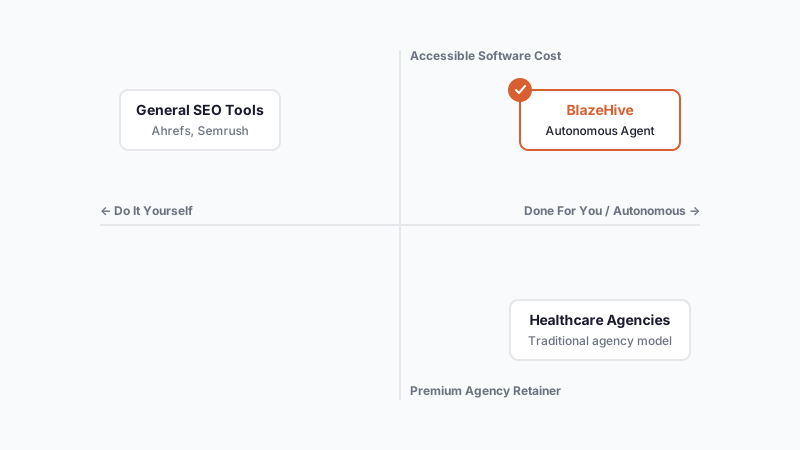
Most healthcare practices are stuck in the same pattern: pay an agency $5,000–$15,000/month, wait six months for results, and still land on page two. BlazeHive breaks that cycle by fully automating the content-to-publish pipeline: keyword research, writing, SEO validation, and daily publishing, all for $99/month, no add-ons required.
No standard SEO tool targets both channels. Every page BlazeHive publishes is optimized for traditional Google rankings and AI answer engine citations - ChatGPT, Perplexity, and Claude. Healthcare agencies are only beginning to figure out Generative Engine Optimization (GEO). BlazeHive was built for it from the start.
Content is AI-humanized - not raw LLM output. Every page goes through strict SEO validation and humanization before it publishes. That matters for healthcare specifically, because Google's E-E-A-T standards are unforgiving about thin or robotic content. Custom in-content diagrams and technical visuals are generated as part of each page, not bolted on as an afterthought.
The published content is informational and educational - patient-facing guides, condition explainers, treatment comparisons, local keyword pages. No patient records, no HIPAA-regulated data, no medical advice. This means small clinics, solo practitioners, and healthtech founders can start immediately without a compliance review, because the content BlazeHive publishes is the same category of content your agency would write - just published daily instead of monthly.
Key Benefits
50–150x cheaper than a healthcare SEO agency Specialized healthcare SEO agencies command $5,000–$15,000/month. BlazeHive costs $99/month. For a small practice, that's $60,000–$180,000/year freed up - money that stays in the practice, not in an agency retainer.
Daily publishing compounds your authority over time Typical agencies publish 4–8 pieces of content per month. BlazeHive publishes one page every morning - 30/month, 360/year. Over 12 months, the volume advantage alone creates local long-tail keyword dominance that batched agency content cannot match.
Ranks on Google AND gets cited by AI search engines BlazeHive explicitly targets Google rankings and AI answer engine citations - ChatGPT, Perplexity, Claude - in a single pipeline. Search is fragmenting. Patients are getting answers from AI before they ever reach a website. Healthcare practices that aren't cited in AI engines are invisible to a growing share of their potential patients.
Setup takes minutes, not months Agencies require weeks of onboarding, audits, strategy workshops, and contract negotiation before a single word publishes. BlazeHive requires one URL. The keyword plan is ready in minutes. Pages ship the next morning.
Informational content only - no HIPAA exposure BlazeHive publishes educational healthcare content: treatment guides, symptom explainers, local SEO pages. It does not touch patient data, records, or private health information. You own every page published. Cancel anytime.
How It Works
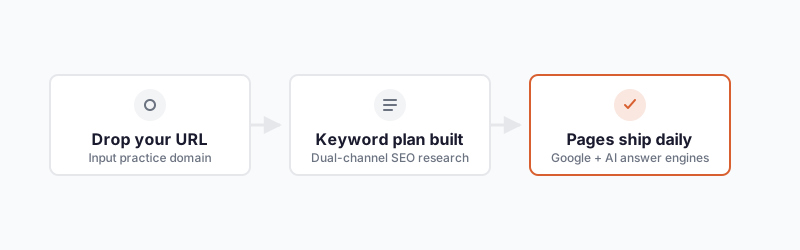
Step 1: Drop your URL Submit your practice or healthtech website URL to BlazeHive. The system reads your existing domain authority, niche, and service area as the foundation for your keyword strategy.
Step 2: Keyword plan built in minutes BlazeHive performs full keyword research across your specialty - local patient-intent keywords, condition-specific long-tail terms, and AI-answer-engine-optimized queries. The plan surfaces terms like "dentist near me accepting new patients" and "what is a root canal recovery" simultaneously, mapped to the dual-channel publishing strategy.
Step 3: Pages ship every morning, automatically The autonomous agent writes, validates, and publishes one SEO-optimized page per day - no drafts to approve, no editorial queue to manage. Each page includes AI-humanized copy, custom in-content diagrams, strict SEO validation, and dual-channel optimization for Google and AI engines.
Step 4: Track rankings and citations The BlazeHive dashboard surfaces keyword rankings, page-one wins, and competitor signals in real time. As your domain authority builds from 30, then 90, then 360 published pages, you see compounding organic growth. Agencies promise that in 6–12 months. BlazeHive starts delivering from month one.
Step 5: Integrate with your existing CMS BlazeHive connects to WordPress, Webflow, Ghost, Framer, Strapi, Contentful, and Storyblok at no extra cost. If your practice site is already on one of these platforms, setup requires no migration and no dev work.
Who This Is For
BlazeHive works best for healthcare practices and founders who have an established online presence but are getting little organic traffic from it. The ideal user is a solo practitioner or small clinic (1–10 providers) currently paying $5,000+/month to an agency - or considering it - who wants to bring content strategy in-house without hiring a content team. Think: a family dentist with a solid domain who hasn't published a blog post in two years, or a physical therapy group with three locations that needs location-specific pages for each branch.
Wellness professionals - therapists, nutritionists, health coaches - are a strong secondary fit. These practitioners have deep subject-matter expertise - exactly what Google's E-E-A-T framework rewards - but no time to run a content calendar. BlazeHive handles the execution. The practitioner's credentials do the rest. Healthie targets a similar audience with practice management tools, but doesn't offer autonomous SEO publishing at any price point.
Bootstrapped healthtech founders building apps, platforms, or services for healthcare providers are also a strong fit. They need organic traffic but can't hire healthcare SEO specialists. BlazeHive gives them the same daily publishing velocity as a funded company's content team - at $99/month.
BlazeHive is not built for large hospital systems with complex legal and compliance infrastructure, or practices in highly regulated specialties (pain management, behavioral health) that require attorney-reviewed content before publishing. Those use cases need white-glove agency support with legal oversight.
Common Use Cases
Solo dentist building local search dominance A dentist in a mid-size city knows patients search "teeth whitening near [city]" and "emergency dentist [city]" but has never published a single page targeting those terms. BlazeHive auto-generates location-optimized patient education pages daily. Long-tail local queries accumulate, and first-page rankings follow within 90 days.
Physical therapy group with multiple locations A PT practice with five locations needs five sets of location-specific service pages - that's 150+ keyword/page combinations manually. BlazeHive auto-publishes location-optimized pages across all branches daily, without any staff overhead or duplicate-content risk.
Healthtech founder building a SaaS for clinicians A bootstrapped founder building an EHR add-on needs top-of-funnel organic traffic but can't hire a healthcare content writer. BlazeHive ships daily SEO pages targeting clinician-intent keywords - "best EHR for small practices," "HIPAA-compliant patient portal" - automatically. A blank domain becomes a ranked resource site within months.
Wellness coach competing with large directories A licensed nutritionist competes against WebMD and Healthline for every search term. BlazeHive's Social Intelligence layer fuels pages built around trending patient questions and underserved long-tail queries those directories ignore. The solo practitioner ends up ranking for terms the big players never bothered to cover.
Therapist building referral-independent practice A therapist dependent on physician referrals wants to build direct patient acquisition through organic search. BlazeHive publishes daily pages on mental health topics, therapy modalities, and symptom-specific content. Over time, the practice website becomes a patient education hub that ranks for high-intent queries like "therapist specializing in anxiety [city]."
What Is Healthcare SEO?
Healthcare SEO is the practice of optimizing a medical or wellness website to rank in search engine results for patient-intent queries - "urgent care near me," "symptoms of a UTI," "how long does physical therapy take" - and increasingly, to be cited inside AI answer engines like ChatGPT and Perplexity. It differs from general SEO because healthcare content is classified as YMYL (Your Money Your Life) by Google, which means every published page faces heightened accuracy and trust requirements under the E-E-A-T framework (Experience, Expertise, Authoritativeness, Trustworthiness).
The stakes are higher in healthcare than in most verticals. Online search drives three times as many hospital website visitors as other sources. When a practice doesn't rank for its specialty and location, those patients book with a competitor. And with HIPAA compliance governing all digital marketing, healthcare SEO requires a disciplined approach to data handling - published content cannot include patient data or trigger privacy regulations.
Search behavior is changing fast. Google's AI Overviews and Bing Copilot now answer health queries directly, before users reach any website. Practices that only optimize for traditional blue-link rankings are losing visibility to AI-generated answers. The new requirement - sometimes called GEO, or Generative Engine Optimization - is content structured to be cited by AI engines, not just indexed by Google crawlers. BlazeHive serves both channels in a single pipeline, which is why it fits healthcare practices that can't afford to ignore either one.
Try BlazeHive
Healthcare practices that rely on agencies for SEO are paying $5,000–$15,000/month for 4–8 pages of content that may not even rank. BlazeHive ships 30 SEO-optimized pages per month - optimized for Google and for ChatGPT, Perplexity, and Claude - for $99/month, starting from your first free day. Drop your URL, get your keyword plan in minutes, and wake up tomorrow to your first published page.
Frequently Asked Questions
What is healthcare SEO?
Healthcare SEO is the practice of optimizing a medical or wellness website to rank for patient-intent queries like "urgent care near me" or "symptoms of a UTI," and increasingly, to be cited by AI answer engines like ChatGPT and Perplexity. Unlike general SEO, healthcare content faces heightened accuracy requirements under Google's E-E-A-T framework because it's classified as YMYL (Your Money Your Life) - meaning every published page must demonstrate expertise, authoritativeness, and trustworthiness. With over 65% of health-related searches now answered inside AI Overviews before users reach a website, practices that only optimize for traditional Google rankings are becoming invisible to a growing portion of their potential patients. BlazeHive addresses this dual-channel requirement by publishing pages optimized for both Google rankings and AI engine citations simultaneously.
How does E-E-A-T healthcare content help my practice rank?
Google's E-E-A-T framework - Experience, Expertise, Authoritativeness, Trustworthiness - directly influences ranking eligibility for healthcare queries, which Google treats as higher-stakes YMYL content. Content authored by or credibly attributed to licensed practitioners, backed by medical sources, and published on established domains ranks higher than thin or generic medical information. BlazeHive humanizes all AI-generated content and validates it against E-E-A-T standards before publishing, ensuring your pages meet Google's trust thresholds rather than triggering penalties. Over time, a compounding library of E-E-A-T-aligned pages signals authority to Google, lifting both new and existing pages in rankings.
How is BlazeHive different from hiring a healthcare SEO agency?
Healthcare SEO agencies typically cost $5,000–$15,000/month and publish 4–8 pages monthly after a 6–12 month ramp-up period, whereas BlazeHive publishes one page every morning - 30/month, 360/year - for $99/month with no setup delays. Over 12 months, this volume advantage alone creates local long-tail keyword dominance that batched agency content cannot match. Agencies provide white-glove onboarding and attorney-reviewed compliance workflows, which large hospital systems and highly regulated specialties require; small practices and solo practitioners gain velocity and cost savings by accepting BlazeHive's self-service model. BlazeHive also explicitly optimizes for AI answer engine citations (ChatGPT, Perplexity, Claude) alongside Google, a capability most agencies are still learning to execute.
Is BlazeHive HIPAA-compliant?
BlazeHive publishes educational and informational healthcare content - patient guides, condition explainers, treatment comparisons, location-specific service pages - and does not touch patient data, medical records, or HIPAA-regulated private health information. Because BlazeHive's content pipeline never processes or stores patient data, it operates outside HIPAA's regulatory scope; your practice retains full ownership of all published content. If your practice needs to include practitioner bylines or medical disclaimers for compliance reasons, you can integrate a review workflow without disrupting the publishing pipeline. This approach lets small clinics and solo practitioners start immediately without a lengthy compliance review, unlike agency onboarding that often requires legal sign-off.
How much organic traffic can I expect from BlazeHive?
BlazeHive guarantees a floor of 30 quality published pages; worst case, you own a rich resource library your patients value; best case, proven sites built with BlazeHive have achieved 100,000+ monthly organic visitors with 95% inbound from organic search. Results depend on your existing domain authority, specialty, local competition, and keyword difficulty - a family dentist in a mid-size city will see first-page rankings for long-tail local queries within 90 days, while a generalist practice in a saturated market may take 6+ months to accumulate authority. The compounding effect of 360 published pages per year works in your favor: as your domain ages and accumulates backlinks from citations and shares, each new page ranks faster than the last. BlazeHive's dashboard tracks rankings and page-one wins in real time, so you see progress from month one.
Can BlazeHive work for my multi-location practice?
BlazeHive auto-generates location-optimized pages daily across all your practice locations, solving the problem of managing 150+ keyword/page combinations manually. A physical therapy practice with five locations can publish unique location-specific service pages, local keyword pages, and branch-focused content without any staff overhead or duplicate-content risk. Each location's pages are SEO-validated separately and published to your domain hierarchy, building local authority for each branch independently. This velocity makes BlazeHive ideal for multi-location practices competing against larger healthcare networks, because daily location-specific publishing compounds faster than agencies can batch monthly content across multiple sites.
What is local SEO for medical practices?
Local SEO for medical practices is the process of optimizing your practice website and online presence to rank in location-specific search results - queries like "dentist near me," "urgent care accepting new patients [city]," or "physical therapy [neighborhood]" - and appearing in Google Maps, local directories, and AI answer engines. Patients researching providers almost always include a location qualifier in their search, and practices that don't optimize for these hyper-local long-tail keywords lose patients to competitors who do. BlazeHive automates local SEO by publishing location-optimized pages daily, targeting patient-intent keywords specific to each service area or branch. Over 12 months, this generates dozens of first-page rankings for local queries that drive high-intent patients directly to your practice website.
How do AI answer engines like ChatGPT affect healthcare search?
AI answer engines including ChatGPT, Perplexity, and Claude now intercept health-related searches and provide direct answers before users ever click through to a website - meaning practices optimized only for traditional Google rankings are becoming invisible to a growing portion of patients. When an AI answer engine cites a source, it links or attributes to the original content, which drives referral traffic and establishes your practice as an authoritative resource. BlazeHive explicitly optimizes every published page for AI answer engine citations, ensuring your content is structured to be found, cited, and linked by these engines alongside traditional Google rankings. This GEO (Generative Engine Optimization) approach is rare among SEO tools and is becoming essential as search behavior fragments across multiple answer channels.
Why should a small medical practice automate SEO instead of hiring a content writer?
Hiring a full-time content writer costs $50,000–$80,000/year in salary plus overhead; contracting freelance writers typically runs $3,000–$5,000/month for consistent output; either path requires editorial management, keyword research, and publishing oversight - totaling $8,500+/month when combined with keyword tools and agency markup. BlazeHive delivers the same output - daily SEO-optimized pages with keyword research, writing, validation, and publishing included - for $99/month with zero editorial overhead. A solo dentist or small clinic can reinvest $60,000–$180,000/year into hiring clinical staff, upgrading equipment, or improving patient experience instead of paying for content. The trade-off is accepting autonomous publishing in exchange for cost and speed; if your practice compliance requires practitioner review, you can integrate an approval workflow without disrupting BlazeHive's daily cadence.