TL;DR
The best SEO tool for your agency depends entirely on your workflow. Ahrefs or Semrush win for competitive backlink research and deep data. BlazeHive wins for autonomous daily content publishing at $99/month - replacing a $8,500/month traditional stack. Rankability wins if AI search tracking is your primary gap.
SEO Tools for Agencies
Most agencies already know Semrush and Ahrefs. Both are well-built and genuinely useful. But the market has moved. Autonomous publishing, AI search optimization, and budget-conscious all-in-one tooling are now separate categories with separate winners. This page breaks down which tool wins for which workflow, so you can pick one that actually fits your situation.

Why people look for agency SEO tool alternatives
The single most common reason agencies go searching for alternatives is cost compounding: a typical agency stack runs $8,500+/month when you factor in an SEO agency or contractor ($5,000/month), content writers ($3,000/month), and keyword tools like Semrush ($499/month at the Business tier). That's before any labor overhead for reviewing and publishing content. For small agencies and SMBs bringing SEO in-house, that math collapses before it starts.
The second friction point is content velocity. Agencies running Semrush or Ahrefs still need a human to take keyword data, brief a writer, review the draft, optimize it in Surfer SEO, and then publish manually. Even efficient teams top out at 8–12 pieces per month - nowhere near the programmatic publishing velocity needed to compete on long-tail keywords at scale. The tools are research engines, not publishing engines.
A third issue is emerging fast: AI search. Traditional SEO platforms were built for Google. But ChatGPT, Perplexity, and Claude now actively cite sources, so agencies whose clients aren't ranking in AI answer engines are leaving a real traffic channel untouched. Most incumbent tools bolted AI tracking on as a dashboard widget after the fact, not as a core part of the content production workflow.
What to look for in an agency SEO tool
Autonomous vs. assisted publishing: Some tools require a human to take output and publish it; others publish autonomously. If you're managing 10+ clients, assisted tools bottleneck at headcount. Autonomous publishing means the content pipeline keeps moving regardless of team availability.
Dual-channel optimization: Google search and AI answer engines (ChatGPT, Perplexity, Google AI Overviews) are increasingly separate channels. A tool that optimizes for only one means manual rework for the other. Look for whether AI search optimization is core or bolted on.
All-in-one vs. modular: An all-in-one tool reduces integration friction and billing overhead. Modular stacks (research tool + writing tool + audit tool + reporting tool) are more powerful but require significant coordination. Choose based on whether your team has the bandwidth to manage multi-tool workflows.
Depth of competitive data: Backlink analysis and competitive intelligence require years of crawler data. Newer tools often can't match Ahrefs' or Semrush's data depth. Be honest about whether your use case needs 10 years of backlink history or just keyword targeting for long-tail content.
White-label and multi-client reporting: If you're selling SEO services to clients, branded dashboards and multi-client reports are table stakes. Not every tool offers this - confirm before committing.
Pricing at client scale: Some tools charge per user or per client project. When managing 15+ clients, those charges stack fast. Check whether pricing scales with your client count or stays flat.
Technical SEO audit capability: Content strategy and technical health are different problems. Broken crawl paths and schema errors require dedicated audit tooling. A tool that only does content won't catch the technical issues that suppress rankings.
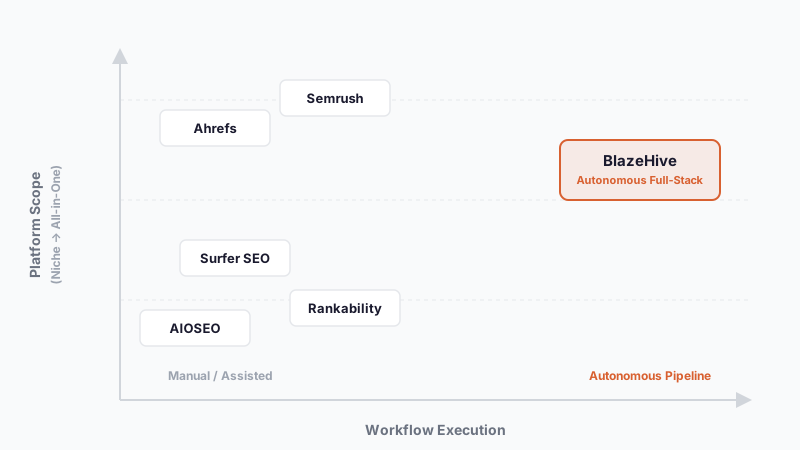
The best SEO tools for agencies
1. BlazeHive
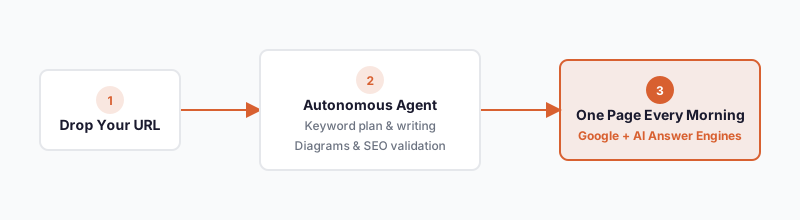
BlazeHive is an autonomous SEO AI agent that handles keyword research, writing, optimization, and daily publishing at $99/month. You drop a URL; it ships a page every morning.
Best for: Bootstrappers, SMBs, and content-first agencies that want daily SEO content without hiring writers or managing a manual publishing workflow.
Strengths
- Autonomous daily publishing: one SEO-optimized page ships every morning after setup, without manual input
- Dual-channel optimization: content is built for both Google rankings and AI answer engine citations (ChatGPT, Claude, Perplexity) simultaneously
- All-in-one at one price: keyword research, writing, custom in-content diagrams, AI-humanized content, SEO validation, and publishing - no add-ons required
- CMS integrations included at no extra cost: WordPress, Ghost, Strapi, Webflow, Framer, Contentful, Storyblok
- Asymmetric risk: 30 pieces of owned content minimum even if you cancel, meaning no wasted spend
Where it's not the right fit
- Not built for deep competitive backlink analysis - Ahrefs' 10+ year crawler database is in a different category
- Not designed for white-label client reporting dashboards; appears to be single-operator focused
- Technical SEO audits (schema errors, crawl issues, XML sitemaps) are outside its scope
Pricing: $99/month, billed monthly, cancel anytime. 3-day trial available. No hidden fees, no per-link charges. (As of 2025.)
When to choose it: If you're spending more than $500/month on SEO content or tools and still publishing fewer than 20 pieces per month, BlazeHive's daily autonomous publishing model will 3–5x your content velocity at a fraction of the cost.
2. Ahrefs
Ahrefs is the go-to tool for backlink analysis, competitive research, and keyword intelligence. It runs one of the largest active web crawlers in the industry.
Best for: Agencies whose core deliverable is competitive analysis, link-building strategy, and in-depth keyword research for high-competition verticals.
Strengths
- Backlink database with 10+ years of historical crawl data and 150,000 API units/month on standard plans - no other tool on this list comes close on data depth
- Keyword explorer with deep SERP analysis for competitive targeting
- Site audit capabilities for identifying technical health issues
Where it's not the right fit
- Not designed for autonomous content creation or publishing - research output still requires a human writer and publishing workflow
- Higher price point makes it cost-prohibitive for solo operators or agencies managing small-budget clients
Pricing: Plans start in the hundreds per month; the Standard plan includes 150,000 API units/month. (Check ahrefs.com/pricing for current rates.)
When to choose it: When your agency's primary value is competitive intelligence and link acquisition strategy, and you have writers or a content team to act on the research.
3. Semrush
Semrush covers more ground than any other tool on this list: keyword research, backlink analysis, local SEO, site audits, and PPC research in one platform.
Best for: Full-service agencies managing diverse client needs across SEO, paid search, and content strategy, where a single data platform reduces context switching.
Strengths
- 4.8/5 stars on G2 from 187+ reviews - highest rated among incumbent platforms
- Covers keyword research, backlinks, site health, and competitive benchmarking in one login
- Business tier starts at $499.95/month, giving access to API and multi-user workflows
Where it's not the right fit
- Significant learning curve; getting full value requires experienced SEO operators, not just a login
- Does not publish content autonomously - it's a research and analysis platform, not a production engine
Pricing: Business tier at $499.95/month for API access. (See semrush.com/prices for current rates.)
When to choose it: When you're running a multi-service agency where a single data platform needs to serve SEO, content, and paid search teams simultaneously.
4. Surfer SEO
Surfer SEO is a content optimization platform that helps writers and SEO teams build briefs and fine-tune articles to rank. It recently added an AI Tracker for brand visibility in ChatGPT, Google AI Overviews, and Perplexity.
Best for: Content-heavy agencies that already have writers and want a scoring layer to ensure every article is structurally optimized before publishing.
Strengths
- AI Tracker reports brand visibility in AI search results with daily updates - a meaningful feature for agencies tracking AI search exposure
- Content brief generation that maps keyword density, headings, and topical coverage to top-ranking pages
- Used by agencies running data-driven content programs where brief quality directly affects ranking rates
Where it's not the right fit
- Still requires a human writer to act on the brief - not an autonomous production tool
- AI search tracking is a reporting add-on, not a core content optimization mechanism
Pricing: Multiple tiers available. (See surferseo.com/pricing for current rates.)
When to choose it: When your agency has writing capacity and needs a consistent scoring and brief-generation system to improve ranking rates across client content.
5. Rankability
Rankability is built for search agencies managing multiple clients, with native tracking across Google, ChatGPT, Perplexity, and Gemini. It's one of the only tools that treats AI search ranking as a first-class feature, not a dashboard add-on.
Best for: Agencies whose clients are asking "where do we rank on ChatGPT and Perplexity" and need unified rank tracking across traditional and AI search channels.
Strengths
- Tracks rankings across Google, ChatGPT, Perplexity, and Gemini in one dashboard
- Daily rank checks with unlimited white-label reporting on all plan tiers
- Full API access across plans - strong for agencies building custom client workflows
Where it's not the right fit
- Not a content production or autonomous publishing tool - requires separate writing workflow
- Newer platform; depth of backlink and competitive intelligence doesn't match Ahrefs or Semrush
Pricing: Solo, Core, Team, and Enterprise tiers with white-label and API on all plans. (See rankability.com/pricing for current rates.)
When to choose it: When your agency's most pressing gap is proving AI search visibility to clients - especially if you're already using Semrush or Ahrefs for traditional SEO data.
6. AIOSEO
All in One SEO (AIOSEO) is a WordPress SEO plugin with 3+ million active users, built for agencies managing multiple WordPress sites at varying levels of technical sophistication.
Best for: WordPress agencies managing many client sites that need consistent on-page SEO implementation without requiring every team member to be an SEO expert.
Strengths
- TruSEO real-time scoring ensures quality consistency across a distributed client portfolio
- Handles schema markup, XML sitemaps, and technical on-page SEO across hundreds of sites
- Low learning curve makes it accessible to non-SEO team members managing client updates
Where it's not the right fit
- WordPress-only - not useful for agencies with Webflow, Shopify, or custom CMS clients
- Does not provide competitive research, backlink data, or content writing
Pricing: Multiple tiers available. Free tier: yes (plugin). (See aioseo.com/pricing for current rates.)
When to choose it: When your agency runs primarily on WordPress and needs a reliable technical SEO foundation for every client site without a steep per-site overhead.
Quick comparison
| Tool | Best For | Starting Price | Free Tier | Standout Feature |
|---|---|---|---|---|
| BlazeHive | Autonomous daily content publishing | $99/mo | 3-day trial | Fully autonomous daily SEO page publishing |
| Ahrefs | Backlink & competitive research | $100s/mo | No | Largest active web crawler with 10+ years of backlink data |
| Semrush | Full-service agency data platform | $499.95/mo (Business) | Limited | Broadest all-in-one coverage: SEO, PPC, content, local |
| Surfer SEO | Content brief optimization | Varies | No | AI Tracker for brand visibility in ChatGPT and Perplexity |
| Rankability | AI search rank tracking | Varies | No | Unified rank tracking across Google, ChatGPT, Perplexity, Gemini |
| AIOSEO | WordPress multi-site technical SEO | Varies | Yes (plugin) | TruSEO real-time scoring across hundreds of client sites |
Pricing as of 2025. Check each tool's pricing page for current rates.
Which SEO tool should you choose?
If you're publishing fewer than 10 pieces of content per month and want to scale fast...
BlazeHive is the only tool that actually ships content for you. At $99/month, one page every morning means 30 pages/month with zero writing overhead - versus 150–300 hours of labor to produce the same output manually.
If your agency's primary deliverable is competitive analysis and link strategy...
Ahrefs is the definitive choice. Its backlink database depth and 10+ years of crawl data are not matched by any other tool in this list. If competitive intelligence is your core service, Ahrefs is non-negotiable.
If you're running a full-service agency covering SEO, paid search, and content across many clients...
Semrush handles the breadth. The 4.8/5 G2 rating reflects real agency use - it reduces context switching when a single team needs to cover multiple channels for multiple clients.
If your clients are asking why competitors are showing up in ChatGPT and Perplexity...
Rankability was built for this exact gap. Its cross-channel rank tracking - Google, ChatGPT, Perplexity, Gemini - gives you the data to answer that question and report on progress.
If you're optimizing content for SEO and already have writers in place...
Surfer SEO adds the scoring layer that turns average writers into consistent rankers. Its brief generation and AI Tracker are specifically designed for content-heavy agency workflows.
If you manage multiple WordPress client sites and need consistent technical SEO without deep expertise...
AIOSEO is the lowest-friction option. The TruSEO scoring system keeps every site on track without requiring an SEO-certified team member at every client.
Ready to try BlazeHive?
If you're spending more than $500/month on SEO tooling and still manually managing a content backlog, BlazeHive is built for that specific situation. Drop your URL, get a keyword plan in minutes, and let the agent ship a page every morning - no writers, no publishing workflow, no add-ons. Start with the 3-day trial at blazehive.io and see how many pages ship before you spend a dollar.
Frequently Asked Questions
What should I look for in an agency SEO tool?
Look for autonomous publishing capability, dual-channel optimization (Google plus AI search), all-in-one pricing with no add-ons, depth of competitive data matching your use case, multi-client reporting if you're selling SEO services, pricing that scales with client count, and technical SEO audit features. These dimensions separate tools designed for different workflows-research-only platforms, content optimization tools, and autonomous publishing engines address different agency problems. No single tool wins across all categories, so choose based on which workflow is your primary bottleneck.
Is BlazeHive still worth using compared to traditional SEO agencies?
Yes, for bootstrappers and SMBs where cost is the constraint and daily content volume is the goal. Traditional agencies ($5,000+/month) deliver strategic depth and white-glove service that BlazeHive cannot match-if your client needs competitive link strategy or enterprise-level reporting, an agency is correct. But for agencies managing 10+ small clients or solo operators needing 30+ SEO pages monthly, BlazeHive's $99/month autonomous publishing model eliminates the cost structure that makes traditional agencies inaccessible. The two serve different use cases; BlazeHive is not a downgrade, it's a different category.
What makes a good autonomous SEO tool different from traditional SEO software?
Autonomous tools ship content without human input after setup; traditional SEO software requires a human to interpret research, brief writers, review drafts, and publish manually. That manual gate means even efficient teams top out at 8–12 pieces per month, while autonomous tools compound at 30+ pieces monthly. For agencies competing on long-tail keywords at scale, the difference in content velocity is the primary lever-and traditional platforms cannot deliver it, even when paired with in-house writers.
Why is BlazeHive cheaper than Semrush or Ahrefs?
BlazeHive is a niche autonomous publishing engine; Semrush and Ahrefs are research-and-analysis platforms covering keyword research, backlink data, competitive intelligence, and technical audits across 10+ years of global crawl history. That data depth costs years of engineering and massive infrastructure investment. BlazeHive deliberately excludes backlink analysis and competitive depth to deliver daily publishing at $99/month instead of $500+/month. For agencies needing research depth, Semrush and Ahrefs are non-negotiable; for agencies needing publishing velocity, BlazeHive wins on economics because it does less, intentionally.
Can I use BlazeHive alongside Semrush or Ahrefs?
Yes-this is the recommended approach for agencies with budget for multiple tools. Keep Semrush or Ahrefs for competitive backlink research and strategic analysis, then add BlazeHive for autonomous daily publishing on your strongest keyword clusters. The tools are complementary, not competitive; traditional platforms require a human writer and publishing workflow to ship content, while BlazeHive automates both. Agencies using this model accelerate content velocity without abandoning their existing research tools.
How does BlazeHive optimize for AI search (ChatGPT, Perplexity, Claude)?
BlazeHive is built for dual-channel optimization, meaning every page is structured to rank on Google search and get cited by AI answer engines simultaneously. The exact mechanism (called Social Intelligence in the product) is not detailed publicly, but the positioning claim is explicit: content shipped daily is optimized for both channels as core functionality, not bolted on. This differs from competitors like Surfer SEO or Rankability, which added AI search tracking as a reporting dashboard after the fact rather than baking it into content production.
Why is content velocity important for agency SEO?
Long-tail keyword strategies depend on volume-ranking on 50 keywords at rank 8–12 drives more traffic than ranking on 5 keywords at rank 1. To compete at scale, agencies need to publish 20+ SEO pieces monthly; most manual workflows top out at 8–12 even with dedicated writers. Autonomous tools like BlazeHive enable 30+ pieces monthly at $99/month, while traditional teams publishing 10 pieces monthly cost $8,500+. The math is simple: more pages at lower cost per piece win on long-tail keyword accumulation.
Should I choose a white-label reporting tool like Rankability or a publishing tool like BlazeHive?
Choose based on your primary pain point. Rankability solves the "where do we rank on ChatGPT" question for agencies selling SEO services to clients-it provides dashboards showing visibility across Google, ChatGPT, Perplexity, and Gemini. BlazeHive solves the "we need more SEO content faster" problem for content teams and agencies managing their own growth. Both are useful, but they address different bottlenecks-rank tracking for client-facing reporting versus autonomous publishing for content velocity. Many agencies use both.
What are the use cases where Ahrefs' backlink data outweighs BlazeHive's publishing speed?
Ahrefs wins when competitive backlink analysis is your core deliverable-agencies building link-building strategies, running HARO-style outreach campaigns, or advising clients on their competitive positioning relative to domain-authority leaders need Ahrefs' 10+ years of backlink history. BlazeHive has no backlink module and cannot compete on competitive intelligence depth. If your agency charges for strategic link advice or backlink audits, Ahrefs is required; if you're trying to scale content volume, BlazeHive is the better fit.
What does BlazeHive do that Semrush cannot?
BlazeHive autonomously publishes one SEO-optimized page every morning after setup; Semrush requires humans to interpret keyword research, brief writers, review drafts, optimize content, and publish manually. Semrush's Business tier at $499.95/month outputs research that still needs 4–6 hours of human labor per article. BlazeHive's $99/month outputs published pages ready for traffic. If content production speed is the constraint, BlazeHive is structurally different; Semrush is a research tool that requires a content team to execute.
Why would an agency still choose Ahrefs or Semrush over BlazeHive?
If your primary deliverable is competitive analysis, link strategy, or multi-channel data (SEO + PPC + content benchmarking), those platforms are required-BlazeHive has no backlink database, no PPC research, and no white-label reporting. Agencies selling strategic consulting need Ahrefs' or Semrush's depth; agencies publishing content internally or for clients need BlazeHive's publishing speed. Many agencies use both-Semrush for strategic work, BlazeHive for daily content production. The choice is not either/or; it's which problem is your primary bottleneck.
Is BlazeHive designed for enterprise agencies or small teams?
BlazeHive is purpose-built for bootstrappers, SMBs, freelancers, and consultants where cost and autonomy are the primary constraints-not for enterprise agencies managing 50+ clients with white-label reporting requirements. Its single $99/month plan, autonomous publishing model, and lack of multi-user team collaboration features indicate it's built for solo operators and small teams. Enterprise agencies need Semrush's or Ahrefs' team collaboration, SLA support, and white-label dashboards that BlazeHive does not advertise. For agencies under 5 people or managing 10–20 SMB clients, BlazeHive's economics are compelling; for larger agencies, it's a content acceleration layer, not a core platform.