
What Is Domain Authority In SEO & How to Boost Your Score
If you've spent any time in the SEO world, you've likely heard the term "Domain Authority" or "DA." So, what is it, and why does it matter?
Developed by Moz, Domain Authority (DA) is a score that predicts a website's ability to rank in search engine results. Think of it as a website's "reputation score."
The score ranges from 1 to 100. A higher score suggests a greater ability to rank for competitive keywords. It's vital to remember that DA is not a metric used by Google. Instead, it's a third-party tool created to help us gauge a site's relative strength.
Understanding Your Website's Reputation Score
Imagine the internet is a giant popularity contest, and search engines are the judges. In this contest, Domain Authority is like a predictive poll—it shows who is most likely to win over the judges. It isn't the final vote, but it's a solid indicator of a site's influence and authority.
A site's DA score is calculated using several factors, but the most important one is its backlink profile. The number of unique websites linking to you (referring domains) and the quality of those links act like votes of confidence. They signal to search engines that your site is credible and valuable. To learn more, see our guide on what is a backlink profile.
Here’s a breakdown of what these scores mean in the real world.
Domain Authority Score Tiers and Their Meaning
This table helps translate a DA number into a practical understanding of a site's competitive strength.
| DA Score Range | Tier Description | Typical Website Profile |
|---|---|---|
| 0-20 | New / Low Authority | Brand new websites, small local businesses, or personal blogs with a small backlink profile. |
| 21-40 | Developing Authority | Growing blogs, established small businesses, or niche sites that have started building a link profile. |
| 41-60 | Established / Competitive | Well-established businesses, popular blogs, or e-commerce stores with a strong history of quality content and backlinks. |
| 61-80 | High Authority | Major national or international brands, respected industry publications, and large e-commerce sites with extensive backlink profiles. |
| 81-100 | Elite Authority | Global names like Wikipedia, Google, major news outlets (The New York Times), and massive social media platforms. |
Seeing your site's score in this context helps you understand where you stand against the competition.
Why Every Point Matters on a Logarithmic Scale
Here’s a critical detail: Domain Authority is measured on a logarithmic scale. This means it's much easier to grow your score from 10 to 20 than it is to push it from 70 to 80.
As you climb higher, each point represents a much greater leap in authority, and the effort required to gain the next point increases exponentially.
For example, a new blog might jump to a DA of 20 by earning a few good links. But for a site with a DA of 75 to move to 76, it would need incredibly powerful links from top-tier domains like major news publications or leading universities.
Moz introduced Domain Authority in 2009 to give SEOs a more reliable way to predict a site's ranking potential. By evaluating the entire domain based on its link profile, DA provides a holistic benchmark for competitive analysis and helps guide a long-term SEO strategy.
How Moz Calculates Your Domain Authority Score
To understand what DA means for SEO, we need to look at how its creator, Moz, calculates the score. Moz uses a machine learning model to predict how well a website will rank, and the most important ingredient is your backlink profile. The entire system analyzes a massive web link index to determine your site's overall strength.
It’s not just a numbers game. The calculation isn't about simply counting how many sites link to you; it’s about which sites link to you.
Think of each backlink as a "vote of confidence." A single vote from a powerhouse like a national news organization carries far more weight than hundreds of votes from unknown blogs.
This diagram breaks down the core idea of Domain Authority.
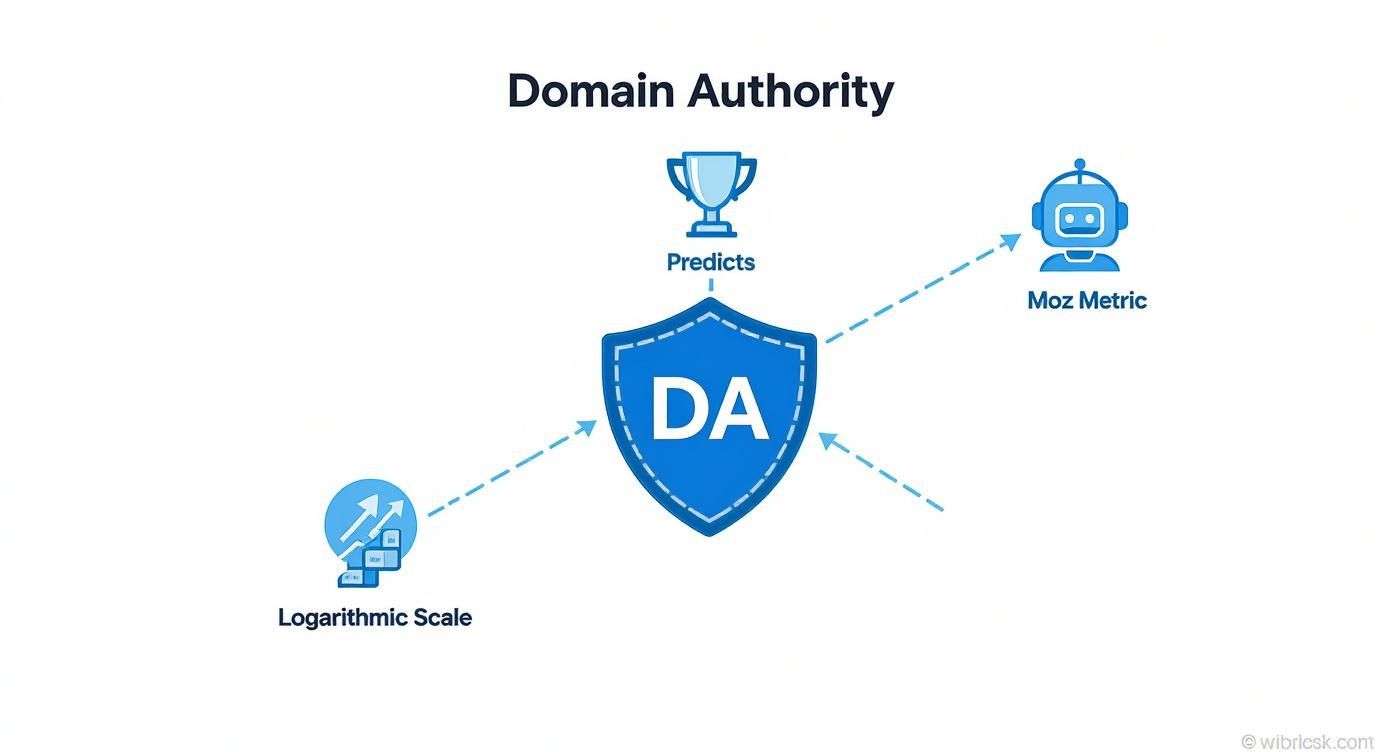
As you can see, DA is Moz's predictive score. It works on a logarithmic scale, meaning it’s much harder to grow your score from 70 to 80 than from 20 to 30. This makes it a great yardstick for comparing your site to competitors.
The Key Ingredients in the DA Formula
At its core, Moz's algorithm looks at two big things: how many unique websites link to you and how powerful those websites are. A site with links from 1,000 different domains will almost always have a higher DA than a site with 1,000 links from only a dozen domains. That diversity signals widespread trust.
But the quality of those linking domains is the real difference-maker. Moz’s model looks at the DA of every site linking to yours, weaving together a complex web of authority signals. This is why one link from a site with a DA of 80 can boost your score more than dozens of links from sites with a DA of 20.
The core principle is simple: Authoritative sites tend to link to other authoritative sites. Your DA score reflects the company you keep online.
A few other signals are also mixed in to paint a fuller picture:
- Total Number of Backlinks: While the number of unique domains is more important, the total volume of links still plays a part.
- MozRank and MozTrust: These are Moz's legacy metrics used to measure the quality and trustworthiness of linking sites.
- Spam Score: This metric identifies red flags. If you have links from low-quality directories or penalized sites, your Spam Score will rise, which can pull your DA down.
Ultimately, calculating DA is a dynamic process. Moz constantly tweaks its algorithm to ensure the score aligns with what we see in Google's actual search results. If you focus on earning high-quality links from a diverse set of relevant websites, you're doing exactly what it takes to improve your Domain Authority.
Why Domain Authority Predicts Ranking Success
Let’s clear up a common confusion: Google has stated it does not use Domain Authority as a direct ranking factor. So, if Google ignores it, why should you care?
The answer is correlation, not causation. A high DA score is a fantastic predictor of ranking success because the actions required to earn it are the same things Google’s algorithm rewards.
Think of it like a gym membership. A doctor doesn't measure your health by your gym card, but it’s a safe bet that someone who goes to the gym consistently is in better shape. Domain Authority is that gym card—it’s not the direct measure of health (your rankings), but it’s a strong sign you're doing the right things.
Websites with high DA scores didn't get them by accident. They've almost certainly spent years executing a solid SEO strategy.
The Overlap Between DA and Google's Signals
The correlation works because Moz's algorithm and Google's ranking system are built on the same foundation of trust and authority signals. While their formulas differ, the core ingredients are nearly identical.
Here are the key activities that raise your DA while also sending the right signals to Google:
- Earning High-Quality Backlinks: This is the top factor for both DA and Google. When authoritative sites link to yours, it's a powerful vote of confidence that signals your content is credible.
- Publishing Expert Content Consistently: Creating genuinely helpful, in-depth content that answers real questions is essential. This is the kind of material that naturally attracts links and establishes your site as a go-to resource.
- Building Trust Over Time: Domain age and a clean history of positive SEO efforts count. A site that has been a reliable source of information for years is seen as more trustworthy than a brand-new one.
In short, you don't build a high DA by obsessing over the score. You build it by executing a smart SEO strategy focused on quality. A high DA score is the natural result of that hard work.
This is why DA is such a useful tool for benchmarking your performance. It gives you a quick, reliable snapshot of a website's overall authority, helping you gauge how you stack up against the competition.
The data backs this up. Higher DA scores consistently correlate with better search visibility. For example, sites with a DA above 50 generally hold stronger positions on Google's first page.
One analysis found that for over 90% of keywords, the top 10 ranking sites had a DA above 60, while sites with a DA below 30 had less than a 5% chance of cracking the first page for competitive terms. You can dig into the research about this correlation to see just how closely DA mirrors SERP performance.
How to Actually Increase Your Domain Authority
Improving your Domain Authority is a marathon, not a sprint. The real goal isn't to chase a number but to build a genuinely authoritative website. The tactics that get you there are the same ones that build lasting trust with both search engines and your audience.
Your roadmap to a better score isn't about quick fixes. It rests on three core pillars of authority building. By focusing on these areas, your efforts will influence third-party metrics like DA and, more importantly, align with what Google rewards in its search results.

Pillar 1: Earn High-Quality Backlinks
Backlinks are the lifeblood of Domain Authority. Think of them as votes of confidence from other websites. The key is quality over quantity. A single link from a high-DA site can be far more impactful than dozens from low-quality ones.
A diverse link profile is also crucial. You want links from many different websites, which shows widespread trust. To learn more, check our guide on what is a referring domain. This variety signals to Moz (and Google) that your site is a credible resource in your industry.
The most sustainable way to build a strong backlink profile is to create content people want to link to. Focus on becoming a primary source of information in your niche.
Here are proven methods for earning valuable links:
- Create "Linkable Assets": Make something truly valuable. Publish original research, develop a comprehensive guide, or offer a free tool. These resources act as link magnets because they provide immense value that other creators want to cite.
- Digital PR: Craft newsworthy stories or studies and share them with journalists and bloggers. When your brand becomes the source for interesting data or a compelling narrative, you naturally attract powerful links from high-authority news and industry sites.
For more tactical ideas, read up on finding links to your website to refine your outreach process.
Pillar 2: Publish Expert-Level Content
Exceptional content is the foundation of authority. Without great content, earning quality backlinks is nearly impossible. Your goal should be to create the most helpful, comprehensive, and trustworthy resource available for any topic you cover.
This means going beyond surface-level articles. High-quality content demonstrates genuine expertise, thoroughly answers user questions, and provides unique insights. When your content is truly the best answer, it naturally attracts shares and links.
Here’s how to ensure your content is top-tier:
- Prioritize Topical Relevance: Instead of covering unrelated topics, focus on becoming the go-to expert in a specific niche. This builds topical authority, a powerful signal for search engines.
- Demonstrate E-E-A-T: Align your content with Google's quality guidelines for Experience, Expertise, Authoritativeness, and Trustworthiness. Include clear author bios, cite credible sources, and provide firsthand insights.
- Update Existing Content: Don't just publish and forget. Regularly refresh your older articles to keep them accurate and relevant. This shows that you are actively maintaining your site as a reliable source of information.
Pillar 3: Master Technical SEO and User Experience
Your site’s technical health and user experience (UX) are silent but powerful contributors to its authority. A website that is technically sound, fast, and easy to use is seen as more credible by both people and search engines.
If your site is slow, has broken links, or is hard to navigate, visitors will leave, and other sites will hesitate to link to it. A poor user experience sends negative signals that undermine your content and link-building efforts.
Focus on these key technical and UX elements:
- Mobile-Friendliness: Your site must provide a seamless experience on all devices, as most traffic now comes from mobile.
- Site Speed: Optimize your page load times. A slow site frustrates users and can negatively impact rankings.
- Clean Site Architecture: A logical site structure makes it easy for users and search engine crawlers to find your content. Smart internal linking also helps spread authority throughout your site.
Essential Tools to Check and Monitor Your Score
You can't improve what you don't measure. Monitoring your Domain Authority—and your competitors'—is a key part of any SEO strategy. Fortunately, several excellent tools make this easy.
The most direct way to check DA is with Moz's own tools. The MozBar, a free Chrome extension, is perfect for quick spot-checks. For a deeper dive, their Link Explorer tool unpacks a site's entire backlink profile, top pages, and historical DA trends.
Comparing Authority Metrics Across Platforms
While Moz created Domain Authority, other platforms have their own versions. It's critical to know they are not interchangeable. Each uses a unique algorithm and data index, so the scores will differ.
- Ahrefs' Domain Rating (DR): This score is heavily weighted toward the number and quality of unique websites linking to you.
- Semrush's Authority Score (AS): Semrush uses a blended approach, considering backlink data, organic traffic, and spam signals.
This dashboard shows how a tool might display Domain Authority alongside other key metrics.
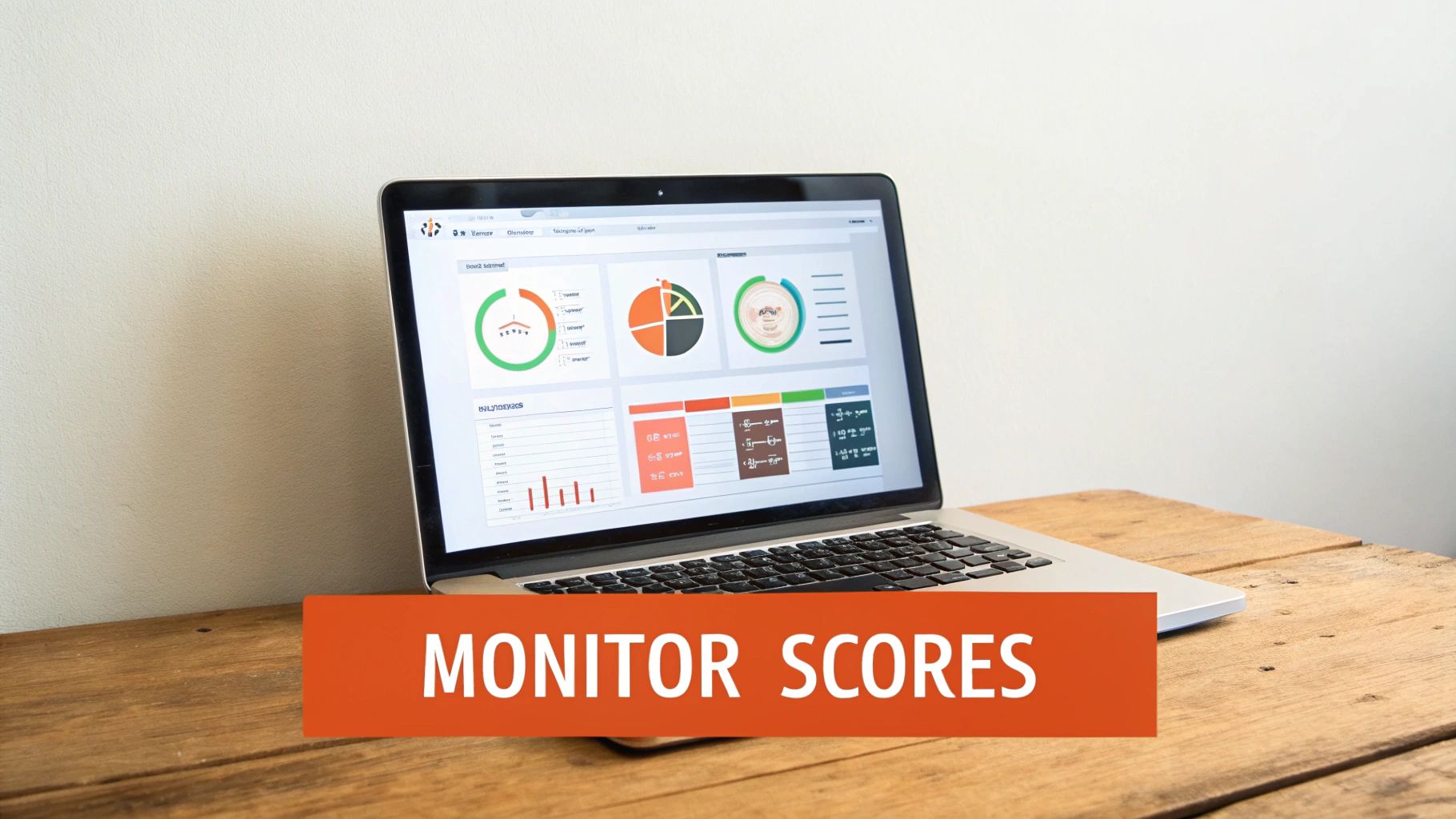
Seeing your data laid out like this makes it simple to track progress and spot competitor weaknesses.
The trick isn't to fixate on one number. It's about using these tools together to get a well-rounded view of your site's authority. Figuring out why your site looks stronger in Moz than in Ahrefs can lead to powerful strategic insights.
Ultimately, you are looking for a steady, upward trend across the board. Using the best AI rank tracker tools alongside DA monitoring gives you a complete picture of your performance. This holistic view ensures you're tracking the metrics that genuinely matter for growth.
Thinking Beyond the Domain Authority Score
Chasing a higher Domain Authority score is a good goal, but see it for what it is: a compass, not the destination. Use DA to benchmark your site's strength against competitors, not as an absolute measure of your ranking power.
A common mistake is thinking a higher DA automatically means higher rankings. It doesn't. Google’s algorithm prioritizes relevance and expertise. A single, perfectly crafted page that answers a user's question better than anyone else can outrank a competitor from a site with a much higher DA.
At the end of the day, relevance and user experience are what truly move the needle.
Broadening Your View of Authority
To get a well-rounded picture of your site's authority, look beyond a single score. It's smart to consult complementary metrics from other platforms. For instance, Ahrefs offers its Domain Rating (DR), which gives you another angle on your backlink profile's strength.
No single number tells the whole story. Using multiple tools provides a more balanced and reliable perspective.
The key takeaway? A solid SEO strategy always puts the user first. Metrics like DA are useful guides, but they are a distant second to creating helpful content that people want to read.
It's also worth remembering that DA reflects your site's entire history, including domain age and past spam scores. This historical context helps forecast performance by showing how past actions have shaped a domain's current ranking potential. You can find more on DA and its historical context on copypress.com.
Ultimately, these scores are tools to inform your strategy, not dictate it. Focus on building a fundamentally strong website by earning the different types of links that create a healthy, authoritative, and trustworthy backlink profile.
Answering Your Top Questions About Domain Authority
Let's clear up some of the most common questions about Domain Authority.
How Long Does It Really Take to Improve My DA?
Patience is key. Boosting your DA isn't a quick win; it's a long-term play. You're typically looking at six months to over a year of dedicated SEO work to see a meaningful jump in your score.
This timeframe makes sense because DA is built on earning legitimate backlinks and consistently publishing expert content. It’s also a logarithmic scale, meaning it gets much harder to climb higher. Going from a DA of 10 to 20 is far easier than going from 60 to 70.
Think of it like building a reputation in the real world. You don't become an expert overnight. It's the result of months or years of consistent, trustworthy work. Your DA score reflects that same accumulated credibility.
So, What's a "Good" Domain Authority Score?
This is a trick question because a "good" DA is entirely relative. Don't chase an arbitrary number like 50 or 60. What really matters is how your score compares to the sites you're actually competing against.
First, identify the top-ranking sites for your target keywords and check their DA scores. Your goal is to get into their ballpark. If they all have a DA around 45, that's your target. Surpassing them gives you a genuine competitive edge.
Can I Just Buy Links to Boost My DA?
Technically, you can, but you absolutely shouldn't. Buying links is a shortcut that violates Google's guidelines and is a surefire way to get your site penalized or even de-indexed. The risk is not worth it.
Furthermore, Moz's own Spam Score is designed to detect these shady tactics. Buying links from low-quality networks won't just fail to help—it could actively hurt your DA score. Real, sustainable authority comes from earning links because your content is genuinely valuable, not because you paid for them.
Ready to stop guessing and start building real authority? BlazeHive uses AI to find perfect backlink opportunities for you, automating the hardest part of SEO. Ditch the manual outreach and see how our intelligent marketplace can accelerate your site's growth. Get started with BlazeHive today.