A Guide to Link Exchange in SEO: Risks, Rewards, and Best Practices

A link exchange in SEO is a simple concept: you link to my website, and I link back to yours. This practice, also called reciprocal linking, was a foundational SEO tactic. While the idea is old, the modern approach is entirely different. Today, success isn't about the number of links; it's about relevance, trust, and providing real value.
What Is Link Exchange in SEO?
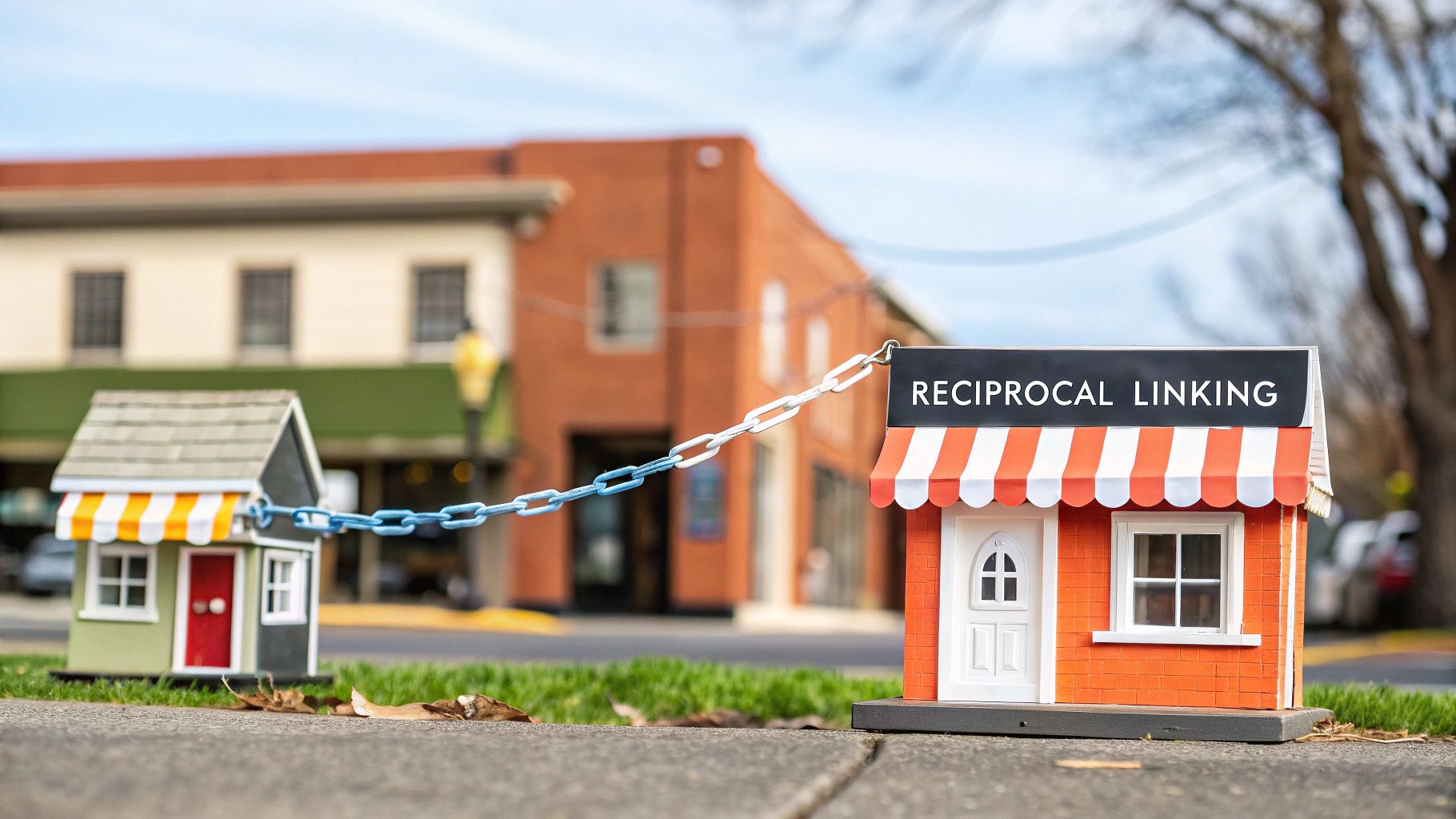
Imagine a boutique bakery next to a coffee shop. The baker tells customers, "You have to try the espresso next door," and the barista suggests, "A croissant from the bakery would be perfect with this latte."
This partnership is natural and helpful. A good link exchange feels the same. In its basic form, Website A links to Website B, and Website B links back. In the early days of the internet, this was a primary way to signal importance to search engines. More links meant more perceived authority.
The Shift From Quantity To Quality
This simple system was quickly abused. People traded links with anyone, regardless of relevance, creating massive, spammy networks just to inflate backlink counts. This "quantity over quality" approach led to a poor user experience, as people clicked links expecting useful information but found something completely unrelated.
To understand why this was a problem, you need to know what backlinks are and why they matter for SEO. As search engines like Google became more sophisticated, they penalized sites participating in these manipulative schemes, forcing the industry to adapt.
Today, the intent behind a link is crucial. A safe and effective link exchange is a partnership that genuinely helps the reader. A modern, Google-friendly exchange has three key features:
- Topical Relevance: Both websites serve a similar niche or audience.
- Editorial Value: The link fits naturally within the content, adding context or pointing to a useful resource.
- Mutual Benefit: The exchange improves the user experience on both sites.
Reciprocal linking has evolved from a spammy, high-volume tactic to a strategic practice. The question is no longer "How many links can I get?" but "Does this link actually help my audience?"
How Google Views Reciprocal Linking Today

The game changed for link exchange in SEO in 2012 with Google's Penguin update. Penguin was Google’s direct assault on reciprocal linking abuse, designed to penalize sites with manipulative backlink profiles. This update ended the era of automated link farms and indiscriminate link swapping. The focus shifted from quantity to quality, forcing SEOs to rethink what a valuable link partnership looks like.
Today, Google's guidelines warn against "excessive link exchanges" created solely to game the system. The key differentiator is intent.
The Fine Line Between Partnership and Penalty
Where does Google draw the line? It comes down to whether a link is editorially placed and genuinely helps the reader. A natural exchange between two relevant sites can be a legitimate partnership. An artificial one is a red flag.
To stay on Google’s good side, ask why a link exists:
- Natural Link: Linking to a partner’s detailed guide to support a point you’re making. This serves your reader and is seen positively.
- Manipulative Link: A generic "Partners" page with dozens of links to unrelated websites. This offers no user value and signals a link scheme.
This focus on intent means a thoughtful link exchange in SEO can still be a safe and effective strategy. Despite the risks, it remains a common practice.
The core principle is simple: If a link serves your audience, it's likely safe. If its only purpose is to manipulate rankings, you're in risky territory.
Interestingly, many SEO professionals still use this tactic. A 2025 survey found that 51.6% of link builders use link exchanges as part of their strategy. This statistic, detailed in the full report by SearchAtlas, shows that when handled carefully, reciprocal links are still considered a valuable tool.
Ultimately, Google wants to reward user-centric websites. A link exchange that improves your content and directs visitors to helpful resources aligns with that goal. An exchange that feels forced or irrelevant signals an attempt to manipulate rankings—and that's exactly what Google's algorithms penalize.
The Risks and Rewards of Link Exchanges
A link exchange is a strategic alliance. Done right, everyone benefits. Done wrong, the consequences can be costly and set your site back significantly. A poorly executed exchange is a gamble that risks a Google penalty, while a strategic one can boost your authority and traffic.
The Dangers of a Poorly Executed Exchange
The biggest risk is a Google penalty. Swapping links with irrelevant, low-quality, or spammy sites can trigger an algorithmic penalty or a manual action from a human reviewer.
The consequences are severe:
- Sudden Traffic Drops: A penalty can cause your organic traffic and rankings to disappear overnight.
- Domain Authority Decline: Linking to untrustworthy sites erodes your own credibility and authority scores through guilt by association.
- Damaged [Backlink Profile](/tools/free-backlink-checker/): A few toxic links can harm your entire backlink portfolio, making it difficult to rank. It's crucial to understand what a backlink profile is and how to maintain its health.
The danger isn't just that a bad link exchange won't work; it's that it can actively harm your website. A single poor partnership can erase your progress.
The Upside of a Strategic Partnership
When approached as a genuine partnership, a link exchange becomes a powerful growth tool. The benefits go beyond a single backlink, creating a positive ripple effect. A successful exchange is about relevance and mutual value, not just a simple trade.
Data supports this. One study found that nearly 50% of pages ranking #1 on Google have reciprocal links. This statistic, along with other link building statistics, shows that natural, editorially sound exchanges are a normal part of the web.
A smart link exchange strategy delivers tangible results:
- Increased Authority: A link from a respected site in your niche acts as a powerful endorsement, signaling trust to search engines.
- Quality Referral Traffic: A well-placed link can send highly interested visitors to your site.
- Stronger Industry Relationships: A good exchange can lead to other collaborations, like guest posts, webinars, or co-branded content.
Comparing Safe and Risky Link Exchanges
This table highlights the difference between a good partnership and a risky scheme, helping you spot the red flags.
| Characteristic | Safe Link Exchange | Risky Link Exchange |
|---|---|---|
| Primary Goal | Provide value to the reader | Manipulate search rankings |
| Site Relevance | High; sites are in the same or a related niche | Low or none; sites are completely unrelated |
| Link Placement | Editorially within relevant, high-quality content | On a dedicated "links page" or in the footer/sidebar |
| Scale | Selective and deliberate; a few quality partners | Large-scale and automated; part of a link farm |
| Relationship | A genuine partnership with communication | Purely transactional; often automated or outsourced |
| Value Proposition | Mutual benefit for both audiences and websites | "I'll link to you if you link to me," with no other value |
The safe path always prioritizes the user experience. If a link adds real value for the reader, Google will likely view it as a positive signal.
How to Build Safe and Effective Link Partnerships
A good link partnership is a strategic alliance, not a quick transaction. Success depends on quality, relevance, and the value you provide your audience. When done right, you minimize risk and turn a link swap into a growth engine.
Start by finding the right partners—websites that are a natural fit for your topic and create excellent content. Once you have a shortlist, the vetting process is critical. Dive into their website's domain authority, traffic, and backlink profile. A site with a clean, authoritative history is a green light; one with spammy links is a major red flag.
A Repeatable Framework for Success
Follow a consistent framework to ensure every exchange supports your long-term SEO goals. This process acts as a quality filter. As you build these relationships, stay current on the importance of backlink quality to maintain high standards.
Here is a simple, five-step process:
- Strategic Partner Identification: Use search operators and SEO tools to find relevant websites with an engaged audience.
- Thorough Vetting Process: Analyze each potential partner’s domain authority, organic traffic, and backlink profile. Prioritize quality over quantity.
- Personalized Outreach: Avoid templates. Write a unique email proposing a genuine collaboration and highlighting mutual benefits.
- Natural Link Placement: Ensure any link—given or received—is placed naturally within high-quality content where it adds value for the reader.
- Ongoing Monitoring: Periodically check that your links are still live and your partner's site continues to meet your quality standards.
This infographic illustrates the decision-making process for a potential link exchange.
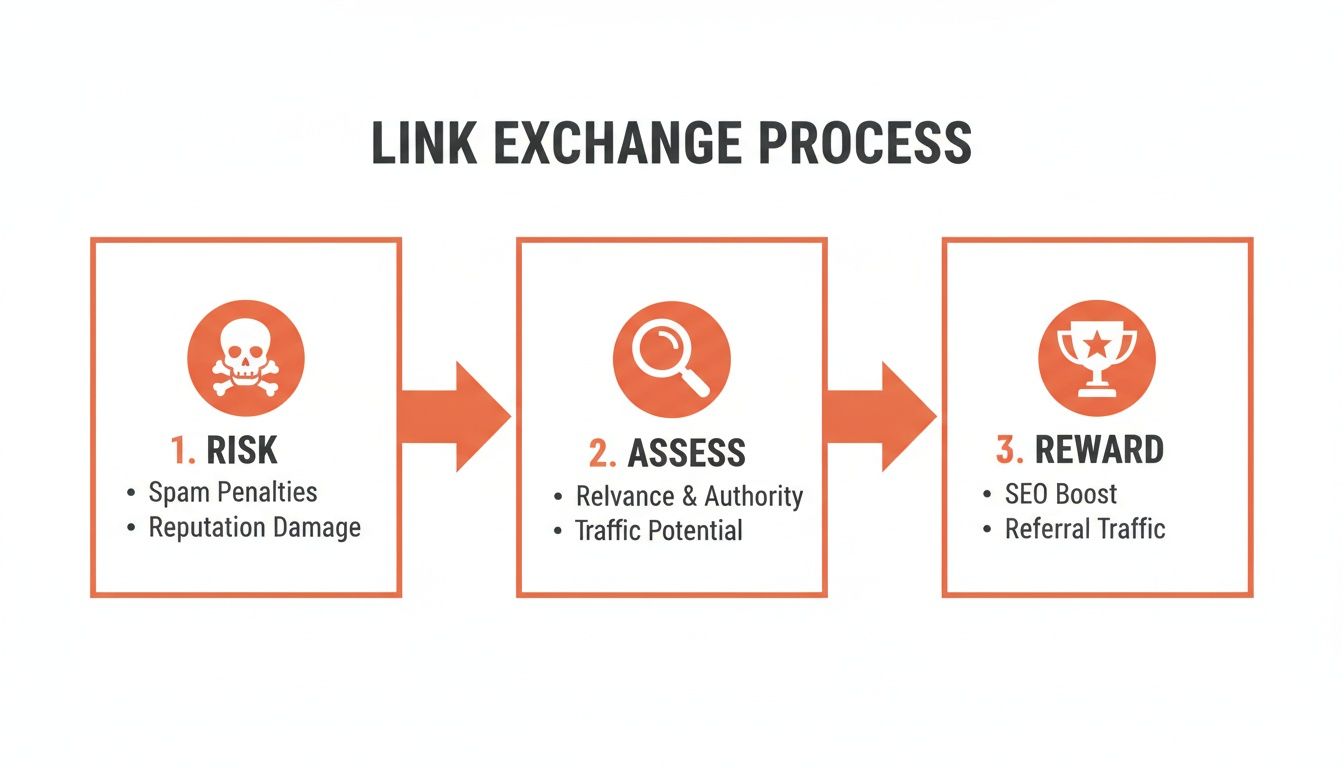
It provides a visual guide to evaluating risk, assessing partner quality, and reaping the rewards of a smart collaboration.
Prioritizing Quality in Modern SEO
The days of old-school link building are over. The SEO industry has shifted from a quantity-first mindset to a focus on genuine quality. Today, a staggering 93.8% of link builders prioritize superior backlinks over sheer volume.
This marks a significant change from the pre-2012 era, reflecting a deeper understanding of how search algorithms reward authority and trust. It’s no longer about how many links you have, but where they come from.
Exploring Modern Link Exchange Alternatives
Direct 1-to-1 link exchanges can appear unnatural to search engine algorithms. The classic "you link to me, I link to you" pattern is often too obvious and still carries risk. Consequently, SEOs have developed safer alternatives that create a more natural link-building environment.
These modern approaches break the direct, two-way connection that algorithms are trained to spot, making the process look less like a transaction and more like participation in a broader community.
The Rise of 3-Way Link Exchanges
One popular alternative is the 3-way link exchange. This method involves a third website to create a non-reciprocal loop.
Here's how it works:
- Site A links to Site B.
- Site B links to a different site, Site C.
- Site C links back to Site A, closing the loop.
This triangular structure means no one is directly linking back to the site that linked to them. To an algorithm, each link appears as a one-way endorsement, which is more editorially sound and less manipulative. It effectively masks the reciprocal agreement, lowering the risk associated with a simple link exchange in SEO.
A 3-way exchange replaces the obvious ABA pattern (A links to B, B links to A) with an ABC pattern (A to B, B to C, C to A), which is much harder for automated systems to flag as a scheme.
AI-Powered Marketplaces and Credit-Based Systems
Modern link-building marketplaces now use AI and credit-based systems, creating an economy for backlinks that removes the need for direct trades.
Here's the concept: you earn credits by placing a quality link on your site for another member. You can then "spend" those credits to get a link from a different website in the network. AI handles the matchmaking, ensuring all links are placed on topically relevant sites to maintain quality.
This model offers significant advantages:
- No Direct Reciprocity: You never link back to the site that linked to you, which is the safest approach.
- Scalability: It's a faster way to acquire links without negotiating every swap.
- Quality Control: Reputable platforms vet their members, ensuring you work with high-quality sites. This is ideal for tactics like niche edit links, where relevance is key.
A credit system separates the act of giving a link from receiving one. This adds a layer of separation that makes the process appear more organic, offering a scalable and lower-risk way to build authority.
A Simple Checklist for Vetting Link Partners
When considering a link exchange in SEO, discipline is essential. Always prioritize quality over quantity. Before reaching out, run potential partners through this quick vetting checklist to ensure they will boost your authority, not harm it. A few minutes of due diligence can prevent a major SEO headache later.
Foundational Quality Checks
Start by assessing the site's overall health and relevance. These initial checks will help you filter out unsuitable candidates quickly.
- Topical Alignment: Is their website in a similar or complementary niche? A link from an unrelated site offers little value and looks manipulative.
- Content Quality: Review their articles. Is the content expert-level and helpful? Avoid sites with thin, poorly written, or AI-spun posts.
- Website Professionalism: Does the site look credible and well-maintained? A professional design and good user experience signal a commitment to quality.
The golden rule is to prioritize editorial value. If a link doesn't genuinely help a reader by providing more context or a useful resource, it’s not worth pursuing.
Finally, analyze their backlink data. Understanding what a referring domain is helps you see who links to them. A clean link profile is a green light; a spammy one is a clear signal to walk away.
Frequently Asked Questions About Link Exchanges
Still have questions about how link exchanges fit into a modern SEO strategy? Here are answers to a few common queries.
Is a Link Exchange Still a Valid SEO Strategy?
Yes, but with a major caveat. A link exchange is only a valid strategy when done correctly. This means two high-quality, relevant websites linking to each other in a way that helps the reader. Think of it as a strategic endorsement between peers, not a transaction.
Old-school schemes with irrelevant sites are dead and penalized by Google. However, the backlink profiles of many top-ranking pages often contain reciprocal links, proving they have a place when they occur naturally within a diverse link-building strategy.
How Many Link Exchanges Are Considered Safe Per Month?
There is no magic number. Safety depends on quality and relevance, not quantity. Focus on building a few high-value partnerships over time rather than chasing a specific count.
A sudden, unnatural spike in reciprocal links is a huge red flag for search engines. A slow, steady, and intentional approach is always best. These exchanges should be part of a broader strategy that includes guest posts and digital PR.
What Is the Difference Between a Link Exchange and Guest Posting?
The main difference is the direction of the links and the nature of the agreement.
-
Link Exchange: A direct, two-way agreement. Site A links to Site B, and Site B links back to Site A.
-
Guest Posting: You write original content for another website (Site B) and include a link back to your site (Site A) within that article.
Guest posting is not inherently reciprocal. Site B gets content, and you get a link. They are not obligated to link back from one of their own articles. This one-way link is seen as more editorially natural and is generally a safer way to build authority.
Ready to build powerful, relevant backlinks without the manual outreach and risk? BlazeHive uses AI to match you with perfect link partners in your niche, making high-quality link building scalable and affordable. Stop guessing and start growing with BlazeHive.