A Practical Guide to Link Building for Ecommerce Sites

Link building is the process of getting other websites to link to your online store. Think of these backlinks as votes of confidence. They signal to search engines that your brand is credible, which boosts your authority, improves your rankings, and drives traffic that converts into sales.
Why Backlinks Drive Ecommerce Growth
For an ecommerce business, visibility is everything. You can have amazing products and a beautiful website, but if customers can't find you on Google, you're losing money. This is where a smart link building strategy becomes essential.
Every high-quality backlink you earn is a trusted voice pointing potential customers—and search engines—to your storefront.
This isn't just a theory; data backs it up. Link building remains a cornerstone of ecommerce SEO. One study found that ecommerce sites with 30 to 35 backlinks attract over 10,501 monthly visits. In contrast, sites with five or fewer backlinks get around 1,000 visits. The correlation is clear. You can explore more link building statistics to see the full impact.
Moving Beyond SEO to Business Impact
Higher rankings are great, but the real win is what they do for your bottom line. A link from a relevant, high-authority site does more than pass "link equity"—it puts your brand in front of a new, targeted audience.
Imagine a popular fashion blog links to your new dress. That's not just an SEO boost; it's a direct pipeline of referral traffic. These visitors are already interested in your products and are more likely to make a purchase. This exposure builds brand authority and trust in a way paid ads cannot replicate.
A strategic backlink is a digital referral from a trusted source. It tells search engines and customers that your store is a credible leader in its niche.
The Compounding Effect of a Strong [Backlink Profile](/tools/free-backlink-checker/)
The best part? Unlike a PPC campaign that stops when you stop paying, link building delivers compounding returns. A single great backlink can send traffic and support your rankings for years.
As you build more of these links, your entire domain authority grows. This makes it easier for all your pages to rank, from product pages to categories. It creates a powerful growth flywheel.
Here’s how it works:
- Increased Authority: More quality backlinks signal to Google that your site is a trusted resource.
- Higher Rankings: As your authority grows, your product and category pages climb the search results for valuable keywords.
- More Organic Traffic: Higher rankings lead to a steady stream of qualified visitors actively looking for what you sell.
- Greater Sales: This targeted traffic translates directly into more revenue and business growth.
Investing in link building is an investment in the long-term health of your business. You're building a durable competitive advantage that is hard for competitors to copy.
Developing Assets That Attract Links Naturally
You can't build links to a boring website. Effective link building starts with creating content and resources that people want to link to. These are called "linkable assets."
Many ecommerce stores assume their product and category pages are enough. While essential for sales, they rarely excite bloggers and journalists enough to earn a link.
The difference between a store that creates linkable assets and one that doesn't is stark.
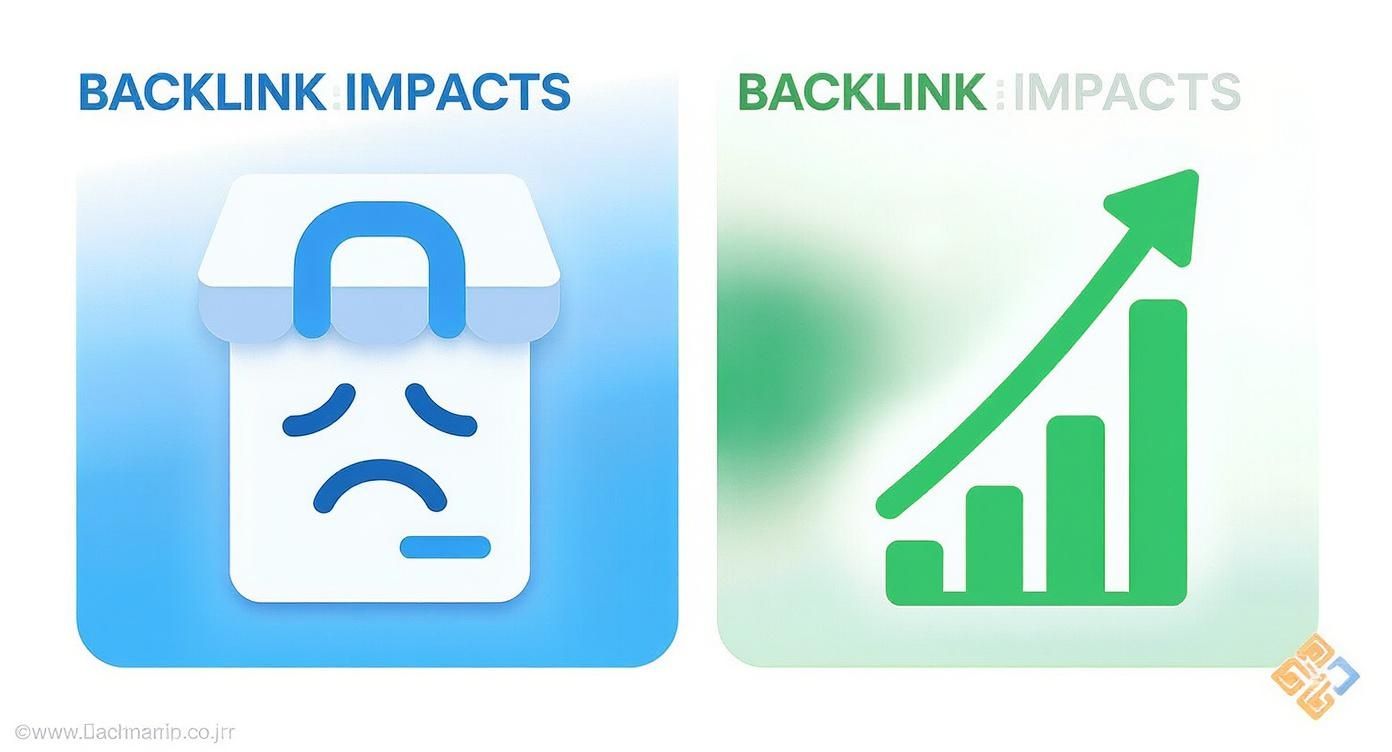
As you can see, a strong backlink profile, fueled by quality assets, directly drives traffic, authority, and growth. It's a core business driver, not a vanity metric.
Turning Core Pages Into Link-Worthy Resources
While dedicated content pieces get the most attention, don't overlook your core commercial pages. With a little effort, your product and category pages can also attract links.
Instead of just using the manufacturer's description, write detailed, insightful copy that answers every potential customer question. Go beyond basic specs to discuss real-world benefits, show different use cases, and explain what makes your product superior.
High-quality visuals are non-negotiable. Use professional photography, 360-degree views, and product-in-action videos. These elements not only boost conversions but also make your page an attractive resource for bloggers seeking visuals for their content.
Finally, user-generated content like customer reviews and Q&A sections adds social proof and constantly refreshes your page, which can earn links from forums and community discussions.
Creating Dedicated Content That Acts as a Link Magnet
This is where the real power is. The best linkable assets are created specifically to earn backlinks. They are the definitive resources that position your brand as a niche leader.
Your goal is to create something a journalist, blogger, or industry expert would be happy to reference because it improves their own work.
A great linkable asset solves a problem, answers a complex question, or presents information in a uniquely helpful way.
Here are proven content types that consistently earn high-quality links:
- In-Depth Buying Guides: Go deep. If you sell hiking gear, create "The Ultimate Guide to Choosing a Backpacking Tent." Cover materials, seasonality, weight, and brands. Make it the only guide someone needs.
- Interactive Tools: Calculators, quizzes, and configurators are highly linkable because they offer immediate, personalized value. A furniture store could offer a "Room Layout Planner," or a paint store could create a "Paint Calculator."
- Original Research & Data: This is a home run for getting links from authoritative sites. Survey your customers or analyze sales data to publish unique industry insights. A pet food company releasing a report on popular dog breeds is a perfect example.
Of course, creating the asset is only half the job. You also need to know how to make viral content to amplify its reach and link potential.
Build Your Content Hub
A smart long-term strategy is to create a resource hub or "learning center" on your site. This becomes a dedicated home for all your guides, tutorials, and data studies.
Organizing your assets into a central hub creates a powerful, authoritative section on your site. This not only helps users find your content but also creates a single, high-value URL perfect for attracting links from broad resource pages. Check out these resource page examples to see how others structure their content hubs.
Let's break down how these different strategies compare.
Comparing Linkable Asset Strategies
This table provides a quick overview of the goals, potential, and effort for different asset types.
| Asset Type | Primary Goal | Link Potential | Example |
|---|---|---|---|
| Product Pages | Conversion | Low to Medium | A product page with detailed specs, unique descriptions, and high-quality videos. |
| Category Pages | Navigation & Conversion | Low to Medium | A well-organized category page with a mini-guide on how to choose the right product. |
| Buying Guides | Education & Authority | High | "The Ultimate Guide to Cold Brew Coffee Makers," covering different types and methods. |
| Interactive Tools | Engagement & Utility | Very High | An online calculator that helps users find their ideal mattress firmness based on sleep style. |
| Original Research | PR & Authority | Very High | An annual report on "The State of Remote Work," based on proprietary survey data. |
A balanced approach is best. Enhance your commercial pages for incidental links, but invest your main effort in creating dedicated guides, tools, and data-driven content. This shifts your strategy from asking for links to offering value, which is the key to successful ecommerce link building.
Mastering Outreach and Building Real Relationships

Creating great, link-worthy content is half the battle. The other half is getting it in front of the right people. This is where outreach comes in—and it's about more than just sending mass emails.
Successful outreach is about building real connections. Stop thinking like a link requester and start acting like a valuable partner. When you approach outreach by asking "how can I provide value?" you earn better links and build a network of allies for the long term.
Identifying Your Ideal Outreach Prospects
Before you hit send, know who you’re talking to. The "spray and pray" method doesn't work; it damages your brand's reputation. Instead, build a targeted list of people who would genuinely benefit from your content.
These people usually fall into a few groups:
- Niche Bloggers & Content Creators: These are the experts in your space whose audience trusts them. A link from them is a powerful endorsement.
- Industry Publications & Journalists: A mention in an authoritative online magazine or news site can drive significant referral traffic and build credibility.
- Complementary Businesses: Think of non-competing brands that serve your exact customer. If you sell coffee beans, a blog that reviews espresso machines is a perfect match.
To find these prospects, plug your top competitors into an SEO tool like Ahrefs or Semrush to see who links to them. You can also use advanced Google searches, like "your niche" + "resource page". Always focus on quality over quantity.
Crafting a Pitch That Gets a Response
Your email is your first impression. Make it count. The difference between a reply and a deletion comes down to two things: personalization and value.
A winning pitch is never about what you want; it's about what you can give. Frame your request around how your content benefits them and their audience. Does your new guide strengthen a point in one of their articles? Do you have an infographic that would simplify their topic?
The best outreach emails are short, personal, and to the point. Show you’ve read their work by referencing a specific article, then clearly explain why your resource is a perfect fit.
For example, instead of a generic "Please link to my article," try this:
"Hi [Name], I was just reading your post on '10 Tips for Beginner Hikers' and loved your advice on choosing the right pack. My team just published a data-driven guide on how pack weight impacts trail endurance, and I thought it might be a great resource to add for your readers."
This approach shows you're a fan offering something genuinely useful, not just asking for a favor.
Three Proven Outreach Plays for Ecommerce
Mastering a few core outreach tactics can dramatically improve your success rate. Here are three go-to plays.
- Unlinked Brand Mentions: This is often the easiest link you'll ever build. Set up a Google Alert for your brand name. When you find an article that mentions your brand without a link, send a polite email. Thank them for the mention and ask if they would consider making it a clickable link.
- Guest Posting Pitches: Find relevant blogs that accept guest posts. Don't just ask "Can I write for you?" Instead, pitch 2-3 unique and compelling topic ideas tailored to their audience. This shows you’ve done your homework.
- Broken Link Building: Use a tool like Check My Links to find dead outbound links on relevant resource pages. Reach out to the site owner, inform them of the broken link (you're helping them!), and then suggest your own high-quality article as a replacement.
Each of these strategies works because it’s based on mutual benefit. When your link building for ecommerce sites focuses on providing value, it becomes a sustainable engine for growth.
Taking Your Link Building to the Next Level
Once you master the basics of content creation and outreach, it's time to level up. Advanced strategies create a competitive advantage by earning high-authority backlinks that are difficult for competitors to replicate. This is where you establish your store as a true authority.
Advanced link building moves beyond one-to-one emails. It’s about creating massive value at scale and building strategic alliances. The links you get from these efforts come from heavy hitters: news outlets, industry publications, and major brands.
Launching a Digital PR Campaign
Digital PR is one of the most powerful ways to earn top-tier links. Instead of promoting a blog post, you create a newsworthy story or data-backed resource that journalists want to cover. You stop asking for links and start becoming the source.
The key is to bring something new to the conversation, whether it's a unique angle or original data.
- Original Research & Data: Survey your customers or analyze your sales data to publish a unique industry report. A skincare brand could release a study on "The Impact of Remote Work on Skincare Routines" with fresh statistics.
- Compelling Data Visualizations: Turn complex data into a sleek infographic or interactive map. An outdoor gear company could create a map visualizing the most popular hiking trails using social media data.
- Expert Commentary: Position your founder as a go-to source for industry commentary. When a relevant news story breaks, you can quickly pitch your expert's take to journalists on a deadline.
These campaigns require more work, but the payoff is enormous: links from places like Forbes, local news stations, and major industry blogs that are nearly impossible to get through cold outreach.
Forging Strategic Brand Partnerships
Some of the most powerful link opportunities come from collaboration. Partnering with non-competing brands that serve the same audience is a fantastic way to create mutual value and earn high-quality backlinks. It’s about co-creating something useful.
Imagine an online coffee bean store teaming up with a company that sells espresso machines. They could co-author "The Ultimate Guide to Brewing Barista-Level Espresso at Home," with each brand contributing its expertise.
The guide could live on one brand's site, and the partner would promote it to their audience, linking back to it as the definitive resource. Both businesses get exposure to a new, aligned audience, and the link appears completely natural.
Strategic partnerships are a true win-win. You tap into a new audience and get a high-quality backlink, while your partner provides their community with valuable content they didn't have to create.
The Art of the Niche Edit
Another advanced tactic is securing niche edits, also known as curated link insertions. This involves finding a relevant, established article and persuading the author to add a link to your content within the existing text. The idea is that your link adds critical value that was previously missing.
For example, if you find a popular post on "Must-Have Gadgets for Your Home Office" and you sell a top-tier ergonomic chair, you could suggest they add a link to your product page when they discuss seating.
To be successful and ethical, the link you suggest must genuinely improve the article. Forcing an irrelevant link won't work. To learn more about executing this strategy correctly, our guide on what niche edit links are offers a deeper dive. The golden rule is to always frame your request around making the original article better for its readers.
How to Measure Your Link Building ROI
Link building is a serious investment. If you're not tracking its impact, you're flying blind. To justify the budget and refine your strategy, you must focus on the business metrics that matter.
Tracking ROI isn't about one perfect number. It's about combining key metrics that tell the story of your campaign's success. This approach transforms link building from an expense into a predictable growth engine.
Key Metrics for Your Performance Dashboard
You don't need complex software to start. A simple spreadsheet or your SEO tool's dashboard is enough. The goal is to connect your link-building activities to real-world results.
Here are the core metrics to watch:
- Domain Authority (DA) or Domain Rating (DR) Growth: While third-party metrics, a steady rise in your DA/DR is a good early indicator of growing authority.
- Keyword Ranking Improvements: Track a list of high-intent keywords for your key pages. Are they climbing the search results? That's your link equity at work.
- Increase in Referring Domains: The number of unique websites linking to you is critical. Ten links from one site is good, but one link from ten new, relevant sites is better. Learn what a referring domain is to understand why diversity matters.
- Growth in Organic Traffic: In Google Analytics, is your organic search traffic growing? This is the clearest sign your increased authority is paying off.
- Referral Traffic Volume: Check how many visitors click through from the sites linking to you.
- Organic Sales & Revenue: This is the ultimate proof. Is the revenue from your organic search channel increasing? Connecting efforts to sales secures future budgets.
Real-World ROI From Systematic Link Building
A consistent strategy delivers massive results. Consider an apparel brand that committed to a systematic link-building plan. By pursuing guest posts and unlinked brand mentions, their Domain Authority jumped from 28 to 45 in one year.
This authority boost directly impacted their visibility. The number of keywords they ranked for on the first three pages of Google increased from 1,038 to 2,101.
But what really matters is the revenue. Their estimated monthly traffic value exploded from $1,608 to $8,824—a 548% increase.
True link building ROI is measured not in the number of links, but in the measurable lift in organic rankings, traffic, and sales. It's about connecting outreach efforts to the cash register.
To monitor your brand's overall visibility and campaign impact, consider tools for ecommerce brand monitoring with AI. Consistently tracking these KPIs will prove the value of your work and help you make smarter decisions to scale your success.
Common Link Building Questions
Even with a solid plan, a few practical questions always come up. Getting these right from the start helps you set expectations and focus on what drives results.
How Many Backlinks Do I Need to Rank?
There’s no magic number. The answer depends on your competition.
Use an SEO tool to analyze the top-ranking pages for your target keywords. Look at the number of referring domains (unique websites) linking to them. This provides a data-backed benchmark to aim for.
But remember, a single powerful link from a major industry site is worth more than 100 weak links from unrelated blogs. For ecommerce link building, quality and relevance always trump quantity.
Dofollow vs. Nofollow: Which Links Matter?
Understanding this difference is crucial.
-
Dofollow links are your priority. They act as a vote of confidence, passing authority ("link equity") from one site to another, which directly improves your search rankings.
-
Nofollow links have a tag that tells search engines not to count them as an endorsement.
Always prioritize building dofollow links. However, nofollow links aren't useless. They can drive significant referral traffic and are great for brand visibility. A natural backlink profile will always have a mix of both.
Think of it this way: Dofollow links are endorsements that boost your authority. Nofollow links are brand mentions that can still drive sales. Both have a role.
How Long Until I See Results?
Link building is a long-term strategy—a marathon, not a sprint. While a link from a major news site might cause a traffic spike, the lasting SEO benefits take time to appear.
Generally, you can expect to see positive movement in keyword rankings and organic traffic within 3 to 6 months of consistent, high-quality effort. The impact is cumulative; the more authority you build, the stronger and faster the compounding effect becomes.
Ready to stop guessing and start building backlinks that drive real growth? BlazeHive uses intelligent AI to automate your link building, connecting you with relevant partners in your niche. Learn more and get your first backlink at blazehive.io.