How to Build Backlinks for Ecommerce: Actionable Strategies to Boost Revenue

Building backlinks for an ecommerce store boils down to one idea: create something valuable that other websites want to link to. This isn't about spammy tactics or buying links. It’s about creating unique content, building real relationships, and getting credit for your brand online. A successful campaign earns high-quality, relevant links that drive both rankings and revenue.
Why Quality Backlinks Are Your Ecommerce Superpower
The ecommerce world is crowded. A great product isn’t enough; the right people need to see it. Backlinks act as powerful, digital word-of-mouth recommendations that make this happen.
Every time a reputable website links to your store, it sends a vote of confidence to search engines like Google. This signal tells them your store is credible and useful. For an online store, these signals translate directly into real-world results.
The Tangible Impact of a Strong [Backlink Profile](/tools/free-backlink-checker/)
A healthy backlink profile is a core driver of sustainable growth. It builds your brand’s reputation and funnels targeted traffic directly to your pages. The benefits are clear and measurable:
- Higher Search Rankings: Pages with more quality backlinks tend to rank higher. Top-ranking pages on Google often have 3.8 times more backlinks than those in positions 2-10.
- Greater Brand Authority and Trust: When established sites in your niche link to you, it builds credibility. That trust is essential for turning a first-time visitor into a paying customer.
- Qualified Referral Traffic: A link from a popular home decor blog to your sustainable bedding line sends shoppers who are already interested in what you sell, making them more likely to convert.
Mastering backlinks is a crucial part of mastering organic search engine optimisation.
Here’s how I think about it: Each quality backlink is a vote of confidence. The more votes you get from authoritative sources, the more Google trusts your store and rewards you with better visibility for your most valuable keywords.
Learning how to build backlinks for your ecommerce store isn't just a technical SEO chore—it's a fundamental marketing strategy. It's about forging genuine connections and creating a competitive edge that pays off long-term.
Building a Link-Worthy Ecommerce Foundation
Before you ask for backlinks, you need to earn them. That starts with building an ecommerce store that other websites actually want to link to. Your store needs a rock-solid foundation before you can start asking for those powerful "votes of confidence" from other sites.
Is Your Site Technically Ready for Links?
Nobody wants to send their audience to a slow, clunky, or insecure website. These technical issues are dealbreakers that make your store a poor link target. Before starting a link building campaign, get these basics right.
A fast-loading website is table stakes. A slow site looks unprofessional and untrustworthy. Your store also has to be flawless on mobile, as Google’s mobile-first indexing judges your site based on its mobile version. Finally, your site must use HTTPS. An SSL certificate is the bare minimum for any online store, signaling security to both people and search engines.
Use this checklist to ensure your site is an attractive destination for users and potential link partners.
Essential Link Building Readiness Checklist
| Area | Checklist Item | Why It Matters for Links |
|---|---|---|
| Performance | Site loads in under 3 seconds | A slow site is a poor user experience, making it an unappealing link target. |
| Mobile | Passes Google's Mobile-Friendly Test | With mobile-first indexing, a poor mobile site hurts rankings and discourages links. |
| Security | Active SSL certificate (HTTPS) | Essential for trust and credibility, especially for an ecommerce store. |
| Architecture | Clean, logical URL structure | Simple URLs are easier to understand, share, and link to. |
| On-Page SEO | Unique, compelling meta titles & descriptions | These act as the "ad" for your page in search results, encouraging clicks. |
| User Experience | Intuitive navigation and site search | A site that's easy to use is one people are happy to link to and recommend. |
Checking these boxes ensures that when you earn a link, the traffic it sends has the best possible experience, maximizing your return on effort.
Creating Your Linkable Assets
Once the technicals are solid, create content that people want to link to. These "linkable assets" are the core of any good link building strategy. While product pages are important, they rarely attract many high-quality links on their own. You need to offer more.
Here are asset types that consistently work for ecommerce stores:
- Deep-Dive Guides and How-To's: If you sell telescopes, a guide like "The Ultimate Guide to Choosing Your First Telescope" becomes a go-to resource. Hobbyist bloggers and astronomy forums love to link to content that provides genuine value.
- Interactive Tools and Calculators: A gift finder, a skincare routine builder, or a bike frame size calculator can be incredibly powerful. These tools solve a real problem, making them highly shareable.
- Original Research and Unique Data: If you sell coffee beans, survey customers about their favorite brewing methods and publish the findings. Journalists and bloggers are always looking for fresh data to cite, making this a great way to earn links from authoritative sites.
The big idea here is to think beyond just selling. Create resources that serve your audience's broader interests and solve their problems. That’s how you shift from being just another online store to an industry authority that people are excited to link to.
For a more detailed guide on getting your store in shape, this ultimate ecommerce SEO checklist is an excellent resource.
Uncover Gold by Spying on Your Competitors
One of the smartest shortcuts is to see what’s already working for your competition. Analyzing their backlink profile reveals a treasure trove of link opportunities. This isn’t about copying them—it’s about reverse-engineering their success.
Using a tool like Ahrefs, Semrush, or Moz, enter a competitor’s domain to get a list of sites linking to them. This gives you a ready-made roadmap of relevant blogs, publications, and resource pages in your niche.
When you analyze their links, you'll see patterns. Perhaps they get links from product roundups, guest posts, or local news features. Every link they've earned is a potential opportunity for you. Understanding their strategy is a critical step in building your own backlink profile and mapping out your path to success.
Time to Build: Actionable Link Building Tactics for Online Stores
You've laid the groundwork. Your site is technically sound, and you have link-worthy content ready. Now, it's time to actively build the high-quality backlinks that boost traffic, authority, and sales. These are proven tactics that work specifically for e-commerce.
The process we're about to dive into assumes you've handled the essentials: optimizing your site, creating great content, and analyzing the competition.
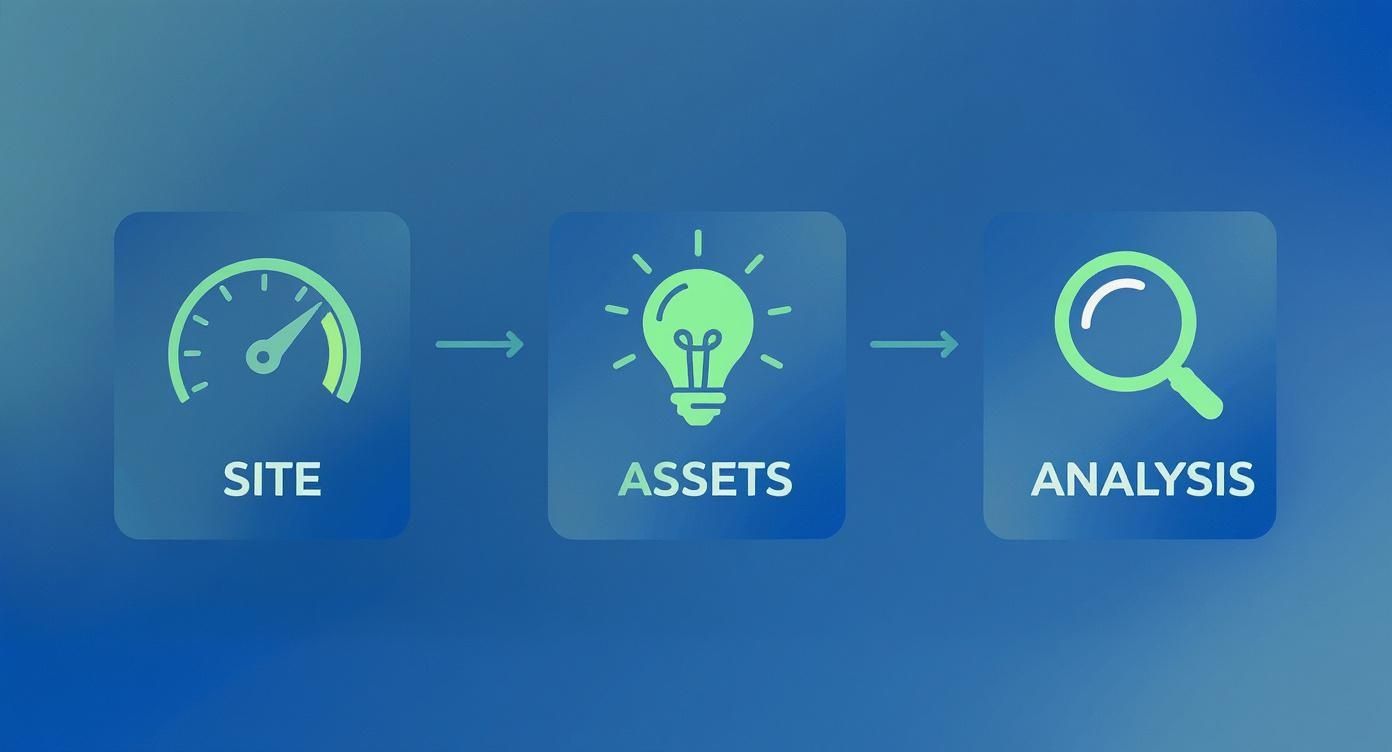
Successful link building isn't a single action. It's a sequence of smart moves where each step makes the next one more effective, giving people a compelling reason to link to your store.
Find and Reclaim Your Unlinked Brand Mentions
This is the lowest-hanging fruit in link building. Unlinked brand mentions are when a website talks about your brand or product but doesn't link to you. Your job is to find these mentions and simply ask for the link.
You've already earned the mention; the author knows and likes your brand. A gentle nudge is often all it takes to turn it into a valuable backlink.
Use tools like Google Alerts or Ahrefs to find these opportunities. Set up alerts for your brand name and unique product names. When you find a mention without a link, send a friendly email to the site owner.
My Go-To Tip: Keep your request short, sweet, and helpful. Frame it as a benefit to their readers. I’ve had great success with, "Hey, I saw you mentioned [Your Brand] in your article! To make it easier for your audience to find us, would you mind adding a link?" It works surprisingly well.
Get Your Products into Roundups and Resource Pages
For any ecommerce store, product roundups and "best of" lists are gold. Articles like "10 Best Running Shoes for Beginners" or "The Ultimate Gift Guide for Coffee Lovers" are built to link to products. Getting featured means a relevant backlink and a direct pipeline of interested shoppers.
Search for lists in your niche using queries like:
- "best [your product type]"
- "top [your product category] of 2025"
- "[your niche] gift guide"
- "[your keyword] + resources"
Once you have a list of prospects, find the author or editor's contact info. Your pitch should be concise: explain why your product is a perfect fit for their article. What makes it stand out? Is it more sustainable, a better value, or does it have a unique feature? Make their job easy by providing a link, a short description, and a high-quality image.
Launch a Creative Digital PR Campaign
Digital PR involves creating something so newsworthy or useful that journalists and top-tier bloggers want to write about it and link to you. This strategy takes more creativity, but the payoff can be massive, landing you links from major publications.
For an online store, this could be:
- An Original Data Study: If you sell pet supplies, survey 1,000 dog owners on their spending habits and publish the results. That unique data becomes a source pet bloggers and news outlets will reference.
- A Creative Project: A sustainable clothing brand could create an interactive map visualizing the environmental cost of fast fashion. Environmental and style blogs would love it.
- A Newsworthy Angle: Launch a unique contest or a product tied to a trending social issue. The right story can attract a wave of media attention and powerful backlinks.
The goal isn't just to sell a product; it's to create a story. These creative campaigns become your link building engine, attracting authority you can then pass to key commercial pages through smart internal linking.
Forge Strategic Brand Partnerships
Collaborating with non-competing brands that share your audience is a fantastic way to build links. It’s a win-win where both businesses get exposure and a high-value backlink.
For example, if you sell artisanal cheese, partnering with a winery is a no-brainer. You could co-create a blog post on "The Perfect Wine and Cheese Pairings," with each of you linking to the other's relevant product pages. It's useful content for both audiences and a natural linking opportunity.
Find the right partners by looking for complementary businesses. A company selling hiking boots could team up with a national park guide service. A store selling baby clothes could collaborate with a popular parenting blogger. The possibilities are endless.
Real-World Impact: Recent 2025 case studies show apparel stores boosting their domain authority from 28 to 45 in a single year using a mix of guest posting, media features, and brand mention reclamation. In another case, a toy retailer generated over 300 backlinks from 150 websites in under 12 months by combining digital PR, blogger contests, and resource page features. These are the results of a deliberate, value-driven system.
Crafting Outreach That Actually Gets a Response
A brilliant link building strategy is useless if your outreach emails are ignored. Your success depends on writing a pitch that makes a busy editor stop, read, and reply.
Most outreach is generic, self-serving, and quickly deleted. To stand out, focus on personalization, genuine value, and building a real connection from the start.
The Anatomy of a Winning Pitch
A great outreach email is short and sharp. It respects the other person's time while making your value clear. Each part, from the subject line to the sign-off, has a specific job.
Every solid pitch needs:
- A Personalized Subject Line: Ditch generic titles. Use something specific like, "Question about your coffee brewing guide" or "Loved your article on sustainable travel gear." It proves you've done your homework.
- A Genuine Opening: Start with an honest compliment about their site or a specific article. It shows you’re not just sending a template.
- A Clear Value Proposition: Answer the question, "What's in it for them?" Are you offering a better resource to fix a broken link? A guest post their audience will love? Make the benefit impossible to miss.
- A Simple, Direct Ask: State exactly what you're asking for, whether it's adding your product to a roundup or placing a link in an article.
Finding the Right Person to Contact
Sending the perfect pitch to the wrong inbox is a waste of time. Your first move is to find the person who can make the change you're requesting. Avoid generic info@ addresses.
Look for a specific name and title—the content manager, site editor, or the article's author. Tools like Hunter.io or a quick LinkedIn search are your best friends. Spending an extra five minutes to find the right person can dramatically increase your response rate.
The harsh reality is that 94% of online content gets zero external links. Standard cold outreach is almost as bleak, with only 8.5% of emails ever getting a backlink. This is why a targeted, personalized approach isn't just a good idea—it's the only way to win. You can find more of these eye-opening link building statistics from recent studies.
Following Up Without Being Annoying
People are busy. Your email might get seen and then forgotten. A smart, professional follow-up is critical. Just one follow-up can dramatically boost your response rate, but there’s a fine line between persistence and being a pest.
A Simple Follow-Up Framework:
- First Follow-Up (3-5 days later): Send a brief, friendly nudge. Reply to your original email to keep the context. Something simple like, "Hi [Name], just wanted to quickly follow up on my email from last week. Let me know if you had a moment to consider it!"
- Second Follow-Up (7-10 days after the first): This is your final attempt. Re-state your value proposition concisely and make it clear this is your last message. Try, "Hi [Name], I know you're swamped. I still think our guide would be a fantastic addition for your readers. I won't bother you again, but let me know if you change your mind."
This two-step process shows you’re serious but respectful, keeping the door open for future opportunities.
How to Know if Your Link Building Is Actually Working (Measuring ROI)
Investing in link building without tracking its impact is like navigating without a map. The goal isn't just to collect backlinks; it's to see a real return through higher rankings, more traffic, and more sales.
Tracking your ROI separates a hopeful expense from a predictable growth channel. It helps you double down on what works and ditch what doesn't. This is how you justify your SEO budget and build a sustainable growth engine.
The Metrics That Matter for Link Building ROI
To get the full story, track a mix of metrics—some showing early momentum and others measuring the ultimate business impact. This table breaks down the essential metrics for your dashboard.
Key Metrics for Measuring Link Building ROI
| Metric | Tool for Tracking | What It Tells You |
|---|---|---|
| New Referring Domains | Ahrefs, Semrush, Moz | The number of unique websites linking to you. Growth here is a primary sign of a healthy campaign. |
| Domain Authority (DA/DR) | Moz (DA), Ahrefs (DR) | A big-picture score of your site's authority. A rising number shows your backlink profile is getting stronger. |
| Organic Keyword Rankings | Ahrefs, Semrush | How your target pages are ranking for valuable keywords. This is a direct measure of SEO progress. |
| Organic Traffic Growth | Google Analytics, Google Search Console | The increase in visitors from search engines. This connects your SEO work to real-world traffic. |
| Referral Traffic | Google Analytics | Visitors who click directly through your backlinks. It measures the immediate traffic-driving power of your links. |
| Conversion Rate & Revenue | Google Analytics | The bottom line—are more visitors turning into paying customers? This is the ultimate measure of success. |
These metrics are connected. An increase in referring domains should lead to better keyword rankings, which drives more organic traffic and, ultimately, more revenue.
Tying SEO Metrics to Your Bottom Line
Decision-makers care less about keyword movements and more about revenue. The key is connecting your link building efforts directly to sales.
Focus on the organic traffic to the specific pages you’re building links to. Using Google Analytics, you can create a segment for that traffic and watch its conversion rate and revenue climb.
For instance, after building links to your "Men's Winter Jackets" category page for six months, you should be able to show a clear lift in organic traffic and sales for that specific category. This makes the value of your work undeniable. Tracking the growth in new referring domains is fundamental to this process, as it drives all other improvements. We explain this concept more in our article on what is a referring domain.
The investment in link building is significant, but so are the returns. The average price for a single quality link is now around $508, reflecting its immense value. For 57.1% of SEO professionals, consistent effort shows real results within one to three months. These high-quality backlinks compound over time, creating an upward spiral of authority and traffic that can deliver a potential ROI as high as 748%.
Scaling Up: When to Bring in Reinforcements
As your store grows, a manual approach to link building won't be enough. To maintain momentum, you'll need to scale. This leads to a choice: hire an in-house expert or partner with an agency?
-
Hiring In-House: An in-house SEO specialist is fully immersed in your brand, leading to highly creative and on-brand campaigns. This is a great move if link building is a long-term, central part of your marketing strategy.
-
Partnering with an Agency: A specialized link building agency hits the ground running with proven processes, media relationships, and a team of experts. They can scale campaigns much faster and provide access to expensive tools and data.
The right path depends on your budget, goals, and existing resources. An agency can be an accelerator if you're just starting, while an in-house expert is a logical next step once you have a solid foundation.
Answering Your Top Ecommerce Link Building Questions
Even with a solid plan, questions will come up. Here are answers to a few of the most common ones from ecommerce store owners.
How Many Backlinks Do I Actually Need?
There's no magic number. The goal is to build a steady stream of high-quality, relevant links from diverse, authoritative sites. Quality always trumps quantity.
A better approach is to analyze your competition. Look at the backlink profiles of the stores ranking on page one for your target keywords. This isn't about matching them link-for-link; it's about understanding the level of authority required to compete. Your goal should be to build a stronger and more diverse profile over time.
One link from a major industry publication that sends you customers is worth more than a hundred spammy links. Focus on earning links that make a real impact, not just padding your numbers.
Is It Safe to Buy Backlinks for My Store?
In a word: no. Buying backlinks clearly violates Google's Webmaster Guidelines. While it may seem like a shortcut, it’s a massive gamble with your business.
The penalties are severe. Your rankings could plummet, or your entire store could be de-indexed from Google. Search engine algorithms are very good at spotting unnatural link schemes. The long-term risk to your brand and revenue isn't worth it.
It’s far better to invest your budget in earning links the right way.
Which Pages Should I Build Links To?
A common mistake is pointing every link to the homepage. While your homepage will attract links naturally, an ecommerce store requires a more strategic approach to build authority to the pages that make you money.
A healthy link building strategy spreads links across your site:
- Category Pages: These are your SEO powerhouses. Building links directly to main category pages (like "Women's Running Shoes") is crucial for ranking for high-value commercial keywords.
- Product Pages: Getting links to product pages is harder, but the payoff is huge. A link from a genuine product review or a "Best Of" list sends traffic that is ready to buy.
- Blog Posts & Guides: These are your "link magnets." It’s far easier to get a link to a helpful guide than a product page. Once you earn that link, you can pass authority to your key product and category pages through internal linking.
By balancing your efforts, you lift the authority of your entire site and, most importantly, the pages that directly impact your bottom line.
Ready to stop the manual grind and automate your link building? BlazeHive uses AI to find perfect, niche-relevant backlink opportunities for your store, saving you time and money while building your site's authority. See how it works at BlazeHive.