Ecommerce Link Building: Proven Tactics to Boost Rankings and Revenue

Ecommerce link building is the process of getting links from other websites to your online store. Think of these links as digital votes of confidence. They signal to search engines like Google that your store is a credible, authoritative source, which is vital for ranking higher and driving more sales.
Why Backlinks Drive Ecommerce Growth
For an online store, a smart link building strategy is a direct engine for growth. Each quality backlink acts as a referral. When a respected site links to your product page, it tells search engines your store is a go-to destination for that item. This directly impacts your ability to outrank competitors for valuable, high-intent keywords.
The collection of all links pointing to your site is called your [backlink profile](/tools/free-backlink-checker/). A strong, relevant profile is fundamental to your visibility in search results.
The Tangible Benefits of a Strong Link Profile
The connection between backlinks and search rankings is clear. Top-ranking ecommerce pages typically have 3.8 times more backlinks than pages in positions 2 through 10. This statistic alone shows why a focused link building effort is critical.
Beyond rankings, a healthy backlink profile delivers crucial business results:
- More Organic Traffic: Links from high-authority sites pass "link equity," pushing your pages higher in search results and capturing more clicks from potential customers.
- Qualified Referral Traffic: A link from a niche blog or product review site sends engaged, ready-to-buy shoppers directly to your store. This traffic often converts at a much higher rate.
- Stronger Brand Authority: When trusted sources in your industry reference your brand, you build credibility and establish your store as a market leader.
A successful link building campaign does more than improve SEO metrics; it generates real revenue by putting your products in front of the right audience at the right time.
Effective link building is a core pillar among the most effective strategies to increase website traffic organically. It creates sustainable pathways for customers to discover and trust your store.
Key Ecommerce Link Building Tactics at a Glance
| Tactic | Primary Target Page | Main Goal | Effort Level |
|---|---|---|---|
| Guest Posting | Blog/Resource Pages | Authority & Brand Exposure | Medium |
| Supplier/Partner Links | Homepage/Product Pages | Foundational Authority | Low to Medium |
| Unlinked Brand Mentions | Any Relevant Page | Link Reclamation | Low |
| Product Reviews | Product Pages | Targeted Traffic & Trust | Medium to High |
| Digital PR | Homepage/Campaign Pages | High-Authority Links | High |
| Resource Page Links | Informational Content | Link Equity & Relevance | Medium |
This table is a quick reference, but this guide provides the full roadmap. We'll cover everything from foundational audits to advanced digital PR, giving you the tools to build a powerful link profile that fuels lasting growth.
Building Your Foundation with a Smart Link Audit
Before building new links, you need a blueprint. Starting outreach without first auditing your backlink profile is like building a house on untested ground—it’s a recipe for a weak foundation. This initial analysis is the most important step in crafting a strategy that works.
A backlink audit gives you a clear snapshot of your current situation. You'll uncover hidden strengths to leverage and weaknesses that might be holding you back. It’s about knowing where you stand before deciding where to go.
Analyzing Your Current Link Profile
First, get a handle on your own backyard. Use a tool like Ahrefs or Semrush to pull a complete report of every site linking to your store. Your goal is to assess quality, not just quantity.
As you analyze the data, ask these critical questions:
- Authority Score: What is the Domain Rating (DR) or Domain Authority (DA) of the linking sites? A profile filled with links from sites with a DR under 20 is a sign of weakness.
- Relevance: Do these links make sense? A link from a major fashion blog is gold for a clothing brand but worthless for a store selling fishing gear.
- Link Diversity: Are all your links from the same type of site, like forums or directories? A healthy profile has a mix of links from blogs, news articles, resource pages, and industry sites.
Part of this analysis is understanding the difference between total backlinks and referring domains. One link each from ten different authoritative domains is far more powerful than ten links from a single domain. Our guide explains what a referring domain is and why it's a key metric.
Spotting and Handling Toxic Links
During your audit, you will likely find some junk. These "toxic" links come from spammy, penalized, or irrelevant websites that can actively damage your SEO. You cannot ignore them.
Look for these red flags:
- Links from obvious private blog networks (PBNs).
- Backlinks from sites with gibberish, spun, or very thin content.
- Strange anchor text, especially from sites in a different language.
- A sudden, unnatural spike in new backlinks.
A clean backlink profile is a massive trust signal for search engines. Regularly finding and disavowing toxic links isn't optional; it's essential maintenance for any serious ecommerce store.
Once you have a list of these bad links, use Google's Disavow Tool to tell Google to ignore them. Think of it as digital housekeeping that protects your site's reputation.
Benchmarking Against Your Competitors
Now that you understand your own link profile, it's time to size up the competition. Run the same analysis on your top three competitors. This is where your strategy comes to life, as you'll uncover patterns and opportunities.
When you analyze their profiles, look for answers to these questions:
- Which pages get their best links? Are they getting links to their homepage, category pages, hero products, or blog content? This reveals what kind of assets earn links in your niche.
- Who are their best referring domains? Pinpoint high-authority sites that link to them but not to you. This is your initial outreach target list.
- How fast are they building links? Look at their link velocity. This helps set realistic expectations for your campaign’s timeline and budget.
By seeing what works for rivals, you get a ready-made roadmap. If a competitor is consistently featured in "best of" listicles, you know that's a link type to pursue. Deconstructing their success lets you replicate their tactics and build a stronger strategy.
Your Tactical Playbook for Ecommerce Link Building
You’ve completed the audit and know your goals. Now it’s time to start building links that move the needle. This is where theory becomes action.
We'll walk through the most effective link building tactics for ecommerce stores. You won't use every tactic at once, but the right combination—based on your niche and audit findings—will build authority, drive qualified traffic, and increase sales.
Secure Foundational Supplier and Manufacturer Links
This is one of the easiest and most overlooked opportunities. Every brand you carry has a website, and many have a "Where to Buy" or "Stockists" page. Your goal is to get your store listed there.
These links are pure gold. They come from sites already aligned with your products, sending a strong relevance signal to Google. Plus, they send you referral traffic from customers actively looking to buy the products you sell.
Here’s how it works: Imagine you run an online shop specializing in high-end coffee gear, carrying brands like Baratza and La Marzocco.
- Your move: Create a list of all your key suppliers. Find the contact info for someone in marketing or website management.
- The pitch: Keep it simple. Send a friendly email stating you're a proud official retailer and would be honored to be added to their stockist locator. Make their job easy by providing your store name, URL, and any other needed details in the first email.
- The result: You land two links from highly respected domains in your niche. This instantly boosts your site's credibility and helps brand-loyal customers find and buy from you.
Repeat this process for every supplier. It's a quick, systematic way to add high-quality links to your profile with minimal effort.
Reclaim Value with Unlinked Brand Mentions
Somewhere on the web, people are already talking about you. A blogger reviewed your product, a news site mentioned your launch, or a forum user recommended your shop—all without a hyperlink. These unlinked brand mentions are low-hanging fruit.
Your mission is to find these mentions and simply ask for the link. Since the author already likes your brand enough to mention it, the success rate for these requests is incredibly high.
Set up alerts using tools like Ahrefs, Semrush, or Google Alerts. When a new mention appears, evaluate the site and send a quick outreach email.
An unlinked mention is the warmest lead for a backlink. They've already endorsed you; you just need to give them a reason to make it official with a link.
Drive Engagement with Product Seeding for Reviews
Getting your products into the hands of influential bloggers, YouTubers, and creators is a classic for a reason: it works. People trust authentic reviews far more than ads. A positive write-up on a respected niche blog can send a flood of targeted traffic and sales, all while delivering a powerful backlink.
The key is precise targeting. Don't just spray and pray. A link from a micro-influencer with a die-hard, relevant following is often more valuable than a mention from a mega-influencer with a generic audience.
Imagine you sell organic, cruelty-free skincare.
- Your move: Find 20 beauty bloggers who focus on "clean beauty" and have high engagement. Applying sales prospecting best practices can help you build a high-quality outreach list.
- The pitch: Craft a personal email to each one. Mention a recent post of theirs you genuinely liked. Briefly introduce your brand and what makes it special. Offer to send them a product to try for free, with no strings attached.
- The result: A handful accept. One loves your face oil and writes a glowing, in-depth review, complete with a link to your product page. You've just earned a valuable link, driven targeted traffic, and built trust with a new audience.
Target High-Authority Resource Pages
In nearly every niche, authoritative websites maintain "Resource" or "Links" pages. These are curated lists of the best tools, guides, and products for their readers. Getting your store or a blog post featured on one is a home run.
The strategy is to find these pages and reach out with a compelling reason why your link would be a great addition for their audience. It's all about adding value.
For example, if you sell homebrewing supplies and have written the ultimate guide to brewing the perfect IPA, you can search Google for "homebrewing resources" or "best beer brewing guides." Find the top-ranking lists, see what they're linking to, and then pitch your guide as another fantastic resource. Understanding the different types of links you can acquire will help you tailor your pitch perfectly.
Create Powerful Linkable Assets
The tactics above are great for actively building links, but the ultimate goal is to create content so good that people link to it without you asking. These are called linkable assets.
These aren't average blog posts. They are cornerstone content pieces that provide massive value.
For an ecommerce store, a linkable asset could be:
- In-Depth Buying Guides: A detailed guide on "How to Choose the Perfect Tent for Thru-Hiking" will naturally attract links from outdoor blogs.
- Interactive Tools & Calculators: A jewelry store could build a "Diamond Price Calculator" that other sites would happily link to in articles about buying engagement rings.
- Original Research & Data: An office furniture store could survey 1,000 remote workers and publish a report on "The State of the Home Office in 2024." This unique data is catnip for journalists and bloggers.
This strategy, often powered by Digital PR, has incredible potential. One ecommerce case study showed a six-month campaign focused on quality link acquisition doubled a site’s organic keywords from 1,038 to 2,101, and its traffic value skyrocketed by 548%. See more details in this link building case study on loopexdigital.com.
Yes, creating these assets takes more upfront effort. But they become the engine of your SEO strategy, passively attracting high-quality links for years.
Mastering Outreach That Actually Gets Replies
Having a great list of link targets is only half the battle. The make-or-break moment is the outreach itself. A brilliant strategy means nothing if your emails are ignored or end up in spam.
Effective outreach is about being human, respecting people's time, and showing what's in it for them. Blasting generic templates is a surefire way to be ignored. The goal isn’t just to ask for a link; it’s to start a genuine conversation.
Finding The Right Person To Contact
Before writing, you must figure out who you're writing to. Sending a pitch to a generic info@ address is like throwing it into a black hole. Your mission is to find the specific person who cares about the content you're referencing.
This could be the site owner, content manager, or editor. Tools like Hunter or RocketReach are great starting points, but don't underestimate manual detective work. Check author bylines on blog posts or search the company's LinkedIn page.
Reaching the right inbox is the first and most critical step. A world-class pitch sent to the wrong person is just as useless as a terrible pitch sent to the right one.
Crafting A Pitch That Highlights Mutual Value
Once you've found your contact, your email needs to cut through the noise. Stop focusing on what you want and start focusing on what you can offer them. They care about making their site better for their audience, not your SEO goals.
Your email should be personal, concise, and valuable. A personalized subject line alone can boost open rates by 26%. Instead of a boring "Link Request," try something like "Quick question about your guide to camping gear."
Here’s a simple framework for great results:
- Lead with genuine praise: Open by mentioning something specific you liked about their work. "I really enjoyed your recent post on sustainable hiking gear—the section on recycled materials was fantastic."
- State your purpose clearly: Get to the point quickly. "While reading, I noticed a link to an older gear guide wasn't working anymore."
- Provide the solution: This is your moment to offer value. "We actually just published an updated 2024 guide on that same topic that your readers might find useful as a replacement."
- Make it easy for them: Give them the exact URL for the new link. Keep the entire email short and scannable.
This approach turns your request from a self-serving ask into a helpful suggestion. You’re not just asking for a link; you're helping them improve their website. This infographic highlights a few core tactics where this value-first approach is crucial.
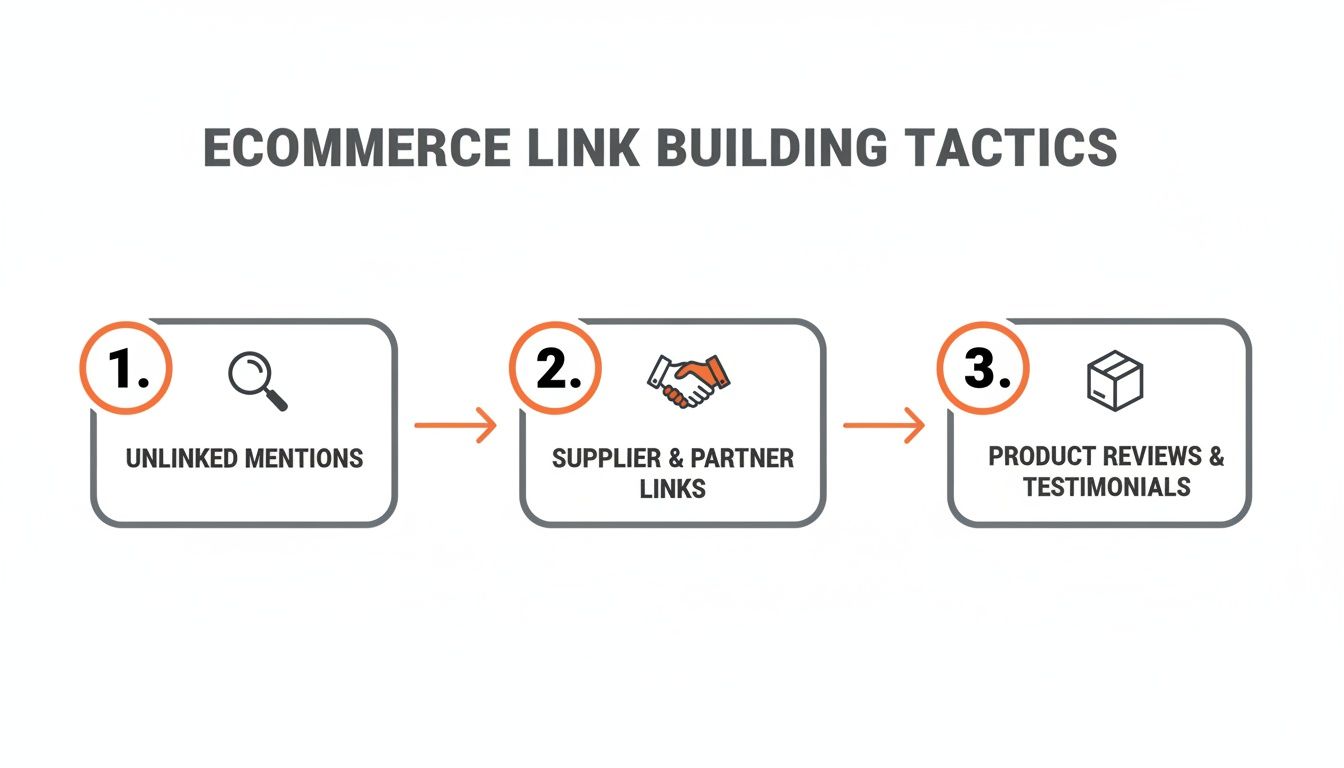
Whether you're reclaiming unlinked mentions, securing supplier links, or getting product reviews, the core principle is the same: lead with value.
The Power Of The Follow-Up
People are busy and their inboxes are overflowing. Many of your initial emails will go unanswered, not due to lack of interest, but because they got buried. A polite, non-pushy follow-up is your best friend.
A single follow-up can boost reply rates by over 65%. The key is to be helpful, not annoying. Wait 3-5 business days before sending it. Keep it short and simply bump the original message to the top of their inbox. Something as simple as, "Just wanted to follow up on this in case it got buried," often works.
Don't overdo it. If you don’t hear back after two follow-ups, move on and focus your energy elsewhere.
Choosing The Right Outreach Tools
Managing outreach in a spreadsheet becomes a nightmare as you scale. Outreach management tools can be a lifesaver for tracking contacts, personalizing emails, and automating follow-ups.
Here’s a look at some leading platforms to help you decide what’s right for your business.
Comparison of Popular Outreach Management Tools
Evaluating key features, pricing models, and ideal use cases for leading link building outreach platforms to help businesses choose the right solution.
| Tool | Key Feature | Best For | Pricing Model |
|---|---|---|---|
| Hunter | Robust email finding and verification capabilities. | Finding accurate contact information for specific domains. | Freemium & Subscription |
| BuzzStream | All-in-one relationship management and outreach tracking. | Agencies and teams managing large, complex campaigns. | Subscription |
| Pitchbox | Highly automated workflows and performance analytics. | SEO professionals focused on scaling link acquisition. | Subscription |
| Mailshake | Simple, effective email sequencing and follow-ups. | Small businesses and individuals focused on sales & PR. | Subscription |
Choosing the right tool depends on your team size, budget, and campaign volume. But remember, software is just a tool. The thoughtful, value-first strategy behind it is the foundation of successful outreach.
Scaling Your Efforts with Digital PR
Manual outreach and guest posting will get you started, but they won't win the game. To truly dominate your niche, you need to think bigger. That's where Digital PR comes in.
This is the shift from asking for links to earning them by creating something genuinely newsworthy.
Instead of one-to-one outreach, Digital PR is a one-to-many play. You create a single, high-impact asset so compelling that journalists, major publications, and top-tier bloggers want to write about it. It’s the difference between laying bricks by hand and using a crane.
This approach transforms link building from a repetitive task into a strategic growth engine.
Turning Your Data into Newsworthy Campaigns
The secret weapon for your first big Digital PR win is likely your own internal data. Journalists are starved for unique insights backed by real numbers. By analyzing your sales data or surveying customers, you can uncover trends and stories no one else can tell.
What’s unique about your store? If you sell sustainable products, you could release a report showing a 25% year-over-year surge in demand for recycled materials. Specialize in home office gear? A survey revealing how remote workers are upgrading their setups is a perfect pitch for business reporters.
Here are a few ways this works brilliantly:
- Mine Your Sales Data: Find your fastest-growing product categories or pinpoint unexpected buying patterns in different cities.
- Survey Your Customers: Ask your audience about their habits, preferences, or pain points related to your niche. The results are gold.
- Create an Index or Ranking: Rank cities, products, or countries based on a fun, interesting metric. These are incredibly linkable.
Your goal is to create a headline. "New Study Finds Coffee Drinkers in Seattle Spend More on Single-Origin Beans Than Any Other City" is a story. Another blog post is just noise.
The Power of Linkable Infographics and Visuals
Once you have a killer data point, package it for maximum impact. A sharp, well-designed infographic makes complex data easy to digest and highly shareable. This dramatically increases the odds that a busy journalist will use it—and link back to you as the source.
These visuals become self-contained link-earning assets. When a publication embeds your infographic, the backlink is a natural part of giving credit. Suddenly, you're not asking for a link; you're providing them with a valuable resource that makes their article better.
A single, data-rich infographic can land you dozens of high-authority backlinks. It becomes the centerpiece of your outreach, giving journalists a tangible, value-packed resource they can immediately use to enhance their own articles.
Executing Large-Scale Outreach and Promotion
With your newsworthy asset in hand, it's time for promotion. This is where you apply outreach tactics on a much larger scale. You’ll build a highly targeted list of journalists, editors, and bloggers who cover your industry and pitch them your unique story.
Specialized PR platforms can help you find media contacts, manage outreach, and measure success. For many brands, partnering with a Digital PR agency is the fastest way to leverage existing media relationships and execute these campaigns flawlessly.
Here's the bottom line: Digital PR is a powerhouse, with a 48.6% effectiveness rating, yet only 17.7% of SEOs are fully using it. The ones who are? They generate an average of 15.58 links per month, often securing premium editorial links. You can discover more insights about these link building statistics on loopexdigital.com.
When you embrace Digital PR, you're not just building links. You're building real brand authority and cementing your store as a market leader.
Answering Your Top Ecommerce Link Building Questions
Even with a perfect playbook, questions will arise. Getting through these roadblocks is what separates a stalled effort from a successful one.
Let's tackle the most common questions from ecommerce store owners.
How Many Backlinks Does a Product Page Actually Need?
There's no magic number. The real answer lies in what your competition is doing.
First, analyze the backlink profiles of the top 3-5 stores already ranking for your main product keyword. Your goal is to build a profile that is in the same league. This means not just matching their link count, but getting links from domains with similar or better authority.
As a general rule, aiming for 5-10 high-quality, relevant links is a solid starting point for a new or competitive product page. From there, monitor your rankings and adjust your strategy.
The golden rule here is that quality and relevance always crush sheer quantity. A single powerful link from a respected industry blog will do more for you than a hundred spammy, irrelevant links ever could.
Is It Safe to Buy Backlinks for My Ecommerce Store?
No. Paying directly for backlinks is a direct violation of Google's guidelines and a fast track to a penalty, from a nosedive in rankings to your entire store being de-indexed.
However, there's a crucial distinction between buying links and investing in the process of earning them.
- Buying Links (Bad): Paying a website owner a flat fee just to place a link on their site. It's a pure transaction with no real value.
- Investing in Earning Links (Smart): Paying for services that create something of value, where links are the natural result. This includes hiring a writer for a guest post, funding a PR campaign for a link-worthy asset, or using a platform to manage strategic outreach.
Stick to white-hat tactics. They build real authority and forge digital relationships that pay off long-term.
How Can I Actually Measure the ROI of Link Building?
Measuring the return on your link building investment means going beyond just counting new links. You must connect your efforts to actual business results.
Here’s what you should be tracking:
- Keyword Ranking Gains: Are the product and category pages you're targeting moving up in the search results? This is your most direct indicator.
- Organic Traffic Growth: In Google Analytics, are you seeing a lift in organic search traffic to the pages you've built links to?
- Referral Traffic: Check how much traffic is clicking directly through your new backlinks. This measures a link's immediate value in sending qualified visitors.
- The Bottom Line—Business Metrics: This is where it all comes together. Connect the dots between your link building, the resulting traffic, and the actual conversions and revenue generated. That’s how you find your true ROI.
Ready to stop the manual grind and automate your link building? BlazeHive uses AI to intelligently match your store with high-value backlink opportunities, helping you build authority at scale. See how it works and start growing at https://www.blazehive.io.