Boost Rankings: What is Anchor Text in SEO and Why It Matters

When you click a link, the visible, clickable text is called anchor text. This simple element plays a huge role in how people and search engines understand and navigate the web.
Think of it as a signpost on a highway. It tells you where a link is going before you click, setting clear expectations for your journey online.
What Is Anchor Text and Why It Matters

In SEO, anchor text is more than just a navigation tool. It gives search engines like Google powerful clues about a page's topic and what keywords it should rank for.
Imagine a library. Anchor text acts like the title on a book's spine—it gives you a quick summary of the content inside. A clear, descriptive label makes it easy to find the right information. Similarly, good anchor text helps Google categorize and rank your content correctly.
This is why anchor text has been a core part of search algorithms from the beginning. The words used to link to a page are a strong signal of that page's subject and authority.
Key Anchor Text Terms
Let's define a few key terms before we dive deeper. This table provides a quick reference.
| Term | Simple Definition |
|---|---|
| Anchor Text | The visible, clickable text in a hyperlink. |
| Link Building | The process of getting links from other websites. |
| Backlink | A link from one website to another. |
| Target Keyword | The specific search term you want a page to rank for. |
| Over-optimization | Using a target keyword too often in anchor text, which can lead to penalties. |
These definitions will help as we explore different types of anchor text and their uses.
The Dual Role of Anchor Text
Effective anchor text serves two audiences at once: human users and search engine bots.
-
For Users: It offers a clear preview of the linked page. Instead of a vague "click here," descriptive text like "SEO best practices" confirms the link is relevant, making users more likely to click.
-
For Search Engines: It’s a powerful relevancy signal. When many websites link to your page using similar, descriptive anchors, it reinforces to Google that your page is an authority on that topic.
Understanding anchor text is a critical piece of any SEO strategy. If you're new to this, a solid grasp of Search Engine Optimization (SEO) is essential. For anyone serious about ranking, a smart anchor text strategy isn't optional—it's necessary.
The Different Types of Anchor Text Explained
A healthy [backlink profile](/tools/free-backlink-checker/) is like a diversified investment portfolio. You wouldn't put all your money in one stock, and you shouldn't rely on one type of anchor text. A mix of anchor types is key to building a strong, penalty-proof profile.
Each type sends a different signal. Understanding them is the first step toward building a link profile that looks natural and drives results.
Exact-Match and Partial-Match Anchors
These are the most potent for SEO but also the riskiest. They use your target keywords to tell Google exactly what a page is about.
- Exact-Match Anchor: The anchor text is identical to your target keyword. If you want to rank for "content marketing tools," the anchor is content marketing tools. This sends a very direct signal.
- Partial-Match Anchor: This anchor includes your target keyword along with other words. For example, "our favorite content marketing tools for teams." It’s still keyword-focused but feels more natural.
Caution: Use these sparingly. Relying on them too heavily is a clear sign of over-optimization and can lead to penalties.
Branded and Naked URL Anchors
These anchors are your defense against over-optimization. They build trust and help create the natural backlink profile that search engines reward.
- Branded Anchor: The anchor text is simply your brand name, like BlazeHive. This is how people naturally link to sites they trust, making it a powerful authority signal.
- Naked URL Anchor: The full URL is used as the link text, such as https://www.blazehive.io. They aren't pretty, but they are very common online and help keep your profile looking natural.
Key Takeaway: A backlink profile stuffed with keyword-rich anchors looks manipulative. Branded and naked URL links form the foundation of a safe, long-term strategy because they prove you're a legitimate brand, not just a site chasing keywords.
Generic and Image Anchors
These anchors add more natural variation to your profile. While not keyword-focused, they play an important role in user experience and accessibility.
- Generic Anchor: These are common, non-descriptive phrases like "click here," "read more," or "learn more." They don't provide much SEO context but are a normal part of the web and are fine in moderation.
- Image Anchor: When an image is linked, Google uses its [alt text](/tools/alt-text-generator/) as the anchor text. An alt tag like "infographic showing anchor text types" gives valuable context to both search engines and visually impaired users.
Knowing the types is step one. The real skill is creating the right mix—balancing the ranking power of keyword anchors with the trust and safety of branded, URL, and generic links.
The Risks of Anchor Text Over-Optimization
While keyword-rich anchor text is a powerful SEO tool, there's a fine line between smart optimization and manipulation. Crossing that line leads to over-optimization, which can seriously harm your search rankings.
Think of it like a conversation. Repeating the same phrase over and over sounds unnatural and forced. Search engines see your backlink profile the same way.
Google's Penguin update changed the game by targeting this exact issue. The algorithm was designed to find and penalize websites with spammy, unnatural backlink profiles, with aggressive anchor text being a primary target. Sites built on a mountain of exact-match anchors saw their traffic disappear overnight.
The Penguin Effect on SEO
Before the Penguin update, the formula was simple: more exact-match anchors often meant higher rankings. It was an easy system to manipulate. But Google got smarter, recognizing that a natural link profile is diverse.
The Penguin update taught SEOs a crucial lesson: context and naturalness matter more than keyword stuffing. An anchor text profile skewed heavily toward one type looks artificial. It's a clear sign that the links were likely built to manipulate search results, not earned organically.
This is why a balanced profile with a mix of anchor types is so important.
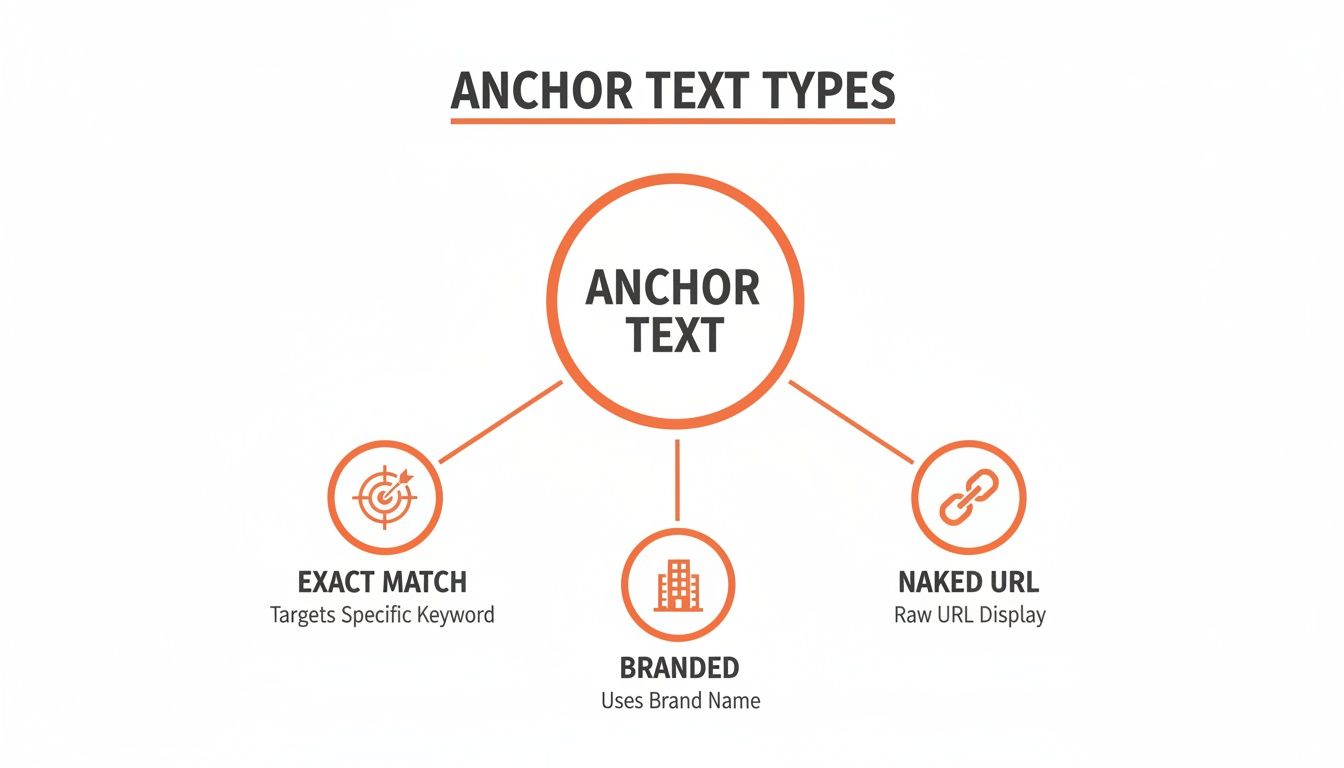
As shown, different anchor types send different signals. A healthy profile contains a mix of all of them.
Why Diversity Is Your Best Defense
Your best defense against penalties is a backlink profile that looks natural. When people link to your website organically, they do it in many different ways. Some use your brand name, others use an article title, and many just paste the URL. Your goal is to build a link profile that mimics this natural behavior.
A healthy anchor text distribution isn't just a recommendation—it's your main defense against search engine penalties. It signals that your links are earned and that your website is a genuine authority.
A diverse anchor strategy is key to long-term SEO success. It proves your credibility is real. Even today, Google evaluates backlink anchor text as a confirmed ranking factor. A natural mix builds authority, while an aggressive approach with too many exact-match links can trigger penalties.
The goal isn't to stop using keyword-focused anchors, but to use them sparingly as part of a broader, more natural strategy.
How to Build a Winning Anchor Text Strategy
Let's move from theory to practice. A smart anchor text strategy isn't about a rigid formula. It’s about building a link profile that looks natural to search engines while still signaling what your pages are about.
The best place to start is with competitor research. Look at the sites already ranking for your target keywords. Use an SEO tool to analyze their backlink profiles and see what's working. You're not trying to copy them link-for-link, but to understand what a "natural" anchor text mix looks like in your niche.
Establish a Natural Distribution Ratio
With competitive data as a baseline, you can guide your own link-building. A healthy, penalty-proof profile prioritizes diversity and brand signals over aggressive keywords.
Think of your anchor text profile as a pyramid. The base—the largest and most stable part—should be your branded and naked URL anchors.
- Branded & Naked URL Anchors (60-70%): This is your foundation. Most of your links should be your brand name (e.g., "BlazeHive") or the direct URL. This is how people link naturally and is great for building brand authority.
- Partial-Match & Topic Anchors (20-25%): These links include variations of your keywords or describe the topic broadly, like "a guide to link building." They provide great context without raising the red flags of exact-match anchors.
- Exact-Match Anchors (1-5%): Use these sparingly. A few exact-match anchors from high-authority sites can provide a significant ranking boost. Overuse them, and you risk a penalty.
- Generic Anchors (1-5%): Simple anchors like "click here" or "read more" are a normal part of the web. A small percentage helps your profile look organic.
Sample Ratios for a Natural Anchor Profile
Use this table as a guideline for a balanced anchor text distribution.
| Anchor Text Type | Target Percentage Range |
|---|---|
| Branded & Naked URL | 60% – 70% |
| Partial-Match & Topic | 20% – 25% |
| Exact-Match | 1% – 5% |
| Generic | 1% – 5% |
These numbers are a starting point. Always let your competitor research inform your specific targets.
Prioritize Contextual Relevance
Modern search engines are smart. They don't just look at the anchor text; they analyze the text around the link. The sentences before and after a link provide crucial context that tells Google what your page is really about.
For example, a link with the anchor "digital marketing" is good. But if that link is in a paragraph discussing social media, SEO, and content creation, its power increases. The surrounding text reinforces its relevance, something Google's AI-driven algorithms value highly.
Anchor text is one piece of a larger puzzle. Effective SEO integrates these tactics with broader strategies to increase website traffic. The goal is to get quality links from a good referring domain, placed within content that is perfectly aligned with your topic. Our guide on what a referring domain is explains why this is so important.
Anchor Text Best Practices for Internal and External Links
Knowing how anchor text works is the first step. Applying that knowledge correctly is the next—and the rules are different for links within your own site versus links from other sites.
A common mistake is treating them the same, which can hurt your SEO. The difference comes down to control. You control your internal links, so you can be strategic. External links need to look natural and earned.
Mastering Internal Link Anchors
Internal links connect the pages on your website. Since you build them, you can be much more deliberate and keyword-focused. The goal is to create a logical site structure, help visitors find information, and tell Google which pages are most important.
For internal links, using keyword-rich or partial-match anchors is not just safe—it’s recommended.
- Be Descriptive: Your anchor text should tell users what they'll find. Linking to a [keyword research](/tools/keyword-research/) guide with the anchor "keyword research strategies" is much better than "click here."
- Guide Users and Google: Descriptive anchors help both people and search engines understand how your pages are related, building a clear map of your site's topical authority.
- Funnel Page Authority: You can strategically link from high-authority pages to important pages that need a boost, using a relevant anchor to pass on some of that ranking power.
This direct approach helps spread "link equity" across your site and strengthen its overall SEO. While some variety is good, you have much more freedom to be precise with internal anchors.
Navigating External Link Anchors
For external links—those pointing to your site from other domains—the mindset must change completely. Here, the goal is to build a backlink profile that looks 100% natural. Chasing exact-match anchors from other websites is a major red flag for Google.
Instead, a healthy external link profile must have a diverse, organic mix of anchor text types.
The golden rule for external links is that you don't control them. A natural backlink profile should look like a collection of links from different people, all linking to you in their own way. That means a healthy mix of branded, naked URL, and topic-based anchors.
When doing link building outreach, focus on getting a link from a relevant page, not on dictating the "perfect" anchor. Let the author link to you in a way that fits their writing. The words around your link are often as valuable as the anchor text itself.
To learn more, our guide on the primary types of links in SEO is a great resource. Remember: internal links are for structure and control; external links are for earning trust and authority.
How to Audit and Monitor Your Anchor Text Profile
A great anchor text strategy isn't a one-time task. To maintain healthy, penalty-proof rankings, you must regularly monitor your site’s anchor text profile. This allows you to spot potential issues early and adjust your strategy before they become major problems.
Think of it as a routine health checkup for your website's backlinks. By auditing your anchor text data, you can ensure your link profile looks diverse, natural, and aligned with your SEO goals.

Conducting Your Anchor Text Audit
First, you need a complete list of all links pointing to your site. SEO tools like Ahrefs or Semrush can export your backlink data into a spreadsheet. This file is your starting point, showing every link and its anchor text.
Next, categorize each link. Add a new column to your spreadsheet and tag each link with its type: Branded, Naked URL, Partial-Match, Exact-Match, or Generic.
This simple sorting process gives you an instant snapshot of your current anchor text distribution. From there, you can create a pie chart to visualize your profile and compare it to the ideal ratios we discussed.
Key Insight: An audit isn't just about finding "bad" links. It's about understanding the overall balance and what story your links are telling Google.
Identifying Red Flags and Taking Action
As you review your data, look for red flags that signal over-optimization to search engines. Getting a full view is a key part of understanding what a backlink profile is and how to manage it.
Use this checklist to guide your audit:
- High Percentage of Exact-Match Anchors: Is your profile too reliant on keyword-stuffed links? This is the most common and dangerous red flag.
- Lack of Diversity: Do most of your links fall into one or two categories? A natural profile should have a healthy mix of all anchor types.
- Links from Low-Quality Sites: Are spammy sites using aggressive, keyword-rich anchor text to link to you? These may need to be disavowed.
Monitoring this data allows you to adjust your link-building strategy in real time. If you notice too many exact-match anchors, you can focus your next campaign on earning more branded or naked URL links to restore balance.
Got Questions? We've Got Answers
Even after a deep dive into anchor text, some common questions often remain. Let's tackle them so you can move forward with confidence.
What’s the "Perfect" Anchor Text for SEO?
This is a trick question—there is no single "perfect" anchor. The best strategy is to build a diverse and natural-looking profile.
Think of it like a healthy diet. The bulk of your links (around 60-70%) should be branded anchors and naked URLs. These are your low-risk foundation. Then, add a smaller, strategic amount of partial-match and exact-match anchors to give Google important context.
How Often Can I Safely Use an Exact-Match Anchor?
Treat exact-match anchors like a potent spice: use them sparingly. A good rule of thumb is to keep them under 5% of your total backlink profile.
Going above this percentage is one of the fastest ways to get a Google penalty. It signals an attempt to manipulate rankings and can easily trigger an over-optimization filter.
Do Generic Anchors Like "Click Here" Hurt My SEO?
Not at all, as long as they are part of a balanced profile. Anchors like "click here" or "read more" are completely normal on the web, and Google expects to see them.
While they don't pass keyword relevance, they help your backlink profile look authentic. They only become a problem if they make up an unnaturally large portion of your anchors.
Ready to build a powerful, natural backlink profile without the manual grind? BlazeHive uses AI to find perfect, niche-relevant backlink opportunities, helping you earn the links you need to rank. Get started for free at blazehive.io.