10 Actionable SEO Strategies for Small Businesses in 2025
For a small business, being visible online isn't just an advantage—it's essential for growth. Mastering search engine optimization (SEO) is how you connect with customers, but it can feel complex and time-consuming. This guide cuts through the noise, offering clear, effective SEO strategies for small businesses that deliver results without a huge budget. We're moving beyond generic advice to give you tactics tailored for lean operations.
To get the most from these strategies, it helps to understand the basics of SEO. For a great overview, read this guide on What is Search Engine Optimization (SEO). A solid foundation will help you implement the steps outlined here. Think of this article as your practical roadmap to what truly moves the needle.
You'll learn ten powerful strategies, each broken down into simple steps with real-world examples. We will cover everything from dominating local search and finding the right keywords to building authority with links and improving your site’s technical health. Let's start turning your website into a powerful tool for attracting customers and achieving sustainable growth.
1. Master Local SEO
Local SEO is the practice of optimizing your online presence to attract more customers from local searches. For a small business, this is often the single most important SEO strategy. When customers search "plumber near me" or "best coffee shop in [City]," local SEO is what gets your business to appear in the top results, often in Google's "Local Pack" or on Google Maps.

This strategy connects you with high-intent customers actively looking for your products or services in your area. The goal is to boost your visibility for these local queries, driving foot traffic to your store and generating qualified leads from your community. It's a fundamental tactic for competing effectively against larger, non-local businesses online.
Why It Matters for SMBs
For brick-and-mortar businesses like restaurants, dentists, or electricians, most customers come from the surrounding area. Dominating local search ensures you capture this audience when they are ready to buy. It levels the playing field, allowing a well-optimized local business to outrank a national chain in local results.
Actionable Steps to Implement
- Claim & Optimize Your Google Business Profile (GBP): Your GBP is the cornerstone of local SEO. Fill out every section, including services, hours, and photos. Ensure your business name, address, and phone number (NAP) are 100% accurate and consistent everywhere.
- Build Consistent Local Citations: A citation is any online mention of your business's NAP. List your business in key local and industry directories like Yelp, your local Chamber of Commerce, and industry-specific sites. Consistency builds trust with search engines.
- Encourage Customer Reviews: Actively ask for reviews on your GBP and other platforms. Positive reviews boost local rankings and provide social proof that attracts new customers.
- Create Location-Specific Content: If you serve multiple towns, create dedicated pages for each one (e.g., "Plumbing Services in Springfield," "Emergency HVAC in Shelbyville"). This helps you rank for location-based searches.
2. Focus on Long-Tail Keywords
Keyword research is about finding the words and phrases your customers use when searching for your services. For small businesses, the key is to focus on long-tail keywords. These are longer, more specific phrases (usually 3+ words) that show a user is closer to making a purchase.

Instead of competing for a broad, difficult term like "accountant," you target specific, lower-competition phrases like "small business tax preparation for freelancers in Austin." While these terms have less search volume, they attract more qualified traffic that is much more likely to convert, making them one of the most efficient seo strategies for small businesses.
Why It Matters for SMBs
Large corporations dominate the rankings for broad keywords. Small businesses can't easily compete. Long-tail keywords level the playing field by letting you target niche audiences with focused content. This attracts high-intent visitors, reduces competition, and leads to better conversion rates because you're directly answering a user's specific need.
Actionable Steps to Implement
- Use Google's Features: Start typing a core service into Google and see what it suggests in the search bar. These are real queries from users. Also, check the "People Also Ask" box in the search results for more long-tail ideas.
- Analyze Your Competitors: Use free or paid SEO tools to see which keywords your local competitors rank for. Look for valuable long-tail opportunities they may be overlooking.
- Focus on Buyer Intent: Prioritize keywords that include words like "for sale," "quote," "near me," "services," or "cost." These signal a user is ready to buy.
- Create Content Hubs: Build your content around a main "pillar" topic and create smaller "cluster" articles targeting related long-tail keywords. For example, a pillar page on "HVAC Maintenance" can be supported by posts on "how often to change furnace filter" and "cost of AC tune-up in [City]."
3. Develop a Content & Blog Strategy
Content marketing is the creation and distribution of valuable, relevant content to attract your target audience. For a small business, a good blog is a powerful tool for building authority, improving search rankings, and generating organic traffic without relying on paid ads. It's about answering your customers' questions and solving their problems.
This strategy positions your business as a trusted industry expert. By creating high-quality articles and guides, you attract users searching for information related to your services. Each piece of content is another chance to rank on Google, drive qualified traffic to your site, and turn visitors into customers.
Why It Matters for SMBs
Paid ads stop working when you stop paying. Great content is an asset that generates traffic and leads for years. It allows a small business to compete by earning trust and showing expertise, rather than just outspending larger rivals. A strong content strategy is one of the most sustainable seo strategies for small businesses because it builds a long-term connection with your audience.
Actionable Steps to Implement
- Identify Core Topics: Brainstorm the main questions, challenges, and pain points of your target audience. Use keyword research to find what people are actively searching for related to these topics.
- Create High-Quality Content: Focus on creating comprehensive, in-depth blog posts (1,500+ words) that cover a topic completely. This type of content attracts more links and ranks higher in search results. You can explore more on our blog.
- Optimize Every Post: Include your target keyword in the title, meta description, URL, and naturally throughout the content. Use clear headings (H2s, H3s) to structure your article and add internal links to other relevant pages on your site.
- Promote Your Content: Publishing is only half the battle. Share your articles on social media, in your email newsletter, and in relevant online communities to drive initial traffic and signal value to Google.
4. Perfect Your On-Page SEO
On-page SEO is the practice of optimizing individual web pages to rank higher and earn more relevant traffic. This core strategy involves refining elements you control, like title tags, headers, content, and internal linking. For a small business, mastering on-page SEO is a direct way to tell search engines what your content is about and why it deserves to rank.
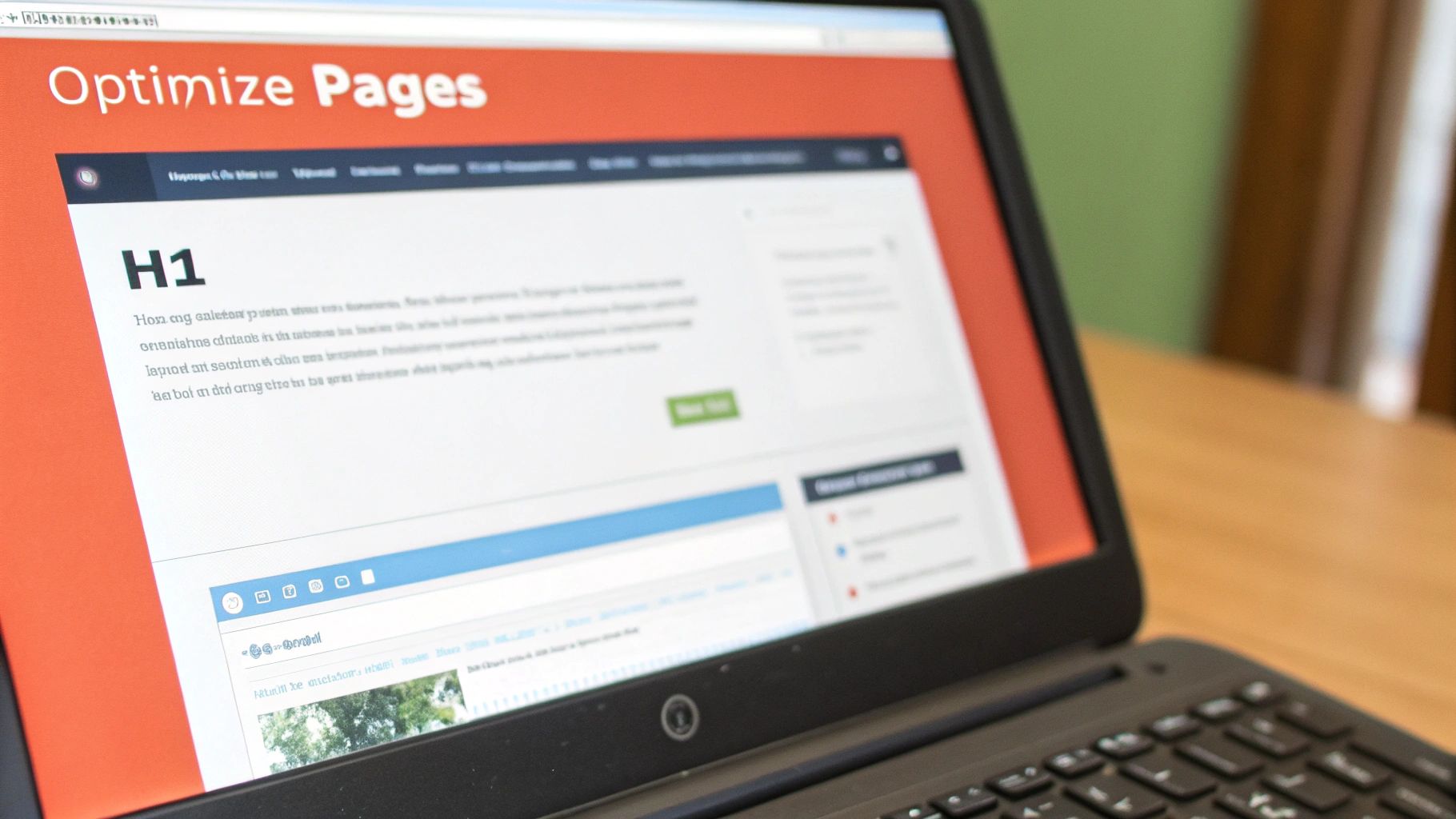
Unlike off-page factors like backlinks, you have complete control over these elements. By optimizing them, you make it easier for Google to understand your content. This directly improves your ability to rank for target keywords and enhances the user experience, encouraging visitors to stay on your site longer.
Why It Matters for SMBs
For small businesses, on-page SEO offers a high-return, low-cost investment. It ensures your website is relevant and technically sound before you spend money on other strategies. A well-optimized page can significantly improve your click-through rate from search results. A compelling meta description can convince a user to choose your link over a competitor's, even if you rank slightly lower.
Actionable Steps to Implement
- Optimize Titles & Meta Descriptions: Your title tag is a key ranking factor. Include your main keyword near the beginning. Write a compelling meta description (around 155 characters) that acts as an ad for your page to encourage clicks.
- Use Header Tags Correctly: Structure your content with a single H1 tag containing your primary keyword. Use H2s and H3s for subheadings to improve readability and give search engines a clear content hierarchy.
- Write High-Quality, Relevant Content: Your content must answer the user's search intent completely. Naturally include your target keyword and related terms throughout the text.
- Optimize Images and URLs: Use descriptive, keyword-rich file names and alt text for all images. Create short, clean URLs that include your primary keyword (e.g.,
yourdomain.com/seo-strategies-small-business). - Implement Internal Linking: Link to other relevant pages on your website using descriptive anchor text. This helps search engines discover your content and spreads authority throughout your site.
5. Build Authority with Links
Link building is the process of getting other websites to link to yours. To search engines like Google, these backlinks act as "votes of confidence," signaling that your content is credible and valuable. A strong backlink profile is a major factor in achieving higher rankings and is a cornerstone of effective SEO strategies for small businesses.
This strategy involves creating content that others want to reference and actively building relationships in your industry. The goal is to earn high-quality links from reputable, relevant sites. This passes authority to your website, improves its standing with Google, and drives referral traffic from new audiences.
Why It Matters for SMBs
For a small business, a strong backlink profile is a powerful competitive advantage. It helps you build brand authority and trust in a crowded market. Earning links from respected local or industry sites can significantly boost your visibility for key search terms, helping you compete with larger, more established companies.
Actionable Steps to Implement
- Create Link-Worthy Assets: Develop content that naturally attracts links, like original research, an in-depth guide, a free tool, or a compelling case study. For example, a local marketing agency could publish a report on small business digital trends in their city.
- Conduct Personalized Outreach: Identify relevant websites, blogs, or directories in your niche. Send personalized emails explaining why your content would be a valuable resource for their audience. A personal touch works far better than generic templates.
- Leverage Local Relationships: Partner with other local businesses for cross-promotion. Get listed on the websites of your local Chamber of Commerce, suppliers, or community organizations you support. These are often high-quality, relevant links.
- Monitor Your Backlinks: Use tools like Ahrefs or Semrush to check who is linking to you. This helps you find new opportunities and identify any low-quality links that might need to be disavowed to protect your rankings. Understanding different types of links on blazehive.io can help you evaluate your profile.
6. Improve Technical SEO & Site Performance
Technical SEO involves optimizing your website's infrastructure so that search engines can easily crawl, index, and understand it. It includes factors like site speed, mobile-friendliness, and security. For a small business, this is the foundation on which all other SEO strategies for small businesses are built. A technically sound website ensures your efforts aren't wasted.
This strategy ensures no technical barriers prevent your site from ranking. If search engine bots struggle to access your pages, even the best content may never be seen. The goal is to create a fast, seamless, and secure experience for both users and search engines, which directly impacts engagement and search rankings.
Why It Matters for SMBs
A slow or broken website creates a poor user experience, leading to high bounce rates and lost customers. For a small business, every visitor counts. Technical SEO ensures your site is fast and accessible on all devices, which is critical since most traffic now comes from mobile. Improving site performance can lead to better rankings and a better user experience, giving you an edge over competitors.
Actionable Steps to Implement
- Prioritize Site Speed: Use Google's PageSpeed Insights to test your site. Compress images, enable browser caching, and minimize code to reduce load times. For businesses using WordPress, WordPress performance optimization tools can streamline this process.
- Ensure Mobile-Friendliness: Google primarily uses the mobile version of your site for ranking. Use Google’s Mobile-Friendly Test to find and fix any issues that create a poor experience for mobile users.
- Secure Your Website with HTTPS: An SSL certificate encrypts data between your site and its visitors, which is a confirmed ranking signal. Ensure your site uses HTTPS. Many hosting providers now offer free SSL certificates.
- Fix Crawl Errors & Submit a Sitemap: Regularly check the "Coverage" report in Google Search Console for errors. Create and submit an XML sitemap to Google to help it discover and understand all your important pages.
7. Integrate Social Media
Social media integration means using social platforms to support your SEO efforts. While social shares and likes aren't direct Google ranking factors, a strong social presence amplifies your content, drives traffic to your website, and builds brand authority. It creates more paths for customers and search engines to discover your business.
This strategy works by increasing your content's visibility and fostering a community around your brand. When your content is shared widely, it gains exposure, leading to more brand mentions, referral traffic, and even natural backlinks from others who discover your work. This synergy is a key part of modern SEO strategies for small businesses.
Why It Matters for SMBs
For small businesses, social media is a cost-effective way to compete. It lets you engage directly with your audience, build relationships, and drive immediate traffic to your latest content without waiting for search engines to index it. A viral post or a successful partnership can generate thousands of website visits and valuable links overnight.
Actionable Steps to Implement
- Optimize Social Profiles: Treat your social media profiles like mini-landing pages. Include your main keywords, a clear business description, and a link to your website. Keep your business name, address, and phone number consistent with your GBP.
- Promote Your Content Strategically: Don't just post a link. Share your blog posts and videos with compelling captions tailored to each platform. Use relevant hashtags to expand your reach.
- Encourage Sharing and Engagement: Add social sharing buttons to your blog posts and product pages. Actively respond to comments and messages to build a loyal community that will promote your content.
- Partner with Micro-Influencers: Collaborate with influencers in your niche to get your brand in front of their established audiences. This can drive significant referral traffic and lead to valuable brand mentions.
8. Enhance User Experience (UX)
User experience (UX) is how a visitor feels when interacting with your website. Search engines like Google monitor engagement metrics—such as bounce rate and how long a user stays on your page—to judge whether your site provides a valuable experience. Optimizing for UX pleases both your users and search algorithms.
This strategy involves making your website intuitive, easy to navigate, and engaging. When users find what they need quickly and have a positive experience, Google sees this as a sign of a high-quality page, which can lead to higher rankings. A better user experience directly translates into more conversions and better SEO.
Why It Matters for SMBs
For small businesses, every visitor is a potential customer. A clunky, slow, or confusing website will cause people to leave, losing you valuable leads. A great UX builds trust and credibility, turning casual visitors into loyal customers. Improving UX is one of the most effective seo strategies for small businesses because it directly impacts both your visibility and your bottom line.
Actionable Steps to Implement
- Analyze User Behavior: Use free tools like Google Analytics to track bounce rate and time on page. For deeper insights, use heat mapping tools (like Hotjar or Microsoft Clarity) to see where users click and scroll.
- Improve Readability and Navigation: Break up text with short paragraphs, subheadings, and bullet points. Ensure your main navigation is simple and directs users to important pages like services, contact, and about.
- Optimize for Mobile: Most of your traffic will come from mobile devices. Test your website on various screen sizes to ensure it is fully responsive, easy to read, and all buttons are easy to tap.
- Simplify Forms and Calls-to-Action (CTAs): Reduce the number of fields in your contact forms to make them easier to complete. Make your CTAs clear, compelling, and visually distinct to encourage more clicks.
9. Optimize for Voice Search
Voice search optimization means adapting your content to be found through voice assistants like Siri, Alexa, and Google Assistant. Unlike typed searches, voice queries are longer, more conversational, and often phrased as questions. Optimizing for voice is one of the key forward-thinking SEO strategies for small businesses that can capture a growing audience.
This strategy involves structuring your content to directly answer the kinds of questions your customers ask aloud. The goal is to have your business's information read back as the definitive answer, often by earning a "featured snippet" at the top of the search results. This positions your business as a trusted authority and provides a direct answer to potential customers.
Why It Matters for SMBs
As smart speakers become more common, more local searches are done by voice. Customers asking "where's the best pizza near me?" or "what time does the local hardware store close?" expect an immediate, spoken answer. Being the source of that answer gives your small business a powerful edge, connecting you with customers at their moment of need.
Actionable Steps to Implement
- Target Conversational Keywords: Focus on long-tail keywords that mimic natural speech. Find questions people ask related to your services, such as "how do I fix a leaky faucet?" or "what are the best flowers for a spring garden?"
- Create a Dedicated FAQ Page: Build a comprehensive Frequently Asked Questions (FAQ) page. Structure it with clear questions as headings and provide direct, brief answers (40-60 words) right below. This format is perfect for voice search.
- Aim for Featured Snippets: Voice assistants often pull answers from featured snippets. Structure your content with clear headings, bullet points, and numbered lists to make it easy for Google to extract your information as the primary answer.
- Keep Local Information Accurate: Many voice searches are local. Ensure your Google Business Profile information—especially your address, phone number, and hours—is perfectly accurate everywhere online. This is crucial for "near me" voice queries.
10. Analyze Your Competition
Competitive analysis is the process of researching your competitors' SEO strategies, keywords, and backlinks to find opportunities. It's about understanding what works for them, where they're weak, and how you can position your business to win. This is one of the most vital SEO strategies for small businesses because it provides a clear roadmap.
Instead of guessing, you use data to inform your strategy. This helps you use your limited resources effectively, target underserved niches, and develop a unique value proposition that makes you stand out. For example, a local bakery might discover its main competitor isn't targeting keywords related to "vegan birthday cakes," creating a clear opportunity.
Why It Matters for SMBs
For a small business, competing directly with established giants is tough. Competitive analysis helps you find the path of least resistance. It reveals less competitive long-tail keywords, uncovers content gaps your rivals have ignored, and helps you find unique link-building opportunities to build your authority faster. This strategic approach prevents wasted effort and accelerates growth.
Actionable Steps to Implement
- Identify Your True SEO Competitors: Your main competitors aren't always who you think. Search for your target keywords and see who consistently ranks on the first page. These are your real SEO rivals.
- Analyze Competitor Keywords: Use SEO tools to find which keywords your competitors rank for that you don't. This can reveal valuable opportunities for new service pages or blog posts.
- Examine Their Backlink Sources: Review your competitor's backlink profile to see who links to them. This can uncover industry directories, guest post opportunities, and local blogs you can also target. Learn more about understanding a backlink profile on blazehive.io.
- Audit Their Content Strategy: Look at the types of content your competitors create, like blog posts, videos, or case studies. Identify what topics resonate with their audience and find gaps where you can create better, more helpful content.
Small Business SEO: 10-Point Comparison
| Strategy | Implementation complexity | Resource requirements | Expected outcomes | Ideal use cases | Key advantages |
|---|---|---|---|---|---|
| Local SEO Optimization | Low–Medium (setup + ongoing maintenance) | Moderate (GBP, citations, review management) | Higher local visibility, more foot traffic/calls | Brick-and-mortar, service-area businesses, local services | Highly targeted local audience; cost-effective; higher conversion rates |
| Keyword Research & Long‑Tail Keywords | Low–Medium (research and grouping) | Low–Medium (tools + analyst time) | Improved rankings for niche queries; higher intent traffic | Small sites, niche offerings, content planning | Lower competition; better conversion intent; cost-effective PPC |
| Content Marketing & Blog Strategy | Medium (planning + execution) | High (writing, media, editorial calendar) | Steady organic traffic growth; authority building | Thought leadership, inbound lead gen, content-driven SEO | Long-term traffic; multiple entry points; linkable assets |
| On‑Page SEO Optimization | Low–Medium (technical + editorial tweaks) | Low (tools/plugins or minor dev time) | Improved CTR, clearer indexing, faster on-page gains | Product pages, landing pages, informational pages | Direct control; immediate improvements; low cost |
| Link Building & Backlink Strategy | High (outreach + content creation) | High (content, outreach, PR resources) | Higher domain authority and ranking improvements; referral traffic | Competitive niches, authority building, content sites | Long-term ranking boosts; referral traffic; brand visibility |
| Technical SEO & Site Performance | Medium–High (development required) | Medium–High (dev resources, monitoring tools) | Better crawlability, faster pages, improved UX & rankings | Large sites, e-commerce, mobile-first experiences | Foundational for all SEO; lasting performance gains |
| Social Media Integration & Engagement | Low–Medium (content + engagement) | Medium (content creation, community management) | Increased content reach, referral traffic, brand awareness | Consumer brands, visual products, community-driven campaigns | Amplifies content; builds community; cost-effective channel |
| UX & Engagement Metrics | Medium–High (design, testing) | Medium–High (design/dev, analytics tools) | Higher conversions, lower bounce, improved dwell time | Conversion-focused sites, SaaS, e-commerce, lead gen | Directly improves conversions and search behavior signals |
| Voice Search Optimization | Low–Medium (content format changes) | Low–Medium (FAQ content, schema) | Visibility for conversational queries; featured snippet potential | Local queries, FAQ pages, mobile/voice users | Aligns with natural language; captures growing voice traffic |
| Competitive Analysis & Market Positioning | Medium (tooling + analysis) | Medium (competitive tools, analyst time) | Identifies gaps, prioritizes opportunities, informed strategy | Market entry, budget allocation, content gap discovery | Data-driven targeting; reveals competitor weaknesses and opportunities |
From Strategy to Success: Your Next Steps
You now have a roadmap of ten powerful SEO strategies for small businesses. We've covered everything from foundational tactics like Local and On-Page SEO to forward-looking strategies like voice search. The journey to the top of the search results can feel intimidating, but it's a strategic climb built on consistent, focused action.
The key is not to do everything at once. Instead, view this guide as a menu. Your first task is to identify the one or two areas that will make the biggest impact for your business right now.
Your Actionable Blueprint for SEO Mastery
To move from learning to doing, take a phased approach. Avoid "analysis paralysis" by committing to a clear plan.
Phase 1: Build a Rock-Solid Foundation (Weeks 1-4)
- Priority #1: Local SEO Optimization: If you serve a local community, this is non-negotiable. Fully optimize your Google Business Profile, make your business info consistent online, and start asking for customer reviews. This is the fastest path to local visibility.
- Priority #2: Foundational On-Page SEO: Review your most important service or product pages. Ensure each one has a unique, keyword-optimized title tag, meta description, and a clear H1. This basic work helps search engines understand and rank your core offerings.
Phase 2: Create Authority & Attract Your Audience (Weeks 5-12)
- Priority #3: Strategic Content & Keyword Research: Identify a core group of long-tail keywords your ideal customer is searching for. Write your first three to five high-quality blog posts that answer their most important questions. This builds topical authority and establishes your brand as a helpful expert.
- Priority #4: Technical SEO Audit: Run a basic site audit using a free tool to find critical errors like broken links, slow pages, or mobile usability issues. Fixing these technical problems improves user experience and sends positive signals to Google.
Phase 3: Amplify Your Reach & Scale Your Growth (Ongoing)
- Priority #5: Scalable Link Building: With a foundation of quality content, you can now focus on building authority. Finding relevant, high-quality backlink opportunities is critical but time-consuming. This is where strategic automation can be a game-changer.
- Priority #6: Analyze & Iterate: SEO is not a "set it and forget it" task. Regularly review your analytics to see what's driving traffic and conversions. Double down on what works and refine what doesn't.
The True Value of Consistent SEO
Implementing these SEO strategies for small businesses is about more than just climbing rankings. It's about building a sustainable, long-term asset. Unlike paid ads, which stop when the budget runs out, a strong organic presence becomes a predictable engine for leads and sales. Every piece of content you create and every backlink you earn compounds over time, strengthening your digital footprint and creating a competitive advantage. You are investing in your brand's future. The path is clear, and the tools are here. Your journey to sustained organic growth starts today.
Ready to conquer the most challenging part of SEO? BlazeHive's LinkSage platform uses AI to automate the tedious process of finding and securing high-quality backlink opportunities, freeing you up to focus on running your business. Stop spending countless hours on manual outreach and start building authority at scale by visiting BlazeHive today.