How to Increase Organic Traffic: A Modern Playbook
Growing organic traffic isn't about secret "hacks." It's a consistent process. Sustainable Google rankings and more visitors come from mastering four key areas: understanding your audience, creating helpful content, ensuring your site is technically sound, and building real authority.
Your Blueprint for Sustainable Organic Growth
Forget chasing algorithm updates. The key to lasting organic traffic is a repeatable system. This playbook provides a strategic framework to consistently attract visitors from search engines.
We'll break down a modern SEO strategy piece by piece. You'll see how keyword research, content, technical fixes, and backlinks fit together to create a powerful growth engine for your site.
This workflow shows the process, from foundational research to establishing your authority.
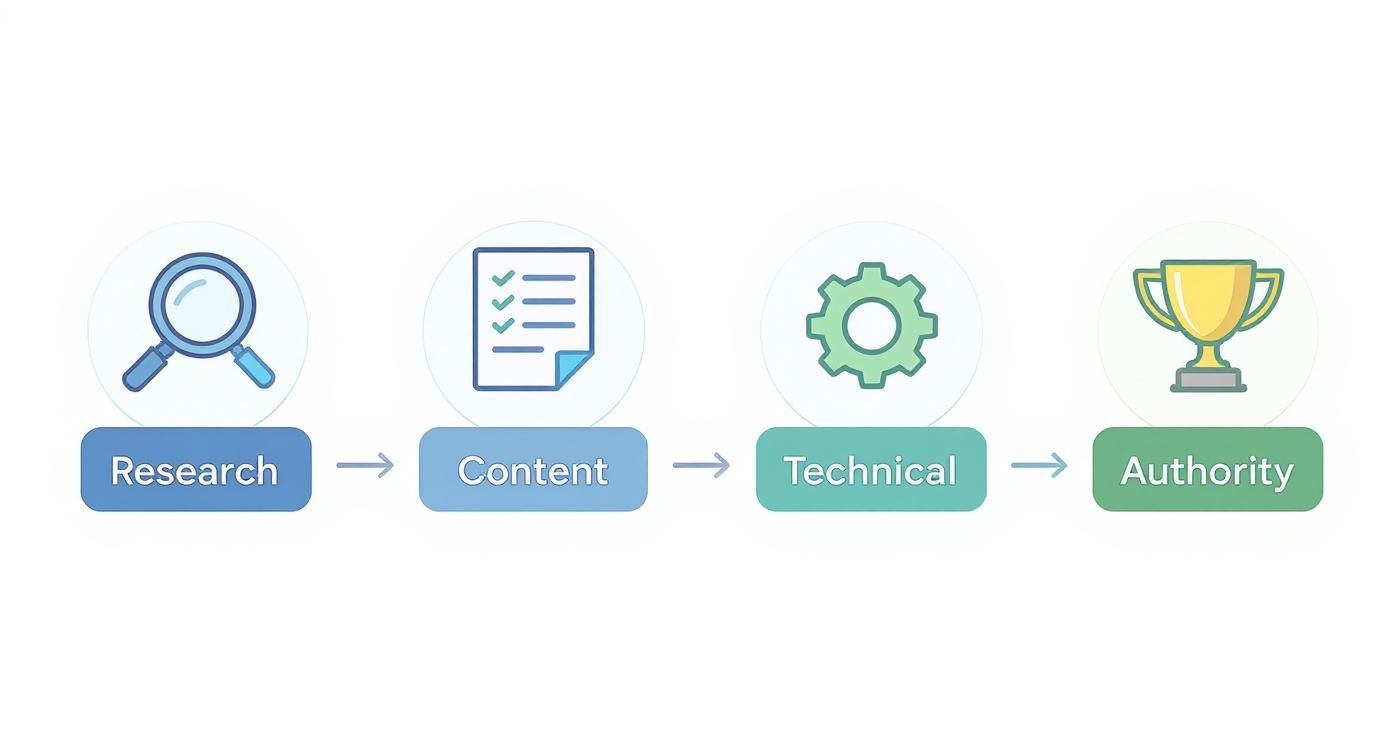
This visual shows that success is a cycle. Each step builds on the last, creating continuous improvement.
The Core Pillars of an SEO Strategy
You can't just be good at one thing. Lasting growth requires competence across four connected disciplines. If one pillar crumbles, it weakens everything. Brilliant content on a broken site that Google can't crawl is invisible.
To succeed, you must nail these four foundational elements:
- Keyword & Audience Research: This is more than finding search terms. It's about understanding your audience's intent. What problems are they trying to solve? What are their urgent questions?
- Content Creation & Optimization: Your content delivers answers. It must be well-written, structured for search engines, and genuinely useful.
- Technical SEO Health: Your website needs to be fast, mobile-friendly, and easy for search engines to crawl and understand.
- Authority Building & Backlinks: Links from credible websites are votes of confidence. They signal to Google that your content is trustworthy, which boosts your rankings.
By 2025, organic search is projected to be 53% of all website traffic. As the most dominant channel for attracting visitors, mastering these SEO pillars is non-negotiable.
The table below breaks down these fundamental components. Use it as a quick reference for each stage.
Core Pillars of an Organic Traffic Strategy
| Pillar | Primary Focus | Key Objective |
|---|---|---|
| Keyword & Audience Research | Understanding user intent and search behavior | Target relevant topics that solve real problems for your audience. |
| Content Creation & Optimization | Developing high-value, helpful content | Satisfy user intent and rank for target keywords by being the best answer. |
| Technical SEO Health | Ensuring site crawlability, indexability, and performance | Provide a seamless user experience and make it easy for search engines to find and understand your content. |
| Authority Building & Backlinks | Earning links from other reputable websites | Build trust and credibility with search engines, proving your site is a valuable resource. |
A strong foundation in all four areas separates the sites that win from those that don't. For a deeper look, you can explore proven strategies to increase organic traffic.
Mastering Keyword Strategy to Attract Real Buyers
A winning SEO plan starts with knowing the exact words your ideal customers use on Google. Guessing at keywords means you might get some traffic, but not the kind that converts into revenue.
The game has changed. It's no longer about chasing high search volume. It’s about understanding the intent behind the search. What is the person's goal? Nail that, and you'll attract traffic that's ready to buy.
Google handles over 6 million searches every minute. That’s a massive opportunity if you can understand the searcher's mindset. To see the scale of this data, seozoom.com has some eye-opening data.
Look for Intent, Not Just Volume
Targeting a keyword just for its high search volume is a rookie mistake. The value is in the why behind the search. We can categorize keyword intent into a few types, each mapping to a different point in the customer journey.
- Informational Intent: Users are in research mode, asking questions like "how to build backlinks" or "what is domain authority?"
- Navigational Intent: They know where they want to go, like "BlazeHive login" or "Ahrefs blog." Don't target these unless it's your brand.
- Commercial Investigation: They're getting serious, comparing options with searches like "BlazeHive vs competitor" or "best SEO tools for agencies."
- Transactional Intent: This is the buying stage. They use terms like "buy," "pricing," "discount," or a specific service name.
Focusing on keywords with commercial or transactional intent often delivers a better ROI, even with lower search volume. These searchers are actively looking for a solution.
Many companies build their strategy around high-volume, informational keywords. This is a trap. While this content builds awareness, it rarely drives sales. A smarter approach is to secure your bottom-of-funnel keywords first, capture ready-to-buy traffic, and then build authority with broader topics.
Uncovering Low-Competition Goldmines
Your best keyword opportunities are often the ones your competitors ignore. These are long-tail keywords—longer, more specific phrases that signal someone is closer to making a decision. For example, "SEO" is broad. But "how to find SaaS link building opportunities" reveals a specific, urgent need.
Finding these gems is part art, part science. Start by seeing what your competitors rank for. Tools like Ahrefs or Semrush can list their top organic keywords, giving you a solid foundation.
Don't just copy their list. Look for gaps. Filter for keywords where they rank, but the keyword difficulty is low. That's your sweet spot—a topic with proven demand you can realistically rank for.
Another great tactic is manual SERP analysis. Search for a broad term like "link building strategies" and look at the "People Also Ask" box and "Related Searches." Google is telling you what people search for next. These are often fantastic long-tail keywords.
Mapping Keywords to the Buyer's Journey
Once you have your keyword list, give it structure. Map each keyword to a stage in the buyer's journey. This ensures you create the right content for the right person at the right time, guiding them from browsing to buying.
Here’s a practical example:
| Buyer's Journey Stage | User's Goal | Example Keyword | Your Content Play |
|---|---|---|---|
| Awareness | Defining their problem. | "why is my organic traffic declining" | A comprehensive blog post or guide. |
| Consideration | Weighing different solutions. | "best tools to increase organic traffic" | A comparison article or an educational webinar. |
| Decision | Ready to choose a solution. | "BlazeHive pricing plans" | A clear pricing page or a compelling case study. |
When you build a keyword map, you’re no longer just chasing traffic. You're building a strategic content engine that addresses audience needs from start to finish.
Weaving Content That Actually Ranks
Your keyword strategy is the map; your content is the engine. The brands that win at SEO aim to create the single best, most helpful answer on the internet for any given query.
This isn’t about stuffing keywords onto a page. It's about crafting an experience so useful that ranking becomes a natural byproduct of its quality.
Structure: The Unsung Hero of On-Page SEO
A great content structure is a game-changer. A massive wall of text makes users leave, sending a negative signal to Google.
To keep people on your page, make your content scannable. This makes it inviting for readers and helps search engines understand its structure and key points.
Here are a few simple but powerful tactics:
- Embrace white space. Keep paragraphs short—two or three sentences, max. This is crucial for mobile readers.
- Use headings. A logical flow of H2s and H3s guides users and crawlers through your article.
- Use lists. Bulleted or numbered lists make steps or complex ideas easy to absorb.
- Add relevant visuals. Images, graphics, or videos break up text and add value. Ensure every image has descriptive alt text.
People don't read online; they scan. The Nielsen Norman Group found that users read only 20-28% of the words on a web page. A scannable layout is essential.
Go Deep with Pillar Pages and Topic Clusters
To establish topical authority with Google, use the topic cluster model. This involves creating a central "pillar page" on a broad subject and supporting it with "cluster" articles that dive into related subtopics.
Think of the pillar page as your definitive guide on "Link Building Strategies."
Your cluster content would be more focused articles on long-tail keywords, like "how to do broken link building." Each cluster post links back to the main pillar page. This interconnected content signals deep expertise to search engines. Your pillar might be a 3,000-word guide, while clusters are shorter, targeted posts.
Nail Your On-Page SEO Fundamentals
On-page SEO helps search engines understand what your content is about. It's the final polish that sets you apart from the competition.
Ensure these fundamentals are locked in for every article you publish.
The On-Page Optimization Checklist
| Element | Best Practice | Why It's Non-Negotiable |
|---|---|---|
| Title Tag | Keep it under 60 characters. Place your main keyword near the beginning. | This is what people see in search results. It’s your first chance to earn a click. |
| Meta Description | Write a compelling teaser (around 155 characters) with the keyword and a clear call to action. | It doesn't directly boost rankings, but a great meta description can skyrocket your click-through rate. |
| URL Structure | Keep it short, clean, and descriptive. Always include the keyword. | Make it easy for people and Google to understand. e.g., yoursite.com/increase-organic-traffic. |
| Internal Links | Link to 3-5 other relevant pages on your site. Use descriptive anchor text. | This spreads authority across your site and keeps users engaged by guiding them to more content. |
The Untapped Goldmine: Refreshing Old Content
One of the most effective SEO strategies is updating existing content. You don't always need to start from scratch. You likely have articles with huge potential just waiting for a refresh.
Find your "low-hanging fruit"—pages ranking on page two or three of Google (positions 11-30). These pieces have some authority but need a push to get to page one.
Here’s a quick process for a content refresh:
- Update the facts. Swap out old stats, add new data, and remove outdated information.
- Make it more comprehensive. See what top-ranking articles cover that you don't. Can you add a new section or go deeper?
- Re-optimize on-page elements. Tweak the title tag, meta description, and headings to better align with your target keyword.
- Add new media. A fresh infographic, updated screenshots, or a new video can boost engagement.
When you’re done, republish the post with the current date. This tells Google the content is fresh and deserves a second look. This tactic can drive a significant traffic boost in weeks, not months.
Fixing Technical SEO Issues That Kill Rankings
You can write brilliant content, but if search engines can't find or crawl it, it's invisible. Technical SEO is the foundation of your website. If it’s cracked, everything you build on top is at risk.
A technically sound website gives search engine crawlers a clear path to your content. Ignoring these fundamentals is a fast way to see your rankings and traffic drop.
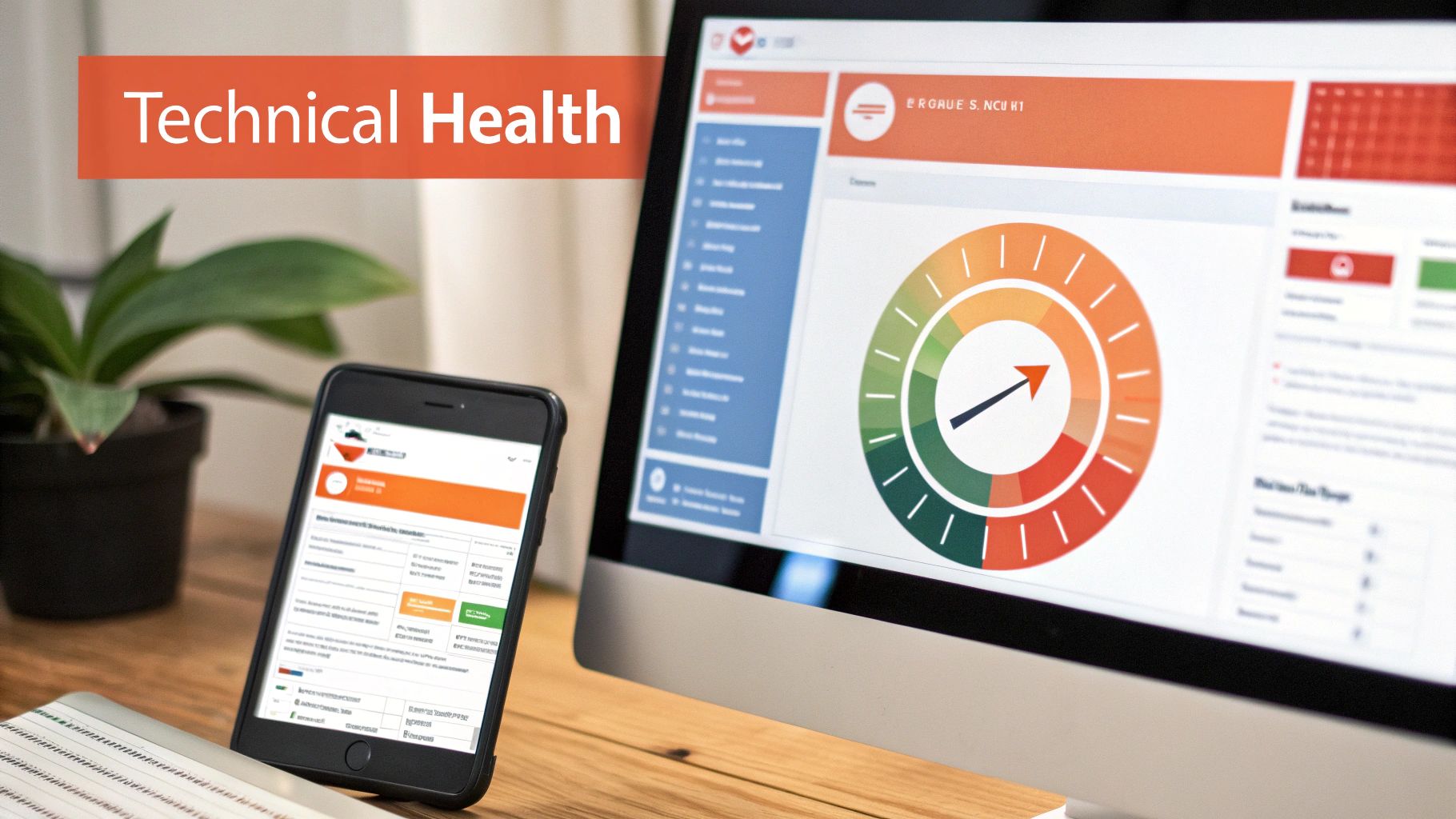
A dashboard like this helps you spot technical issues before they hurt your traffic.
Conduct a Technical Health Checkup
First, get a clear picture of your site’s technical condition. You don't have to be a developer to find common problems. A tool like Google Search Console is essential; it's your direct line to Google, showing you exactly how it sees your site.
Start with crawl errors. These happen when a search engine can't access a page. A few 404 ("Not Found") errors are normal, but a large number could signal bigger structural issues.
Also, check your index coverage report. It tells you which pages Google has indexed and which it has excluded. If important pages are on the "excluded" list, you need to find out why.
Prioritize Site Speed and Mobile Experience
Speed and mobile-friendliness are not optional. Google uses mobile-first indexing, meaning it primarily looks at the mobile version of your site for ranking. A slow, clunky mobile experience is a direct ranking killer.
Focus your efforts here:
- Image Optimization: Large images slow down your site. Always compress images before uploading them.
- Responsive Design: Your website must adapt to fit any screen, from desktops to smartphones.
- Core Web Vitals: These are Google's metrics for user experience, focusing on loading speed, interactivity, and visual stability. Aim for "Good" scores across the board.
SEO-generated leads convert at an average rate of 14.6%, compared to just 1.7% for outbound leads. This stat makes a powerful case for investing in technical fixes, as the organic traffic you gain is far more likely to become revenue. Discover more insights into how organic traffic impacts B2B revenue.
Master Your Site Structure and Security
A clean, logical site structure acts as a roadmap for users and search engines. Keep your hierarchy simple and use breadcrumbs to help bots and people understand where they are.
Also, HTTPS is mandatory. A secure site encrypts data between a user's browser and your server, and Google uses it as a ranking signal. Browsers actively flag non-secure sites, which kills user trust.
Finally, implement structured data (schema markup). This code helps Google understand specific parts of your content, like a product’s price or an FAQ list. Getting this right can earn you eye-catching "rich snippets" in search results, boosting your click-through rate.
Building Authority with Strategic Link Building
Backlinks are like votes of confidence on the web. When a reputable site links to your content, it signals to Google that you are trustworthy and authoritative, which is essential for increasing organic traffic.
Not all links are created equal. A single, high-quality backlink from an industry leader is worth more than hundreds of low-quality links. The goal is quality over quantity—earning the right links to move the needle.
This means focusing on white-hat strategies that build real relationships and provide genuine value.
Focus on Earning, Not Just Building
The most powerful links are earned editorially—when another creator willingly links to your content because it's so valuable. The key is creating "linkable assets."
Here are proven methods for creating content that naturally attracts links:
- Original Research and Data: Conduct a survey or analyze data to create a comprehensive report. People love citing fresh data, making this a reliable way to earn high-authority backlinks.
- Ultimate Guides and Resources: Create the most thorough resource on a specific topic. When you have the definitive guide, others will naturally link to it as a trusted source.
- Free Tools and Templates: Develop a simple calculator, checklist, or template that solves a common problem. These practical resources are incredibly shareable and attract links.
The most effective link-building strategies are rooted in providing value. Shift your mindset from "how can I get a link?" to "how can I create something worth linking to?" and the process becomes more natural and successful.
Proactive Outreach That Actually Works
Creating great content is half the battle; you also have to promote it. Strategic, personalized outreach is about building genuine connections, not sending spammy emails.
Guest posting is a highly effective tactic. Write an article for another reputable blog in your industry. In exchange, you typically get an author bio with a link back to your site. It's a win-win: they get quality content, and you get a relevant backlink and exposure to a new audience.
Another powerful technique is finding unlinked brand mentions. This happens when a site mentions your brand but doesn't link to you. It's low-hanging fruit. A simple, polite email asking them to add the link is often all it takes. To understand the different kinds of links that impact SEO, check this guide on the various types of links you can acquire.
Streamlining Your Link Building Efforts
Manual outreach is effective but time-consuming. Finding prospects, getting contact information, and sending personalized follow-ups can take hours. Automation platforms like BlazeHive can be a game-changer.
Instead of spending dozens of hours on manual outreach with a low success rate, these platforms use AI to connect you with relevant websites that are open to link exchanges. This cuts through the noise and helps you secure valuable placements more efficiently.
So, how do these two methods compare?
Manual vs. Automated Link Building Approaches
The table below breaks down the differences between traditional outreach and a modern, platform-based approach.
| Aspect | Manual Outreach | Automated Platforms (e.g., BlazeHive) |
|---|---|---|
| Time Investment | Extremely high (10-20+ hours/week) | Very low (minimal setup and management) |
| Success Rate | Typically low (2-5% response rate) | Significantly higher due to pre-vetted matches |
| Scalability | Difficult without hiring more people | Easily scalable to acquire multiple links per month |
| Cost | High if outsourcing ($500-$5,000/mo) | Low monthly subscription cost |
By automating the most tedious parts of link building, you can focus on what matters: creating high-quality, link-worthy content that drives your entire SEO strategy.
Answering Your Top Organic Traffic Questions
As you implement these strategies, questions will arise. SEO is a dynamic field. It's normal to wonder about timelines and tactics.
Let's address a few of the most common questions to help you move forward with confidence.
How Long Does It Really Take to See SEO Results?
The honest answer is: it depends. SEO is a long game, not a sprint.
Generally, you can expect to see the first positive signs within 3 to 6 months. But this timeline can shift based on your site's authority, industry competition, and consistency.
In a competitive niche, reaching top rankings could take 6 to 12 months or longer. The key is to know what to look for. Early wins are often subtle. Watch for:
- An increase in impressions in Google Search Console.
- Improved rankings for less competitive, long-tail keywords.
- A slow but steady upward trend in your organic traffic graph.
Patience is crucial. The effort you put in today builds a reliable stream of traffic for years to come.
Content vs. Backlinks: What's More Important?
This is a classic SEO debate. The truth is, they are codependent. You can't have lasting success with one and not the other.
Think of it this way: high-quality content is the engine, but backlinks are the fuel.
Quality content is the foundation of SEO. Without it, search engines have nothing to rank, and other sites have no reason to link to you. But even the best article can get buried without backlinks to signal its authority to Google.
The winning formula is to create outstanding content first, turning it into a "linkable asset." Then, actively promote it to attract valuable links. The two feed each other in a powerful growth loop.
A strong backlink profile and why it matters is built over time with consistent, quality-focused effort.
Can I Get More Organic Traffic Without a Blog?
Technically, yes, but it's much harder.
Without a blog, you would need to focus your efforts on other types of content that can target keywords and earn links.
Your options would include:
- Optimizing Core Pages: Maximizing the SEO value of your main product or service pages to rank for high-intent commercial keywords.
- Building Resource Hubs: Creating massive, detailed guides that aren't structured like a blog but provide immense value.
- Developing Free Tools: Offering simple calculators or interactive widgets that solve a user problem and attract links naturally.
A blog, however, provides a scalable way to target countless informational keywords. It lets you answer customer questions, build topical authority, and consistently produce new assets for link building.
For most businesses, skipping a blog means forgoing the best opportunity for steady, long-term organic growth. It's the most reliable way to connect with people at every stage of their buying journey.
Ready to stop wasting time on manual outreach and start building high-quality backlinks that move the needle? BlazeHive uses AI-powered matching to connect you with relevant websites, making link building efficient and scalable. Discover how BlazeHive can automate your authority building today.