A Practical Guide on How to Get Backlinks Free

Getting free backlinks comes down to two things: creating valuable content and building real relationships. It's a shift in focus. Instead of chasing quick wins, aim to become a trusted authority by offering real value. The best links—the ones that boost your rankings—are a natural result of great content and smart outreach.
Why Earning Backlinks Matters More Than Ever

Before diving into the "how," let's understand the "why." Earning backlinks is a cornerstone of any effective SEO plan.
Think of a backlink as a vote of confidence. When a credible site links to you, it tells search engines like Google, "This page is a trustworthy resource." These editorial endorsements are powerful because they must be earned, not bought.
It proves your content is good enough for another site to stake its reputation on. This creates a sustainable competitive advantage that paid links can't match. Understanding different types of links is key to knowing why earned ones carry more weight.
The Opportunity in a Link-Poor Landscape
Here’s what most people miss: the internet is flooded with content, but most of it has a weak [backlink profile](/tools/free-backlink-checker/). This creates a huge opportunity for anyone willing to put in the work.
A staggering 55.24% of websites have zero referring domains. On top of that, another 29.79% have fewer than three. This data is a roadmap. It shows that even a consistent effort can help you stand out and climb the rankings by building a foundation of authentic links. This highlights the core importance of an SEO strategy and its direct link to results.
This gap is your golden ticket. While competitors chase distractions, your focused investment of time and creativity becomes a powerful differentiator that drives long-term growth.
To give you an idea of the strategies we'll cover, here's a quick summary. Each tactic is designed to get you high-quality, free backlinks by providing value first.
Effective Free Link Building Strategies
| Strategy | Primary Effort | Best For |
|---|---|---|
| Broken Link Building | Finding & Reporting Dead Links | Anyone with a detail-oriented approach. |
| Guest Posting | Content Creation & Outreach | Building authority in a specific niche. |
| Resource Page Links | Finding & Pitching Value-Add Content | Sites with high-quality guides or tools. |
| HARO & Journalist Quotes | Expert Contributions | Founders & experts who can respond quickly. |
| Content Upgrades | Creating Supplemental Assets | Enhancing popular existing content. |
| Skyscraper Technique | Improving & Promoting Content | Ambitious teams with strong content skills. |
These methods are the core of a robust, no-budget link-building plan.
The Undeniable Link Between Links and Rankings
Ultimately, the data doesn't lie. The connection between backlinks and search engine rankings is direct and powerful.
Top-ranking pages on Google have, on average, 3.8 times more backlinks than the pages ranking below them. That single statistic says it all. A strong backlink profile isn't just a "nice-to-have"; it's critical for ranking for competitive keywords.
This guide is your playbook for earning those high-impact links. We’ll focus on proven tactics that work for busy founders and small businesses—all without spending a dime.
Building Relationships Through Digital PR
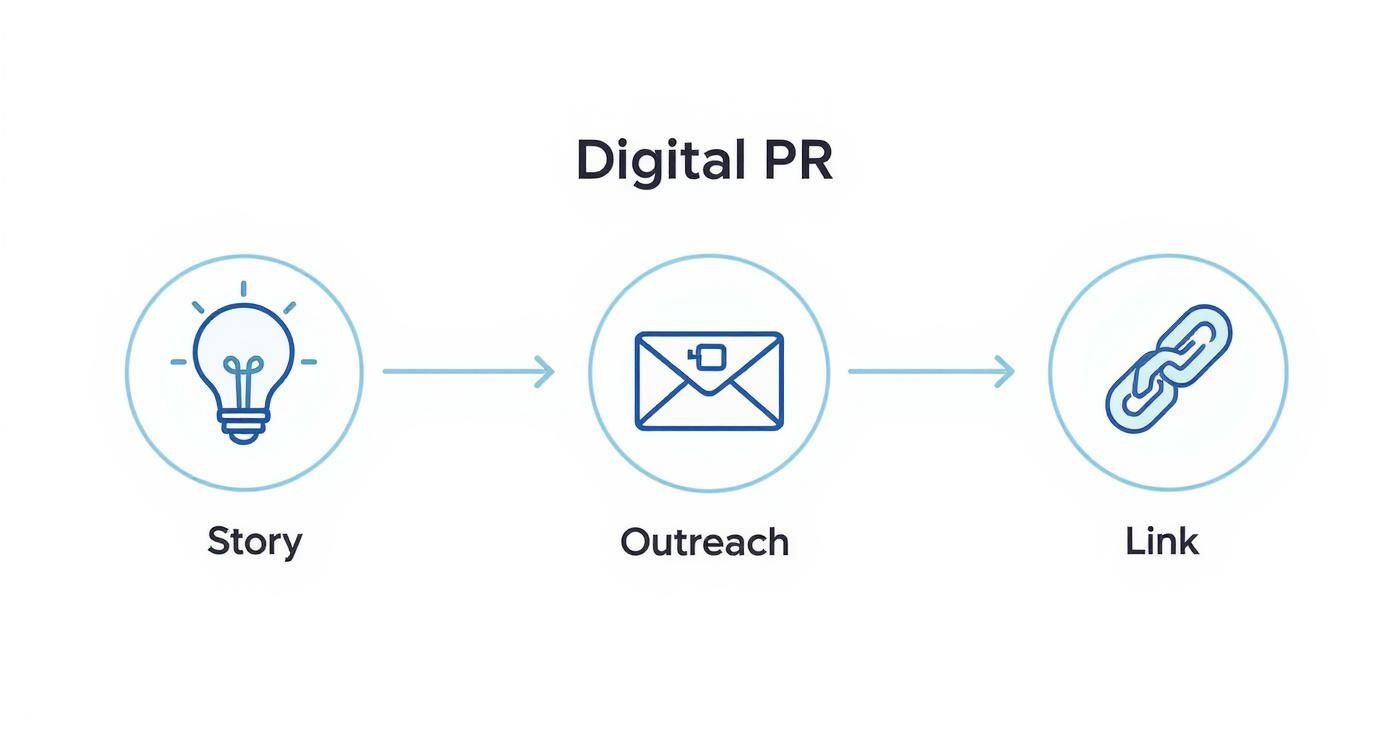
Digital PR is a sustainable, high-impact way to earn free backlinks from authoritative sites. It’s a mindset shift from traditional link building. You're not just asking for a link; you're offering a newsworthy story—a unique data report, an expert take, or a compelling case study that journalists want to cover.
Instead of a solicitor, you become a source. This approach builds links and your reputation as a go-to expert. The result is powerful, editorially-given links that significantly improve your SEO.
Finding Your Angle and Your Audience
First, figure out what makes your business newsworthy. You don’t need a massive PR budget. A killer angle can come from anywhere:
- Original Data: Run a small survey with your customers or analyze public data to spot a new trend.
- Expert Commentary: Share a strong, perhaps even contrarian, opinion on a hot topic in your industry.
- Unique Case Studies: Break down a customer's success story into clear, actionable steps that provide value.
Once you have your story, find the right people to tell. This means building a curated list of journalists, reporters, and bloggers in your industry. A "spray and pray" approach is a waste of time. For personalized outreach, knowing how to find someone's email on LinkedIn is a valuable skill.
The Art of the Personalized Pitch
Let's be blunt: generic outreach emails are dead. To get a response, your pitch must be short, relevant, and personal.
The data backs this up. Digital PR is the go-to tactic for link building, with 89.6% of SEOs calling it their most effective strategy. Why? It’s built on genuine connection. Personalized outreach outperforms generic templates at a 3-to-1 conversion ratio. Simply using a journalist's first name can boost your success rate by 50%. You can explore more stats on effective link building tactics on buzzstream.com.
Your goal isn't to trick someone into linking to you. It's to make their job easier by handing them a compelling story their audience will love. The backlink is a natural byproduct of that value exchange.
Here’s what a personalized pitch that works looks like. It respects the journalist's time and gets straight to the point.
Subject: Data: [Your Industry] Sees X% Shift in [Specific Trend]
"Hi [Journalist's Name],
I saw your recent article on [Their Recent Article Topic] and appreciated your take on [Specific Point].
My team just finished a study on [Your Study Topic] and found that [One-Sentence, Surprising Stat]. This seems to build on your recent coverage.
The full report is here: [Link]. Happy to provide an exclusive quote if it's helpful for your readers.
Best,
[Your Name]"
This approach works. It's specific, shows you've done your homework, and offers immediate value without being pushy. This is how you build real relationships that lead to high-quality, free backlinks for years.
Capitalize on Broken Links and Resource Pages
Sometimes, the best way to get a backlink is to fix what's already broken on the web. That’s where broken link building and resource page outreach come in. These tactics position you as a helpful expert, not just someone asking for a link.
From the site owner's perspective, you're not just asking for a favor; you're offering a solution. You're helping them fix a dead link or improve their content by suggesting a useful resource. It’s a classic win-win that builds relationships and gets you the link.
The Art of Broken Link Building
The internet is full of dead ends—links leading to 404 pages. Broken link building is the simple process of finding these dead links on other sites and offering your content as a replacement. Site owners are often grateful when you point these out, giving you a perfect opening.
Here's the basic workflow:
- Find relevant pages: Use search operators like
"[your topic]" + "resources"or"[your topic]" + "links"to find pages in your niche that link out to other sites. - Scan for dead links: Use a free browser extension like Check My Links to instantly scan the page. Dead links are easy to spot.
- Offer a better alternative: This is the critical step. Your content can't just be a replacement; it must be a genuine upgrade. If the broken link pointed to a basic "10 tips" list, your guide should offer "25 tips with expert commentary."
Your outreach should always lead with helpfulness. The first thing they read should be, "Hey, I found a broken link on your page." Only after providing value should you mention your own content.
This value-first approach is the core of any successful link-building campaign.
As you can see, it all starts with a strong value proposition. Without that, your outreach is just noise.
Pitching Your Way onto Resource Pages
Resource pages are curated lists of the best tools and guides on a given topic. They are goldmines for link builders because their entire purpose is to link out to helpful content. Getting included is a fantastic way to land a contextual backlink that drives relevant traffic.
To find these opportunities, use a few simple Google searches:
"[your topic]" + inurl:links"[your topic]" + "helpful resources""[your topic]" + "useful links"
Once you find a promising page, craft a pitch that shows you’ve read their list and can explain how your resource adds unique value. For inspiration, check out these excellent resource page examples.
Here’s a simple template that starts the conversation:
Subject: A quick thought on your [Topic] resources page
Hi [Name],
I was looking into [Topic] today and found your resource page. It's a really solid collection.
I saw you mentioned [Example Resource A] and [Example Resource B]. We just published a guide on [Your Content Topic] that goes a step further by covering [Unique Feature #1] and [Unique Feature #2].
It might be a nice addition for your readers. Here's the link: [Link to your content].
Either way, keep up the great work.
Best,
[Your Name]
Creating Content That Earns Links Naturally

While outreach is effective, the ultimate goal is creating content so good that people want to link to it without you asking. This is about playing the long game.
Stop thinking in terms of "blog posts" and start thinking in terms of "assets." You're building a library of resources so useful they become the go-to reference in your industry. Journalists and bloggers will find and cite your work because it solves a problem better than anything else.
These assets work for you 24/7, passively attracting links and authority.
Finding Your Content Opportunity
Before writing, find a gap in the conversation. Your niche doesn't need another generic "Top 10 Tips" article.
Find what's missing, outdated, or unhelpful. Google your target keywords and analyze the top results. What questions are people still asking in the comments? What are the common complaints on Reddit or Quora? Look for superficial content you can improve with real data and depth.
Building Your "Link Magnet" Assets
Once you’ve found an opportunity, it’s time to build. Your goal is to create something specifically engineered to be cited.
Here are a few formats that work well:
- Definitive Guides: Create the resource on a topic. Cover every angle, include visuals, and offer actionable steps.
- Original Research & Data: Run a small survey, analyze public data, or synthesize information to reveal a new trend. People love to cite fresh statistics.
- Free Tools & Templates: Build a simple calculator, a handy checklist, or a downloadable template that solves a real pain point.
- Compelling Infographics: Turn complex data into a beautiful, easy-to-understand visual. Then, make it simple for others to embed on their sites.
The shift is from creating disposable content to building durable assets. One phenomenal guide will earn more quality backlinks over its lifetime than 50 mediocre blog posts.
The data backs this up. Content marketing drives 68% of all backlinks that marketers get.
Deeper content moves the needle. A study on link building statistics found that articles over 3,000 words get 3.5 times more backlinks than shorter pieces. Multimedia also helps—posts with more than three videos attract 55% more links.
The lesson is clear: earning links organically is a value game, not a volume game.
Strategic Guest Posting and Collaborations
Guest posting remains a reliable way to earn great backlinks, but the game has changed. The old approach of blasting articles to any blog that would accept them is gone. Today, one high-authority guest post is worth more than ten links from low-quality sites.
Stop thinking of it as "getting a link." Frame it as a strategic collaboration. You're offering your expertise to benefit another site's audience. This shift forces you to focus on quality and relevance—exactly what Google wants. The goal is to be a valued contributor, not just someone asking for a favor.
Finding and Vetting the Right Opportunities
First, find blogs and publications where your ideal customers hang out. Don't just chase sites with a high Domain Authority (DA); context is king.
Uncover these opportunities with smart Google searches:
"[your topic]" + "write for us""[your topic]" + "guest post guidelines""[competitor name]" + "guest post by"
Once you have a list, investigate each site. Are they publishing content regularly? Do people comment and share articles? If a blog looks like a ghost town or a "guest post farm," steer clear. Those links won't help your rankings.
Pitching with Value, Not Just an Idea
Your pitch email is your one shot to make a good impression. A generic template will be deleted instantly. A winning pitch proves you've done your homework and have something valuable to offer their audience.
Don't just pitch a vague topic. Pitch a compelling story or a unique angle that solves a real problem for their readers.
A great pitch makes the editor's job easy. It clearly outlines the value and shows you understand their content.
For example, instead of, "A Guide to Email Marketing," try: "How SaaS Founders Can Use a 3-Part Welcome Sequence to Cut Churn by 15%." The second pitch is focused, promises a tangible result, and speaks to a niche audience. It shows you're there to deliver expertise.
Beyond the Blog Post: Other Collaborations
Don't limit yourself to writing articles. Thinking bigger about "collaborations" can unlock amazing backlink opportunities and build your authority.
Explore these other avenues:
- Podcast Appearances: Being interviewed on a relevant podcast almost always gets you a backlink in the show notes.
- Expert Roundups: Contribute a short quote or tip to a bigger article, and you get a link back. This is a low-effort, high-reward tactic.
- Webinar Co-Hosting: Team up with a complementary business to host a webinar. This can generate links from promotional materials and recap articles.
All these methods follow the same rule: give away real value. When you share your expertise generously, visibility and high-quality backlinks will follow.
How to Know if Your Link Building Is Actually Working
Getting free backlinks requires consistent effort and smart tracking. If you don't measure your progress, you're just guessing. A simple tracking framework helps you see which strategies are working and which aren't.
Move past just counting links. Focus on the metrics that signal a real boost in your website's authority and search visibility.
The Metrics That Really Matter
When starting your link-building efforts, it's easy to get lost in data. Focus on a few key metrics that tell the true story of your progress.
Here’s what to track:
- New Referring Domains: This is your most important metric. Ten links from ten different websites are far more valuable than ten links from the same site. It signals to search engines that a wide variety of sources trust your content. Learn more in our guide on what is a referring domain.
- Domain Authority (DA) of Linking Sites: Not all links are created equal. A backlink from an established authority is worth more than one from a new blog. Track the average authority of the sites linking to you to ensure you're earning links that move the needle.
- Organic Traffic Growth: This is the ultimate goal. The point of building links is to rank higher and get more traffic. Watch your organic traffic in Google Analytics for a steady upward trend over a few months—that's proof your hard work is paying off.
Remember, link building is a marathon, not a sprint. You won't see a huge traffic spike overnight. The payoff comes from the slow, steady accumulation of quality links that build trust with search engines.
Setting Realistic Goals and Measuring Your Return
It’s important to set achievable goals. Brands actively building links grow organic traffic two times faster than competitors who ignore it.
What's a realistic target?
For a newer site, aiming for 5-10 quality free links per month is a great starting point. For established websites, shooting for 15-25 links a month signals healthy, natural growth.
While the main investment is your time, the data shows it's worth it. A recent report on link building ROI found that 78% of marketers see a positive return on their link-building efforts, confirming its long-term value.
Got Questions About Free Backlinks? Let's Clear Things Up.
When starting with link building, it's easy to have questions. Knowing what to expect and where to focus your energy is half the battle. Let's tackle a few common ones.
The big one is timing: "How long until I see results?" While you might land a few links in the first few weeks, think of this as a long-term strategy. Most SEOs expect to see a noticeable bump in rankings and traffic after at least 3 to 6 months of consistent work. The trade-off for "free" is time and persistence, but the quality links you earn this way have serious staying power.
What's the Difference Between a Good and a Bad Backlink?
Getting this right is fundamental. Not all links are created equal, and knowing the difference protects your site.
A good backlink:
- Comes from a respected, relevant website in your industry.
- Is placed naturally within the content, not in a footer or sidebar.
- Sends interested visitors to your site (referral traffic).
A bad backlink is usually from a spammy, low-authority, or unrelated site. These can do more harm than good. A simple rule: if you wouldn't be proud to show the link to a client, you probably don't want it.
Modern link building is a value exchange. Emailing people to ask for a link without offering something in return is a waste of time. Your success rate will be near zero.
Before you hit "send" on an outreach email, ask yourself, "What's in it for them?" Maybe you're pointing out a broken link, offering a great guest post, or providing a better resource for their audience. Always lead with how you can help. This small shift in mindset changes you from a random person asking for a favor into a potential partner.
Ready to stop the manual grind and start earning backlinks on autopilot? BlazeHive uses AI to find perfect, niche-relevant link exchange opportunities, saving you time and money. Join for free and get your first backlink in days.