Mastering Guest Posting Outreach for High-Quality Backlinks

Guest posting is a strategic way to build relationships and provide real value, not just a numbers game of sending emails. Done right, it earns high-quality backlinks, drives targeted traffic, and builds your brand's authority. This guide covers how to succeed, starting long before you hit "send."
Building Your Strategic Foundation
A winning guest posting campaign starts with a solid plan. Skipping this step isn't outreach; it's spam. This planning phase helps you identify the perfect partners whose audience mirrors your own.
First, define success. Are you trying to boost your site’s domain authority, drive converting referral traffic, or establish your founder as a go-to expert? Your goals shape your entire approach.
- For SEO Authority: Target sites with strong backlink profiles. One high-quality link is worth more than ten weak ones. Understanding what a referring domain is is key.
- For Referral Traffic: Focus on blogs with high organic traffic and an engaged community. Look for active comment sections and social shares.
- For Lead Generation: Find platforms where your ideal customers gather. The traffic must be hyper-relevant.
Creating Your Ideal Publisher Profile
With your goals set, create a profile of your ideal publisher. Go beyond a simple Domain Authority (DA) score. Use tools like Ahrefs or Semrush to analyze the metrics that truly matter.
This process is a systematic flow from goals to a vetted list of opportunities.
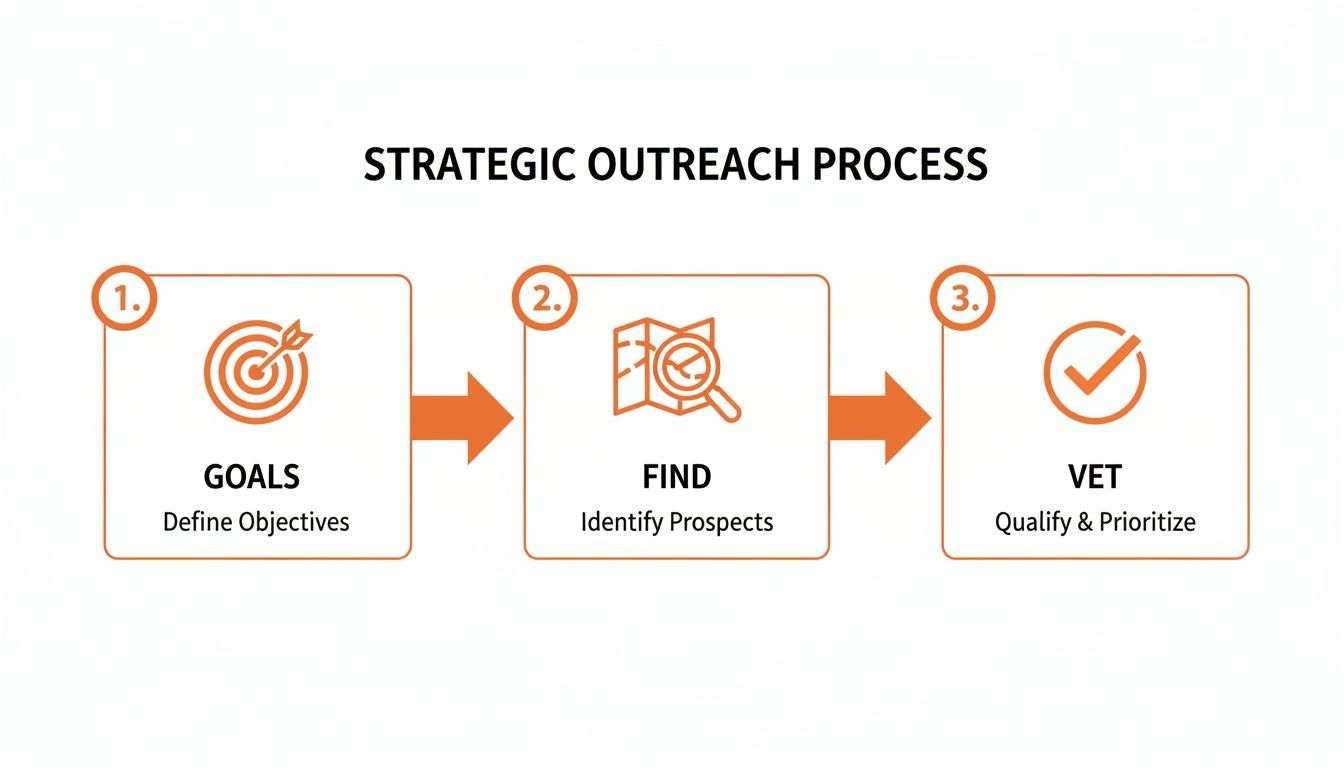
A methodical approach is crucial. Start with your "why" before you decide on the "who."
Vetting Prospects: Beyond Surface-Level Metrics
Be ruthless when vetting prospects. A high DA is useless if the site gets no traffic. An analysis of over 26,000 guest post sites found that 19% get 0-100 visits per month. This proves you can't rely on vanity metrics alone.
Focus on what's important. Here are the key metrics to check before adding a site to your outreach list.
Key Metrics for Vetting Guest Post Prospects
This table outlines essential metrics for evaluating potential guest post sites, helping you prioritize high-value opportunities.
| Metric | What It Measures | Why It Matters for Outreach | Ideal Range |
|---|---|---|---|
| Domain Rating (DR/DA) | A website's overall [backlink profile](/tools/free-backlink-checker/) strength. | A proxy for link equity. Higher DR/DA sites pass more "link juice." | 50+ for high impact, 30+ for niche sites. |
| Monthly Organic Traffic | Estimated visitors from search engines. | Shows the site has a real, active audience for your content. | 1,000+ monthly visits is a good start. |
| Traffic Value | The estimated PPC cost for the site's keywords. | Indicates the commercial value of the site's audience. | Varies by niche, but higher is better. |
| Topical Relevance | How closely the site's content aligns with yours. | Ensures your content is a natural fit for a receptive audience. | The site should be in your industry or a related vertical. |
These data points together give a clearer picture than any single metric. A DR 40 site with 50,000 monthly visitors is often better than a DR 70 site with 1,000 visitors.
Beyond numbers, look for signs of life. Are there thoughtful comments? Does the owner promote content on social media? These qualitative signals point to a thriving community where your content can make an impact.
A great guest post target isn't just a website with good numbers; it's a thriving community where your content can genuinely contribute and solve problems for readers.
Finally, build a system to keep your pipeline full. Monitor keywords related to your industry and guest posting. Setting up alerts can be a game-changer. This guide on How to Set Up Google Alerts is a great starting point. This ensures you're always discovering new opportunities.
Crafting Outreach That Actually Gets a Response
You've built your prospect list. Now comes the part where most campaigns fail: the outreach.
Sending a generic, copy-paste template is a waste of time. It’s the fastest way to get your email ignored, deleted, or marked as spam. To cut through a crowded inbox, you must show you've done your homework and want to provide value.
The goal is to start a real conversation with an expert, not just get a backlink. Shift your mindset from "what can I get?" to "what can I give?" An effective pitch respects an editor's time, proves your expertise, and makes it obvious how your content will benefit their audience.
Moving Beyond "Hey, I Liked Your Post"
Using a first name is the bare minimum, not personalization. To make a real impression, find a specific, recent point of connection that feels authentic.
A focused 5-minute research sprint is all you need to find the perfect hook.
- Scan recent articles: Reference a specific point from a post published last week, not six months ago. Freshness matters.
- Check their social media: Did they just speak at a conference or share a strong opinion on LinkedIn? Mention it.
- Listen to podcast appearances: Citing an insight they shared on a podcast shows you’re paying close attention.
This detail immediately shows your email isn't a mass blast. It proves you respect their work and establishes common ground before you make your ask.
The Value-First Pitch Framework
Think in flexible frameworks, not rigid templates. A winning pitch has three parts: the personalized hook, the value proposition, and a clear, low-friction ask. This structure provides a proven foundation you can adapt for any prospect.
Here’s a great example of a pitch that nails this by showing genuine research and offering clear value.

This email works because it connects a topic they've already covered with a fresh, valuable angle. It feels like a natural addition to their content calendar, making the editor's job easy.
A powerful value proposition is the heart of your pitch. It’s the irresistible offer that makes an editor think, "I need this for my readers."
Your pitch needs to solve a problem for the editor. That problem could be filling a content gap, providing fresh data, or offering a unique perspective on a familiar topic.
This value-first approach gets results. A SaaS startup I know ran a campaign where every email mentioned a recent article, offered exclusive data, and proposed unique angles. Their acceptance rates soared past the industry average.
Crafting Irresistible Topic Ideas
Your topic ideas are your currency. Vague pitches like "10 Tips for Digital Marketing" are dead on arrival. Propose specific, compelling ideas tailored to the site's audience.
- The Fresh Angle: Take a trending topic and offer a contrarian view. Instead of "Using AI in Marketing," pitch "How Small Ecommerce Brands Can Use AI to Cut Customer Support Time in Half."
- The Data-Driven Insight: Offer a post based on original data from a survey or case study. Editors love exclusive data.
- The Problem-Solution Masterclass: Identify a common pain point for their audience and pitch a comprehensive, step-by-step guide to solving it.
Present your ideas as three distinct bullet points. This gives the editor choices and shows you've put real thought into your contribution.
Finally, a great pitch is useless if it's never seen. The technical side of outreach is crucial. To ensure your emails don't end up in spam, review a solid guide to email deliverability.
From 'Yes' to a Published Post
Getting a "yes" from an editor is the starting line, not the finish. The real work is just beginning.
How you handle the next steps—from writing to post-publication promotion—separates a one-off backlink from a lasting partnership. Your goal is simple: make the editor's life as easy as possible. A smooth, professional process makes you stand out and gets you invited back.
Crafting Content That Blends In
The best guest posts don't feel like guest posts. They should match the host blog's tone, style, and formatting perfectly. Think of yourself as a temporary part of their team.
Before you start writing, immerse yourself in their content.
- Listen to their voice: Is it casual and humorous or formal and data-driven? Mirror that tone.
- Study their structure: Note their paragraph length, heading formats, and use of bolding. Mimic everything.
- Find internal linking opportunities: Proactively find places in your draft to naturally link to their other posts. This shows you care about their site's health, not just your own link.
This extra effort saves the editor time and makes you look like a pro. Most people skip this, so doing it will immediately set you apart.
The Art of Placing a Natural Link
Let's be honest, you're doing this for the backlink. But you have to earn it. Forcing a keyword-stuffed link into your article is the quickest way to get it removed or have the piece rejected.
Your link should feel like a helpful, logical next step for the reader. For example, if you're writing about email deliverability and mention sender reputation, it’s the perfect spot to link to your comprehensive guide on that topic. It adds value.
A great backlink serves the reader first and your SEO second. If it doesn’t genuinely help the reader, it doesn’t belong.
Your author bio is your other prime real estate. Keep it short, state who you are, what you do, and include one strong link to your homepage or a key social profile. A single, focused link is all you need.
Keep the Relationship Going After Publication
Once your article is live, your job isn't done. Show you’re a true partner, not just a content-dropper. Help drive traffic and engagement to their article, which makes everyone look good.
Here's a simple post-publication checklist:
- Share it everywhere: Post the article on your social channels, tagging the host blog and editor.
- Tell your email list: Share the guest post with your newsletter audience as social proof.
- Jump into the comments: For the first few days, monitor and respond to every comment to show you're invested in their community.
- Send a simple thank you: A week later, send the editor a quick email. Thank them and share a win, like "My newsletter drove over 150 clicks to the post!"
This follow-through solidifies your reputation. You become a reliable contributor, not just a random pitcher. That’s how you get invited back.
How to Measure and Scale Your Outreach
Running a guest post campaign without tracking results is like flying blind. You need to measure real business impact to turn your outreach into a predictable growth engine.
Effective measurement connects your outreach efforts to your bottom line. It reveals which posts drive converting traffic, which links boost keyword rankings, and which partnerships deliver the best return. This data-driven mindset separates pros from amateurs.

Defining Your Key Performance Indicators
Before you can measure success, define it for your business. Your Key Performance Indicators (KPIs) should tie directly to your initial goals. Forget vanity metrics and focus on what moves the needle.
These are the essential KPIs for a clear picture of your guest-posting ROI.
To get a complete picture of your campaign's performance, track a mix of traffic, conversion, and SEO metrics. The table below outlines the core KPIs for your dashboard.
Essential KPIs for Guest Posting Outreach
Track these key performance indicators to accurately measure the impact and ROI of your guest posting campaigns.
| KPI Category | Specific Metric | How to Track It |
|---|---|---|
| Traffic Impact | Referral Traffic | Use Google Analytics to monitor visitors from your guest post links. High traffic indicates a relevant, engaged audience. |
| Business Growth | Leads & Conversions | Set up Goal Tracking in Google Analytics to see how many referred visitors sign up, start a trial, or make a purchase. |
| SEO Performance | Keyword Ranking Lifts | Use a tool like Ahrefs or Semrush to monitor SERP positions for pages you're building links to. |
| Authority Building | Backlink Profile Growth | Track your total number of referring domains and Domain Rating. Learn more in our guide on what is a backlink profile. |
Monitoring these metrics helps you connect outreach activities to tangible business results, making it easier to justify and scale your efforts.
When these metrics align, the results can be massive. One B2B SaaS client saw a 340% increase in organic traffic within six months from strategic guest posting, which led to a 25% jump in trial sign-ups, proving the direct line from outreach to revenue.
Building a System to Scale Your Outreach
Once you know what works, scale up without sacrificing quality. Scaling guest posting means building a repeatable, efficient system, not just sending more generic emails.
A tiered outreach strategy is your best friend here. Not all opportunities are equal, so you shouldn't treat them that way.
Scaling effectively means dedicating the most personalization to your highest-value targets while streamlining your process for secondary opportunities. This optimizes your time and maximizes your impact.
Segmenting your prospect list into tiers helps you manage resources effectively.
Structuring Your Campaign Tiers
A tiered approach focuses your energy where it counts most. By sorting prospects into categories, you can customize your personalization and follow-up, making your workflow more efficient.
| Tier | Prospect Profile | Outreach Approach | Goal |
|---|---|---|---|
| Tier 1 | "Dream" sites: industry leaders, high DR, perfect audience fit. | Hyper-personalized: Deep research, custom pitches, relationship focus. | Secure high-authority, needle-moving backlinks and build strategic partnerships. |
| Tier 2 | Strong, relevant blogs with good traffic and engaged audiences. | Semi-personalized: Use a proven framework but customize key details. | Consistently build quality, relevant links to support SEO. |
| Tier 3 | Niche blogs or newer sites with good potential and relevance. | Streamlined: Use a refined template with minimal personalization. | Increase the volume of relevant referring domains efficiently. |
This tiered system creates a workflow that is both effective and sane. For Tier 1 targets, you might invest 30-45 minutes on one perfect email. For Tier 3, you might only spend 5-10 minutes.
Leveraging Tools for Efficiency
To make this scaled approach work, you need the right tools. A spreadsheet works at first, but as you grow, dedicated outreach platforms like Pitchbox, Mailshake, or BuzzStream are game-changers.
These tools help you:
- Streamline Prospecting: Quickly find and vet potential sites.
- Automate Follow-ups: Schedule and send follow-up emails automatically.
- Track Performance: Get a clear view of open rates, reply rates, and conversions.
- Manage Relationships: Keep a central hub of all conversations so nothing is missed.
By combining a smart, tiered strategy with the right technology, you can turn guest posting from a manual chore into a scalable growth channel. You'll build the right links more efficiently, ensuring every effort contributes to your core business goals.
Common Guest Posting Mistakes That Will Sink Your Campaign
Even with a solid plan, it's easy to make mistakes in guest posting. These aren't just small stumbles; they're errors that get your emails ignored, waste time, and can even tarnish your brand's reputation.
Let's review the most common pitfalls so you can avoid them.
Chasing Vanity Metrics Like Domain Authority
One of the biggest blunders is an obsession with vanity metrics like Domain Authority (DA). A high DA score is a hollow victory if it's the only thing you consider. A site with high DA but zero engagement, irrelevant content, or a poor reputation is worthless.
A guest post on a respected DA 40 blog that your target audience reads daily is far more valuable than one on a generic DA 80 site in an unrelated field. Always prioritize relevance and an engaged audience over a number.
Sending Generic, Uninspired Pitches
The fastest way to the trash folder is an email that screams "I don't know who you are." Editors can spot a copy-and-paste template instantly. If your pitch starts with "Dear Sir/Madam" or offers a bland topic like "10 Tips for Success," you've already lost.
Your pitch has one job: to prove you've done your homework.
- Lazy Personalization: Getting their name wrong or citing an old blog post shows you don't care.
- Vague Topic Ideas: Proposing overly broad topics or ones they've already covered is an instant red flag.
- "Me, Me, Me" Language: Focusing on what you want (a backlink) instead of the value you can provide their readers is a huge turn-off.
The fix? Spend five minutes researching. Find a recent article you liked, mention a recent social media post, or pitch a topic that fills a clear content gap. It makes all the difference.
Submitting Low-Quality or Spun Content
Getting a "yes" from an editor is a great feeling. Don't ruin it by submitting a poor-quality article. Sending a poorly written, thinly veiled advertisement for your company is a fast way to get blacklisted and burn that bridge for good.
Editors have standards. Violating their trust with subpar content is disrespectful.
Your guest post is a direct reflection of your brand's quality. Submitting anything less than your best tells an editor you're a link-hungry marketer, not a valuable partner.
Always deliver a polished, well-researched article that meets their guidelines. Make your link feel earned, not forced. If you're unsure how, our guide on the different types of links can help you weave them in naturally.
Having a Transactional Mindset
This may be the most critical mistake: treating guest posting as a one-off transaction. The goal isn't just to get a backlink and disappear. The real value comes from building genuine relationships with editors.
A transactional mindset means you miss out on turning one successful post into a regular column, a podcast appearance, or a deeper strategic partnership.
Instead, after your post is live, share it with your audience, engage in the comments, and send a thank-you email to the editor. These small gestures show you're a true partner, not just another person asking for a link.
Your Burning Guest Posting Questions, Answered
If you're new to guest posting, you likely have questions. This area is full of conflicting advice, so let's get straight to the answers for the most common questions.
How Many Emails Does It Realistically Take to Land One Guest Post?
There's no magic number. It all depends on the quality of your outreach.
If you build a targeted prospect list and personalize your emails, you can expect an 8-15% response rate. That means every 7-12 well-crafted emails should land one placement.
On the other hand, if you blast a generic template to a huge list, you'll be lucky to get a 1% response rate. This is why quality beats quantity. Your time is better spent on a small, hyper-targeted list.
The only metric that truly matters is your acceptance rate, not your email volume. A handful of thoughtful pitches to your dream sites will always outperform a hundred generic blasts.
Is It Okay to Pay for Guest Posts?
This is a gray area. Directly buying links from sites that exist only to sell them is a fast track to a Google penalty. Avoid any site that openly advertises "guest posts for sale" without an editorial process.
However, many legitimate, high-authority publications charge "editorial fees" or "processing fees." These cover the time their team spends reviewing, editing, and publishing your content, not the link itself.
The key is to tell the difference. Look for sites with a real readership, strict editorial guidelines, and a clear publishing process. If they care about content quality, it's a good sign. If it feels purely transactional, it probably is.
What Are the Best Outreach Tools for Someone Just Starting Out?
You don’t need an expensive software suite to get started. A simple, effective tech stack is all you need.
- Finding Opportunities: SEO tools are your best friend. Start with Ahrefs' Content Explorer or Semrush's Link Building Tool to find sites linking to your competitors.
- Finding Emails: Once you have targets, a tool like Hunter or Snov.io is perfect for finding the right email addresses.
- Tracking Everything: A simple Google Sheet is all you need initially. Use it to track who you've contacted, when you followed up, and the status of each pitch.
As you scale, you can explore dedicated platforms like Pitchbox or Mailshake. But for now, keep it simple.
How Long Should My Outreach Email Actually Be?
Short. Really short.
The editor on the other end is busy. A wall of text will be deleted. Be clear, compelling, and respectful of their time. Aim for 100-150 words, maximum.
Here’s a structure that works:
- Personalized Opener: One genuine sentence about their work.
- The Pitch: One sentence explaining your idea and why it's a fit for their audience.
- The Outline: Two or three bullet points teasing the article's key takeaways.
- Quick Credibility: A brief mention of who you are and why you're qualified.
- Simple CTA: End with a low-pressure question like, "Is this something you'd be interested in?"
This format is scannable, confident, and makes it easy for an editor to say "yes."
Ready to stop the manual grind of cold outreach? BlazeHive uses AI to match you with relevant websites for backlink opportunities, automating your entire link-building process so you can focus on growth. Get your first high-quality backlinks with BlazeHive.