A Modern Guide to Guest Blogging Outreach

Guest blogging outreach is connecting with editors to publish your content on their sites. It's a proven way to build quality backlinks, boost brand visibility, and drive targeted traffic to your website. The strategy is simple: offer genuine value by providing another site's audience with great content.
Why Guest Blogging Still Drives Growth
Some dismiss guest blogging as an old SEO tactic, but done right, it's a powerful growth engine. It’s more than just link building; it's a smart strategy for establishing your authority and building real industry connections. A well-placed guest post puts your brand in front of an engaged, relevant audience.
Think of it as a win-win partnership. You provide valuable content their audience loves, and in return, you gain credibility, visibility, and a powerful backlink. This signals to search engines that your site is a trustworthy source. To understand how these links boost your SEO, it helps to know the different types of links you can build.
The Modern Value of Outreach
In a world full of content, smart guest blogging outreach helps you stand out. It’s a direct way to build relationships with key people in your niche, leading to other opportunities like collaborations or co-marketing campaigns. The process also sharpens your brand message by forcing you to identify what resonates with your ideal audience.
The commitment to this strategy remains strong. Recent data shows that 60% of bloggers write between 1 and 5 guest posts per month, with most managing their own outreach. This highlights that a personal, strategic approach delivers consistent wins. You can explore more of these blogging trends here.
Guest blogging is about creating value in someone else's ecosystem. When you focus on helping their audience, you naturally build the authority and trust that drives your brand's long-term growth.
Modern guest blogging isn't a numbers game of blasting out generic emails. It's a targeted, relationship-driven discipline. It’s about finding the perfect intersection of your expertise and a platform's audience, ensuring every article educates readers and grows your business.
Finding and Qualifying the Right Partners
A successful guest blogging campaign starts before you write a single email. It begins with finding the right platforms—websites where your content will connect with an audience that cares. Spraying pitches blindly is a surefire way to waste time.
Your first task is to build a targeted list of potential partners. This means going beyond basic Google searches like "[your niche] + write for us". A strategic prospecting approach ensures every pitch is aimed at a target that can genuinely move the needle for your business.
The process is straightforward, but execution is key.
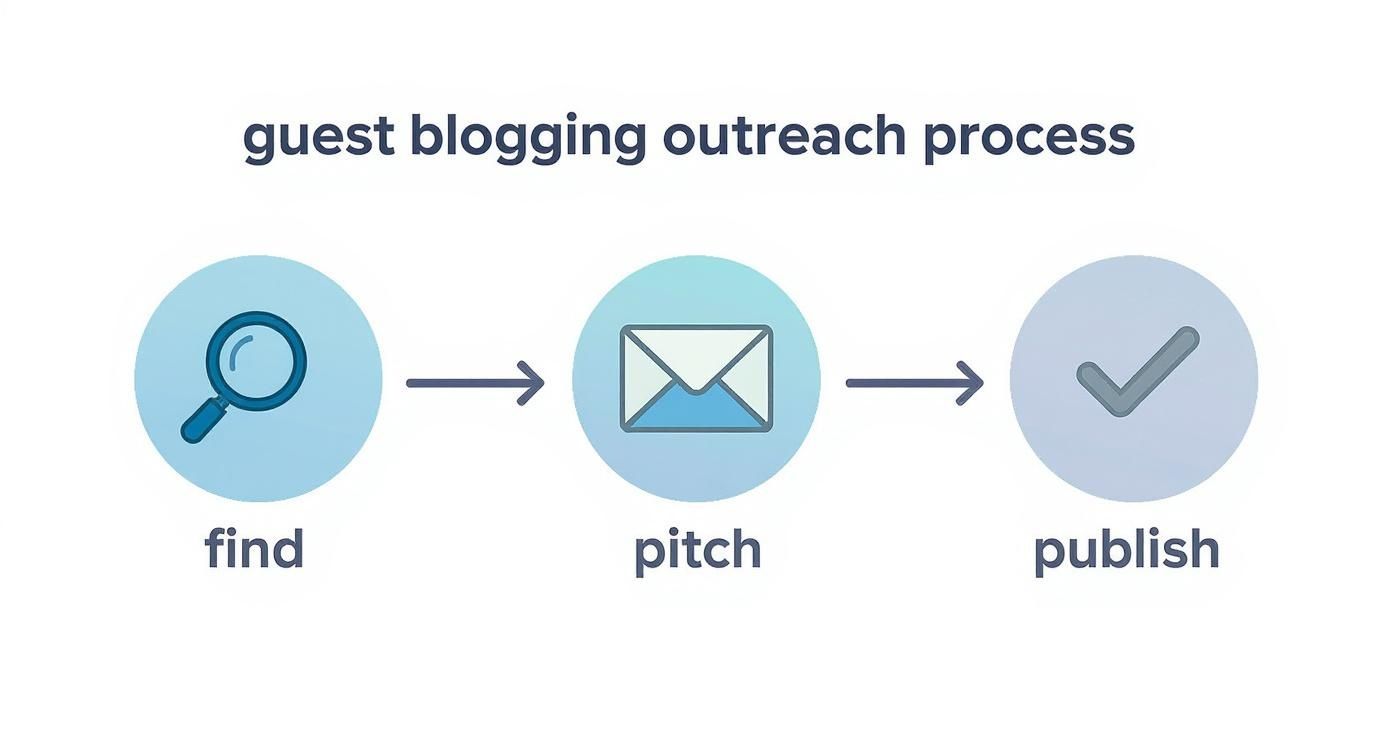
This simple framework—find, pitch, publish—transforms a chaotic task into a repeatable system.
Uncovering Opportunities Like a Pro
To find the best blogs to pitch, think like a detective. A great place to start is with your competitors. Use a tool like Ahrefs or Semrush to analyze their backlink profiles. This is a goldmine for discovering websites that publish content in your niche and are open to guest contributors.
Another smart tactic is to find prolific guest authors in your space. A quick search for "Author Name" + "guest post by" often reveals a ready-made list of sites they've written for. These are proven targets you can add to your list.
If you have the budget, specialized outreach platforms like Pitchbox or BuzzStream can accelerate the process. They help you find and filter prospects using key metrics like Domain Rating or organic traffic, saving you hours of manual work.
The quality of your prospect list determines the success of your outreach campaign. A smaller list of highly relevant, vetted sites will always outperform a massive list of low-quality targets.
The Essential Qualification Checklist
Once you have a list of potential sites, it's time for the most critical step: qualification. Not all blogs are created equal. Your job is to separate high-authority partners from low-value link farms to ensure your effort pays off.
Run every potential site through this checklist:
- Audience Relevance: Does this blog's audience match your ideal customer? Read a few posts and scan the comments. If their readers aren't your potential customers, the referral traffic will be worthless.
- Organic Traffic: A site's traffic signals its health. Use a tool like Similarweb or Ahrefs to check its monthly organic visitors. Look for steady or growing traffic.
- Domain Authority (DA) or Domain Rating (DR): These metrics from Moz and Ahrefs offer a quick snapshot of a site's authority. While not the only factor, they're a solid benchmark. Aim for sites with a DR similar to or higher than yours.
- Engagement Signals: Look for signs of an active community. Do people comment on posts? Are articles shared on social media? An engaged community is far more valuable than a digital ghost town.
- [Backlink Profile](/tools/free-backlink-checker/) Quality: A site is known by the company it keeps. Check who links to them to see if they associate with spammy websites. It's also vital to understand what a referring domain is and why a diverse set of quality links matters.
- Content Quality and Frequency: Does the blog publish well-researched, insightful content regularly? Avoid sites that churn out thin articles or haven't been updated in months.
By rigorously applying these filters, you'll build a list of A-tier partners. This methodical approach is the foundation of any high-impact guest blogging outreach strategy.
Crafting Pitches That Editors Actually Read
Your pitch is your first and often only impression in an editor's crowded inbox. A generic, copy-pasted template is a ticket to the trash folder. A thoughtful, personalized pitch starts a real conversation.
The goal isn't just to get your email opened; it's to make the editor want to reply. Shift your mindset from "What can I get?" to "Here's how I can help your audience." A great pitch shows you understand their needs and have arrived with a solution, not just a request for a backlink.

Your pitch must instantly communicate three things: you know who they are, you understand their audience, and you have something valuable to offer.
The Anatomy of a Standout Pitch
A winning pitch combines a few key ingredients that show genuine interest and clear value. It's about understanding the human psychology of what makes a busy editor interested.
Here’s what every successful pitch includes:
- A Subject Line That Earns the Click: Ditch the clickbait. Be clear and professional. "Guest Post Idea for [Blog Name]" or "A couple of content ideas for you" are straightforward and effective.
- The Personalized Opener: Prove you’ve done your homework. Reference a recent article they published, mention a podcast they appeared on, or point out something specific you admire about their brand. This simple step separates you from 90% of the pitches in their inbox.
- The Value Proposition: This is the core of your pitch. Don't just mention an idea; explain why it's a perfect fit for their audience. Show how it connects to their existing content or fills a gap you've identified.
This structure makes the editor's job easy. They can see who you are, what you're proposing, and the value for them in seconds.
Good vs Bad Pitch Examples
Seeing examples makes the theory clear. Imagine you're pitching a blog about productivity for remote teams.
The Bad Pitch (Generic & Self-Serving):
Subject: Guest Post Submission
Dear Editor,
I am a big fan of your blog. I have been reading it for a long time. I have a guest post idea that would be great for your site. It is about remote work. Please let me know if you are interested so I can send it over.
Thanks,
[Your Name]
This email is impersonal, vague, and puts all the work on the editor. It screams, "I just want a link."
The Good Pitch (Personalized & Value-Driven):
Subject: Idea for your remote work series
Hi [Editor's Name],
I just finished your article on "The Burnout Epidemic in Hybrid Teams" and loved your point about asynchronous communication.
It got me thinking—you've covered the problems of remote burnout well, but your audience might benefit from a tactical guide on preventing it. I'd love to write a piece for you called: "Beyond Zoom: 5 Asynchronous Workflows That Reduce Team Burnout."
I can cover practical examples using tools like Slack, Loom, and Notion to give your readers actionable steps. I've written on similar topics for [Site A] and [Site B] if you'd like to see samples.
What do you think?
Best,
[Your Name]
The difference is clear. This pitch is specific, shows familiarity with their content, and offers a concrete solution that helps their readers. It proposes a partnership, not a transaction.
The Art of the Follow-Up
Editors are busy. A lack of response isn't always a "no"; it often means your email got buried. A polite follow-up can get your pitch the attention it deserves. The key is to be persistent without being a pest.
A simple follow-up sequence builds rapport. The goal isn't to pressure them but to gently remind them of the value you're offering and make it easy for them to say yes.
Here’s an effective cadence:
- First Follow-Up (3-5 business days later): Keep it short. Reply to your original email and say, "Just wanted to follow up on this idea in case it got buried. Let me know if you think it's a good fit!"
- Second Follow-Up (Another 5-7 business days later): Add a little more value. Offer an alternative topic or link to a new stat that supports your pitch. This shows you're still thinking about how to help them.
If you don’t get a reply after two follow-ups, it's best to move on. Your time is better spent on new opportunities. As these guest posting findings show, a well-executed outreach strategy has a direct impact on your traffic, rankings, and lead generation.
From 'Yes' to Published High-Value Content
Getting a "yes" is the starting line, not the finish. Now the real work begins: creating a standout piece of content that builds your authority and drives results.
How you handle this phase can be the difference between a one-time link and a long-term partnership. Your goal is to make the process so seamless and professional that the editor wants to work with you again.
Clarifying the Terms of Engagement
Before you write a single word, get clear on the specifics to avoid future headaches. A quick, polite email to confirm the details shows professionalism and respect for everyone's time.
Here’s what you need to confirm:
- Backlink Specifics: How many links are allowed? Will they be dofollow or nofollow? This directly impacts your SEO value, so don't hesitate to ask.
- Author Bio Guidelines: Can you include a link in your bio? Are there character limits? Knowing this helps you craft a bio that drives traffic back to your site.
- Content and Formatting: Confirm the target [word count](/tools/word-counter/), any specific formatting rules (like image sizes or heading structure), and their preferred submission format (e.g., Google Doc).
- Promotion Plan: Ask how they promote new articles (email list, social media). This gives you a sense of the potential reach.
Clarifying these points upfront sets a collaborative and professional tone.
Crafting an Unforgettable Guest Post
Once the terms are clear, it's time to write an article that exceeds expectations. This post is your business card and brand's first impression. A generic post won't impress anyone.
First, structure the post for readability with clear headings, short paragraphs, and ample white space. Nothing makes a reader leave faster than a wall of text.
The best guest posts are written for people, not search engines. When you genuinely solve a problem or provide a unique perspective, you create content that earns both shares and backlinks naturally.
To stand out, back up your points with data. Saying personalized pitches work better is one thing; stating they can boost replies by 50% or more is far more compelling. Use stats, charts, and expert quotes to add weight to your arguments.
Finally, write a thoughtful author bio. This small section is prime real estate for converting readers into visitors. Ditch the generic "John Doe is the founder of XYZ" and offer something valuable.
Try this: "Jane Smith co-founded SaaS Co, where she helps teams reduce burnout with asynchronous workflows. Download her free burnout prevention checklist here." This offers immediate value and gives readers a compelling reason to click. A great bio is a crucial part of a guest blogging outreach strategy that generates real leads.
How to Measure and Scale Your Outreach
Moving guest blogging from one-off tasks to a growth engine requires two things: measuring the right metrics and scaling your system. Without tracking, you're just guessing. Without a system, you'll hit a ceiling where quality drops as volume increases.
This is where you transition from simply doing the work to strategically managing a growth channel. By focusing on key KPIs and building efficient workflows, you can prove ROI and expand your reach without burning out.

Defining the KPIs That Actually Matter
Vanity metrics like "links built" don't tell the whole story. Track metrics that tie directly to your business goals to show a tangible return on your investment.
Set up a dedicated dashboard in Google Analytics 4 (GA4) with custom reports to get a data-backed view of what’s working. The table below breaks down the essential metrics that show the real impact of your work.
Essential KPIs for Guest Blogging Outreach
| KPI | What It Measures | Tool for Tracking |
|---|---|---|
| Referral Traffic | Visitors clicking from your guest post to your website. | Google Analytics 4 (GA4) |
| New Keyword Rankings | SEO ranking improvements for keywords in your anchor text. | Ahrefs or Semrush |
| Leads & Conversions | Visitors from guest posts who complete a goal (e.g., sign-up). | GA4 with UTM parameters |
| Backlink Profile Growth | The impact of new links on your site's overall authority. | Ahrefs or Moz |
| Response Rate | The percentage of positive replies to your outreach emails. | Your outreach tool |
Tracking these KPIs provides the data to justify your efforts and make smarter decisions. Understanding what a backlink profile is is key to appreciating the long-term SEO value you're building.
Systemizing Your Workflow for Scale
Scaling means creating a repeatable system that maintains high-quality personalization as you increase volume. Document your process and use tools to handle repetitive tasks.
Create a master playbook for your outreach. This document should cover your ideal partner profile, qualification checklist, email templates, and follow-up schedule. This ensures consistency, whether it's you or a team member running the campaign.
Scaling outreach isn't about removing the human element; it's about using systems to free up your time for it. Automate repetitive tasks so you can spend more energy on high-impact personalization and relationship building.
Once your process is documented, bring in the right tools to execute it efficiently.
Choosing the Right Tools and People
As you grow, a spreadsheet won't cut it. Invest in technology—and maybe people—to scale without dropping the ball.
Outreach and Prospecting Tools
The right toolkit can make or break your efficiency:
- For Finding Contacts: Tools like Hunter or RocketReach are excellent for quickly finding email addresses for editors and content managers, saving you hours each week.
- For CRM and Follow-ups: A central hub is essential. Platforms like BuzzStream or Pitchbox help you manage prospects, track replies, and automate follow-ups so no opportunity is missed.
Hiring a Virtual Assistant (VA)
Eventually, your time will be better spent on high-level strategy. Hiring a VA can be a game-changer.
A trained VA can handle prospecting, list building, and initial outreach, freeing you to focus on personalization, negotiation, and writing. Start by delegating a specific task, like finding and qualifying 50 new prospects each week, and gradually expand their responsibilities.
Answering Your Top Guest Blogging Questions
Even the best guest blogging process has challenges. Here are answers to common questions to keep your campaigns running smoothly.
How Many Follow-Up Emails Should I Send?
It's a delicate balance between persistence and annoyance.
As a rule, I send a maximum of two follow-up emails, spaced about three to five business days apart. More than that can feel like spam and damage your reputation.
The first follow-up is a gentle nudge—a simple "Just making sure this didn't get buried" message. For the second, I try to add more value, like suggesting another topic or sharing a relevant new statistic.
Remember, the point of a follow-up is to politely resurface your pitch in a crowded inbox. Keep it light, professional, and focused on the value you offer.
What If a Blog Asks Me to Pay for a Guest Post?
You will encounter this. The key is to distinguish between a legitimate sponsored post and a shady paid link scheme. Evaluate it as a marketing investment, not just an SEO win.
Here's my checklist before considering payment:
- Audience & Authority: Is it a respected site with a real, engaged readership that matches my ideal customer? If yes, a "sponsored post" can be as valuable as any other paid advertising.
- Site Quality: Does the site seem to exist only to sell links? Red flags include thin content, no engagement, and a weak backlink profile. If you see them, walk away.
- Google's Guidelines: Buying links to pass PageRank violates Google's webmaster guidelines and can lead to penalties. If a site is transparent about sponsored content and uses
nofolloworsponsoredtags, it's a much safer option.
How Do I Find the Right Person to Email?
Sending your pitch to a generic info@ email is rarely effective. Getting it to the right person makes all the difference.
First, check the blog for a "Write for Us" or "Contribute" page. These pages often list the correct contact person and their submission guidelines.
If that fails, use LinkedIn. Search for the company and look for titles like "Content Manager," "Head of Content," or "Editor."
Once you have a name, tools like Hunter.io or RocketReach can help you find their email address. A direct pitch to the right person shows you've done your homework and sets you apart.
Ready to stop the manual grind of outreach and start building high-quality backlinks on autopilot? BlazeHive uses AI to match you with relevant websites in your niche, making link building effortless and effective. Discover how BlazeHive can scale your SEO today.