Link Building for Local SEO: 7 Practical Ways to Rank Higher
Local link building isn't just another SEO task—it's about weaving your business into your community's digital fabric. It’s the art of earning links from other local websites, which signals to search engines that you're a trusted and prominent local player.
The right local links lead directly to more calls, clicks, and customers walking through your door.
Why Local Links Drive Real Business Growth
When a customer searches "plumbers near me," Google's algorithm looks for the most trustworthy and relevant options. A key factor is "prominence," which is heavily influenced by what other local websites say about you. This is the core of local link building.
Think of a backlink from a local newspaper, a neighborhood blogger, or a nearby business as a powerful vote of confidence. It tells Google you’re not just on the map, but you're part of the local conversation. These "votes" carry far more weight for local rankings than a generic link from a random national site. To succeed, you must first understand the different types of links and learn to spot those with the strongest local signals.
The Power of Geographic Relevance
Let's simplify. Whose recommendation for a local service would you trust more: a stranger from another state or your next-door neighbor?
Google thinks the same way. A link from your local Chamber of Commerce website is a powerful endorsement, telling Google, "Yes, this business is real, it's here, and it's part of our community."
This is a massive ranking factor. Look at the Google "Local Pack" for a competitive search like "plumbers near me." The businesses in those top spots have a potent mix of great reviews, an optimized profile, and—working behind the scenes—a solid local backlink portfolio.
Landing in that prime real estate is rarely an accident. It's often the direct result of earning more authoritative and locally relevant backlinks than the competition.
When you combine a well-optimized Google Business Profile with a strong local backlink profile, you can increase clicks sevenfold. This shows why link building must be a core part of your local SEO strategy.
From Digital Signals to Real-World Customers
Let's see how local backlinks directly benefit your business. It's about more than just rankings; it's about connecting with customers and driving tangible results.
The table below breaks down the key impacts.
| Impact Area | How Local Links Contribute | Business Outcome |
|---|---|---|
| Local Search Rankings | Boosts "prominence" for Google's local algorithm. | Higher visibility in the Local Pack and map results. |
| Brand Authority | Creates the perception of a trusted, community-endorsed leader. | Increased customer trust and brand recognition. |
| Website Traffic | Drives direct referral traffic from relevant local sources. | More qualified leads and potential customers on your site. |
| Competitive Edge | A strong link profile is hard for competitors to replicate. | Puts you ahead of rivals who neglect off-page SEO. |
A well-executed local link building campaign creates a clear path from an online search to a real-world transaction.
The numbers back this up: 46% of all Google searches have local intent, and 88% of consumers who search for a local business on their phone will call or visit within 24 hours. The opportunity is huge, powered by the local presence you build, one quality backlink at a time. To learn more, see what recent studies reveal about local SEO's impact.
Secure Your Foundation with Local Citations
Every great local link building strategy starts with a solid foundation. For local businesses, that foundation is built on local citations—any online mention of your business's Name, Address, and Phone number (NAP).
Think of citations as digital breadcrumbs leading customers and search engines to your door. This isn't just about visibility; it's about building trust through consistency. When Google sees the same NAP information across dozens of reputable sites, it confirms your business is legitimate. This consistency is a huge signal of your local prominence.
The process is straightforward: quality local links boost your Google ranking, which fuels real business growth.
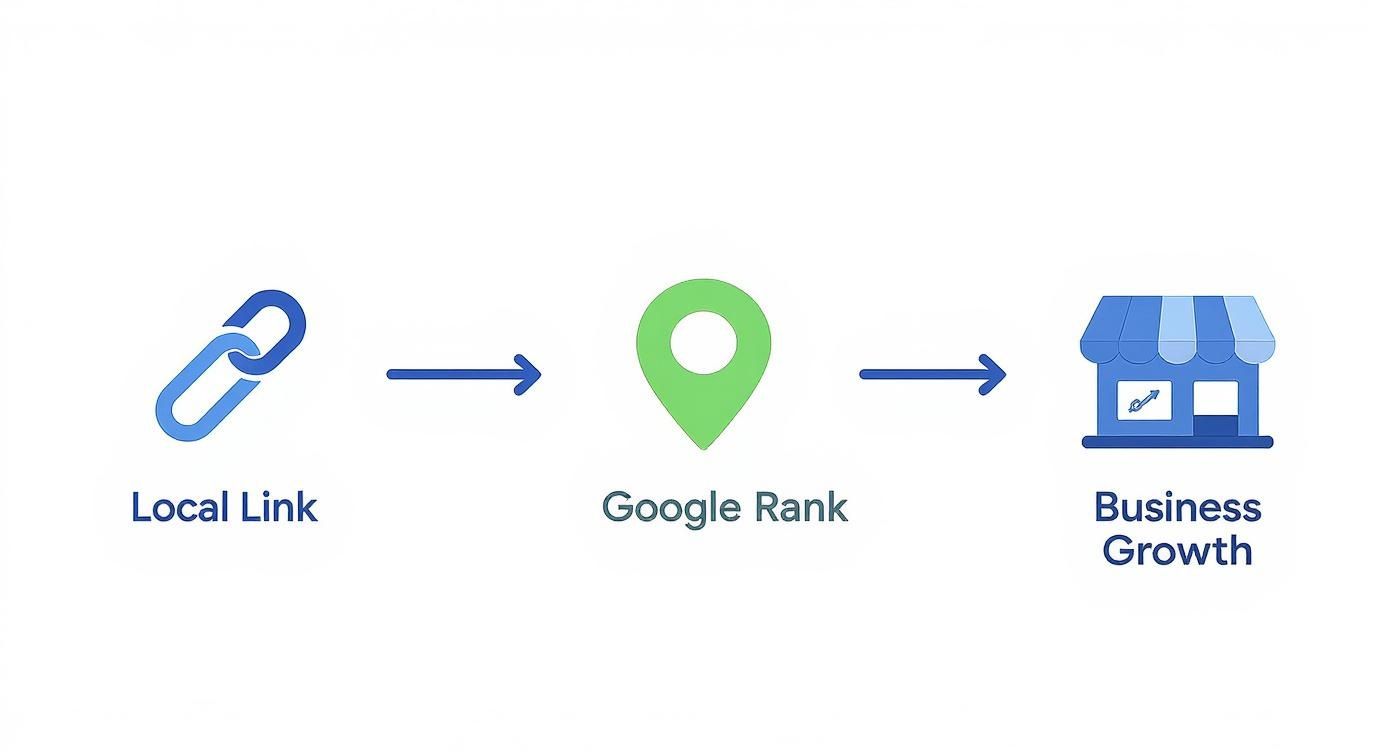
This simple flow highlights a powerful truth: earning relevant local links is the engine that drives your rankings and your bottom line.
Audit and Clean Up Your NAP
Before building new citations, you must get your house in order. Inconsistent data is a major red flag for search engines. If your address is "Main St." on one site and "Main Street" on another, it creates confusion and erodes trust.
Your first job is to find and fix these errors. Search for your business name and check every mention for accuracy.
- Name: Is your business name exactly the same everywhere? Watch for variations like "LLC" or "Inc."
- Address: Ensure the street name, suite number, and ZIP code are formatted identically on every listing.
- Phone Number: Stick to one primary phone number. Don't alternate between a toll-free number and a local one.
Prioritize High-Value Directories
Not all directories are equal. While services promising hundreds of submissions are tempting, a targeted approach is better. Quality over quantity is key.
The Google Local Pack—the map with three business listings—gets a staggering 44% of all clicks for local searches. To claim a spot, you need high-quality citations and backlinks from authoritative local sources. These local SEO findings drive this point home.
So, where should you start? Begin with the heavy hitters: Google Business Profile, Apple Maps, and Yelp are non-negotiable.
Once those are perfect, move to respected industry-specific directories. For example, a law firm needs to be on Avvo, and a home contractor should be on Houzz. Finally, target hyper-local sites like your city’s Chamber of Commerce or business association. These links are gold because they send powerful geographic signals, crucial for effective link building for local SEO.
Earn Powerful Links Through Community Engagement
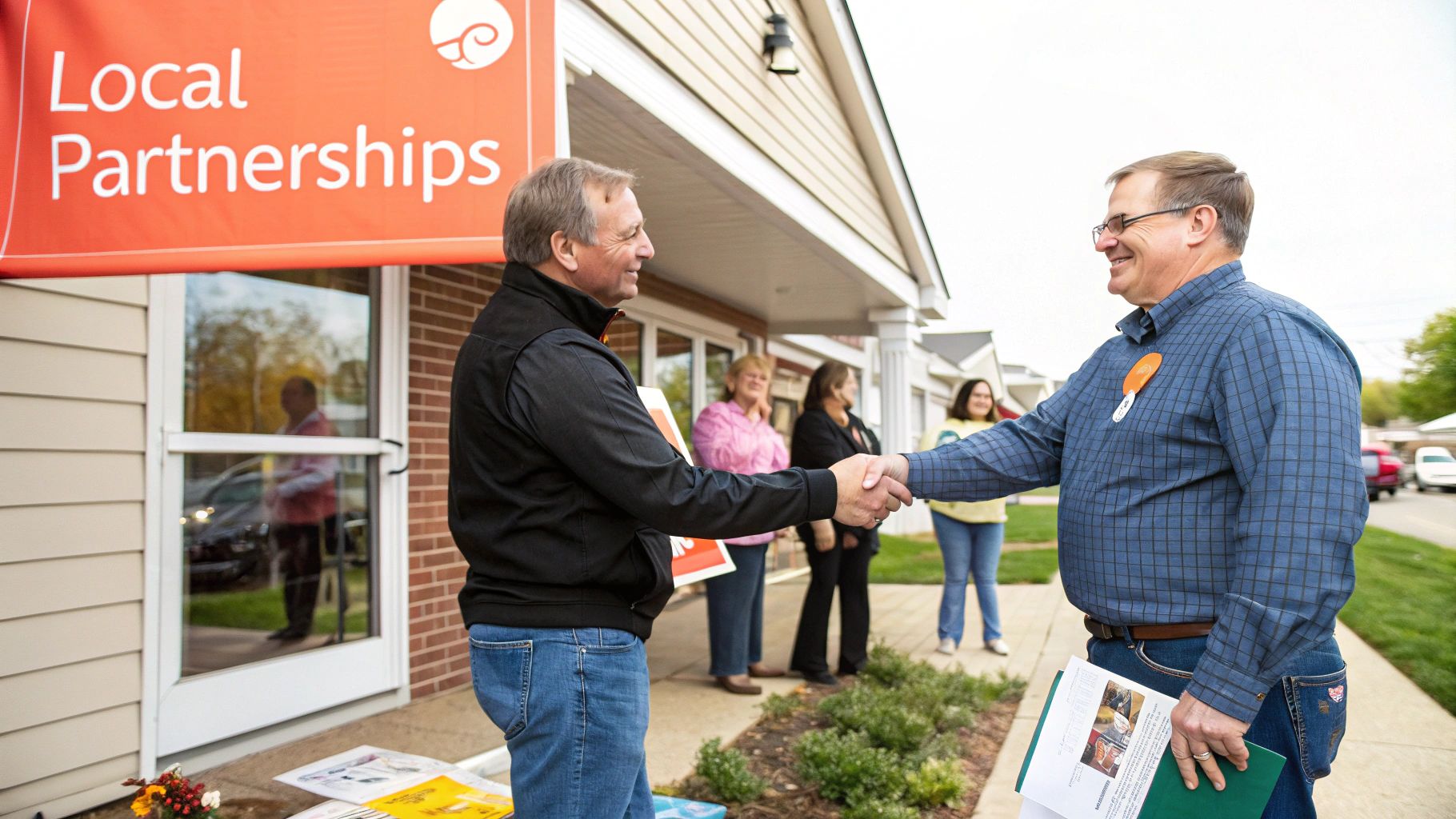
The best backlinks aren't just found online; they're earned in the real world. By genuinely engaging with your local community, you build relationships that lead to authentic and powerful links. This isn't just about sending outreach emails—it's about becoming a trusted local name that Google can't ignore.
Think of it this way: local SEO link building is about showing you're invested in the area you serve. When you participate, other local organizations, news outlets, and businesses will naturally start talking about you and linking to your site.
Sponsor Local Events and Teams
Sponsorships are one of the quickest ways to get on the local map. Think about community events, charity 5Ks, and Little League teams—they nearly all need support from local businesses. In return for a donation, they are often happy to feature sponsors on their websites, giving you a highly relevant, location-specific backlink.
To get the most SEO value, ensure your sponsorship agreement includes a clickable do-follow link from their site to yours.
- Real-world example: A local bakery sponsors the city's annual summer festival. The festival website adds the bakery’s logo and a link to its homepage on the "Our Sponsors" page. That link is a huge local signal and drives referral traffic from people in the community.
This is a solid tactic because the links come from established local entities that Google already trusts.
Host a Community Workshop or Meetup
Position yourself as the go-to expert in your field. Hosting a valuable event—like a free workshop or seminar—is a great way to generate buzz and create organic link opportunities.
Local news sites, community calendars, and neighborhood bloggers are always looking for fresh content. When they add your workshop to their listings, they will almost always link back to your registration page or website.
Hosting an event builds more than links—it builds brand authority. When local media and attendees share your event online, it creates a ripple effect of mentions and links that is difficult for competitors to replicate.
For instance, a financial advisor could host a free "Retirement Planning 101" seminar at the public library. The library's website, a local news blog, and community Facebook groups would likely promote the event, each providing a valuable backlink.
Partner with Neighboring Businesses
Forge alliances with complementary, non-competing businesses in your area. A simple and effective strategy is to create a "Local Favorites" or "Our Partners" page on your website and ask them to do the same for you.
This creates a small, interconnected web of local sites that reinforces your community ties in the eyes of search engines.
Here are a few partnership ideas:
- Joint Promotions: A gym and a health food store could offer a joint discount, with both businesses blogging about the partnership and linking to each other.
- Referral Networks: A wedding photographer and a florist could recommend each other to clients, adding one another to their "Recommended Vendors" pages with a link.
- Co-Hosted Content: A pet groomer and a local vet could co-create a "Local Dog Owner's Guide" that lives on both of their sites, linking to each other.
Create Local Content That Attracts Links
Effective local link building requires having something valuable to offer. When you create content deeply connected to your community, you give other websites a real reason to link to you. The goal is to become a go-to resource for local information, making link building a natural result of your authority.
Forget generic blog posts and think like a local publisher. What do people in your town actually want to know? Answering that question helps you create "linkable assets"—content so useful that local bloggers, journalists, and organizations can't help but share it.
Brainstorming Link-Worthy Local Content
The key is to create something unique and hard to copy. A generic "how-to" guide won't cut it. Your content needs a strong geographic anchor that makes it indispensable for a local audience.
Here are a few proven ideas:
- The Ultimate Local Guide: Create a comprehensive guide, like "The 10 Best Dog-Friendly Patios in Austin" or "A Complete Weekend Itinerary for Visitors in the Pearl District." These are gold for tourism sites and local lifestyle bloggers.
- Local Event Calendars: Become an information hub by maintaining a calendar of community events. This is a surefire way to get links from event organizers, local news outlets, and community groups.
- Data-Driven Local Reports: A simple survey or analysis of public data can result in a unique report. For example, a real estate agent could publish a "Quarterly Denver Housing Market Analysis." This original research is a magnet for links from local journalists.
Think about how Wikipedia gets so many links—it's the primary source for information. Your mission is to become a mini-Wikipedia for your specific local niche. When you're the authority, the links will follow.
Creating localized content does more than just attract links. It signals a deep commitment to your community, which builds trust with both customers and search engines. Google rewards businesses that are an integral part of their local ecosystem.
Matching Local Content to Link Prospects
Once you create great local content, don't just hit "publish" and hope for the best. You have to get it in front of the right people. The type of content you create dictates who you should contact.
Strategic planning goes a long way. Before writing, you should know who might link to it. This table shows how to pair content ideas with outreach targets.
Matching Local Content to Link Prospects
A practical look at different local content ideas and the specific websites you should target for backlinks.
| Content Idea | Primary Link Target | Outreach Angle |
|---|---|---|
| "Best of [Your City]" Guide | Local bloggers, city tourism boards, hotel concierges. | "Thought your readers/visitors would love this resource for exploring our city." |
| Local Event Calendar | Community organizations, local news (events section), venue websites. | "We've compiled a great list of local happenings and would love to include your event." |
| Local Industry Report | Local journalists, Chamber of Commerce, industry-specific blogs. | "We uncovered some interesting data about [local topic] that might be newsworthy for you." |
This targeted approach makes your outreach relevant and valuable, dramatically boosting your success rate. By creating content that serves the community, you’re no longer just asking for a link; you’re offering a resource. That simple shift separates struggling campaigns from successful link building for local SEO strategies.
Find Untapped High-Authority Local Links
Once you've mastered the basics like directories and sponsorships, it's time to pursue the links that truly move the needle. These high-authority backlinks can put you leagues ahead of competitors. They aren't easy to get, but the SEO payoff is massive. They come from trusted sources like local news outlets, university websites, and respected community blogs.
Getting these links requires creativity and proactive value. You must earn mentions by demonstrating your expertise. This is where you'll find opportunities your competitors are missing.

Become a Source for Local Journalists
Local reporters, podcasters, and bloggers are always looking for experts to quote. You can be the local voice that adds credibility to their stories. Platforms like Help a Reporter Out (HARO) connect journalists with experts like you. A sharp, timely quote can easily land you a powerful backlink from a major local news site.
Here’s how to succeed:
- Set Up Alerts: Sign up for HARO and create alerts for keywords related to your industry and city, like "Denver real estate."
- Act Fast and Be Sharp: Journalists work on tight deadlines. Your response must be quick, concise, and directly answer their question.
- Emphasize Your Local Angle: Mention your connection to the community. A pitch from a local business owner is more compelling for a local story.
A single placement provides a great link, builds your brand's authority, and can send a wave of referral traffic your way.
Create a Local Scholarship Program
One of the best ways to earn authoritative backlinks is from .edu domains. Google trusts these links from educational institutions. A simple and effective way to get them is by creating a small, locally-focused scholarship.
It doesn't have to be a large amount. A local dental practice could offer a $500 scholarship to a local high school student pursuing healthcare. Create a page on your website with the scholarship details. Then, reach out to financial aid offices at local high schools and colleges. They will often be happy to list your scholarship—and a link to your site—on their student resources page.
This isn't just a link-building tactic. It generates fantastic local PR and shows you're invested in the community's future, cementing your brand as a positive local force.
Land Guest Posts on Local Blogs
Guest posting is still a great way to earn a relevant backlink while reaching an engaged, local audience. The key is to be selective. Target blogs that are genuinely part of your local scene, not a random site that accepts any content. A link from a popular "What to Do in [Your City]" blog or a local business journal is SEO gold.
Start by listing local influencers, community bloggers, and industry publications. Before pitching, spend time reading their content to understand their voice and audience.
When you reach out, pitch a topic that provides genuine value and naturally creates a reason to link back to a helpful resource on your own website. Each quality link you earn adds another layer of trust to your site's profile, boosting the power of every referring domain.
Measure Your Impact and Avoid Common Mistakes
Investing in local link building without tracking results is just guesswork. You must connect your efforts to real outcomes to know what's working. This means looking beyond link counts to the metrics that matter for business growth.
The biggest win you're seeking is a better position in the Google Local Pack. A single, powerful backlink can push a business from the bottom of the page into the top three. That directly translates into more calls, foot traffic, and customers.
Key Metrics to Monitor
Don't get lost in data. To see how your campaigns are performing, track a few key performance indicators (KPIs).
- Local Pack Rankings: Are you climbing the map results for your most important local keywords? Use a rank tracker to find out.
- Organic Traffic: Is your website getting more visitors from local search? A consistent upward trend in your analytics is a great sign.
- Referral Traffic: Check Google Analytics to see which sites are sending you direct traffic. This proves your links are sending potential customers your way.
Building links isn't the end goal; it's about building a healthy digital presence. A strong backlink collection is a huge asset, but you must manage it carefully to avoid penalties and ensure long-term success.
Common Mistakes That Can Derail Your Progress
Knowing what not to do is as important as knowing what to do. A few common missteps can waste time or even hurt your SEO.
The most damaging mistake is chasing quantity over quality. A dozen links from irrelevant, spammy directories can do more harm than good. It signals to Google that you're trying to game the system and can damage your entire backlink profile.
Another pitfall is overly aggressive anchor text. If every link pointing to your site says "plumber in denver," it looks unnatural. You need a healthy mix of branded anchors (your business name), generic ones ("click here"), and natural keyword variations to build a link profile that looks trustworthy to search engines.
Your Local Link Building Questions, Answered
So, How Many Local Backlinks Do I Actually Need?
There's no magic number. What truly matters is quality over quantity. One powerful link from a major local news outlet can be more effective than 50 generic directory listings.
Your best bet is to analyze your top local competitors. Use a backlink analysis tool to see who links to them. This provides a realistic benchmark and a great starting point for your own efforts.
Can I Handle Local Link Building Myself?
Absolutely, especially when you're starting. Foundational tactics like getting listed on main directories, managing your Google Business Profile, and reaching out to community organizations are perfect for DIY efforts.
However, advanced strategies like digital PR campaigns or securing links from high-authority news sites are more complex. An experienced agency can often get these bigger wins faster because they have existing relationships and processes.
When Will I Actually See Results From All This Work?
Patience is key in SEO. Local link building is a marathon, not a sprint.
You might see small boosts from basic citation building within a few weeks. But for high-authority links to make a noticeable difference in your rankings, you're typically looking at a 3 to 6 month timeframe.
The key is consistency. Keep building good links month after month to create a strong, defensible local presence that lasts.
Stop wasting time on manual outreach. BlazeHive uses AI to find and secure high-quality backlinks for you, so you can focus on running your business. Learn more about BlazeHive.